
A podcaster can spend weeks planning episodes, recording clean audio, and publishing polished content, then still wonder why the show isn't creating business momentum. Downloads look nice. Compliments feel encouraging. But neither automatically turns into clients, donors, buyers, or booked calls.
That confusion usually starts with one basic question. What is lead in lead generation? For podcasters, the answer isn't “a number in a spreadsheet.” It's a listener taking a small but meaningful step closer. A lead is the moment passive attention becomes active interest.
For creative entrepreneurs, consultants, authors, nonprofit teams, and thought leaders, that shift changes everything. The podcast stops being just an audio file and starts acting like a relationship engine.
Table of Contents
- What a Lead Really Is And What It Is Not
- The Lead Lifecycle From Listener to Client
- How to Capture Leads Directly From Your Podcast
- Nurturing Leads Without Being Salesy
- Practical Podcast Lead Generation Examples
- Measuring What Matters for Your Podcast's Growth
- Frequently Asked Questions for Podcasters
- Do podcasters need a big audience before generating leads
- What's the easiest lead magnet to create
- Should every episode have a call to action
- Is a newsletter signup enough to count as a lead
- What if conversion feels low at first
- What makes a lead qualified
- Can a podcast work for services, nonprofits, and products
What a Lead Really Is And What It Is Not
A lead is like someone raising a hand in a crowded room. They aren't buying yet. They aren't promising anything. They're signaling, “This is relevant to me. I want the next step.”
That's the cleanest way to understand what is lead in lead generation. In podcasting terms, a lead isn't every listener. It's the listener who moves from consuming content to taking action. That action might be joining an email list, downloading an episode companion, requesting a consult, or visiting a focused landing page after hearing a call to action.
Contact information alone isn't enough
A lot of creators treat any email address as a win. That's where things get muddy. A contact is just data. A lead shows intent.
A person who enters an email to get a random freebie might not care much about the actual offer. A person who listens to three episodes on one problem, visits the website twice, and signs up for a topic-specific checklist is different. That listener is showing a pattern. The pattern matters more than the form.
Practical rule: A lead becomes more valuable when behavior supports the contact details.
That's why the most useful definition goes beyond capture. A strong modern approach is to define a lead by demonstrated intent, not just a form submission. According to Adobe, companies using intent-based lead definitions are seeing 35% higher conversion rates than those relying on form-only definitions in 2026 projections, which is a strong argument for paying attention to behavior, not just inbox entries (Adobe's lead generation guidance).
What this means for a podcaster
Podcast creators often track the easiest metric first. Downloads. Reach. Listens. Those numbers can show interest at the audience level, but they don't tell who is ready for a closer relationship.
A better lens looks like this:
- A listener is not automatically a lead: They may enjoy the show and never need the offer.
- A subscriber is not automatically a lead: They may want updates without buying intent.
- A lead has taken a meaningful next step: They've acted in a way that suggests curiosity, fit, or readiness.
Creators building their systems can explore latest lead generation solutions from Formzz to see how forms, automation, and qualification tools can support that shift from simple capture to actual intent.
The real question isn't “How many people listened?” It's “Who showed they want to continue the conversation?”
That small mindset change helps a podcaster stop chasing vanity metrics and start building a business asset.
The Lead Lifecycle From Listener to Client
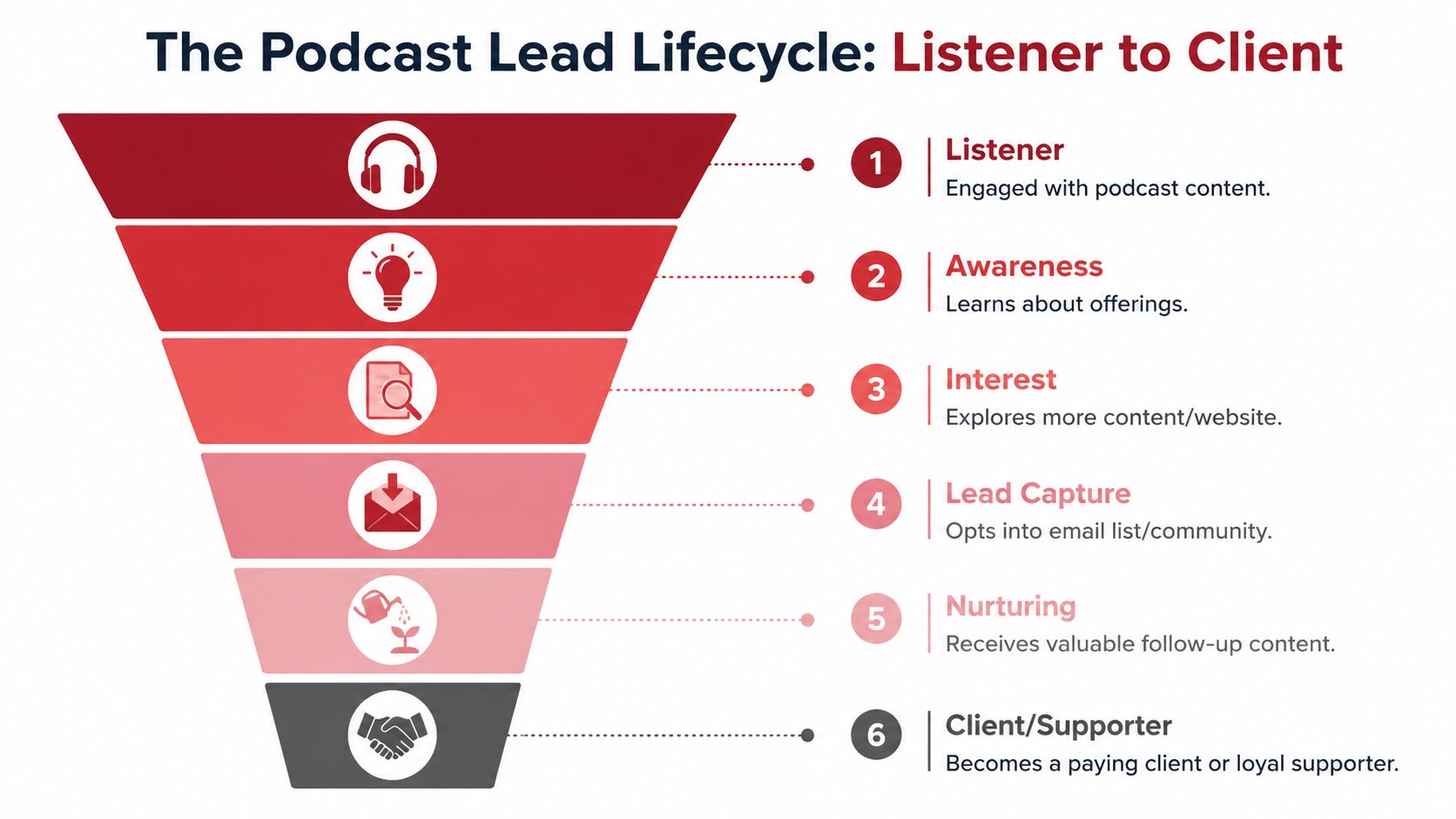
A podcast lead rarely appears out of nowhere. Prospects typically move in stages. They listen, recognize a problem, get curious, take a small step, receive follow-up, and only then decide whether to buy, book, donate, or engage more.
A podcast funnel in plain language
The funnel for a podcaster is easier to understand when it's tied to real behavior.
Listener
Someone hears an episode and pays attention.Awareness
They realize the host offers a service, community, program, mission, or resource connected to the topic.Interest
They click through to learn more, read show notes, or explore other episodes.Lead capture
They opt in for something useful. This is the point where audience attention becomes a trackable relationship.Nurturing
They receive thoughtful follow-up, usually through email or a community touchpoint.Client or supporter
They take the bigger step. They book, buy, donate, enroll, or otherwise commit.
This is why asking for a sale too early often falls flat. A listener may trust the content but still need time before they trust the offer. Salesforce notes that the median MQL-to-SQL conversion rate was 9.8% in 2026, which means only a small share of early-stage interested people become ready for a sales conversation (Salesforce lead generation guide).
MQL vs. SQL for podcasters
An MQL and an SQL are just two different relationship milestones.
| Attribute | Marketing Qualified Lead (MQL) | Sales Qualified Lead (SQL) |
|---|---|---|
| Intent level | Curious | Serious |
| Typical action | Downloads a checklist, joins a newsletter, registers for a webinar | Books a call, requests pricing, asks about working together |
| Podcast example | A listener grabs an episode worksheet | A listener replies to an email asking about services |
| Best next step | Education and nurturing | Direct conversation or offer |
| Primary question | “Is this relevant to me?” | “Is this the right solution for me?” |
A podcaster who wants cleaner lead tracking also needs a simple system behind the scenes. A useful starting point is understanding how audience records are organized inside a marketing database, because the handoff from listener to lead gets messy fast without structure.
A podcast doesn't need to force people down the funnel. It needs to give the right next step to the right person at the right time.
How to Capture Leads Directly From Your Podcast
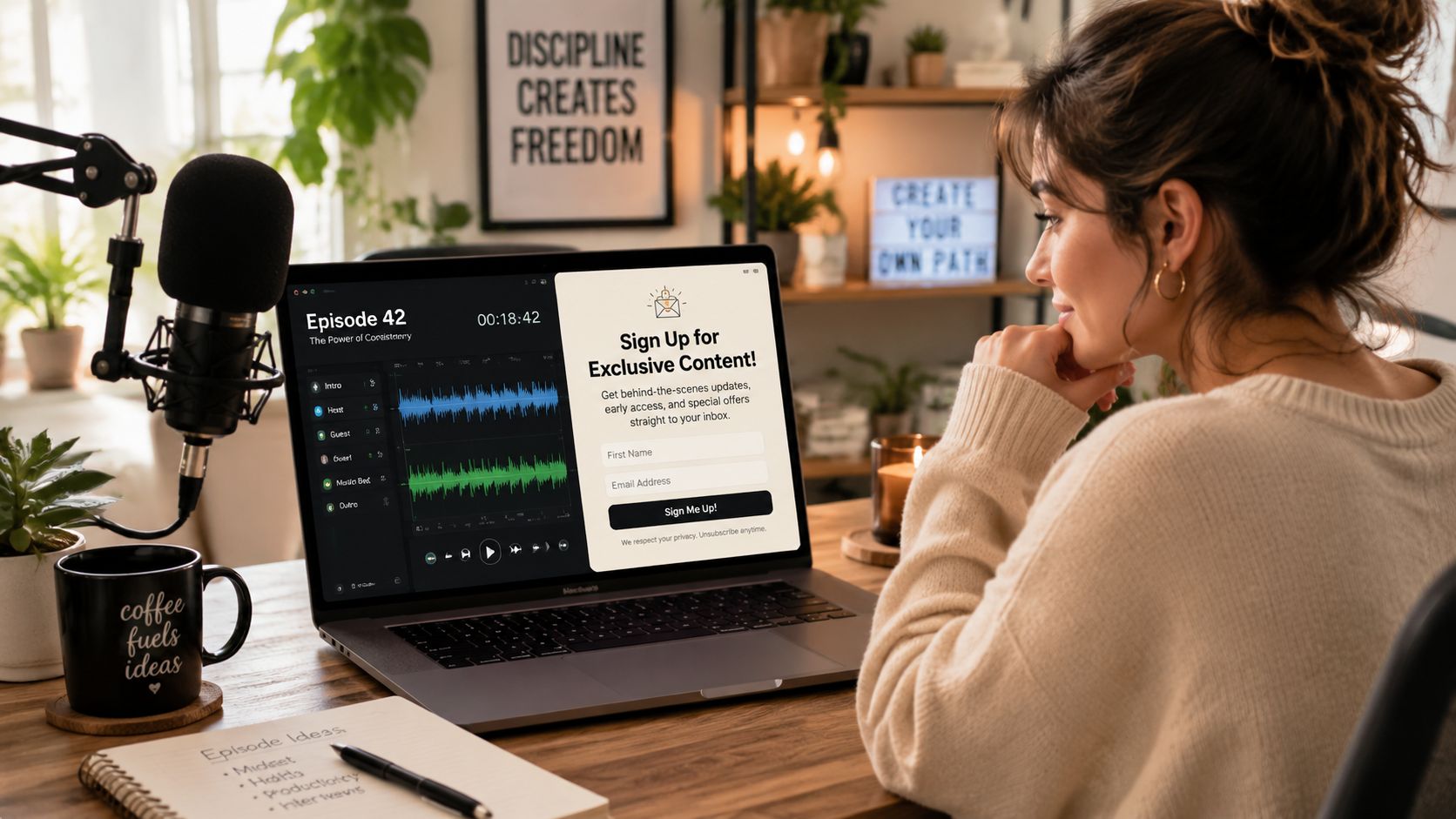
A podcast can generate leads without sounding like a radio commercial. The key is alignment. The offer should feel like a natural extension of the episode, not a random detour.
Start with the episode, not the form
The best podcast lead magnets are built from the content itself. If the episode teaches a process, offer the template. If the episode shares a framework, offer the worksheet. If the episode features a rich interview, offer the summary, key takeaways, or implementation guide.
That content-first approach works because consistency builds attention over time. Companies that maintain an active blog generate 13 times more leads on average than those that do not, which reinforces the same principle for podcasters. Regular, valuable content creates more opportunities for the audience to take the next step (lead generation statistics on content consistency).
A few podcast-friendly lead magnet ideas:
- For teaching episodes: A checklist, swipe file, script, or workbook.
- For interview episodes: A recap PDF, resource list, or action summary.
- For spiritual or community-focused shows: A reflection guide, devotional prompt sheet, or discussion questions.
- For B2B shows: A buyer guide, audit worksheet, or consultation prep sheet.
Make the next step easy to take
A strong call to action sounds specific and low-friction. Instead of “visit the website,” a host might say, “Download the one-page checklist for this episode at brand.com/checklist.” That's clearer, easier to remember, and tied to listener intent.
Landing pages matter here. A generic homepage forces people to hunt. A focused episode page converts better because it matches what they just heard. For creators building those pages, this guide to a podcast landing page is helpful because it shows how to turn episode traffic into measurable action.
Some practical capture rules work across almost any show:
- Keep the offer narrow: One episode, one problem, one next step.
- Use spoken URLs: Short, memorable, and easy to type.
- Repeat the CTA naturally: Early, middle, and end placement works better than one rushed mention.
- Deliver the asset fast: The listener should receive it immediately after opting in.
A quick walkthrough can help a creator hear how this sounds in practice.
If the listener has to work hard to claim the offer, many won't bother. Convenience is part of conversion.
Nurturing Leads Without Being Salesy
A captured lead is the start of a relationship, not the finish line. This is the point where many podcasters freeze. They worry that every follow-up email will sound pushy, transactional, or out of character with the trust they've built on the mic.
That fear makes sense. It's also why many good podcasts leave money, impact, and opportunities on the table.
Trust grows in the follow-up
A podcast already does the hard part. It builds familiarity through voice, repetition, tone, and perspective. Nurturing should continue that same experience in a different format.
Salesforce reports that the average time it takes for a lead to convert into a customer is 64.5 days, which shows why immediate pressure usually backfires. Leads need time, reminders, relevance, and a few proof points before they act.
Aggressive follow-up says, “Buy now.” Effective nurturing says, “Here's the next useful thing.”
That might mean:
- Sending a welcome email: Deliver the promised resource and restate why it matters.
- Sharing a related episode: Help the lead go deeper on the same problem.
- Offering a small win: A tip, checklist, or question that helps them apply what they learned.
- Making a clear invitation: Only after value has been delivered.
A creator trying to grow this system should understand the basics of how to build an email list because the list itself isn't the asset. The relationship inside it is.
A simple welcome sequence that feels human
A three-part sequence is enough for many podcasters to start.
Email one delivers the promised asset. It thanks the subscriber, reminds them where it connects to the episode, and gives one simple action step.
Email two expands the conversation. It shares another related episode, a short story, or a useful perspective that deepens trust.
Email three invites the next step. That might be a strategy call, webinar, donation page, application, community invite, or product page.
A good nurture sequence doesn't interrupt the listener experience. It extends it.
The tone matters as much as the timing. Helpful beats polished. Specific beats clever. A lead should feel guided, not cornered.
Practical Podcast Lead Generation Examples
Theory gets easier when it's attached to real use cases. Podcast lead generation looks different for a consultant, a nonprofit, and an author, but the core pattern stays the same. Each one uses the show to create trust, then gives the listener a relevant next step.
A B2B consultant uses guests as pipeline
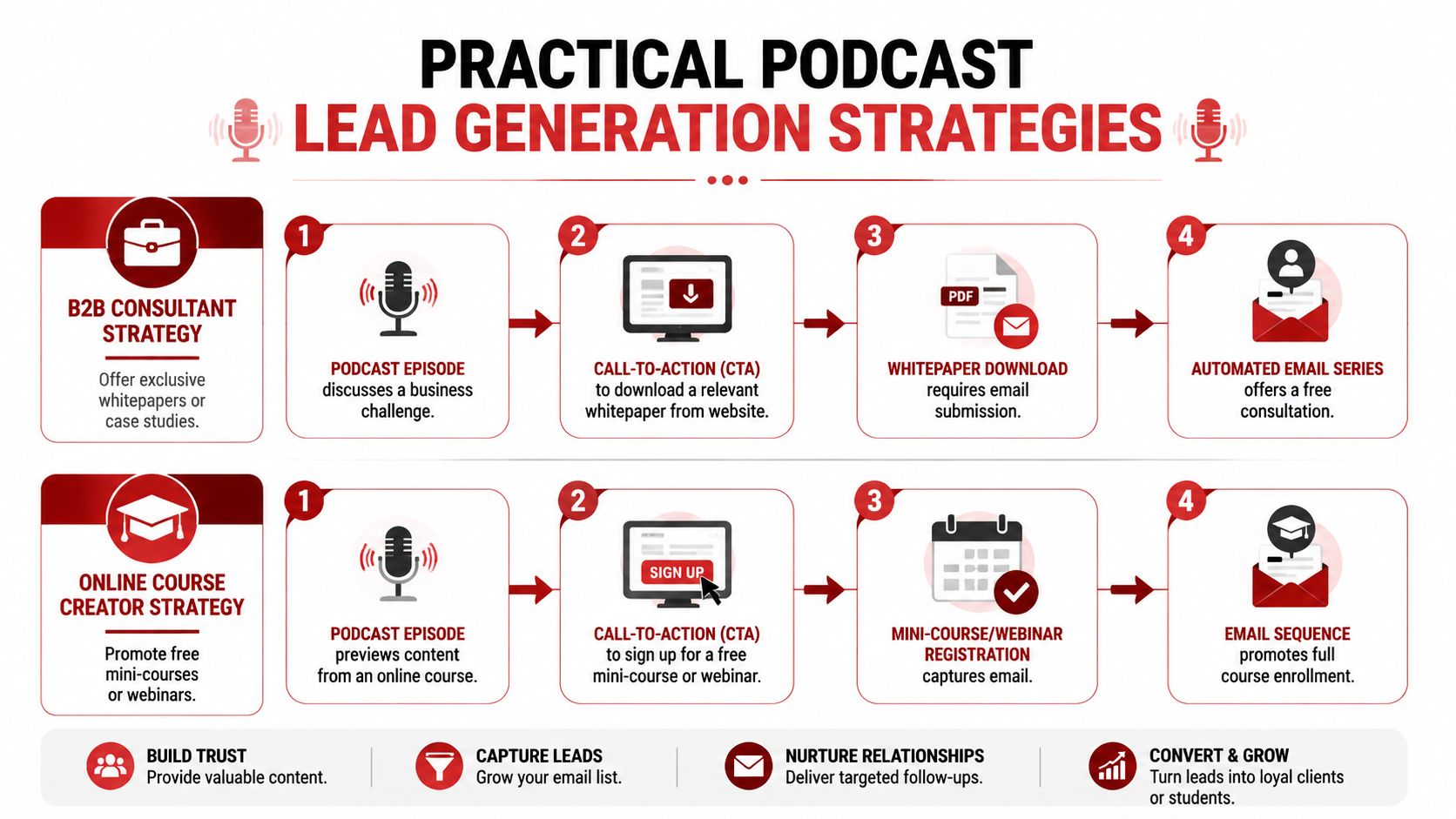
For a B2B consultant, one of the smartest plays is to invite ideal clients or strategic partners as guests. The podcast becomes more than content. It becomes a business development channel.
Resonate Recordings notes that in B2B podcasting, lead conversion is driven by inviting ideal clients as guests, and a 3-to-6 month publishing cadence is often needed before consistent lead flow appears because trust compounds through repeated exposure (B2B podcasting for lead generation).
That can look like this:
- A consultant hosts an episode on operational bottlenecks.
- The guest is a decision-maker at a company that fits the consultant's ideal client profile.
- The CTA offers a practical whitepaper or diagnostic checklist related to the episode.
- The follow-up email sequence shares examples, insights, and eventually an invitation to talk.
This strategy gets stronger when the episode is repurposed well across channels. Creators exploring mastering AI content distribution for creators can extend each episode's reach and create more entry points into the funnel.
A nonprofit segments interest through episode offers
A nonprofit can use the podcast to deepen donor connection and qualify interest by topic. One episode might focus on youth programs. Another might highlight field work. Another might tell a volunteer story.
Each episode can point to a different resource:
- A field report PDF
- A volunteer interest form
- A donor update list
- A community prayer guide
That structure helps the organization learn what each listener cares about. Someone who downloads a field report may respond to impact updates. Someone who opts into a volunteer guide may need local opportunities, not fundraising asks.
The lead magnet shouldn't only collect contact details. It should reveal what kind of relationship the listener wants.
An author or course creator turns listeners into buyers
An author, coach, or educator can use a podcast to warm up future buyers long before launch week. A show about productivity might offer a chapter sampler, workbook page, or private lesson tied to a specific episode. A course creator might offer a free workshop that leads naturally into a paid program.
The sequence is simple. The episode introduces the problem. The lead magnet gives structure. The email sequence helps the listener make progress. The offer arrives after trust has already been earned.
This is why podcasts work so well for authority-driven businesses. They let a creator demonstrate expertise in public, over time, before asking for commitment.
Measuring What Matters for Your Podcast's Growth
A podcast doesn't need a complicated analytics stack to measure lead generation. It needs a few signals that connect content to action. The goal isn't to obsess over dashboards. The goal is to learn which episodes, offers, and calls to action are moving the right people forward.

Track the steps that show intent
A useful podcast lead dashboard might include:
- Landing page visits: How many people reached the page mentioned in the episode.
- Opt-ins: How many visitors claimed the offer.
- Lead quality: Which opt-ins match the actual audience the show wants to serve.
- Booked conversations or applications: Which leads moved from curiosity to serious interest.
- Sales conversations mentioning the show: A strong sign that the podcast is influencing buying decisions.
A podcaster promoting links across email, social posts, and show notes may also want a better framework for defining an effective CTR, especially when testing which calls to action generate actual clicks.
Simple attribution beats guesswork
Messy tracking breaks the feedback loop. The Pod FM reports that an estimated 68% of podcast leads fail due to messy tracking, which is why simple attribution tools matter. Unique UTM links, vanity URLs, and promo codes help connect a listener's action to a specific episode or campaign (podcasting attribution guidance).
A podcaster doesn't need enterprise software to start. A practical setup can be surprisingly simple:
- Use one memorable URL per offer: Something short enough to say on air.
- Add UTM parameters behind the scenes: This helps separate traffic sources.
- Tag leads by episode or topic: Basic CRM or email platform tags are enough.
- Ask one question on forms: “Which episode sent you here?” can reveal a lot.
Good measurement answers one question clearly. Which content is creating the right kind of response?
Frequently Asked Questions for Podcasters
Do podcasters need a big audience before generating leads
No. Lead generation depends more on relevance and trust than raw audience size. A smaller, focused audience can produce better leads than a broad audience with weak alignment.
What's the easiest lead magnet to create
An episode companion is usually the fastest. That could be a checklist, summary PDF, worksheet, or resource list pulled directly from the episode topic.
Should every episode have a call to action
Not necessarily the same one, but most episodes should offer a logical next step. The CTA should match the conversation the listener just heard.
Is a newsletter signup enough to count as a lead
Sometimes. It depends on intent. A generic signup is weaker than an opt-in tied to a clear topic, problem, or need.
What if conversion feels low at first
That's normal. A podcast lead system improves through repetition, clearer offers, and better tracking. Most creators learn by testing different topics, lead magnets, and spoken CTAs.
What makes a lead qualified
Qualification comes from fit plus behavior. A person who matches the audience and takes meaningful actions is more qualified than someone who casually joins a list and disappears.
Can a podcast work for services, nonprofits, and products
Yes. The mechanism is the same. The show builds trust, the offer captures interest, and the follow-up moves the relationship forward.
A podcast can do far more than publish polished episodes. It can build authority, attract the right people, and create a steady path from listener to lead. Get Up Productions helps brands, founders, nonprofits, and thought leaders turn that vision into a show that supports real growth, without drowning in production and content work.