
A podcast can earn loyal listeners for months and still fail to build an owned audience. People hear an episode, nod along, and disappear into the next app notification. The show feels active, but the relationship stays rented.
This is the core reason creators keep searching for how to build email list systems that last. A podcast gives reach, trust, and recurring attention. Email turns that attention into a direct channel the host controls. For podcasters, consultants, nonprofit leaders, and brand teams, that shift matters more than another spike in downloads.
The mistake is treating list growth like a website widget problem. It isn't. It's an audience design problem. The show topic, the offer, the signup path, and the follow-up all need to work together if listeners are going to become subscribers who open, click, and stay engaged.
Table of Contents
- Your Foundation for Sustainable List Growth
- Choosing Your Email Platform and Tech Stack
- Crafting Irresistible Podcast-Driven Lead Magnets
- Designing High-Converting Opt-in Forms and Pages
- Driving Targeted Traffic with Your Content Waterfall
- Nurturing Subscribers and Maintaining List Health
Your Foundation for Sustainable List Growth
An email list is essential for a podcast brand because listeners don't stay in one place. They move between Apple Podcasts, Spotify, YouTube, search, social clips, and guest appearances. Without email, the host relies on platforms to reconnect with people who already showed interest.
Permission matters more than raw volume. Modern email guidance has pushed list building toward explicit consent and double opt-in because confirmation helps verify that subscribers are real, engaged contacts and reduces spam complaints, as noted by Klaviyo's email list guidance. That shift also fits the compliance reality creators now operate in, including GDPR, CAN-SPAM, and CCPA.

Decide what the list must do
A podcast email list should have one primary job. It can support sales conversations, donor engagement, event attendance, community building, or repeat attention to each new episode. It shouldn't try to do all of them equally on day one.
That decision changes everything downstream:
- Lead generation focus means the host offers assets tied to a business problem, such as a framework, worksheet, or consultation prep guide.
- Community focus works better with recurring editorial emails, behind-the-scenes notes, and audience replies.
- Nonprofit focus often centers on mission updates, campaign storytelling, and calls to participate, not just donate.
- Authority-building focus benefits from curated insights, show takeaways, and consistent commentary that extends beyond the audio feed.
Twilio and Salesforce recommend a practical baseline sequence for growth: choose an ESP, create a lead magnet, publish a dedicated landing page, add a welcome or autoresponder sequence before promotion, then drive traffic and monitor metrics like deliverability, opens, clicks, unsubscribes, and spam rates in Twilio's list-building resource.
Practical rule: A podcast list grows faster when each signup path answers one clear question: “What will this subscriber get that they can't get by only listening?”
For creators who need another view on the mechanics of permission-based growth, this guide on how to attract and nurture subscribers is useful because it reinforces the same principle. Relevance beats noise.
Build around one subscriber profile
Most podcast lists go stale because the host speaks to an audience category instead of a person. “Entrepreneurs” is too broad. “First-time B2B founders using a podcast to build authority with buyers” is specific enough to shape an offer, a landing page, and a welcome sequence.
A workable subscriber profile only needs a few points:
| Element | What to define |
|---|---|
| Core identity | Who this listener is in plain language |
| Immediate problem | What they're trying to solve now |
| Content trigger | Which episode topics make them stop and pay attention |
| Value exchange | Why they'd trade an email address for more |
| Desired cadence | How often they want to hear from the host |
That kind of clarity prevents weak list growth. It also protects the show from attracting people who like a viral clip but don't care about the deeper topic.
Choosing Your Email Platform and Tech Stack
A listener hears your CTA at the end of an episode, pulls up your site, enters an email address, and expects the promised resource in under a minute. If that handoff breaks, the problem usually is not the podcast. It is the stack behind it.
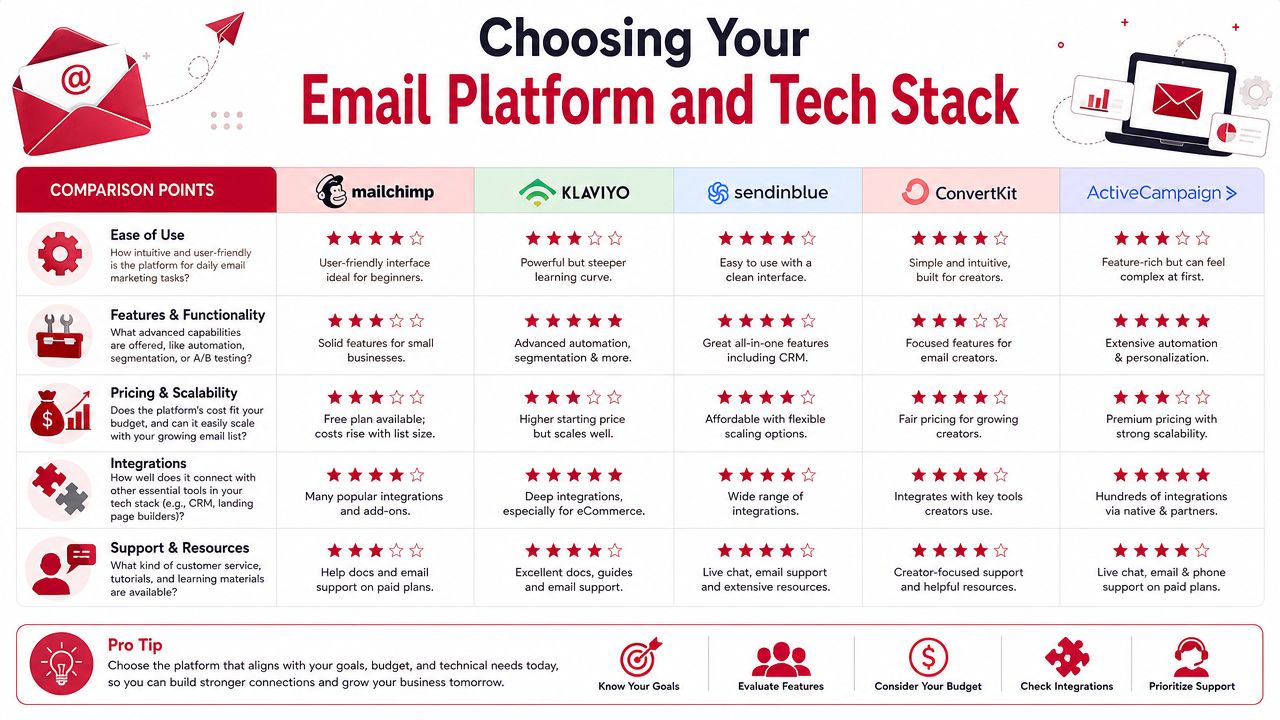
For podcasters, the most valuable ESP feature is its ability to support a clean handoff from listener to subscriber. That means fast delivery, clear tagging, reliable consent settings, and automations that match the reason someone joined. Fancy features matter less than whether the system holds up week after week when every episode creates a new entry point.
What matters most for podcasters
Start with automation. If someone subscribes for a checklist tied to your interview with a SaaS founder, they should receive that asset right away, followed by a short sequence that fits that topic. A generic “thanks for joining” email wastes context you already earned through the episode.
Next is segmentation. Podcasts often cover recurring themes, even when the show has one broad promise. A business podcast might rotate between audience growth, sales systems, and hiring. Tagging subscribers by signup source, episode topic, or lead magnet keeps follow-up relevant and makes future promotions more accurate.
Then there is ease of maintenance.
This matters more than teams admit. I have seen creators buy advanced platforms, build one welcome sequence, then stop updating forms and tags because the backend feels like a part-time job. A simpler tool with clean forms, dependable automations, and clear reporting often produces better list growth because the system gets used.
Consent settings deserve attention early. Double opt-in usually improves list quality, especially for shows that collect subscribers from multiple sources such as episode pages, guest swaps, live events, and social clips. It adds one extra step, so some lists grow slower on paper, but the subscribers who confirm are more likely to receive and engage with future emails.
A simple platform comparison lens
The tools change. The trade-offs do not.
| Platform type | Strength | Trade-off | Best fit |
|---|---|---|---|
| Newsletter-first | Fast setup, clean writing experience | Lighter automation depth | Solo creators and thought leaders |
| General SMB email tool | Familiar templates and broad integrations | Can feel generic for content businesses | Small teams needing a balanced setup |
| Advanced automation platform | Strong workflows and segmentation | More setup overhead | Brands with multiple offers and audience paths |
Use a short evaluation process before you commit:
- Map the subscriber journey from podcast CTA to signup confirmation to first follow-up email.
- List the systems that must connect such as your site, landing page tool, webinar platform, or checkout flow.
- Test consent and tagging rules so topic-based permissions and double opt-in are easy to configure.
- Review reporting for source tracking, unsubscribes, and engagement by form or campaign.
- Build one real email in the editor. If creating the weekly newsletter feels clumsy, publishing consistency will suffer.
A lean stack usually wins for podcasts. One ESP, one landing page system, one form builder, and a tagging structure your team can explain in a sentence will outperform a messy setup with too many integrations and too many failure points.
Crafting Irresistible Podcast-Driven Lead Magnets
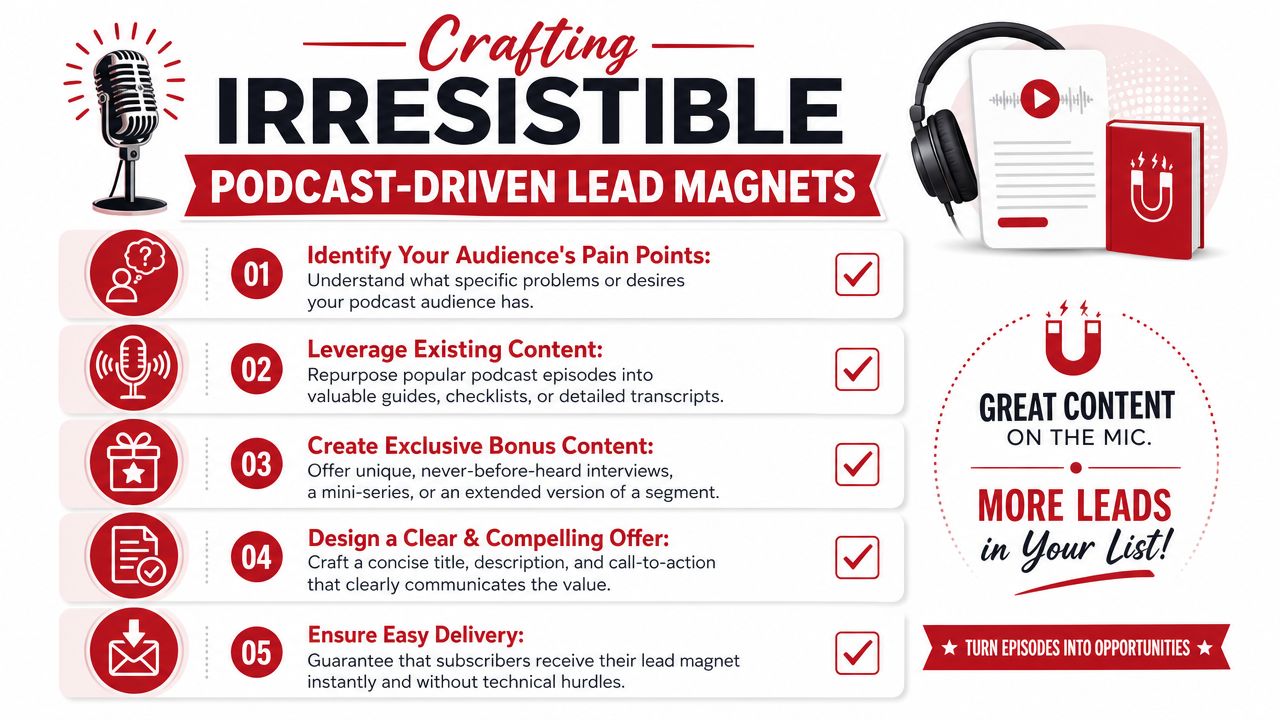
Podcasters already create raw material for list growth every week. The problem usually isn't lack of content. It's failure to package that content into a clear value exchange.
A weak lead magnet says, “Join the newsletter for updates.” A strong one says, “Get the exact resource that makes this episode immediately useful.”
Lead magnets that fit podcast behavior
Listeners consume audio while driving, walking, working out, or multitasking. That means the best offers usually help them capture, apply, or revisit what they just heard.
Strong podcast-driven lead magnet ideas include:
- Episode toolkit with key takeaways, links, templates, and action steps from one standout episode.
- Guest resource bundle that compiles the books, tools, frameworks, and references mentioned in an interview.
- Private audio bonus such as a follow-up segment, rapid-fire Q&A, or uncut closing discussion.
- Searchable transcript with highlights for listeners who want to revisit a quote or process without scrubbing through audio.
- Implementation worksheet that helps a listener apply one topic from the episode to their own role or business.
- Top episodes starter pack for new listeners who need a curated on-ramp instead of a giant archive.
The best version is almost always narrow. A focused offer tied to a specific listener problem beats a broad “ultimate guide” that tries to serve everyone.
This video gives helpful context for shaping podcast offers into something worth subscribing for:
How to turn one episode into an offer
A practical workflow keeps this manageable. The host or team can build most lead magnets from assets already created during production.
Start with one episode that already has one of these traits:
- High intent topic tied to a recurring audience pain point
- Strong guest authority that gives the episode extra perceived value
- Clear framework that can be turned into a checklist or worksheet
- Evergreen usefulness so the asset keeps working after launch week
Then package the episode in a format that matches the promise. A tactical interview becomes a checklist. A nuanced conversation becomes a summary plus transcript. A compelling guest story becomes a lesson sheet with links and quotes.
A simple transformation model works well:
| Episode type | Best lead magnet |
|---|---|
| Tactical solo episode | Checklist or worksheet |
| Expert interview | Resource roundup |
| Story-driven conversation | Takeaway summary with action prompts |
| Deep educational episode | Transcript plus framework graphic |
A podcast lead magnet should complete the listening experience, not repeat it.
The copy matters as much as the asset. “Subscribe for bonus content” is vague. “Get the founder interview breakdown with every tool mentioned, plus the hiring scorecard discussed in minute 18” is concrete.
Many creators finally understand how to build email list momentum from audio. The show earns attention. The lead magnet captures intent at the moment interest is highest.
Designing High-Converting Opt-in Forms and Pages
A good offer can still underperform if the page feels confusing, busy, or distrustful. Conversion friction usually hides in small decisions. Too many fields. Weak copy. Unclear payoff. No reason to act now.
That's why form design deserves more attention than most creators give it.
The anatomy of a page that converts
A focused landing page needs a few things and almost nothing else.
The headline should make the benefit obvious. Not clever. Not abstract. A podcast-related example could be a page promising a guest interview toolkit, a transcript bundle, or a curated starter pack for new listeners.
Below that, the page should quickly answer four questions:
- What is this?
- Who is it for?
- What will someone get immediately?
- Why is it worth the email address?
Salesforce gives a simple conversion example in its email list guide. If a signup form gets 500 views and 50 subscribers, the conversion rate is 10%. If that same page improves to 12%, it yields 60 subscribers from the same traffic, while 8% yields 40. That's why small page improvements matter in Salesforce's explanation of signup form math.
A strong page often includes:
- Benefit-led headline that reflects the episode topic or audience problem
- Short supporting copy that explains what arrives after signup
- Minimal fields so the user doesn't hesitate
- Clear button text tied to the offer, not generic wording
- Trust cues like expected email cadence or relevance statement
Where podcasters should place forms
Podcasters usually need more than one form type because listeners arrive in different contexts.
An embedded form belongs on episode pages and show notes. A dedicated landing page works best for spoken calls to action read on the show, guest appearances, and social links. A pop-up or slide-in can help on blog posts if the offer tightly matches the page topic.
For teams that want to simplify implementation, tools that streamline newsletter signup setup can reduce the friction of getting a working form live without custom development.
Dedicated pages deserve special attention because they let the team match message to source. Someone coming from a guest interview should land on a page built for that conversation, not a generic homepage. For podcast-specific examples, this guide to a podcast landing page is useful because it shows how the page itself can support listener conversion rather than just hosting episode links.
Remove every field that doesn't directly improve delivery, segmentation, or follow-up.
That usually means email first. Sometimes first name too. More than that needs a clear reason.
Driving Targeted Traffic with Your Content Waterfall
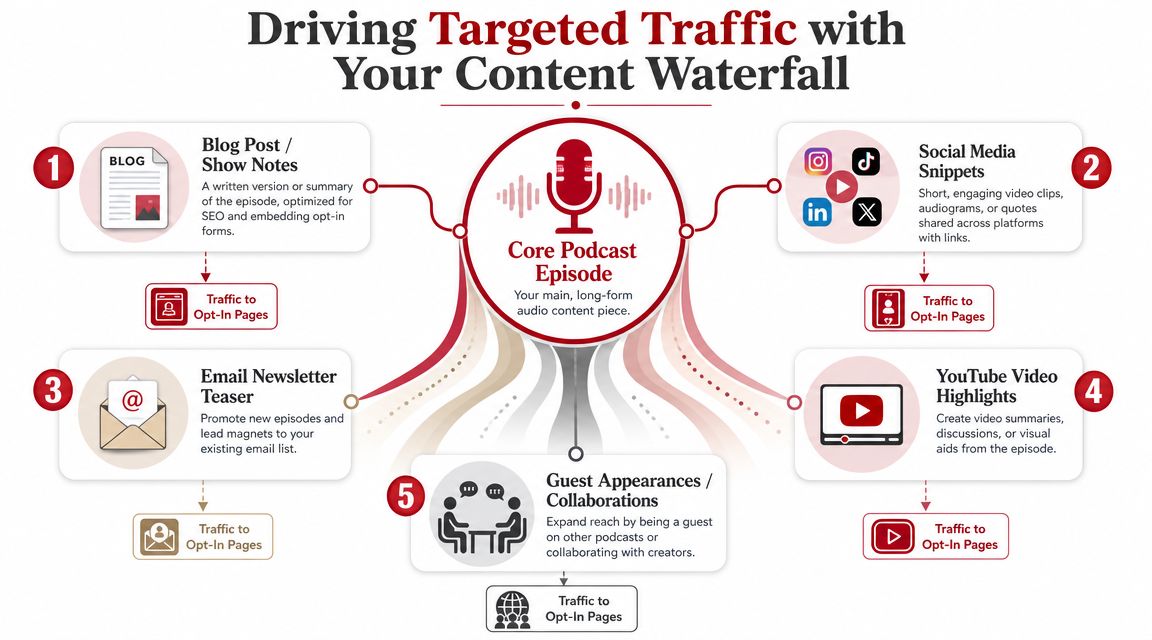
Traffic generation gets framed as a promotion problem. For podcasters, it's more useful to treat it as a repurposing system. One strong episode can create multiple paths into the same email offer.
That's where a content waterfall works. The core episode stays at the top. Every derivative asset sends a slightly different audience segment toward the same or a closely related opt-in.
One episode becomes many entry points
A single interview or solo episode can produce a full week or month of distribution assets without inventing new ideas from scratch.
A workable waterfall often looks like this:
- Full episode published on the primary podcast platform
- Show notes or blog post summarizing the key argument, lesson, or guest insight
- Short video clips for YouTube Shorts, Instagram Reels, or TikTok
- Quote graphics built from concise moments with a clear takeaway
- Email teaser sent to existing subscribers with a link to the episode and related opt-in
- Guest collaboration assets the interviewee can share with their own audience
This internal consistency matters. The listener hears a point on the show, sees a clip later, clicks to a show note article, and finds the same promise reflected in the lead magnet.
For teams building a repeatable system around repurposing, this content repurposing strategy is a practical reference because it mirrors the way podcast content can fuel broader audience growth without demanding constant reinvention.
Distribution channels that still feel natural
Not every channel deserves equal effort. Some create visibility but weak intent. Others produce fewer clicks but better subscribers.
The most useful traffic sources for podcasters often include:
| Channel | Why it works | Best CTA style |
|---|---|---|
| Show notes and blog posts | Captures search and episode interest | Episode-specific lead magnet |
| Guest appearances | Borrows trust from adjacent audiences | Dedicated landing page |
| Short-form clips | Expands reach from one key moment | Curiosity-based CTA |
| Existing email list | Reactivates warm audience segments | Bonus resource CTA |
| Creator-native platforms | Lower-friction discovery | Direct signup link |
One emerging channel deserves attention. More recent creator advice points to posting on Substack Notes as a platform-native growth tactic instead of leaning only on paid ads or older social patterns, as discussed in this YouTube discussion of current list-building approaches. That reflects a broader shift toward creator-owned audience building and lighter-friction entry points.
Distribution works better when every asset carries the same promise in a different format.
That's what keeps the waterfall from becoming random content recycling. Each asset should move the audience toward one relevant next step, not just generate impressions.
Nurturing Subscribers and Maintaining List Health
A listener hears your CTA at the end of an episode, grabs the bonus resource, and joins your list. If the next thing they get is a bland delivery email followed by two weeks of silence, the momentum is gone. Podcast-led list growth works when the inbox continues the conversation the episode started.
That first stretch matters more than many creators expect. Subscribers who came in through a specific episode, guest interview, or series theme need quick confirmation that your emails will stay relevant to the reason they signed up.
Build a welcome sequence that earns attention
The welcome flow should deliver the promised asset right away, then guide the subscriber deeper into your world while their interest is still high.
For a podcast brand, a simple sequence usually works best:
Confirmation and delivery
Send the lead magnet immediately. Reference the episode, guest, or topic that drove the signup so the email feels connected to the moment of conversion.Positioning email
Explain what the subscriber will get from being on your list. Weekly episode summaries, behind-the-scenes notes, curated resources, launch updates, or private Q&As all set a different expectation.Best-of email
Send a short playlist of standout episodes, articles, or clips. For example, a B2B show might send "start here" links for the three interviews that generated the strongest listener response.Reply or preference email
Ask one useful question. What are they trying to solve right now? Which topic do they want more of? Replies improve deliverability and give you cleaner segmentation for future sends.
Business.com makes a useful distinction in its guide on the topic. List size, relevance, and engagement are separate variables. That matters for podcasters because a bloated list with weak interest will underperform during sponsorship pushes, product launches, and event promotions.
Track subscriber quality from the start. Look at net growth, unsubscribe patterns, and early engagement by source. If subscribers from guest appearances open and click at a higher rate than subscribers from generic site popups, that tells you where your strongest audience fit is.
Protect deliverability with routine cleanup
List health is ongoing operational work.
VerticalResponse recommends keeping forms simple, avoiding purchased lists, and cleaning contacts regularly because poor-quality addresses hurt engagement and inbox placement, in this email marketing mistakes guide. For podcast operators, that means treating the list like an audience asset, not a trophy metric.
A workable maintenance routine includes:
- Reviewing engagement trends to spot subscribers who have gone cold
- Running re-engagement campaigns before suppressing inactive contacts
- Watching unsubscribe and spam complaint spikes after promotional sends
- Checking address quality before major campaigns or imports
If you want the technical side explained in plain English, this guide will help you learn about email validation. It also helps to manage subscriber data as part of a larger audience system. This overview of what is a marketing database is a useful reference for that broader view.
Buying lists is still one of the quickest ways to damage a podcast email program. Those contacts did not ask for your episodes, your insights, or your offers. The result is predictable: weaker engagement, more complaints, and worse deliverability when you need the inbox most.
A healthy list is often smaller than the vanity version. It produces more replies, more clicks, and better conversion from the audience you want to keep.