
A founder records a sharp podcast episode, posts clips to Instagram, uploads the full video to YouTube, sends a newsletter, and sees real engagement. Comments come in. A few people reply to the email. Website traffic bumps up for a day or two.
Then nothing happens.
The problem usually isn’t the content. It’s the lack of a system that connects all those signals. One person watched a clip three times, another downloaded a resource, and someone else visited the contact page after hearing the episode, but those actions live in separate tools and never form a usable picture.
That’s where a marketing database becomes valuable. It acts like the brain behind the content machine. Instead of treating every platform as its own island, it brings audience activity into one place so the business can tell who’s paying attention, what topics pull interest, and when someone is moving from casual follower to real lead.
For creators, podcasters, consultants, and nonprofits, this matters more than ever. Content alone builds visibility. A database gives that visibility memory, context, and follow-up. Without it, a brand keeps producing content and hoping the right people eventually raise their hands. With it, the brand can build a real audience system that turns attention into conversations, applications, bookings, or donations. Teams building that kind of system usually end up rethinking their whole marketing media strategy once they see how much value was sitting in disconnected audience behavior.
Table of Contents
- Introduction Your Content Needs a Brain
- What a Marketing Database Actually Is
- The Anatomy of a Powerful Marketing Database
- How to Build and Maintain Your Database
- Turning Data Into Leads and Authority
- Staying Compliant and Building Trust
- Getting Started Today Your First Three Steps
Introduction Your Content Needs a Brain
Content creators rarely struggle with ideas. They struggle with follow-through.
A personal brand might have podcast listeners on Spotify, video viewers on YouTube, newsletter subscribers in ConvertKit, and inbound leads sitting in HubSpot or Airtable. Each platform shows activity, but none of them explains the full buyer journey. That’s why good content often produces scattered attention instead of reliable pipeline.
A marketing database fixes that disconnect by giving the business one place to store and interpret audience behavior. It doesn’t just collect names and emails. It connects touchpoints so the team can spot patterns. Which episode topic pulls in founders? Which clip gets consultants to click? Which resource tends to attract people who later book a call?
Practical rule: If a brand can’t connect content consumption to a next step, it’s publishing blind.
For a podcaster, this changes the operating model. Instead of measuring success only by views, listens, or follower growth, the business starts tracking who engaged, what they engaged with, and what offer should come next. That’s the shift from media activity to lead generation.
This matters for small teams because time is limited. A founder can’t afford to make every episode, email, and landing page from scratch without learning from prior behavior. A centralized system turns content into an asset that compounds. One episode can inform future clips, nurture sequences, landing page messaging, and outreach priorities because the audience data now has a home.
What a Marketing Database Actually Is
A simple way to answer what is a marketing database is this. It’s a smart digital library for the audience.
Every contact becomes more than a line in a spreadsheet. The database stores who that person is, what they’ve done, what they’ve responded to, and how close they may be to taking action. Done well, it becomes the working memory of the marketing function.
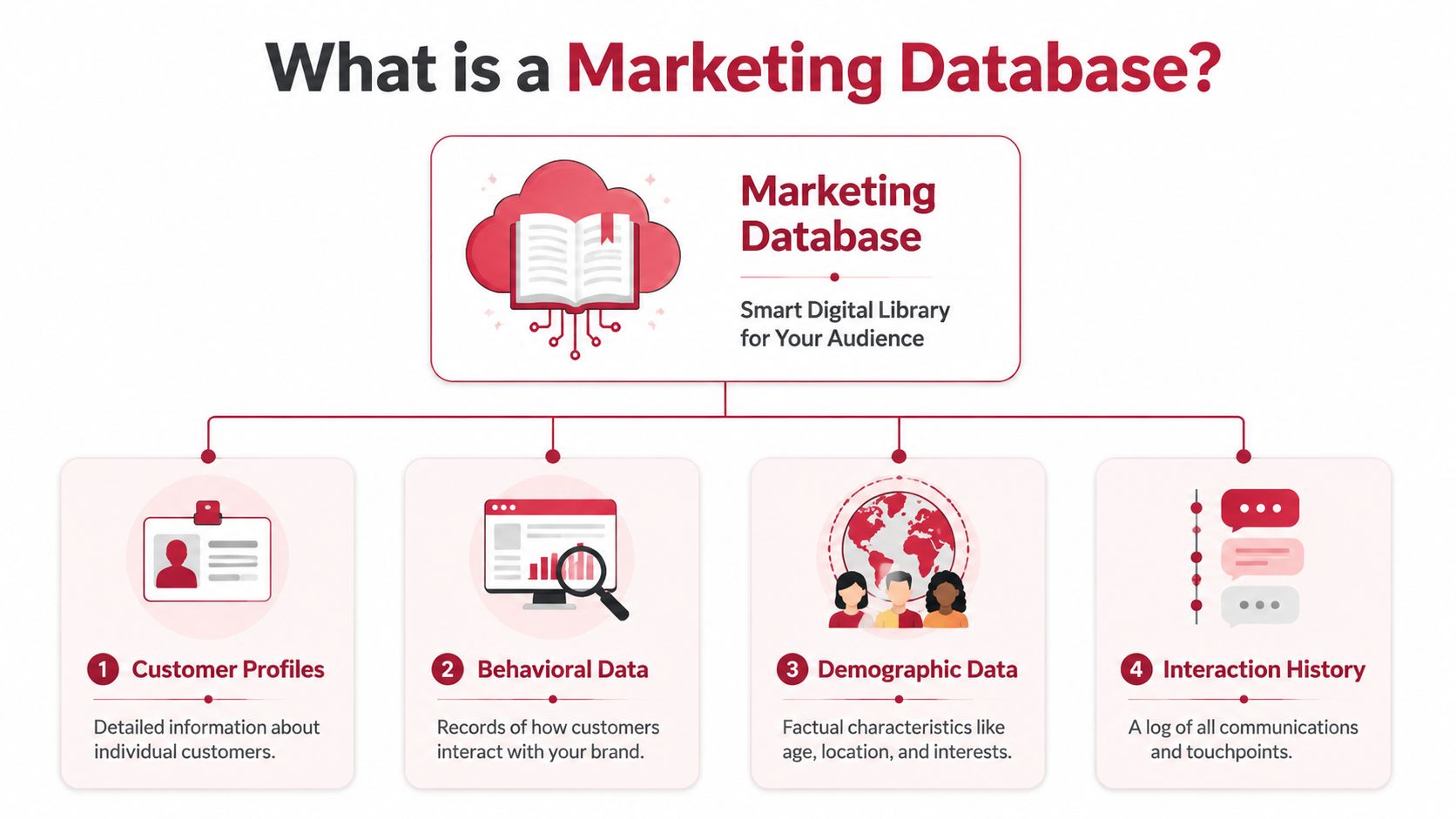
The formal definition is straightforward. A marketing database is a centralized repository of customer and prospect data that enables targeted campaigns, personalization, and performance analysis. It evolved from contact lists in the 1960s to CRM-driven systems used today. One milestone came in 1992 with Siebel Systems, which pioneered commercial CRM software. Today, these systems power 87% of B2B marketers’ lead generation and underpin $500 billion in annual digital ad spend, according to the University of Michigan marketing databases overview.
More than a spreadsheet
A spreadsheet can hold names, titles, and email addresses. It can’t easily tell a team that one contact watched a leadership episode, clicked a donor resource, visited the booking page, and then went quiet for two weeks. A database can.
That difference matters because modern marketing depends on context. Without context, every message sounds generic. With context, outreach starts to feel timely and relevant.
A strong setup usually includes tools like HubSpot, Salesforce, Airtable, Segment, or a lightweight CRM tied to forms and analytics. The exact stack matters less than the operating principle. The system should centralize information and make it usable.
For teams still working out the structure, Orbit AI’s guide to online lead databases is useful because it helps translate the idea from abstract software language into an actual working database model.
What it’s for in practice
A marketing database should help a business do three things well:
- Remember interactions: Every form fill, email click, and content touchpoint adds context.
- Organize audiences: Contacts can be grouped by role, interest, source, or behavior.
- Trigger action: The business can send the next message, assign outreach, or adjust content based on real signals.
A contact list stores names. A marketing database stores relationships in progress.
That’s the practical answer to what is a marketing database. It’s not just storage. It’s the system that makes content, audience insight, and conversion work together.
The Anatomy of a Powerful Marketing Database
The strength of a database depends on what goes into it. Many teams collect the easy stuff, like email and company name, then stop there. That creates a shallow system. It might help with basic outreach, but it won’t tell the team why someone is interested or what should happen next.
A useful database usually combines four kinds of information. Together, they create a fuller picture of audience fit and buying intent.
The four data types that matter
| Data Type | What It Is | Example for a Podcaster |
|---|---|---|
| Demographic or Firmographic | Basic identifying details about a person or organization | A listener is a founder, consultant, nonprofit director, or local business owner |
| Behavioral | Actions the person takes across content and channels | They watched a full YouTube episode, clicked a newsletter link, or downloaded show notes |
| Transactional | Purchase, donation, or conversion history | They bought a course, booked a strategy call, or gave through a campaign page |
| Psychographic | Motivations, values, priorities, and pain points | They care about authority building, donor trust, thought leadership, or audience growth |
Demographic and firmographic data answers the first question. Who is this person?
For a consultant, that might be job title, company size, and industry. For a nonprofit, it might be donor type, volunteer role, or region. This data is useful, but it’s often overrated when used alone. Knowing that a contact is a founder doesn’t say much about readiness.
Behavioral data is usually the turning point. It shows what someone does. A person who listens to an episode about personal branding, clicks through to a landing page, and returns to read another piece of content is signaling much more than a job title ever could.
Why behavioral data changes everything
Content-led businesses should pay close attention here because behavior connects attention to intent.
A few examples make this obvious:
- Episode consumption: A listener finishes episodes on a specific theme, such as authority building or lead generation.
- Resource engagement: That same listener downloads a checklist, template, or recap tied to that topic.
- Commercial action: They later visit a booking page, case study, or contact form.
Those signals belong together. If they live in separate platforms, the team misses the pattern.
The database becomes useful when it stops asking only who the contact is and starts tracking what the contact keeps doing.
Transactional data adds commercial reality. It tells the business who has already taken an economic action, whether that means purchasing, subscribing, donating, or booking. These insights typically initiate upsell, retention, and reactivation workflows.
Psychographic data is harder to collect but often makes the biggest messaging difference. It comes from surveys, intake forms, sales calls, DM conversations, and reply emails. A founder might say they want more inbound leads, but the deeper motive is often authority, consistency, or trust. That’s the kind of insight that improves offers and copy.
A powerful database doesn’t rely on one category. It layers all four. That’s what allows content-driven brands to market with nuance instead of guesswork.
How to Build and Maintain Your Database
The fastest way to build a bad database is to connect every tool at once.
It is often best to start smaller. Pick one high-value audience action, capture it cleanly, and make sure the data lands in the right place before adding more complexity. That discipline matters because a database is only as useful as the structure behind it.

Start with one capture point
For many content businesses, the best starting point is a form attached to a useful offer. That could be an episode companion guide, a workshop replay, a donor toolkit, a speaking inquiry form, or a newsletter signup tied to a specific content theme.
The form should collect only what the team will use. Name, email, and one useful qualifier often beat a bloated form full of fields nobody references later. Once the form is live, the data should flow into a CRM or structured base such as HubSpot, Salesforce, Airtable, or another tool the team will maintain consistently.
This is also where channel integration starts to matter. Email platforms, webinar tools, podcast landing pages, and website analytics should feed the same contact record whenever possible. Teams looking for broader prospecting ideas can review this resource on how to grow your reach with client database, then adapt the concept to a content-first workflow rather than a pure outbound motion.
Connect tools before adding complexity
A modern system doesn’t just store static fields. In a 2026 projection, high-performing B2B marketing databases integrate real-time intent signals, and teams using those signal-based systems report 3x faster conversion from MQL to SQL because they can micro-segment with over 85% accuracy in predicting readiness to buy, according to Apollo’s marketing database analysis.
That doesn’t mean every creator needs a complex event-stream architecture on day one. It means the direction of travel is clear. Better systems connect signals instead of trapping them in separate apps.
Common sources worth connecting include:
- Website forms: Resource downloads, contact requests, and newsletter opt-ins
- Email engagement: Opens, clicks, replies, and topic interest over time
- Content behavior: Video views, podcast landing page activity, and repeat visits
- Manual notes: Sales calls, consultation forms, or DM conversations logged back into the record
A lot of teams discover their content starts working harder once the audience journey is mapped into a consistent content repurposing strategy instead of being published as isolated assets.
After the data starts flowing, it helps to watch a practical walkthrough of how capture and follow-up systems fit together:
Maintenance is where most systems fail
Most database problems don’t come from missing software. They come from neglect.
Contacts get duplicated. Tags become inconsistent. Old fields stay in forms long after the team stopped using them. One part of the company calls someone a lead, another calls them a subscriber, and nobody can trust the reports.
A maintenance routine doesn’t need to be elaborate, but it does need to exist.
- Audit fields regularly: Remove fields that don’t shape messaging, segmentation, or routing.
- Standardize naming: Pick one set of lifecycle stages, source labels, and tags.
- Deduplicate often: Merge repeat records before they distort follow-up and reporting.
- Enrich carefully: Add context from forms, calls, or relevant integrations rather than stuffing the database with noise.
A clean database saves time twice. It reduces wasted outreach now, and it makes automation safer later.
Turning Data Into Leads and Authority
A database becomes valuable when it changes what the audience receives next.
That’s the practical difference between storing data and using it. A creator with a podcast, newsletter, and short-form content pipeline shouldn’t send the same message to everyone. Someone who watched a full episode about authority building needs a different follow-up than someone who only joined the list for a general update.

Segmentation makes content feel relevant
Segmentation means dividing the audience into groups that matter for the business.
For a content-led brand, useful segments might include new listeners, repeat viewers, founders interested in thought leadership, nonprofit leaders focused on donor engagement, or subscribers who clicked on service-related content. These aren’t vanity categories. They shape what the team sends, what offer appears next, and which topics get repurposed hardest.
A strong database supports behavioral segmentation. That means grouping people by what they’ve done, not just who they say they are.
Field note: The more a segment reflects action, the more useful it becomes for conversion.
A content waterfall model gets sharper. One long-form episode can produce clips, quotes, email angles, a recap article, and a targeted call to action. But the follow-up shouldn’t be universal. A high-engagement viewer may get invited to a demo or strategy conversation, while a newer subscriber gets a nurture sequence that deepens trust first.
Personalization changes the follow-up
Personalization doesn’t mean dropping a first name into an email subject line. It means aligning the message to the contact’s demonstrated interest.
If someone repeatedly engages with content about podcast authority, the next email should probably offer a related asset, not a broad company update. If a donor or supporter responds most to mission-focused episodes, the follow-up should reflect that pattern rather than forcing a generic funnel.
This approach is especially effective when paired with stronger nurture systems. Teams refining those handoffs can borrow useful ideas from these strategies for B2B lead conversions and adapt them to creator-led audience journeys.
It also helps when the content points to a focused destination. A well-built podcast landing page gives the team a place to capture intent and connect episode engagement to a next step.
Lead scoring helps teams act faster
Lead scoring is a way to rank who deserves attention first.
A team might assign higher value to contacts who watched longer, clicked commercial links, returned to the site, or engaged with multiple assets around the same topic. Even if the scoring model is simple, it keeps follow-up from being random.
That matters because content can attract very different levels of interest at the same time. One viewer is curious. Another is evaluating vendors. A third is ready to book. Without a database, those contacts often get treated the same way.
The payoff shows up when segmentation and behavioral triggers work together. According to Optimove’s database marketing resource, B2B marketing databases that use segmentation for behavioral triggers can produce tangible results. In the example cited there, a video podcast agency ingests listener data from YouTube and podcast platforms into a CRM, then sequences Content Waterfall demos to high-engagement viewers, directly converting 10-15% more trials to clients.
That example matters because it reflects how content businesses really grow. Authority is built in public through consistent episodes and repurposed media. Leads convert in private through timely, relevant follow-up. The database is what connects those two motions.
Staying Compliant and Building Trust
A marketing database can help a brand grow faster. It can also create risk if the team treats audience data casually.
This is especially important for nonprofits, spiritual leaders, and mission-driven creators. Their audiences often share personal information, values-driven interests, and sensitive engagement patterns. A sloppy system doesn’t just create legal exposure. It damages trust.
Consent has to be obvious
The baseline rule is simple. People should understand what data is being collected, why it’s being collected, and what happens next.
That means clear opt-ins, straightforward privacy language, and forms that don’t hide consent inside vague copy. If a website tracks behavior or a podcast funnel feeds listener actions into a CRM, the organization should be able to explain that clearly.
Many general guides focus on standard B2B compliance scenarios and miss the nuances for faith-based or community-led audiences. According to BlueConic’s database marketing resource, there’s a 25% YoY rise in podcast donor conversions for faith-based shows using behavioral triggers, but only 10% are estimated to fully comply with emerging privacy laws, creating a meaningful trust gap.
Trust grows when the audience knows the organization is using data to serve them, not to quietly profile them.
Simple systems can be safer
A lot of teams assume more software means better compliance. Often the opposite is true.
If the staff can’t explain the data flow, the system is too complicated. A lightweight setup with explicit consent, well-labeled fields, and limited access is often safer than a sprawling stack full of synced tools nobody fully understands. That’s especially true when audience members may include minors, donors, or people engaging with sensitive spiritual or personal topics.
A practical compliance posture usually includes:
- Clear permission: Use direct opt-in language for forms, subscriptions, and follow-up communication.
- Limited access: Only relevant team members should view contact records and behavior data.
- Purpose-based collection: If the team won’t use a field responsibly, it shouldn’t be collected.
- Easy removal: Unsubscribe, deletion, and preference changes should be simple.
Compliance isn’t a creativity tax. It’s part of responsible audience stewardship. Brands that treat it that way usually earn stronger long-term loyalty.
Getting Started Today Your First Three Steps
Many teams don’t need a perfect system. They need a working one.
The best first move is to choose a foundation the team will maintain. That might be HubSpot, Airtable, Salesforce, or another CRM that fits the current stage. The key is consistency, not complexity.
Then pick one data source. For most content-led brands, that’s a newsletter form, a lead magnet tied to a podcast episode, or a contact page connected to the main offer. Get that flow working before adding more sources.
Finally, define one use case. Not five. One. For example:
- Choose the home: Set up the CRM or database where all new contacts will live.
- Capture one signal: Send one form, landing page, or resource opt-in into that system cleanly.
- Trigger one action: Create a simple follow-up for people who engage with a specific topic.
That’s enough to start learning. Once the team can see who opted in, what they engaged with, and what happened next, the database stops feeling abstract. It becomes part of the growth engine.
A content business doesn’t need more disconnected attention. It needs a system that remembers, organizes, and acts on the right signals. That’s what a marketing database is for.
Get Up Productions helps brands turn podcasts into organized growth systems, not just polished episodes. For teams that want a show built around audience capture, repurposed content, and lead generation, Get Up Productions offers the production and strategy support to make that happen.