
Teams often aren’t short on ideas. They’re short on a system.
A founder records a webinar, posts one clip to LinkedIn, forgets to email the list, then goes quiet for two weeks. A consulting firm publishes thoughtful articles, but nobody on the sales team knows how to reuse them in outreach. A nonprofit captures moving stories in the field, yet those stories stay trapped in folders because turning them into usable marketing assets takes too much time. The result is familiar. Content gets treated like a series of isolated chores instead of a coordinated asset base.
That’s the trap in modern marketing & media. The pressure isn’t just to make content. It’s to make enough content for every platform, every format, every audience segment, all the time. Most organizations respond by sprinting harder. They hire freelancers, test more channels, and pile approvals on top of a workflow that was already fragile.
A stronger model starts with a different assumption. The goal isn’t to become a better content factory. The goal is to build a media engine.
A media engine works like a publisher. It has a repeatable format, a clear audience, and a distribution rhythm that turns one meaningful recording into many useful assets. Instead of asking, “What should be posted today?” the team asks, “What core episode or show are all channels drawing from this week?” That shift changes everything. Strategy gets simpler. Production gets more efficient. Messaging gets more consistent.
Practical rule: Random posts can create activity. A recurring show creates memory.
That distinction matters because buyers don’t make decisions from a single impression. They build familiarity over time. A show-based approach gives that familiarity structure. It lets a business teach in depth, capture authentic conversations, and translate those moments into short clips, articles, emails, and sales enablement content without reinventing the wheel every week.
Table of Contents
- Introduction From Content Treadmill to Media Engine
- Understanding Modern Media Channels and Funnels
- The Show-Based Framework Your Media Engine's Core
- Executing the Content Waterfall Distribution Strategy
- Measuring What Matters KPIs for Media Success
- Actionable Use Cases for Your Organization
- Conclusion Your Next Step to Building a Media Engine
Introduction From Content Treadmill to Media Engine
The content treadmill usually looks productive from the outside. Calendars are full. Drafts are moving. People are busy. But the outputs rarely add up because each asset is created as a one-off. One post exists for Instagram. Another gets written for the blog. A third becomes a sales deck slide. None of them share a common source or a long-term narrative.
That’s why many capable teams still feel stuck. They aren’t failing because they lack effort. They’re failing because their workflow has no center of gravity.
What burnout looks like in practice
A typical week inside a small marketing team often includes scattered requests from every direction:
- Leadership wants visibility: more thought leadership, more founder presence, more authority.
- Sales wants proof: clips, objections handled, examples that can support outreach.
- Social wants consistency: fresh posts in multiple formats for multiple channels.
- Operations wants efficiency: fewer handoffs, fewer revisions, less wasted production time.
Each request is valid. The problem is that teams often answer them separately. That creates duplicate work and weakens the message. It also forces the brand to sound different in every channel, which makes growth harder because the audience never gets a clear repeated signal.
The shift from creator to owner
A more durable approach treats the business like a media property. That doesn’t mean acting like a news company. It means creating one recurring flagship format that the company owns fully. A video podcast, expert roundtable, founder interview series, customer story show, or issue-based briefing can all fill that role.
Owned media becomes the base. Paid media amplifies what proves it can hold attention. Earned media grows from content that’s useful enough to share.
The businesses that feel least frantic aren’t always publishing less. They’re publishing from a stronger source.
A media engine creates that source. It gives every other format something to pull from. It also makes brand building more human. A polished landing page can explain what a company does. A recurring show can demonstrate how it thinks, how it solves problems, and why people should trust it.
What changes when the engine is working
When the system is built correctly, the team stops asking for endless new topics and starts extracting more value from strong original conversations. One episode can support short-form clips, blog summaries, newsletter insights, sales snippets, guest quotes, and platform-native edits without diluting the message.
That’s the central argument in modern marketing & media. Sustainable growth comes less from feeding every channel separately and more from creating one reliable signal and distributing it intelligently.
Understanding Modern Media Channels and Funnels
Media strategy gets easier when channels are assigned jobs. Without that discipline, teams overinvest in the wrong format at the wrong stage and then blame the platform.
The simplest way to think about the overall picture is through a real-estate analogy. Owned media is property the business controls. Earned media is attention granted by other people. Paid media is rented reach. Strong brands use all three, but they don’t expect them to do the same work.

Owned, earned, and paid in plain terms
Owned media includes the website, blog, email list, show feed, and YouTube channel. These are the places where the brand controls the environment, the archive, and the call to action. They matter because rented attention is unreliable if there’s nowhere durable to send people.
Earned media includes guest appearances, shares, mentions, testimonials, community recommendations, and press coverage. This type of attention is powerful because it carries borrowed trust. It’s also inconsistent, which is why it works better as an amplifier than as the foundation.
Paid media buys speed. Social ads, search ads, sponsorships, and promoted clips can place a message in front of a targeted audience quickly. The opportunity is large. Statista’s social media marketing data projects global social media advertising spend will reach $317.33 billion in 2026, and identifies short-form video as the highest-ROI content format.
Matching channels to funnel stages
Most confusion in marketing & media comes from expecting conversion from a channel that mainly creates awareness, or using a trust-building asset as if it were a direct-response ad.
A practical mapping looks like this:
| Funnel stage | Primary channel types | Best role |
|---|---|---|
| Awareness | Shorts, reels, guest clips, paid social, community posts | Get noticed quickly and clearly |
| Consideration | Full episodes, YouTube videos, email sequences, blog articles | Build trust and show thinking |
| Conversion | Website pages, demos, consultation pages, sales emails | Capture demand and move to action |
What each channel is really for
- YouTube long-form: Best when the buyer needs depth before trusting expertise.
- Instagram Reels and TikTok: Useful for discovery, pattern interruption, and repeated lightweight exposure.
- LinkedIn posts and audiograms: Strong for professional framing, especially when paired with a clear point of view.
- Email newsletters: Ideal for moving known audiences from passive attention to deliberate action.
- Website and landing pages: The place where interest gets turned into inquiry.
A common mistake is trying to make every clip do everything. Most short-form pieces shouldn’t close a deal. Their job is to earn the next step. The next step might be a full episode, a newsletter signup, or a visit to a service page.
Where the funnel breaks
Funnels usually break at the handoff points. Teams create awareness content but fail to route people into deeper assets. Or they create excellent long-form material but don’t cut it into enough entry points for discovery.
Working principle: The channel matters less than the sequence. Discovery without depth fades fast. Depth without discovery stays hidden.
That’s why a show-based engine works so well. It gives every stage a connected asset set. One core recording can serve awareness, consideration, and conversion without forcing the team to invent separate campaigns from scratch.
The Show-Based Framework Your Media Engine's Core
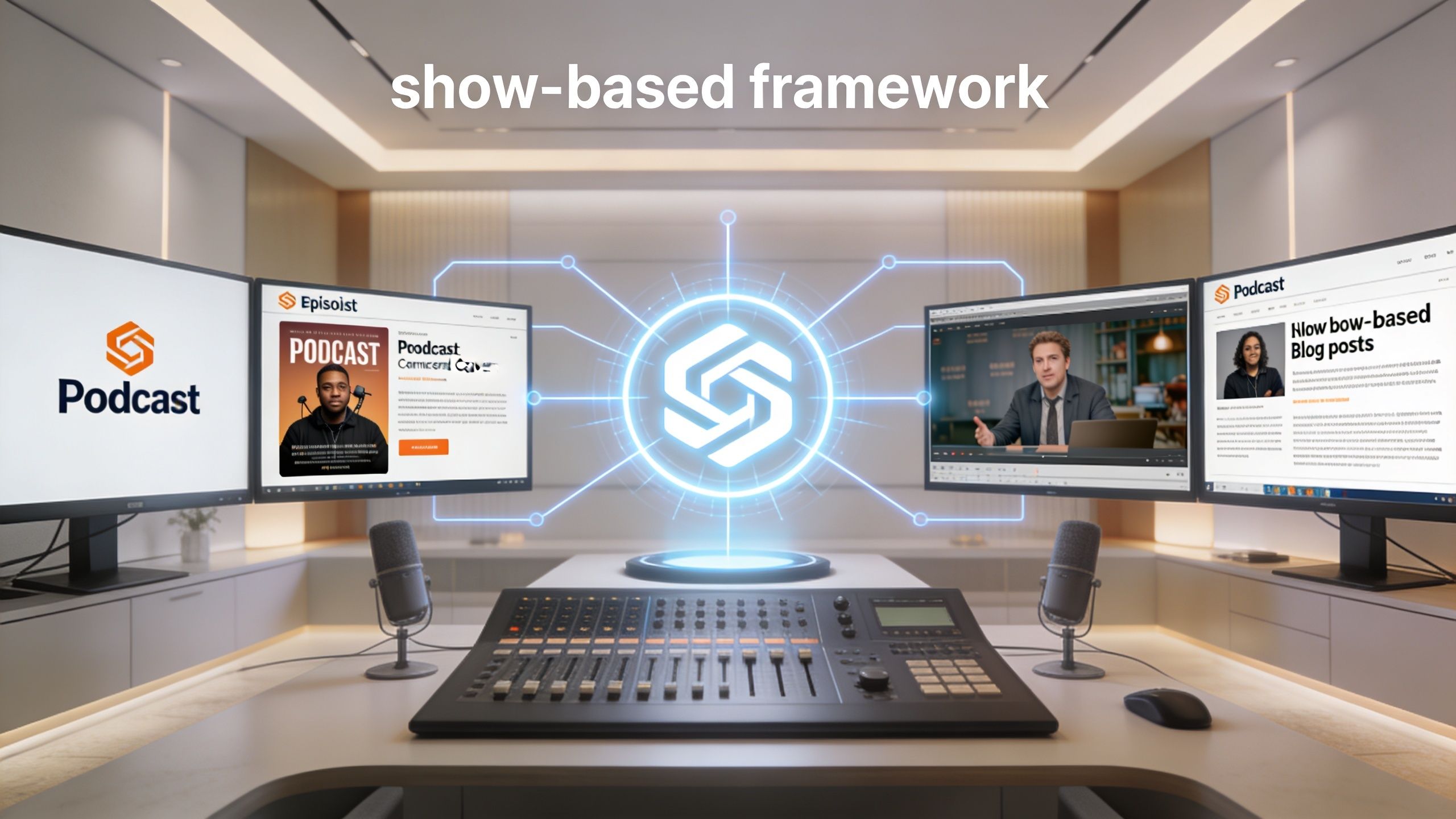
A strong show beats a pile of disconnected posts because it compounds. Each episode adds another proof point, another searchable asset, another chance for a buyer to hear the same themes expressed with nuance. That’s how authority is built in public.
Random content behaves like a collection of flyers. A show behaves like a series. People know what it is, what to expect, and why they should return.
Why episodic beats one-off production
A one-off campaign can create a moment. A recurring show creates a habit. That difference matters for any business that sells trust, expertise, or long-cycle services.
Think of the contrast this way:
- One-off content is often optimized for immediate reach.
- A recurring show is optimized for memory, consistency, and cumulative proof.
- Campaign assets usually expire quickly.
- Episodes stay useful because buyers discover them at different stages of readiness.
For founders, consultants, and experts, the show format also creates a better environment for substance. It allows room for context, objections, examples, and point of view. Buyers don’t just hear claims. They hear reasoning.
The show becomes the brand's voice in motion
A website explains the offer. A show demonstrates the intellect behind the offer.
That’s why the format is so effective for service firms. The business doesn’t need to rely on polished slogans when it can publish repeated, useful conversations around client problems, industry shifts, or decision criteria. A buyer who watches three thoughtful episodes usually arrives more prepared than a buyer who skimmed ten generic social posts.
For teams building the backbone of that system, podcast marketing strategy guidance is useful because it forces a decision on format, audience, cadence, and distribution before production starts. That planning step is where many organizations either create momentum or guarantee waste.
What a strong show includes
Not every show needs a studio set or a celebrity guest list. It does need structure. The strongest examples usually share a few traits:
- A defined audience: not “everyone in business,” but a specific buyer, peer group, or stakeholder.
- A repeatable premise: interviews, breakdowns, case discussions, founder commentary, or customer stories.
- A recognizable point of view: the audience should know what kind of lens the show applies.
- A publishing rhythm: enough consistency that the archive feels alive rather than abandoned.
Trade-offs that matter
A show-based system isn’t the right choice if the organization can’t commit to repetition. A single well-produced episode won’t create the benefits described here on its own. The advantage comes from consistency and reuse.
There’s also a quality trade-off. Producing a show demands stronger preparation than posting off-the-cuff updates. The host needs prompts. Guests need direction. Recording quality matters because weak audio and scattered conversation make repurposing harder.
A show doesn’t need to feel expensive. It does need to feel intentional.
That’s the key distinction. The goal isn’t perfection. The goal is a durable source asset that can support the rest of the media mix.
Why this model reduces the content burden
Teams often assume a show adds work. In reality, it can remove a large amount of low-value work because the business stops generating every asset from zero. One conversation yields transcripts, hooks, objections, quotes, clips, visual moments, and narrative angles.
That makes the show less like a content type and more like production infrastructure. Once it exists, the rest of marketing & media becomes a process of extraction, editing, packaging, and distribution rather than constant invention.
Executing the Content Waterfall Distribution Strategy
The Content Waterfall starts with one substantial asset and turns it into platform-specific outputs without forcing the team to re-create the message each time. It works because each derivative piece serves a different viewing behavior. Some people will give a business half an hour. Most won’t. The waterfall makes sure the shorter formats still connect back to the deeper one.
Start with one master recording
The process begins with a strong long-form episode. That could be an interview, a solo breakdown, a panel discussion, or a client education session. The source material matters because weak originals produce weak repurposed clips. Good editing can sharpen a point. It can’t manufacture one.
A useful operating sequence looks like this:
- Record one high-substance episode with a clear central topic.
- Pull the transcript and mark moments with standalone value.
- Identify content roles such as insight clip, objection-handling clip, quote card, article angle, and email takeaway.
- Edit for native behavior rather than posting the same cut everywhere.
- Route each asset to the next logical destination, such as full episode, blog, newsletter, or contact page.
A practical weekly output example
One episode can become an entire week or more of distribution when the team thinks in layers instead of duplicates.
- Full-length video: Publish on YouTube with a search-friendly title and description.
- Short vertical clips: Cut several excerpts for YouTube Shorts, Instagram Reels, and TikTok, each built around a single idea.
- LinkedIn asset: Turn one sharp section into an audiogram or caption-led post for professional audiences.
- Blog summary: Convert the conversation into a written article that sales and search can both use.
- Email newsletter: Send one distilled lesson with a link to the full episode.
- Sales enablement snippets: Give the business development team clips that answer common objections.
That’s the difference between repurposing and reposting. Repurposing adapts the message to the platform. Reposting just duplicates the file.
Keep approvals from killing momentum
Most waterfall systems don’t fail in editing. They fail in review. Assets pile up waiting for sign-off, then the moment passes. Teams that need multiple reviewers usually benefit from a documented approval path with ownership, deadlines, and version control. A resource on Scheduler.social approval steps is useful because it breaks down how structured approvals prevent content from stalling between draft and publish.
A production partner can also handle that packaging layer. One option in this category is Get Up Productions’ content repurposing strategy, which is built around taking a recorded episode and turning it into multiple platform-ready assets.
Use different cuts for different audience intent
A short clip should have one job. It might spark curiosity. It might challenge an assumption. It might answer a specific pain point. It shouldn’t try to summarize an entire episode.
This embedded example shows the kind of teaching content that can anchor a waterfall and generate multiple derivative cuts:
Add one underrated distribution layer
Many firms stop at the major platforms. That leaves a gap.
Arbiclick’s write-up on underrated marketing channels notes that Reddit communities can be especially useful for B2B firms and thought leaders, and that raw behind-the-scenes clips can convert lurkers to listeners at times 3x higher than paid ads on saturated platforms when they’re shared with genuine value. The key word is genuine. Reddit punishes polished self-promotion quickly. It responds better when the post contributes something specific to the discussion.
Behind-the-scenes clips often work because they feel like participation, not broadcasting.
That trade-off matters. A cinematic teaser may perform well in paid social. A rougher excerpt with a useful opinion can fit better inside a niche community thread. Good distribution teams know the difference and package accordingly.
Measuring What Matters KPIs for Media Success
A media engine can look busy while underperforming. That’s why measurement needs to move beyond likes, views, and follower counts. Those metrics can be useful signals, but they aren’t proof of business impact.
The better question is whether content is expanding reach, deepening trust, and creating movement toward revenue or mission outcomes.
Stop treating vanity metrics as the scoreboard
Follower growth can flatter a weak strategy. A clip can attract views because the hook was broad, controversial, or entertaining without attracting the right audience at all. Teams need metrics that reveal fit, not just activity.
A cleaner KPI stack often includes:
| KPI type | What it answers |
|---|---|
| Reach quality | Is the right audience seeing this repeatedly? |
| Engagement quality | Are people saving, replying, sharing, or watching with intent? |
| Pipeline contribution | Did content influence inquiries, calls, or sales conversations? |
| Segment performance | Which audience, device, or funnel stage actually converts? |
Use GRPs and SOV without overcomplicating them
Two terms from media planning are especially useful once a team starts distributing at scale.
Gross Rating Points (GRPs) measure campaign reach and frequency. Improvado’s overview of digital media math explains the formula as GRPs = (Booked Impressions / Target Demographic Population) × 100 and notes that campaigns with GRPs above 200 correlate with 15-25% higher engagement rates. For show-based media, that matters because repeated exposure is what turns a familiar host into a trusted one.
Share of Voice (SOV) measures how much of the visible conversation a brand owns relative to available impressions in a niche. The same source notes that maintaining SOV over 30% can yield 2x greater visibility and lead generation. That’s a practical way to think about competitive presence. If a firm publishes occasionally while competitors dominate feeds, newsletters, and clips, the market experiences the competitor as the authority.
Measurement lens: Frequency matters when the message is strong. Repetition of weak content only scales annoyance.
Segment before making budget decisions
Top-line averages hide where genuine value is. A campaign may look average overall while one audience slice is performing exceptionally well. Another might be consuming content but never converting.
That’s where influencer or creator-based distribution also needs discipline. Teams running cross-platform partnerships should have a process for attribution and comparison. A guide on building an influencer tracking system can help teams connect creator activity across TikTok and Instagram to measurable outcomes instead of guessing from screenshots and isolated platform metrics.
What to review every week
Weekly review works better than sporadic deep dives because the goal is correction, not just reporting.
A practical review cadence includes:
- Content review: Which clips earned strong watch behavior and why?
- Audience review: Which persona or market segment responded with intent?
- Channel review: Which platform drove deeper actions, not just surface engagement?
- Conversion review: Which assets influenced booked calls, replies, applications, or donations?
When teams do this consistently, media stops being a branding expense with fuzzy value. It becomes an operating system for audience growth and demand capture.
Actionable Use Cases for Your Organization
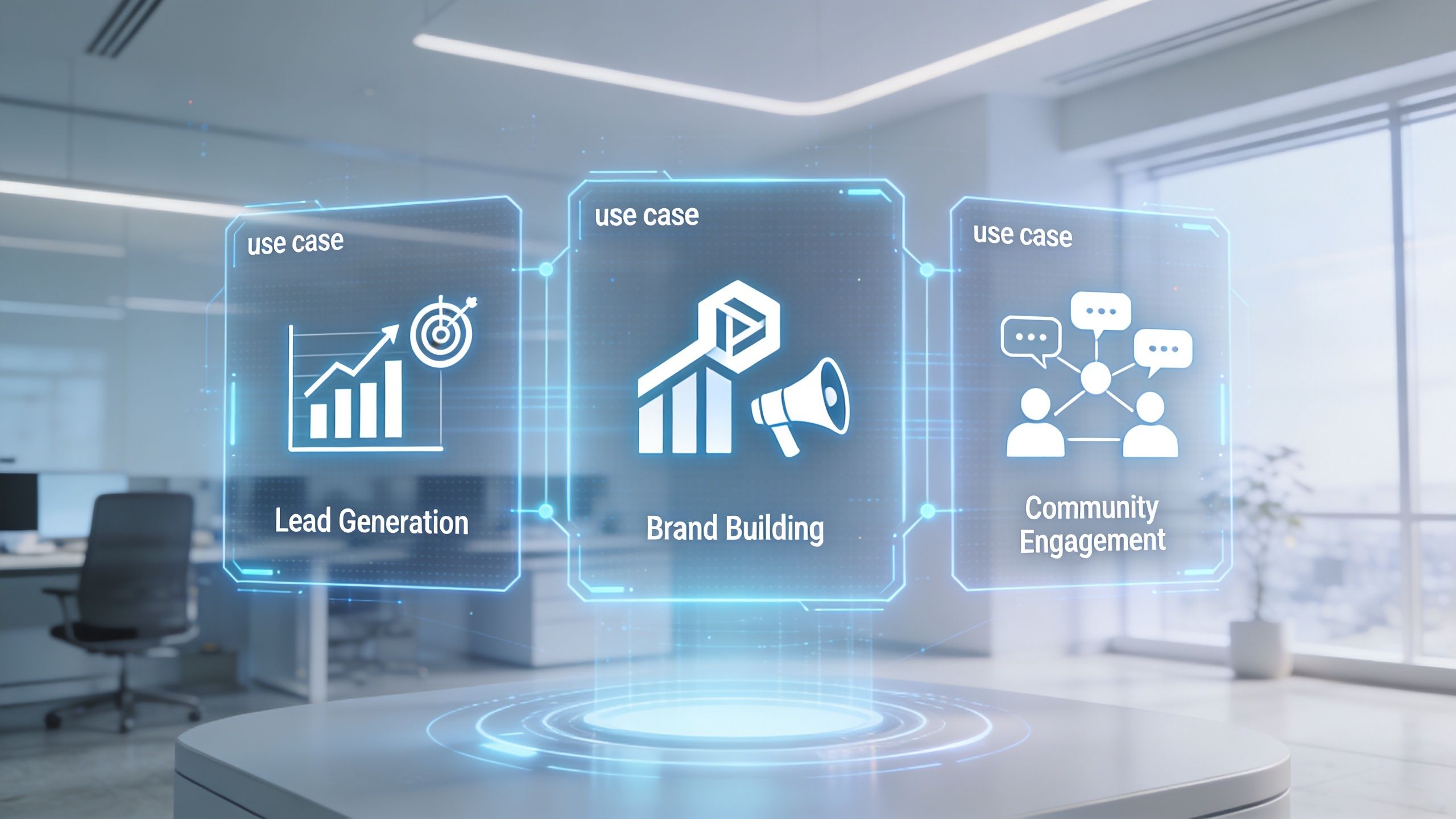
A show-based engine only matters if it fits real organizational goals. The model looks different for a founder, a consulting firm, and a nonprofit, but the underlying pattern stays the same. One recurring show creates the source material. Distribution adapts it for the right people. Measurement determines what gets emphasized next.
Entrepreneur building a personal brand
An entrepreneur usually doesn’t need more motivational posts. The entrepreneur needs visible proof of thinking quality. A weekly interview or solo video show can do that well because it creates repeated exposure to decision-making style, market understanding, and communication clarity.
The strongest version usually focuses on a narrow lane such as fundraising lessons, product positioning, leadership decisions, or category analysis. Short clips feed discovery. Full episodes give depth to investors, partners, or recruits who want to assess substance.
A tool like ShortGenius AI ad generator can help turn strong excerpts into ad-ready video assets when the entrepreneur wants to test amplification, but the source material still needs a coherent show premise behind it.
B2B consulting firm generating qualified leads
A consulting firm benefits when the show mirrors the sales conversation. Instead of posting generic expertise, the firm can build episodes around buyer questions, implementation mistakes, hidden costs, vendor selection criteria, and changing industry conditions.
That approach also helps the firm reach beyond active followers. Destination CRM’s discussion of underserved markets points to four audience types: active, aware, latent, and non-audiences, and notes that 82% of small business buyers crave B2C-like digital experiences. For a consulting firm, that means the show shouldn’t only serve current fans or existing clients. It should also speak to people who recognize the problem but haven’t engaged yet, and to buyers who don’t know the firm exists.
A practical format for this use case might include:
- Problem episodes: break down one costly mistake buyers keep making.
- Decision episodes: compare paths, trade-offs, and timing issues.
- Proof episodes: discuss anonymized client patterns or market scenarios.
- Response clips: turn one sharp answer into short-form content for outreach and retargeting.
For firms ready to formalize that operation, guidance on how to start a video podcast is useful because it forces alignment on host role, audience promise, and production rhythm before launch.
Nonprofit growing donor engagement
Nonprofits often have powerful stories but weak packaging. The show-based model gives those stories a consistent home. A nonprofit can record recurring conversations with staff, beneficiaries, partners, and local leaders, then turn those moments into clips, newsletters, donor updates, and event promotion assets.
This format works especially well because donors don’t only respond to facts. They respond to continuity. A show lets the organization demonstrate ongoing work rather than appearing only when fundraising is urgent.
What underserved audiences change
The biggest upside often comes from people who aren’t currently engaging. That includes latent audiences who see content but don’t respond publicly, and non-audiences who are relevant but unaware. Social listening helps reveal what those groups care about, which terms they use, and where current messaging misses the mark.
When a team only studies its loudest followers, it builds media for the smallest visible part of the market.
That’s why the best use cases don’t start with platform selection. They start with audience gaps. Once the gap is known, the show can be designed around it and the waterfall can distribute that message in formats each audience is willing to consume.
Conclusion Your Next Step to Building a Media Engine
The hard part in marketing & media isn’t knowing that content matters. Every team already knows that. The hard part is creating a system that can keep producing useful, credible, audience-specific content without burning out the people responsible for it.
That’s why the shift from content treadmill to media engine matters. A recurring show gives the organization a durable center. The Content Waterfall turns that center into a practical distribution model. Better measurement keeps the system honest by showing which audiences, formats, and channels deserve more investment.
The strongest teams also accept that averages can mislead. Funnel’s overview of marketing data analysis notes that segmenting metrics like CAC and LTV by audience persona, device, or funnel stage helps teams focus on what’s working, and that mobile-first segments can show 2.5x higher conversion rates. That kind of segmented view is what turns a content program from “active” to effective. It shows where short-form belongs, where depth matters more, and where budget needs to move.
There are two realistic next steps.
One path is to build the engine internally. Choose a show format. Set a cadence. Record a pilot batch. Create a review process. Turn each episode into a structured waterfall and measure what moves business outcomes, not just social activity.
The other path is to keep ownership of the strategy while bringing in specialists for production, editing, packaging, and distribution. That makes sense when the internal team has the expertise but not the capacity, or when speed matters more than learning every operational detail from scratch.
Both paths can work. The wrong path is staying trapped in reactive posting and hoping volume will eventually create momentum.
A practical next step is to evaluate whether the organization already has enough expertise to anchor a recurring show. If the answer is yes but the production workload keeps getting in the way, Get Up Productions offers video podcast production, editing, YouTube optimization, and repurposing support built around a show-based content engine.