
OTT stands for over-the-top. In media, that means video, audio, or messaging is delivered over the internet instead of through traditional cable, broadcast, or satellite providers.
That's why so many creators hear the term and feel slightly unsure whether it applies to them. A podcaster uploads video to YouTube. A brand publishes episodes on a smart TV app. A viewer watches on a phone, then finishes on a Roku or smart TV. All of that sits inside the same bigger shift in distribution.
For an independent creator, this matters because OTT isn't just a tech label. It changes how content reaches people, how audiences watch, and how a show can grow without waiting for a gatekeeper to hand over a channel. Someone building a brand show today is often already participating in OTT, even if they've never used the term out loud.
Table of Contents
- What OTT Means in Plain English
- Beyond the Acronym How OTT Actually Works
- OTT vs Traditional TV The Great Media Shift
- The OTT Universe Examples You Already Use
- Why OTT Matters for Your Brand and Podcast
- How to Use OTT in Your Content Strategy
What OTT Means in Plain English
Someone opens Netflix on a smart TV, taps a documentary on a tablet, or streams a live show on a phone. In each case, the media arrives through the public internet instead of a cable box. That's the basic idea behind OTT.
OTT stands for over-the-top, a term used for media services that deliver video, audio, or messaging directly over the public internet rather than through traditional cable, broadcast, or telecom distribution, as explained in Unity's OTT definition glossary. The phrase sounds technical, but the idea is simple. The service goes around the old middlemen and reaches the audience directly.
A simple analogy
A useful way to think about OTT is food delivery.
Traditional TV works more like a hotel room service menu. The building decides what's available, when it's served, and how it reaches the guest. OTT works more like ordering directly from a restaurant through an app. The customer picks what they want, when they want it, and on whichever device they already have in hand.
That shift is why OTT matters so much to creators. Distribution is no longer tied to one screen, one schedule, or one provider.
OTT describes how content gets delivered, not whether the content is a movie, a podcast, a live event, or a talk show.
Why creators should care
For podcasters and brand builders, OTT lowers the mental barrier to entry. A show no longer has to “look like TV” to live in a television-sized ecosystem. If an episode streams online and people can watch it on smart TVs, phones, tablets, computers, or streaming devices, it fits the OTT space described in this overview of the rise of OTT platforms.
The main conclusion is this: Questions concerning what OTT stands for in media frequently get at whether internet-first content counts as legitimate media distribution. It does.
Beyond the Acronym How OTT Actually Works
OTT feels abstract until the delivery path is broken into a few concrete parts. For most creators, the process is simpler than it sounds.
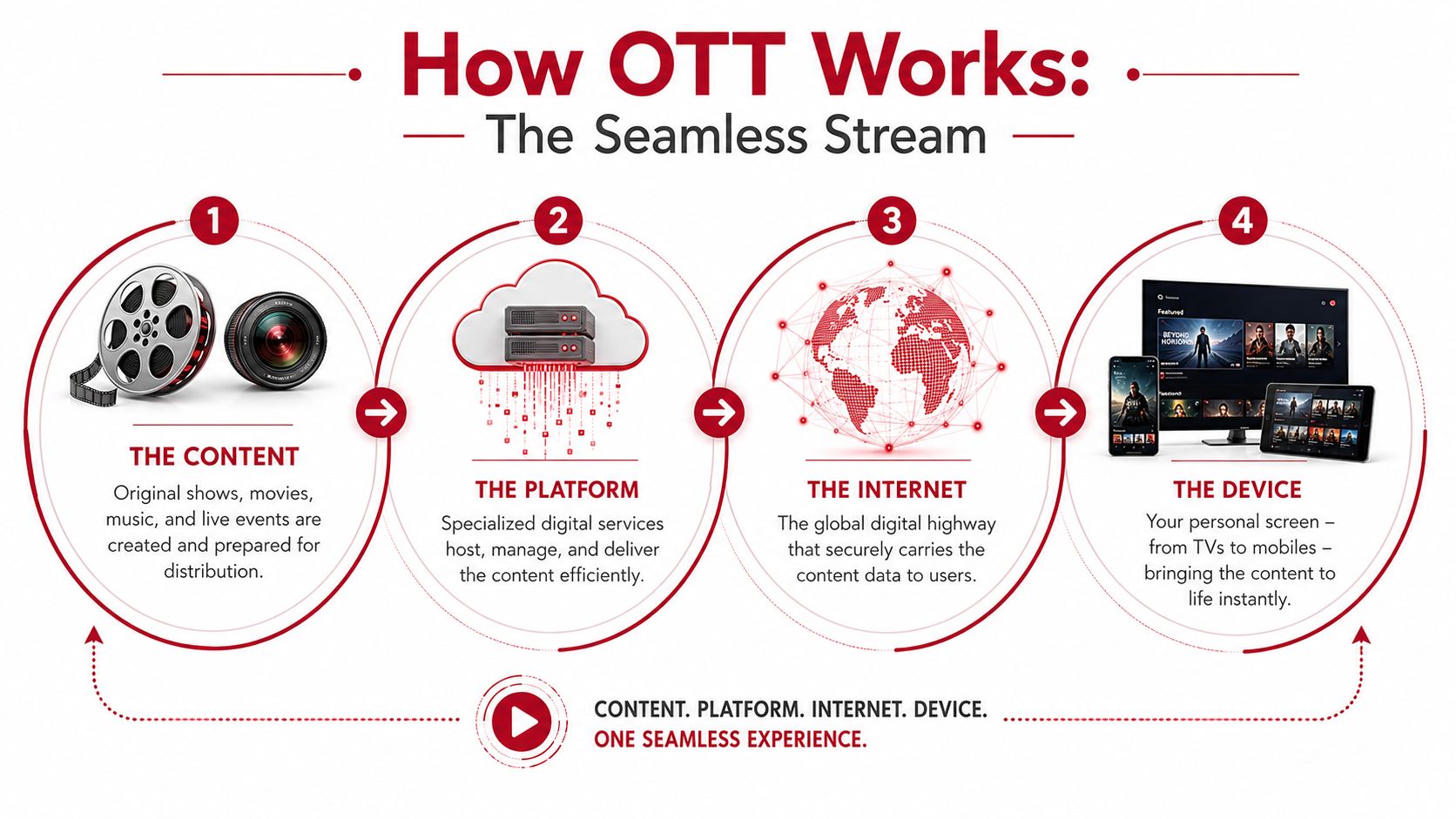
The four moving parts
The content
A creator records something. That could be a video podcast, an interview, a sermon, a coaching session, a documentary, or a livestream.The platform
A service such as YouTube, Hulu, Netflix, or a branded streaming platform hosts and serves that content.The internet connection
The audience doesn't need cable infrastructure. They need an internet connection that can carry the stream.The viewing device
The same piece of content might be watched on a laptop in the afternoon and on a smart TV at night.
That's the mechanics of OTT in plain language. The platform places content online, and the viewer pulls it through the internet on the device they prefer.
The terms that usually confuse people
A few related terms often show up alongside OTT:
- SVOD means subscription video on demand. Think of services where viewers pay a recurring fee for access.
- AVOD means ad-supported video on demand. The viewer watches content with ads instead of paying directly.
- TVOD means transactional video on demand. The viewer pays for a specific rental, purchase, or event.
These labels describe business models, not the delivery path itself. OTT is still the bigger umbrella.
Practical rule: If the content reaches people through the public internet instead of through a cable or satellite system, it's OTT. SVOD, AVOD, and TVOD just describe how access gets sold.
One distinction matters a lot for creators and advertisers alike. Nielsen explains in its guide to OTT vs. CTV that OTT is the distribution path, while CTV is the device category. In other words, OTT is the stream. CTV is when that stream is watched on a television screen through a smart TV, streaming stick, or console.
A YouTube episode watched on a phone is OTT. The same episode watched through a smart TV app is OTT on CTV.
That sounds small, but it changes strategy. A creator making a video podcast for mobile-only viewing may frame shots, captions, pacing, and graphics differently than a creator designing for a living room screen.
OTT vs Traditional TV The Great Media Shift
The easiest way to understand OTT's importance is to compare it directly with traditional television.
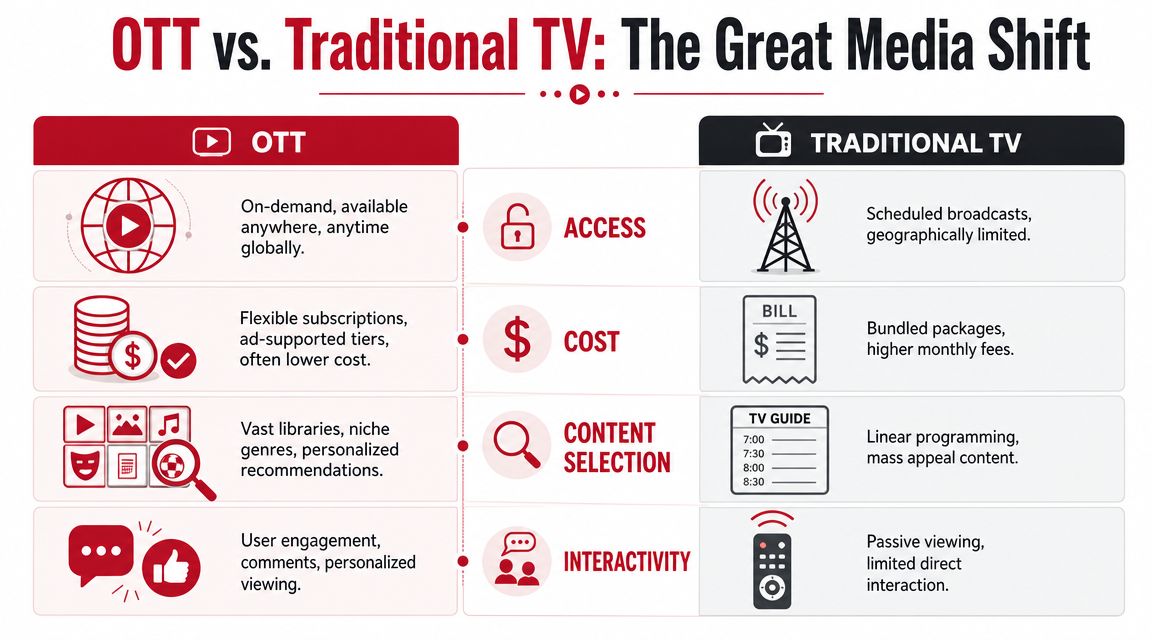
A side-by-side view
| Attribute | OTT (Over-The-Top) | Traditional TV (Cable/Satellite) |
|---|---|---|
| Delivery | Through the public internet | Through managed cable, satellite, or broadcast systems |
| Access | Usually available on demand across multiple device types | Often tied to channel schedules and provider packages |
| Viewing style | Flexible, app-based, user-controlled | Linear, provider-controlled |
| Monetization | Can include subscriptions, ads, rentals, or hybrid models | Commonly built around bundles and channel packages |
| Creator opportunity | Easier for niche and independent distribution | Harder to access without institutional distribution |
Traditional TV was built around scarcity. There were limited channels, fixed schedules, and a small number of companies controlling access. OTT is built around direct internet delivery, app-based discovery, and far more flexibility in how audiences watch.
Why the shift matters
This isn't a niche behavior anymore. According to the Wikipedia overview of over-the-top media services, streaming platforms accounted for 38% of global television consumption in 2023, OTT platform subscriptions reached 1.8 billion worldwide, and by May 2025 streaming viewership in the U.S. had risen 71% since 2021, reaching 44.8% of all television viewership and surpassing network and cable TV combined.
That changes the strategic question for a creator. It's no longer “Should this brand think about streaming?” The better question is “How should this brand show up in the way people already watch?”
Traditional TV trained audiences to follow the channel's schedule. OTT trained audiences to expect the content to be there when they're ready.
For a podcast host or brand marketer, that expectation is huge. People don't separate “TV behavior” and “internet behavior” the way the industry once did. They open an app and watch. If a show is available there, it competes. If it isn't, it disappears from that habit loop.
The OTT Universe Examples You Already Use
Consumers already use OTT every week without thinking about the acronym behind it.
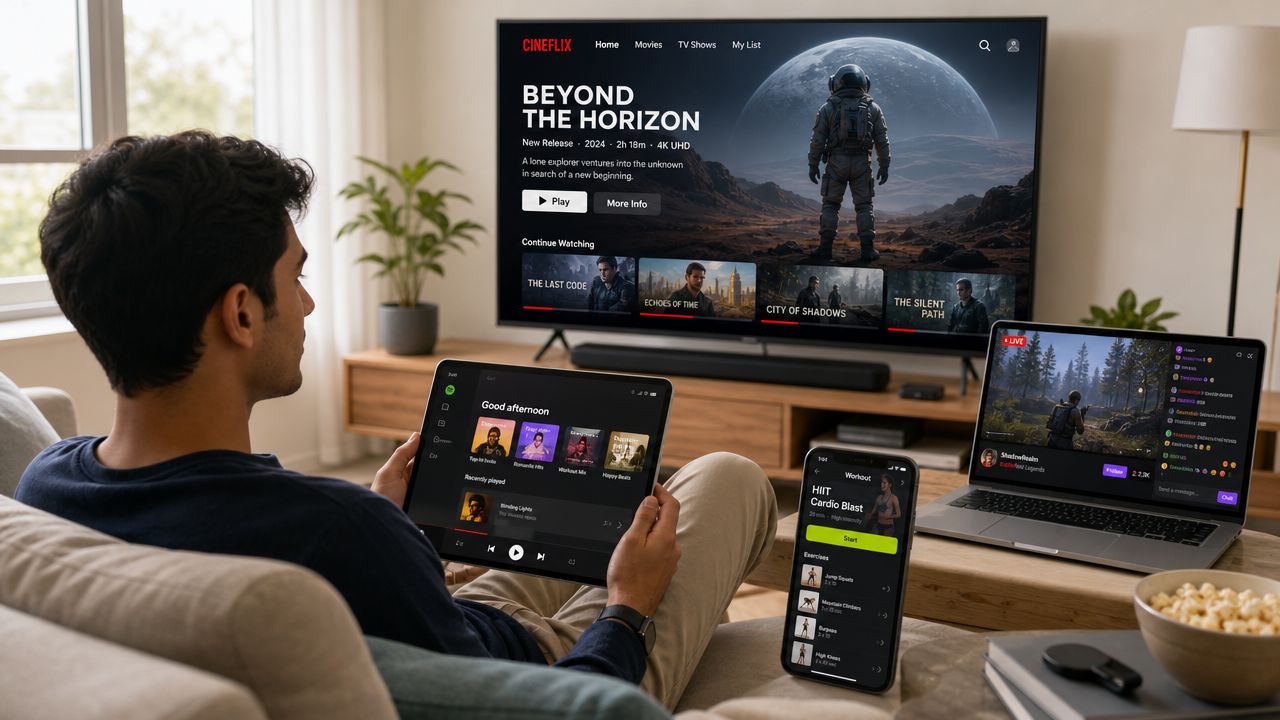
A household might stream Netflix on a smart TV, rent a film through Amazon Prime Video, watch interviews on YouTube, and follow a live sports stream through a platform built for cord-cutters. Someone comparing options for live golf, for example, could use Fubo's guide to PGA Tour live for cord-cutters as a practical example of how internet-delivered viewing now replaces what once required a traditional TV package.
Three common OTT business models
Subscription services
Netflix and Disney+ fit the subscription pattern. The viewer pays recurring access for a library of content.
Ad-supported services
YouTube is the example most creators already understand. The viewer gets access without a direct fee, and ads support the platform and creators.
Transactional services
Some platforms charge for a single event, rental, or purchase. That model often appears with special releases or live event access.
These categories help creators think clearly about monetization. They also prevent a common misunderstanding. OTT doesn't mean one platform type. It describes a distribution method that can support several revenue models.
Why YouTube matters so much for creators
For independent podcasters, YouTube is often the most practical OTT entry point because it combines video hosting, search, recommendations, and living-room viewing through connected TV apps. A video podcast on YouTube isn't just “content on social.” It can function like an episodic internet TV show.
A short explainer can help make that ecosystem easier to picture:
Creators can also look beyond major consumer apps. Services such as Vimeo OTT show that brands and niche publishers can build dedicated streaming destinations around their own libraries, audiences, and identity.
Why OTT Matters for Your Brand and Podcast
A lot of creators treat OTT like an industry term that belongs to streaming giants. That leaves opportunity on the table.
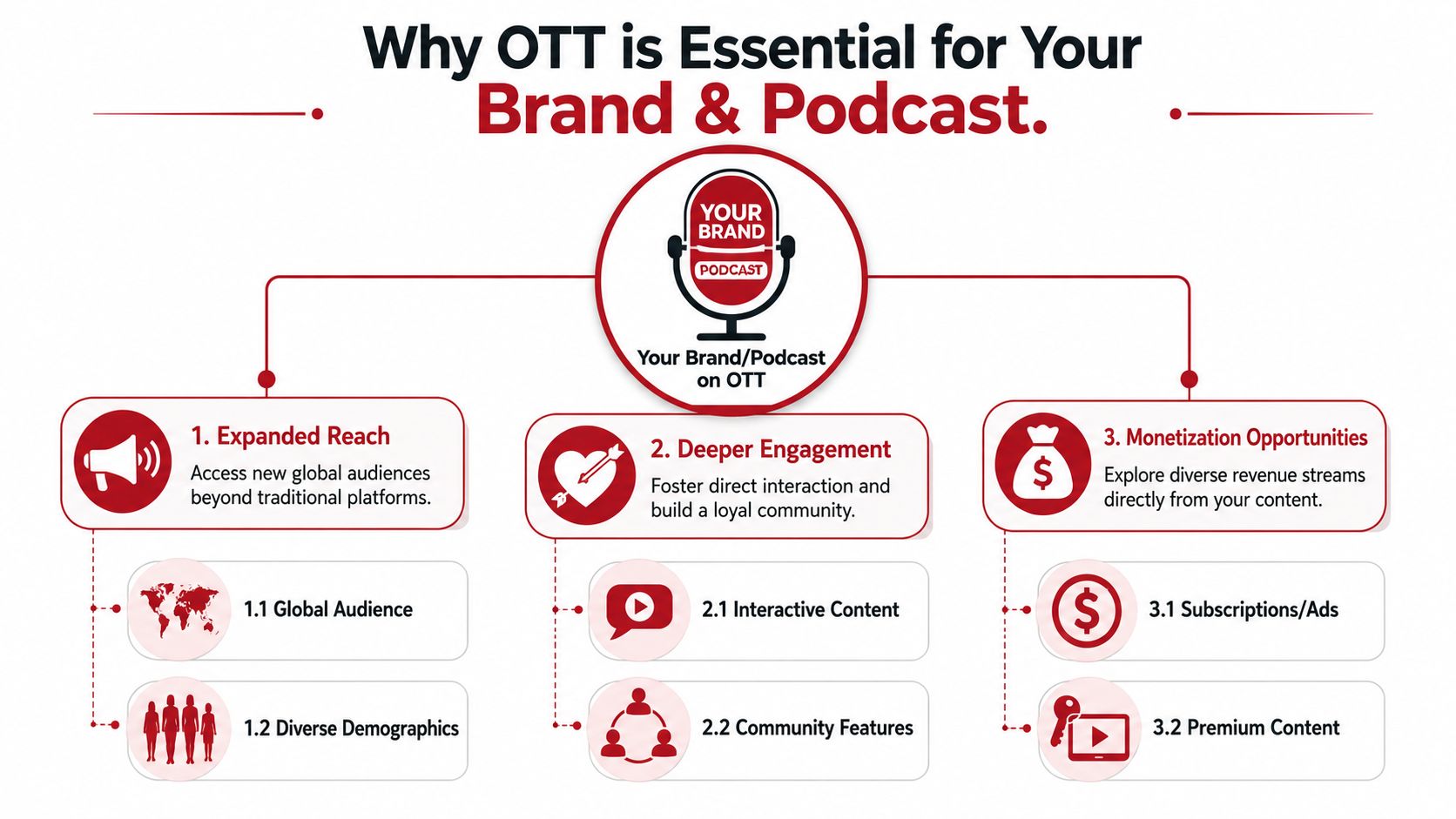
A podcast can be OTT content
Amazon Ads notes in its guide to what OTT includes that people often ask whether podcasts and audio streaming count. That question matters because OTT now spans video, audio, and even communications services, not just on-demand TV.
That broader definition gives podcasters a more useful frame. A show doesn't have to become a scripted series to participate in OTT. If it's distributed through internet-based platforms and consumed through streaming behavior, it belongs in the same strategic conversation.
A video podcast is often better understood as an episodic OTT show with an audio version, not as “just a podcast with cameras.”
That shift in framing changes decisions quickly. It affects thumbnails, set design, pacing, guest booking, episode packaging, and where a team expects the audience to watch.
The brand advantage
Brands that understand OTT can make better content choices:
- They build for audience habits instead of forcing people back into old media assumptions.
- They treat episodes like assets that can live on more than one screen and in more than one format.
- They think in series, not one-off posts, which helps build recognition and repeat viewing.
- They connect audio and video strategy instead of running them as separate silos.
For an ambitious creator, the primary benefit is positioning. A weekly interview show on YouTube, a polished webinar series, a thought-leadership program, or a sermon archive with video all start to look less like random uploads and more like a coherent OTT presence. That's the mindset behind stronger OTT marketing meaning for brands.
People searching what does OTT stand for in media usually want the term defined. What they often need is a strategic reframe. Their content may already belong to a bigger ecosystem than they realized.
How to Use OTT in Your Content Strategy
A simple way to pressure-test your strategy is to ask one question. If someone finds your show on a TV app, YouTube, or a streaming device, does it feel like a real series or just another upload?
That distinction matters for podcasters and brand creators because OTT favors shows people can return to. A strong episode can introduce your expertise. A strong series can build a habit.
Plan like a show, not a feed
For independent creators, OTT works a lot like programming a channel. Each episode should feel connected to the last one and give viewers a reason to come back. If your content feels random, the audience has to do too much work to understand what you offer.
A practical OTT content strategy usually includes:
A clear episodic promise
Viewers should understand what the show covers, who it helps, and what they will get next week.Visual clarity on larger screens
Titles, captions, and on-screen graphics need to stay readable on a television, not only on a phone.A recognizable look and feel
Repeated framing, set choices, colors, and thumbnail patterns help your show feel familiar after a quick glance.A distribution plan built around one core asset
One full episode can become clips, quotes, short videos, and audio cuts. Teams that want a better repurposing system can study ways to maximize your content across platforms without turning every platform into a separate production project.
Build for the screen people use
A viewer watching from a couch behaves differently from someone scrolling between meetings. Your production choices should respect both settings.
That usually means doing a few things with discipline:
Open with a clear reason to stay
The first moments should tell the viewer what this episode is about and why it deserves attention now.Compose shots cleanly
Conversation-driven shows still need strong framing, steady cameras, good lighting, and clean eyelines. Small visual flaws feel bigger on a television.Treat audio like part of the brand
OTT is screen-based, but sound still shapes trust. If the audio feels thin, noisy, or uneven, the show feels less polished.Create once, adapt many times
The long-form episode is your source material. Short clips and social edits should support it, not replace it.
A strong OTT plan for a small brand usually starts with one dependable show and a smart distribution system around it.
That is why OTT is useful for podcasters in particular. Your video podcast is not just a recorded conversation. It can become a repeatable media asset that builds authority on YouTube, feeds short-form channels, supports the audio podcast, and gives your brand a show people recognize. If you want a clearer framework for that, this guide on OTT in digital marketing strategy is a helpful next step.
You do not need a cable network. You need a show format people can follow, a production system you can sustain, and packaging that fits modern viewing habits.