
A lot of creators have had the same moment lately. They sit down to watch a show on Hulu, Peacock, Tubi, or another streaming app and an ad appears for a local law firm, a business coach, a regional nonprofit, or a niche software company. It doesn't look like a national TV buy. It looks targeted, modern, and oddly relevant.
That's the point.
What used to feel like “TV advertising” now works much more like digital media. A smart brand can put the right message on the biggest screen in the house without building a massive broadcast campaign from scratch. For podcasters, consultants, authors, nonprofits, and B2B marketers, that changes the question from “Can this brand afford TV?” to “How can existing content be adapted for streaming?”
That's where OTT digital marketing gets interesting. It gives content creators a way to turn expertise into visible authority on connected screens, especially when the source material already exists in the form of interviews, solo episodes, donor stories, product explainers, or thought leadership videos.
Table of Contents
- Your Brand on the Big Screen
- What Is OTT Digital Marketing Really
- Navigating the OTT Advertising Ecosystem
- Targeting and Measuring Your Audience on TV
- Repurposing Podcasts for OTT The Content Waterfall
- Actionable OTT Strategies for Small Brands
- Your Next Steps in Streaming Advertising
Your Brand on the Big Screen
A few years ago, most small and midsized brands treated TV as a prestige channel. It was expensive, rigid, and hard to measure. Streaming changed that. The global digital advertising and marketing market reached $671.6 billion in 2023 and is projected to hit $1.5 trillion by 2030, according to Semrush's digital marketing statistics roundup. That scale matters because OTT now sits inside the same digital buying environment as search, social, video, and mobile.
For a podcaster or brand marketer, that creates a practical opening. Instead of asking a production team for a polished TV commercial first, it often makes more sense to start with the content already being recorded every week. A strong interview clip, a sharp monologue, or a compelling customer story can carry real authority on a television screen if it's edited for the format.
Why the screen changes perception
A message that feels ordinary in a social feed can feel more established on a TV screen. The setting does some of the work. Viewers are already in long-form mode. They're watching intentionally, often in a living room setting, and the brand appears in a premium context.
That's why OTT digital marketing works so well for expertise-driven brands. It doesn't require celebrity creative. It requires clear ideas, clean editing, and a message that lands fast.
Practical rule: The strongest OTT creative for smaller brands usually starts as strong teaching content, not as a fake big-brand commercial.
Teams building from podcast episodes don't need Hollywood tools to begin shaping those assets. They need a repeatable workflow for extracting clips, adding visual structure, and packaging them for video distribution. For brands that need help creating those source assets, these resources for generating business videos can be useful for planning and testing early concepts before a full campaign build.
What Is OTT Digital Marketing Really
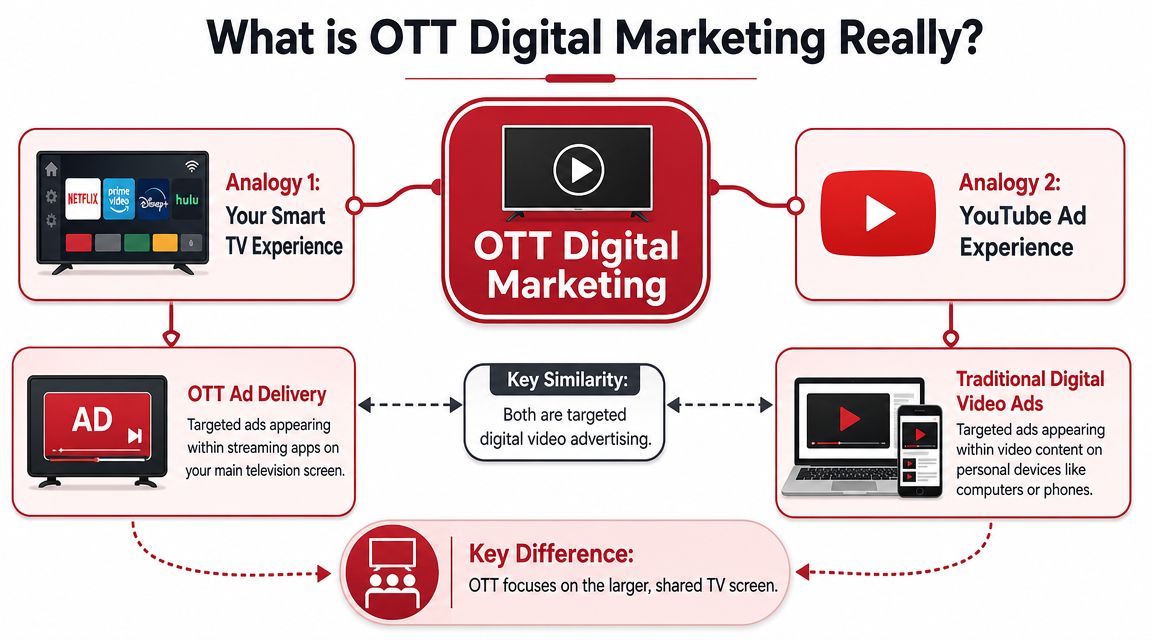
OTT means over-the-top content delivery. In simple terms, it refers to video delivered over the internet instead of through traditional cable or satellite distribution. CTV means connected TV, which is the device itself: a smart TV, Roku, Apple TV, gaming console, or another internet-connected screen that plays streaming content.
The easiest way to understand OTT digital marketing is this: it's digital video advertising inside streaming content, often watched on a TV.
If YouTube ads are digital video ads in a browser or mobile app, OTT ads are the close cousin that show up in streaming environments on larger screens.
OTT versus CTV versus traditional TV
These terms get mixed together constantly, so a quick distinction helps:
| Term | What it refers to | Practical meaning |
|---|---|---|
| OTT | Delivery method | Content and ads delivered over the internet |
| CTV | Device or screen | The connected television where viewers watch |
| Traditional TV | Broadcast or cable distribution | Scheduled programming bought in broad audience blocks |
A marketer doesn't usually need to obsess over the terminology. What matters is knowing that OTT digital marketing keeps the impact of TV while borrowing targeting and measurement logic from digital media.
What that means for creators
For a podcaster, OTT isn't only about running polished commercials in front of TV shows. It can also mean building short video assets from long-form content and placing them in streaming environments where the brand appears more established than it would in a crowded social feed.
That difference matters because the creative job changes.
A social ad can survive with rough edges. An OTT ad usually needs tighter pacing, stronger framing, readable on-screen text, and a cleaner visual package. The idea doesn't have to be different. The presentation does.
OTT works best when a brand respects the screen. A clip that feels fine on a phone can feel unfinished on a television.
A simple working definition
For most brands, a practical definition is enough:
- OTT digital marketing is the use of streaming video ad placements to reach audiences watching internet-delivered content.
- CTV is often the screen where that ad appears.
- The creative standard sits between social video and traditional TV.
- The biggest advantage is that the ad can still behave like digital media, with better audience control than old broadcast buying.
That's why OTT has become useful for brands with existing thought leadership. The channel rewards clarity, consistency, and context more than flashy production for its own sake.
Navigating the OTT Advertising Ecosystem
OTT isn't one inventory bucket. It's a collection of platforms, device environments, ad formats, and buying paths. That's where many brands get sloppy. They treat streaming as one channel, then wonder why the same asset performs differently across placements.
Recent industry guidance stresses that brands need to choose among platforms, devices, and formats, and adjust creative for short hooks and sequential messaging instead of dropping in a standard TV spot, as outlined in Mountain's OTT advertising overview.

The platform layer
A viewer might watch ad-supported content on a free streaming service, a hybrid subscription platform, or a live streaming environment. Those contexts shape attention and expectation.
Some placements feel more like premium television. Others feel closer to digital video inventory at scale. Neither is automatically better. The right fit depends on the campaign's job.
A useful starting point is mapping the streaming space before any creative decisions. This overview of the rise of OTT platforms helps frame how varied that environment has become.
The format layer
Most brands will encounter some version of these ad placements:
- Pre-roll appears before the selected content starts.
- Mid-roll interrupts during a content break.
- Post-roll appears after the main content ends.
- Interactive formats can add a response mechanic, depending on the platform.
Format affects creative. A pre-roll often needs an immediate opening hook because the viewer hasn't settled in yet. A mid-roll can feel more natural if the pacing matches the viewing experience. A post-roll usually isn't the place to introduce a complicated message for the first time.
The buying layer
Brands generally face two broad routes:
| Buying approach | Best for | Main trade-off |
|---|---|---|
| Direct platform buys | More control over placement context | More manual coordination |
| Programmatic buying | Broader access and easier testing | Less direct feel for each placement environment |
For smaller teams, programmatic access can make testing much easier. For brand-sensitive campaigns, direct deals can offer more comfort around context and packaging. Most serious advertisers end up using a mix over time.
Strong OTT planning usually starts with one question: what job should this placement do in the journey? Awareness, reinforcement, or conversion support?
That question matters more than the label on the platform. Streaming works best when each placement has a clear role and the creative is built for that role.
Targeting and Measuring Your Audience on TV
The reason OTT digital marketing attracts performance-minded teams is simple. It combines TV-scale attention with more useful audience control than traditional television ever offered.

OTT advertising is strongest when platforms use first-party and authenticated viewing data for segmentation. That allows targeting by account information, device IDs, viewing behavior, and household-level attributes, which helps reduce wasted impressions and supports cross-device attribution from TV exposure to actions like website visits or purchases, as described in AiDigital's explanation of OTT advertising.
What better targeting actually looks like
Traditional TV buying often forced marketers into broad demographic assumptions. OTT lets teams think more like digital operators.
That doesn't mean unlimited precision. It means the brand can build a smarter audience from known signals instead of guessing from age-and-gender buckets alone.
A practical audience plan often includes:
- Geographic filters so a regional brand doesn't waste spend outside its service area.
- Household relevance when the message is best suited to certain life stages or purchase contexts.
- Viewing behavior cues that help align creative with audience interests.
- First-party audience overlays when a brand has usable customer or prospect data.
For brands trying to connect this with the rest of their funnel, a strong marketing database foundation makes the targeting side much more useful.
Measurement works, but not in the lazy way
Many teams move into OTT expecting the same kind of instant dashboard comfort they get from paid social. That's usually where disappointment starts.
OTT can support downstream measurement, but the smartest teams don't judge it like a last-click search campaign. The medium often earns its keep by building trust, increasing recognition, and lifting response in other channels.
The wrong question is “Did this TV ad close the sale alone?” The better question is “Did this exposure make the next action more likely?”
That's why cross-device attribution matters. A person sees a streaming ad on a television, then later visits the website on a phone or laptop. OTT measurement tries to connect those dots.
A useful way to frame OTT reporting is to separate three layers:
Three layers of OTT evaluation
- Delivery
Did the campaign reach the intended audience in the right environments?
Engagement proxy
Did viewers stay with the ad, and did the creative hold attention long enough to land the message?
Downstream action
Did the campaign contribute to site traffic, sign-ups, inquiries, or purchases on other devices?
That's also why creative and measurement need to be planned together. If the ad asks viewers to remember a show name, search a brand later, or visit a simple URL, the team needs a measurement approach that matches that behavior.
A good visual overview of the mechanics helps make that less abstract.
Repurposing Podcasts for OTT The Content Waterfall
OTT holds practical value for creators. The strongest entry point usually isn't a brand-new commercial. It's a repurposed asset pipeline built from long-form content that already contains trust, personality, and point of view.
That matters because podcasting and OTT exist in a content space with varying usage patterns. Industry reporting notes that 91% of businesses use video, while only 25% use podcasts and other audio content. The same source says businesses using blogs get 67% more monthly leads, and podcast advertising delivers an average 4.9x ROI, which reinforces the value of long-form owned media and underused audio formats in a broader digital system, according to WSI's digital marketing trends and stats roundup.
Start with source material that can survive editing
Not every podcast episode deserves OTT distribution. Some conversations are too rambling. Some intros take too long. Some guest segments make sense only to loyal listeners.
The best source episodes usually have at least one of these qualities:
- A clear problem statement the audience immediately recognizes
- A teachable framework that can be condensed into a short clip
- A sharp point of tension such as a common mistake or surprising insight
- A memorable line that can carry a visual edit
A well-run content repurposing strategy starts by identifying those moments before editing begins. That prevents teams from chopping an episode into random snippets that lack context.
Build OTT clips from ideas, not timestamps
Many creators repurpose badly because they think in terms of “best moments.” OTT creative usually performs better when the team thinks in terms of “best claims.”
A useful clip for streaming often follows a shape like this:
| Clip element | What it does |
|---|---|
| Hook | Stops the viewer quickly |
| Core insight | Delivers one clear idea |
| Proof or context | Makes the claim believable |
| Call to action | Tells the viewer what to do next |
That's different from a social highlight reel. OTT clips need more structure and less reliance on platform behavior. The viewer is farther away from the screen, often multitasking lightly, and not in swipe mode.
A strong OTT clip should still make sense with the volume low, the phone in the viewer's hand, and no prior knowledge of the host.
The waterfall workflow that actually works
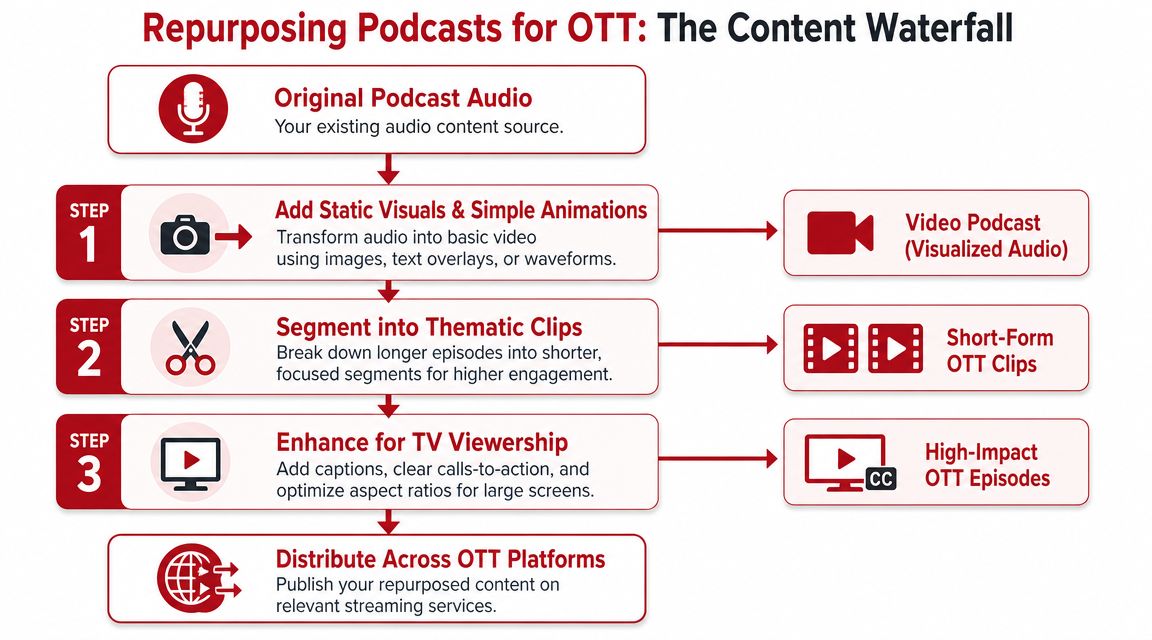
The content waterfall model turns one strong long-form recording into several layers of distribution-ready assets.
Record for visual authority
A creator doesn't need a huge set. The footage does need to look intentional. Stable framing, clean audio, controlled lighting, and a backdrop that feels credible are enough to create TV-safe source material.
Before editing ever starts, many podcast-first teams win or lose. Bad audio can slide on some social platforms. It won't feel credible on a television.
Pull thematic segments
After the full episode is complete, isolate segments by topic rather than by chronology. One episode might produce several different OTT angles:
- a pain-point clip
- a myth-busting clip
- a client education clip
- a brand positioning clip
These aren't duplicates. They serve different audience states.
Add TV-friendly visual treatment
A raw talking-head excerpt rarely feels complete on a large screen. Most clips need:
- Readable captions that don't crowd the frame
- Simple graphic support to reinforce the main point
- Branding cues that are visible but not intrusive
- A clear CTA that can be remembered later
The right pacing is usually cleaner and less frantic than social editing. OTT isn't TikTok on a television. The ad still needs momentum, but it also needs breathing room.
Sequence the assets
One of the biggest mistakes in OTT digital marketing is asking a single clip to do every job. Better campaigns sequence messages.
A first exposure can introduce the host or the problem. A second can deepen the argument. A third can invite the audience to visit a site, search a show name, or watch a longer piece of content elsewhere.
That sequencing mindset also helps when budgeting. Teams trying to estimate media spend often benefit from brushing up on a practical CPM guide for e-commerce brands, even when they aren't running a retail campaign. The point isn't to copy another industry's model. It's to understand how impression-based buying affects planning.
What usually fails
A few patterns break repeatedly:
- Uploading a generic TV-style brand reel that says little and costs too much.
- Using a podcast clip with no editing logic, so the viewer gets dropped into the middle of a thought.
- Writing a weak call to action that's too long to remember from a couch.
- Overpacking the frame with tiny text and unnecessary motion.
OTT rewards restraint. One idea. One message. One next step.
Actionable OTT Strategies for Small Brands
A consultant, a nonprofit, and an author can all use the same OTT logic without producing the same creative.
A B2B consultant might take a podcast segment where they explain one costly mistake buyers make before hiring an agency. The OTT cut opens with the mistake, shows the consultant delivering the correction, and ends with a simple invitation to visit the website for the full framework. That works because the clip teaches first and sells second.
A nonprofit can use a donor or community story already captured for another campaign. Instead of editing it like a fundraising gala recap, the team can turn one emotional section into a shorter streaming spot targeted within the organization's region. The message isn't “support us because we exist.” It's “here's what changed, and here's why local support matters.”
An author or speaker can pull a concise explanation of a core idea from a video podcast appearance. The clip works well when it sounds like a compelling thesis, not a book trailer. The audience should leave remembering the idea and the name attached to it.
What these examples share
- They use existing authority assets
- They focus on one idea at a time
- They fit the screen instead of copying social edits
- They treat streaming as a trust channel first
For teams still designing their production stack, this breakdown of an AI video workflow for marketers is helpful for understanding how ideation, editing support, and repackaging can fit together without turning every asset into a manual project.
The best small-brand OTT ads don't pretend to be national commercials. They look credible, sound sharp, and deliver one idea worth remembering.
Your Next Steps in Streaming Advertising
OTT digital marketing works best when it extends a content system that already has substance. It usually underperforms when a brand treats it like a shortcut and expects one streaming impression to do the entire sales job.
That's why the most useful framing isn't “what is OTT?” but “when does OTT fit into the broader content engine?” Recent industry commentary points to privacy, workflow fragmentation, and scale as ongoing challenges, while also noting that OTT often performs best as a top-of-funnel trust builder rather than a one-touch conversion channel, as discussed in Streaming Media's analysis of OTT ad-tech challenges-147781.aspx).
The practical move is simple. Start with source material worth amplifying. Record long-form conversations with visual discipline. Pull the sharpest moments. Edit them for a television screen. Then distribute those assets with a clear job in the funnel.
Streaming won't fix a weak message. It will amplify a strong one.
Get Up Productions helps brands, creators, and organizations turn one strong podcast episode into a full distribution system. If the goal is to build authority with cinematic source content and repurpose it into assets that can travel across YouTube, social, and streaming environments, Get Up Productions is built for exactly that.