
A lot of brands are sitting on strong video and getting weak distribution. The podcast clips are polished. The message is clear. The team posts to LinkedIn, Instagram, YouTube Shorts, maybe even paid social. Then performance flattens because every feed is crowded and every impression fights against scroll behavior.
That's where ott marketing meaning becomes useful. It isn't just “ads on streaming TV.” It's a way to move video out of noisy social environments and into a full-screen viewing context where people have chosen to watch. For creators, nonprofits, consultants, and B2B firms, that changes the job of video from chasing vanity reach to building authority with the right audience.
The challenge is that OTT still gets framed like a big-brand channel. Most articles stop at definitions, reach, and platform acronyms. Smaller teams need something else. They need to know when OTT is worth testing, how it differs from linear TV and standard digital video, what creative actually translates to streaming, and how to connect exposure to outcomes like podcast growth, webinar sign-ups, donor engagement, or booked calls.
Table of Contents
- Beyond the Feed Why Your Video Content Needs OTT
- What OTT Marketing Really Means for Your Brand
- OTT vs Linear TV vs Digital Video Ads
- Navigating the OTT Platforms and Ad Formats
- How to Target and Measure OTT Campaigns
- OTT Strategies for Creators and Niche Brands
- Your First Steps into OTT Advertising
Beyond the Feed Why Your Video Content Needs OTT
Most smaller brands hit the same wall. Their team keeps making video, but the distribution plan never really changes. More clips go into social feeds, more money goes into boosting posts, and the outcome stays inconsistent because the environment itself works against sustained attention.
OTT gives video a different job. Instead of asking someone to stop scrolling, it reaches them inside streaming content they already chose to watch. That matters for message-heavy brands, especially authors, consultants, spiritual leaders, and nonprofits who need more than a split second to establish credibility.
Historical viewing and ad spend shifts explain why this channel moved from optional to practical. U.S. OTT ad spending reached US$14.44 billion in 2021, up 59.9% from 2020, and was projected to hit US$27.47 billion by 2025. That growth followed a sharp rise in viewing time, from 44 minutes per day in 2018 to 62 minutes in 2020, with 70 minutes per day projected by 2022, according to TVScientific's OTT stats roundup.
Practical rule: If a brand already has video that educates, persuades, or tells a story well, OTT can often extend the life of that asset better than another round of feed-only distribution.
That doesn't mean every clip belongs on streaming TV. Fast-cut meme editing, tiny captions, and hook-heavy social pacing often feel out of place on a television screen. Teams usually get better results when they adapt the creative for a calmer, premium environment. A useful starting point for that production shift is AdCrafty's creative platform guide, especially for teams translating short-form habits into ad-ready video.
There's also a strategic reason to pay attention now. Streaming isn't a side channel anymore. It's a normal part of media consumption, which is why a broader primer on the rise of OTT platforms is worth reviewing before planning spend.
Three signs OTT deserves a test:
- Your brand already has strong video assets. Podcast interviews, founder explainers, donor stories, and webinar clips often adapt well.
- Your goal requires trust, not just traffic. OTT works best when the audience needs to believe the messenger before taking action.
- Your current paid mix is too feed-dependent. If every campaign lives inside social scroll behavior, OTT adds a different attention environment.
What OTT Marketing Really Means for Your Brand
OTT marketing means advertising within streaming content delivered over the internet instead of through cable or satellite distribution. The easiest working definition is this: it delivers the visual weight of TV with more of the targeting and measurement logic marketers expect from digital.
By 2024, 254.2 million people in the United States were projected to watch OTT video services at least once per month, and Statista projects worldwide OTT video revenue will reach US$352.96 billion in 2026, according to EMARKETER's OTT video streaming guide. That scale is the reason ott marketing meaning now matters to brands outside traditional television budgets.
The simple definition that actually matters
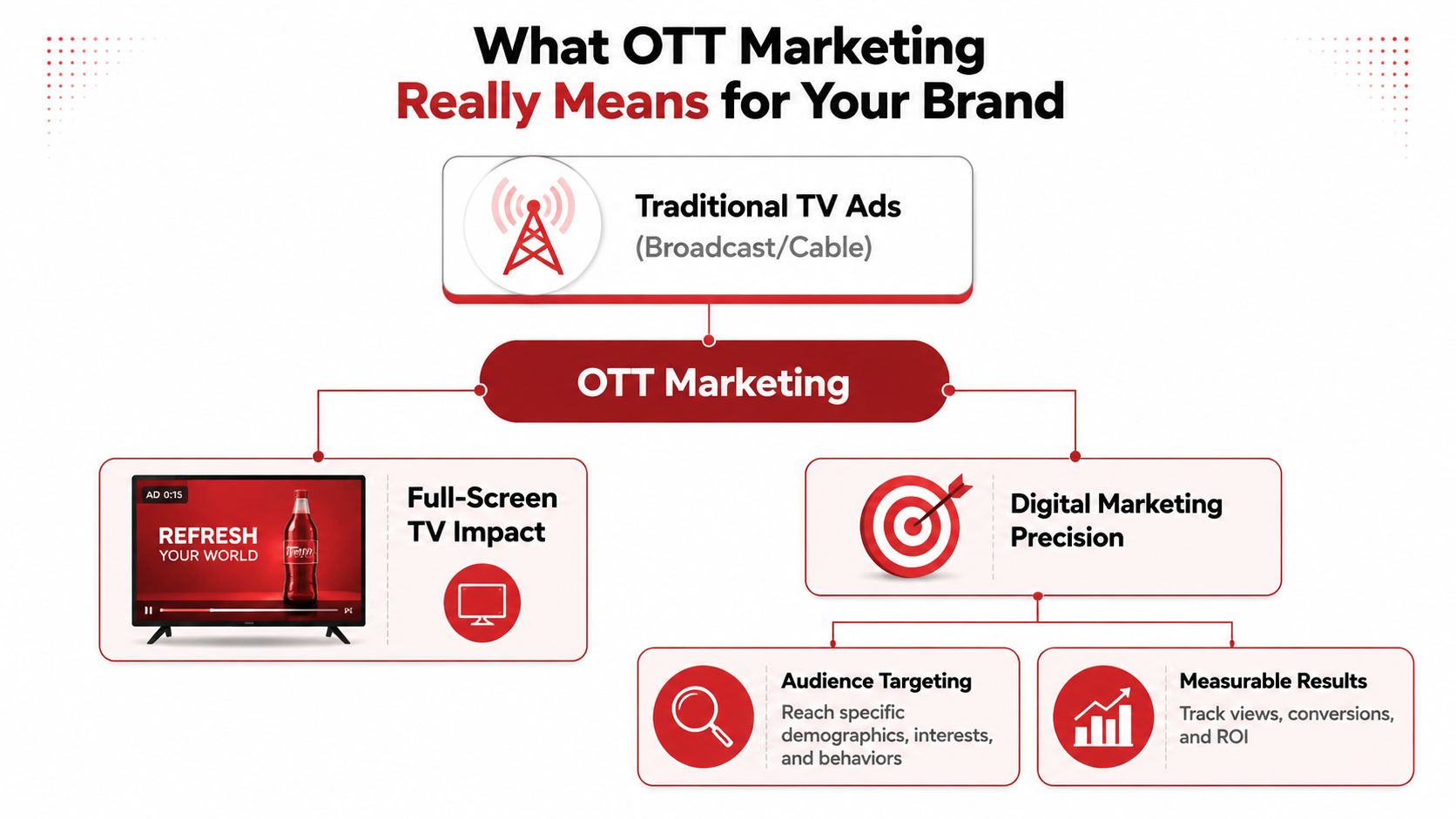
A lot of confusion comes from treating OTT like a single app or a single ad placement. It's really an ecosystem. The stream might happen on Hulu, Peacock, Roku, Pluto TV, or another service. The device might be a smart TV, a streaming stick, a tablet, or a phone. The ad appears before, during, or after content inside that streaming experience.
That's why “TV experience, digital brain” is the most practical way to think about it. The ad feels closer to television because it's full-screen and often non-skippable. The planning side feels closer to digital because buyers can use audience logic, creative rotation, and clearer reporting than traditional TV typically provides.
A deeper overview of how brands build media around those channels lives in this guide to marketing media strategy.
Why this matters beyond awareness
For creators and niche brands, OTT is useful because it can make a small brand look established without forcing that brand to buy broad TV reach. A leadership coach can run a polished authority ad to audiences likely to care about personal development. A B2B firm can put a sharp problem-solution message in front of the kinds of households or professionals it wants to influence. A nonprofit can tell a stronger story in a full-screen setting than it can in a crowded feed.
OTT isn't valuable because it feels modern. It's valuable because it gives strong video a better context.
That said, OTT isn't magic. It won't rescue weak creative, fuzzy offers, or vague audience definitions. It works when the brand already knows who it wants to reach and what next step it wants the viewer to take.
A useful way to judge fit:
| Brand situation | OTT is usually a fit | OTT is usually a stretch |
|---|---|---|
| Video quality | Strong, polished, story-driven | Casual, low-context, feed-native only |
| Offer clarity | Clear next step or audience goal | General awareness with no follow-up path |
| Audience definition | Specific segments or geographies | “Anyone who might be interested” |
| Success criteria | Reach plus downstream action signals | Clicks only |
OTT vs Linear TV vs Digital Video Ads
OTT gets misunderstood because it sits between two familiar models. It isn't linear TV, and it isn't just another version of YouTube pre-roll. The difference starts with delivery. OTT ads are served within streaming video over the public internet, bypassing traditional cable and satellite systems. That delivery path allows more precise targeting and digital-style measurement than broad household TV buying, as outlined in Tinuiti's OTT advertising guide.
Channel comparison
| Attribute | OTT Advertising | Linear TV | Digital Video (e.g., YouTube) |
|---|---|---|---|
| Delivery path | Streaming over the internet | Broadcast, cable, satellite | Web and app video placements |
| Targeting style | More audience-specific and digital-like | Broad household or program-based buying | User-level and platform-driven |
| Measurement | More granular than traditional TV | Ratings and broader estimates | Platform-level digital reporting |
| Viewer experience | Full-screen, premium streaming context | Traditional TV viewing | Often feed, search, or platform-driven |
| Skip behavior | Often non-skippable | Non-skippable | Often skippable or quickly ignored |
| Best use | Reach with stronger precision | Mass awareness | Direct response and high-volume testing |
Linear TV still has value when a brand needs broad regional or national visibility and can support waste in exchange for scale. It's a blunt instrument, but it can work. OTT is better when the brand wants television-style presence without buying everyone at once.
Digital video sits on the other side of the spectrum. It's usually faster to test, easier to click, and often stronger for immediate response. But it also lives in a more distracted environment. Someone watching a pre-roll on a laptop between tasks isn't in the same state as someone watching long-form content on a living room screen.
Where OTT fits best
A smart media mix treats these channels differently rather than trying to force one to do the other's job.
- Choose linear TV when broad market visibility matters more than precision.
- Choose digital video when the campaign needs speed, clicks, and cheap creative testing.
- Choose OTT when the brand wants stronger attention than standard digital video, but more targeting control than linear TV.
A common mistake is using OTT like paid social with a TV screen. Another is using it like old TV with digital reporting layered on top. It's a hybrid, and it needs planning that respects both sides.
Creative choices should reflect that. OTT usually rewards cleaner visuals, stronger pacing, and a more deliberate call to action than feed video. Teams used to short-form social often need to rebuild the ad, not just resize it. Brands working through that transition often benefit from tightening their video marketing for business before they ever buy inventory.
Navigating the OTT Platforms and Ad Formats
OTT inventory isn't one pool of impressions. It's a set of different platform types with different audience expectations, ad loads, and creative constraints. Buyers who lump everything together usually end up with the wrong message in the wrong place.
Platform types that matter to buyers
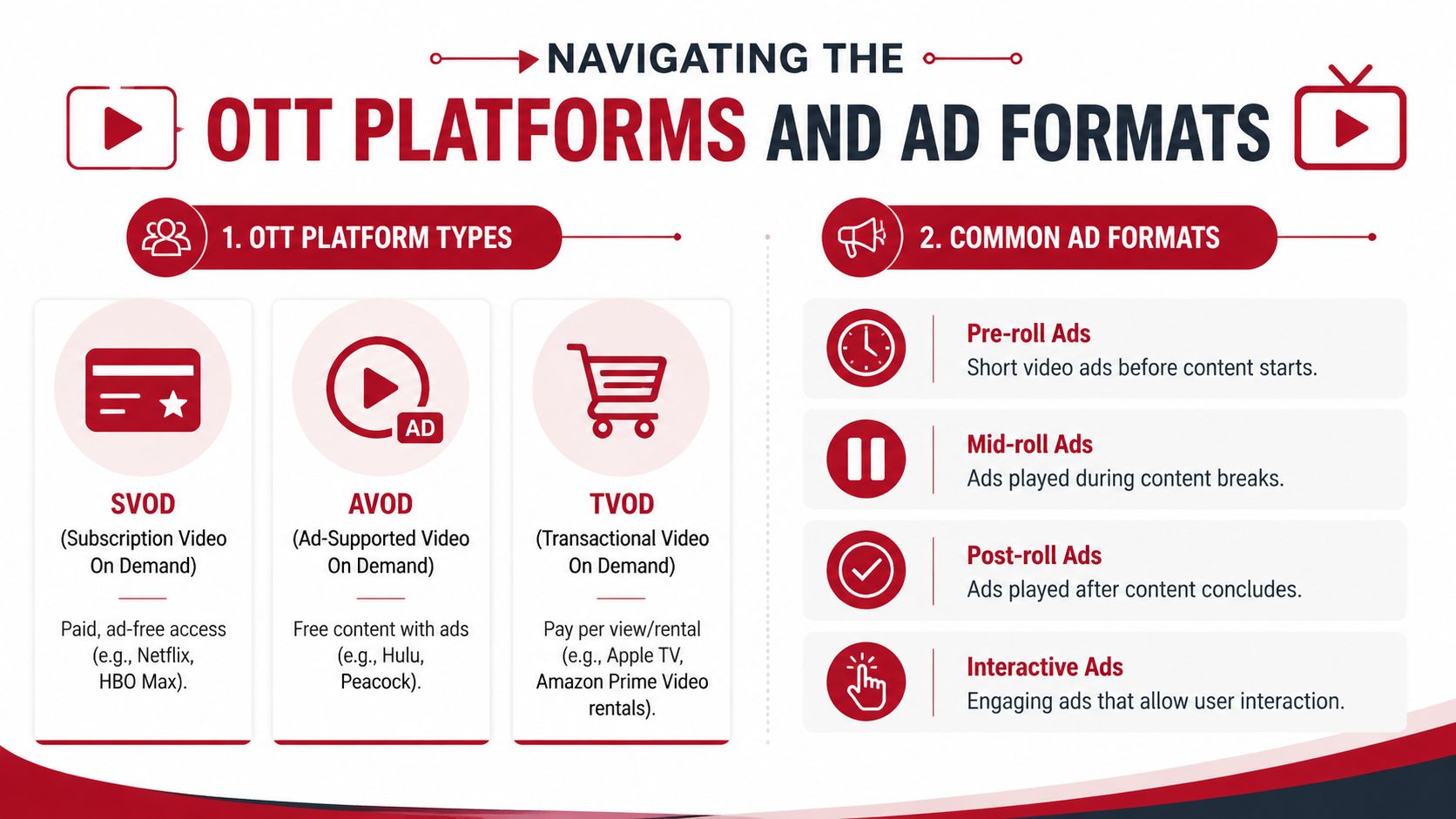
The first distinction is business model.
- SVOD platforms are subscription-led. Depending on the service and plan structure, ad opportunities may be limited or tied to specific tiers.
- AVOD platforms are ad-supported by design. For many advertisers, OTT buying becomes most accessible and flexible through them.
- TVOD centers on rentals or purchases. These environments matter more for distribution economics than for most ad strategies.
- FAST channels deserve special attention even when they aren't listed in every basic glossary. They recreate a channel-like experience inside streaming and often offer attractive reach for awareness campaigns.
What matters in practice is viewer mindset. Someone watching ad-supported episodic content may tolerate a mid-roll break. Someone renting a film expects a different experience. Someone browsing a free streaming channel lineup behaves differently again.
Ad formats and device context
Nielsen's distinction is the nuance many marketers miss. OTT is the delivery method, while CTV is specifically the TV screen. The same OTT ad can run across internet-connected devices, but the context changes a lot between a living room television and a phone, as explained in Nielsen's OTT vs CTV explainer.
That affects both format choice and creative style.
| Format | Where it usually appears | When it works best | Common mistake |
|---|---|---|---|
| Pre-roll | Before content starts | Short, clear brand intros | Overloading the first seconds |
| Mid-roll | During natural content breaks | Storytelling and authority building | Using weak openings |
| Post-roll | After content ends | Follow-up prompts and reminders | Expecting broad completion |
| Interactive ads | Supported devices and placements | Simple next steps | Adding too much friction |
A few practical rules help:
- Pre-roll needs speed. The viewer hasn't settled into the ad yet, so the message must land early.
- Mid-roll can carry more narrative. The viewer is already invested in content, which gives the ad more room.
- Interactive units should stay simple. If the next step feels complicated from a couch, most viewers won't bother.
- CTV creative needs larger visual hierarchy. Tiny text and cramped layouts that survive on mobile usually fail on a television screen.
Creative that performs on mobile doesn't automatically belong on a TV. Screen size changes attention, pacing, and readability.
For podcast brands repurposing studio footage, this matters a lot. A punchy vertical teaser may work on Instagram. A cleaner widescreen cut with tighter copy usually works better on a connected TV.
How to Target and Measure OTT Campaigns
The attractive part of OTT is targeting. The frustrating part is attribution. Both are true, and campaigns work better when buyers accept that upfront instead of pretending streaming behaves like paid search.
Targeting that helps and targeting that wastes money
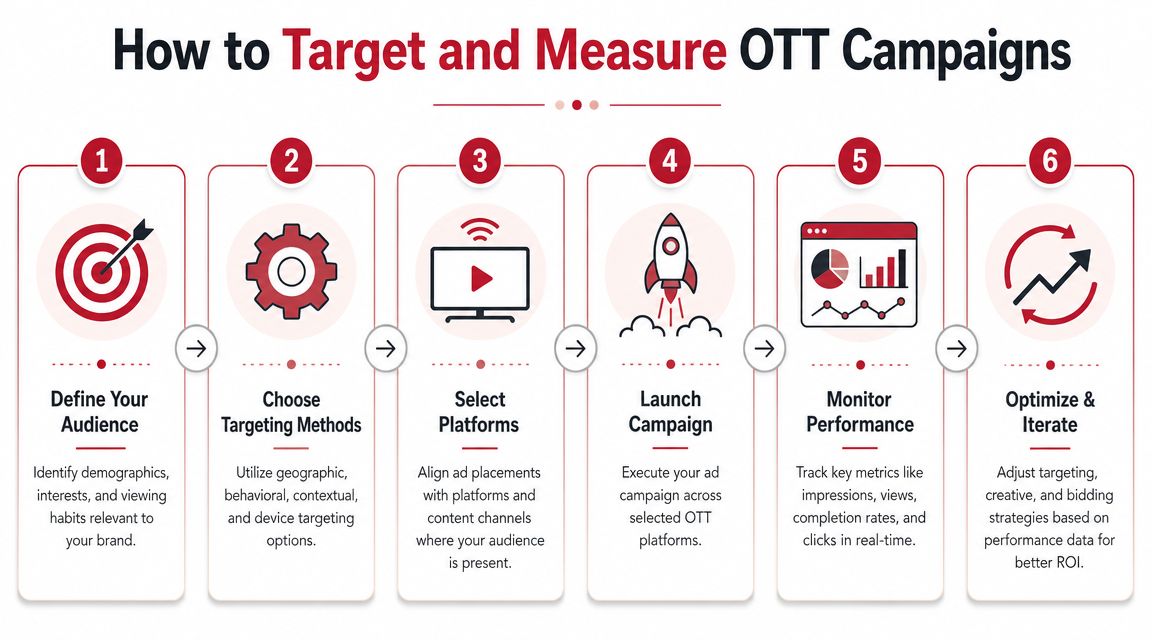
Most platforms and buying partners offer combinations of geographic, demographic, behavioral, contextual, and device-level targeting. That sounds impressive, but more toggles don't always mean better campaigns.
Good targeting starts with audience clarity, not tool enthusiasm.
- Geographic targeting works well for nonprofits, local service firms, regional events, and any brand with market-specific demand.
- Behavioral or interest-driven targeting helps when the buyer knows what adjacent content or audience traits correlate with intent.
- First-party audience use can be powerful when a brand has a real email list, customer file, or donor base to inform broader audience modeling.
- Device targeting matters when the campaign depends on the viewing environment. A living room message often needs different creative than a mobile-follow-up message.
Where teams get into trouble is stacking too many conditions and crushing delivery, or choosing audience filters that sound impressive but don't connect to a real business outcome.
Field note: Narrow targeting helps when the offer is specific. It hurts when the message is broad and the buyer still needs learning.
A practical framework looks like this:
- Start with one business goal. Audience growth, lead generation, donor engagement, webinar sign-ups, or branded search lift.
- Choose one primary audience definition. Geography, interest cluster, customer list expansion, or category context.
- Build one clear next step. Visit a landing page, search for a branded show, register for an event, or remember a key message.
- Test creative variants before audience variants multiply. Weak creative gets blamed on targeting all the time.
What OTT can measure and what it can't prove cleanly
The hardest part of ott marketing meaning isn't the definition. It's explaining what “worked.”
The attribution gap is real. OTT exposure happens high in the funnel. The viewer may see a non-skippable ad on a television, then visit a website later on a phone or laptop. Connecting those steps can be difficult, especially for smaller brands without advanced analytics infrastructure. That challenge is highlighted in Adjust's OTT glossary.
That doesn't mean OTT can't be measured. It means it should be measured accurately.
Useful signals often include:
- Completion behavior. Did viewers stay through the ad?
- Reach and frequency patterns. Did the campaign hit enough of the intended audience often enough to matter?
- Site traffic movement. Did direct, branded, or campaign-specific traffic shift during the run?
- Landing page behavior. Did targeted destinations attract more qualified visitors?
- Downstream conversion trends. Did lead volume, webinar registrations, or donor actions improve while other conditions stayed relatively stable?
Less useful thinking sounds like this: “If nobody clicked, the ad failed.” On many OTT placements, clicking isn't even the right behavior to expect.
A more realistic measurement approach for smaller brands is to create an attribution bridge:
| Campaign goal | Stronger OTT measurement approach |
|---|---|
| Podcast growth | Track branded search, episode landing page traffic, and returning visitors |
| Lead generation | Use a dedicated landing page, clean URL structure, and CRM source tagging |
| Webinar sign-ups | Pair OTT with retargeting on mobile and desktop |
| Donor campaigns | Monitor direct traffic, campaign page visits, and donation trend windows |
The smartest OTT setups usually don't rely on OTT alone. They pair streaming exposure with retargeting, branded search capture, direct traffic analysis, and sales or CRM feedback. That's how upper-funnel media becomes accountable enough to scale.
OTT Strategies for Creators and Niche Brands
OTT gets more practical when it stops being abstract. Smaller brands don't need a giant awareness campaign. They need a use case.

Thought leaders and podcast hosts
A thought leader with a strong show often has one hidden asset. Long-form authority content already exists. The problem is that clips in social feeds rarely communicate the full weight of the host's expertise.
An OTT approach works better when the ad isn't trying to cram a whole argument into thirty seconds. Instead, it should do three things: establish the host's point of view, show visual credibility, and direct viewers to one clear destination. That could be a flagship episode, a book page, or a “start here” landing page.
A workable structure looks like this:
- Open with the strongest premise. Not the bio. Not the show title.
- Use studio-quality visuals. The frame should feel premium enough for a living room screen.
- End with one action. Search the show, visit a short URL, or watch a featured episode.
For creators who also need a better organic system around YouTube distribution, PostPlanify for YouTube creators can help support the publishing side while OTT handles premium reach.
B2B firms selling expertise
B2B teams often dismiss OTT because they assume it's too broad or too consumer-oriented. That's usually a planning problem, not a channel problem.
A consultancy, SaaS services firm, or professional advisor can use OTT to build credibility before the prospect ever lands on a sales page. Instead of pushing a hard conversion in the ad, the brand can promote a focused webinar, a category explainer, or a problem-solution narrative aimed at a narrow audience segment. The streaming environment helps the message feel more established than a typical feed video.
This is the kind of creative pacing that tends to translate well from long-form content into streaming:
What usually works:
- Authority-led messaging. A clear problem statement from a credible voice.
- Specific audience framing. Talk to operations leaders, founders, HR teams, or finance decision-makers, not “businesses.”
- A softer conversion step. Webinar registration, resource download, or demo request often fits better than an immediate sales ask.
What usually doesn't:
- Generic brand anthem creative.
- Talking-head footage with no visual structure.
- Trying to explain a complex service menu in one ad.
Strong B2B OTT ads don't try to close the deal on TV. They make the next touchpoint easier to win.
Nonprofits building donor intent
Nonprofits can use OTT especially well when the campaign has geographic relevance or a clear community story. The lean-back environment gives emotional storytelling more room than social usually does.
A regional nonprofit might run a short mission-driven spot to audiences in selected areas and send them to a campaign page with a direct ask. A national organization might use OTT for awareness while retargeting site visitors elsewhere. In both cases, the ad should focus on one human outcome, not a broad institutional overview.
Three choices make a difference:
- Lead with story, not mission language. People respond to stakes and people.
- Use geography intentionally. If the campaign matters to a specific community, target like it.
- Define the donor path early. Donation page, event sign-up, volunteer interest, or newsletter growth.
The smaller the brand, the more OTT should be tied to one concrete objective. That's what keeps it practical.
Your First Steps into OTT Advertising
The biggest mistake new advertisers make is treating OTT like a major media rollout from day one. A smaller team should treat it like a focused test with a clear business question attached. Can this channel increase qualified awareness with a specific audience? Can it improve the volume or quality of downstream actions when paired with the rest of the funnel?
A practical starting checklist
A disciplined first campaign is usually built around a narrow setup:
- Pick one outcome. Podcast episode visits, webinar registrations, booked calls, donor page traffic, or branded search lift.
- Choose one audience. One geography, one segment, or one customer-like group.
- Use one landing destination. Don't scatter the response path.
- Start with one strong video concept. Repurpose the best-performing long-form content, but edit it for a streaming environment.
- Plan the follow-up channel. Retargeting, email capture, branded search, or direct site response should already be in place.
Teams don't need a huge creative slate to start. They need one polished asset that feels native to a television-style experience. Clean framing, readable text, a strong opening line, and a simple call to action beat overcomplicated ad concepts almost every time.
Questions to ask before spending
A media partner, platform rep, or agency should be able to answer practical questions without hiding behind jargon.
- What targeting options are available? Not just in theory, but for the budget and inventory under discussion.
- How will success be measured beyond impressions? The answer should include real business signals, not vanity reporting.
- What devices will carry the campaign? The creative may need to change if delivery skews beyond connected TV.
- What are the creative specs and ad formats? That affects edit decisions immediately.
- What does optimization look like after launch? Buyers should know what can be adjusted.
- How will attribution be handled? If the answer assumes perfect click-based tracking, expectations are already off.
OTT is accessible, but it isn't casual. It works best for brands that respect creative quality, know their audience, and build a path from exposure to action. For teams already producing podcasts, interviews, founder videos, or story-driven brand content, that puts OTT much closer than it used to be.
Get Up Productions helps brands, creators, and organizations turn podcast and video content into polished assets that can support channels like OTT, YouTube, and social without drowning internal teams in production work. If a brand needs cinematic footage, repurposed clips, and a stronger content engine behind its growth strategy, Get Up Productions is a smart place to start.