
A lot of podcasts start with strong intent and weak operations.
A founder wants to turn client conversations into authority. A marketing leader wants a branded show that supports pipeline. A consultant wants to stop publishing random content and build a repeatable platform. The idea is solid. The breakdown happens after the first few recordings, when every episode starts dragging behind the calendar.
The host is suddenly doing everything. Guest outreach, scheduling, mic checks, remote recording setup, editing notes, thumbnail feedback, show notes, uploads, clips, transcripts, social posts, and the quiet panic of wondering whether any of it is moving the business forward. That's usually when a core question shows up. Not “how do podcasts work?” but what does a podcast producer do, and is that the missing role?
A skilled producer doesn't just make a show sound better. A skilled producer makes the show work. That means protecting the host's time, keeping the process on schedule, and turning each episode into a reliable business asset instead of a recurring production headache.
Table of Contents
- The Podcast Paradox Why Doing It All Yourself Holds You Back
- The Producer as the Architect of Your Podcast
- A Producer's Duties Through the Four Phases of Production
- Producer vs Editor vs Engineer Differentiating the Roles
- Essential Skills and Tools of a Modern Producer
- When and How to Hire a Podcast Producer
- FAQ Working With Your Podcast Producer
The Podcast Paradox Why Doing It All Yourself Holds You Back
The first version of a podcast often looks efficient on paper. Record for an hour, send the file off, post it online. In practice, that simple plan keeps expanding. One guest reschedules. Another uses laptop audio. The intro needs revision. The host forgets to ask the key question. The upload is late. The clips never get approved. The episode goes live, but nothing around it is organized enough to build momentum.
That's the paradox. Doing everything internally can feel lean, but it usually creates drag. The host becomes the bottleneck because every decision waits on the same person.
For experts and teams with real business goals, this gets expensive fast in ways that don't show up as a line item. The problem isn't only time. It's fragmented attention. The host should be preparing ideas, leading conversations, and using the show to deepen authority. Instead, that person ends up buried in follow-ups, file naming, edit feedback, and publish-day cleanup.
A podcast starts as content. It becomes a system problem almost immediately.
A producer's role is to change the equation. The producer takes ownership of the moving parts that make a show consistent. That includes the obvious technical tasks, but also the less visible operational work that determines whether the show feels easy to run or constantly behind.
What self-production usually gets wrong
- It treats recording as the main event. Recording is only one stage. The value comes from what happens before and after it.
- It assumes the host should approve everything. That slows the workflow and creates avoidable delays.
- It confuses activity with strategy. Publishing an episode isn't the same as building an authority asset.
- It ignores repeatability. A show that depends on last-minute heroics won't scale.
The right producer doesn't remove the host from the show. The producer removes the chaos around the show.
The Producer as the Architect of Your Podcast
A podcast producer is the closest thing a show has to a general contractor. The host may own the vision, voice, and subject matter. The producer makes sure that vision turns into a finished product on schedule, at quality, and in a format that supports the larger goal.
That's why the producer role is bigger than editing. Editing is one function. Producing is accountability across the whole build.
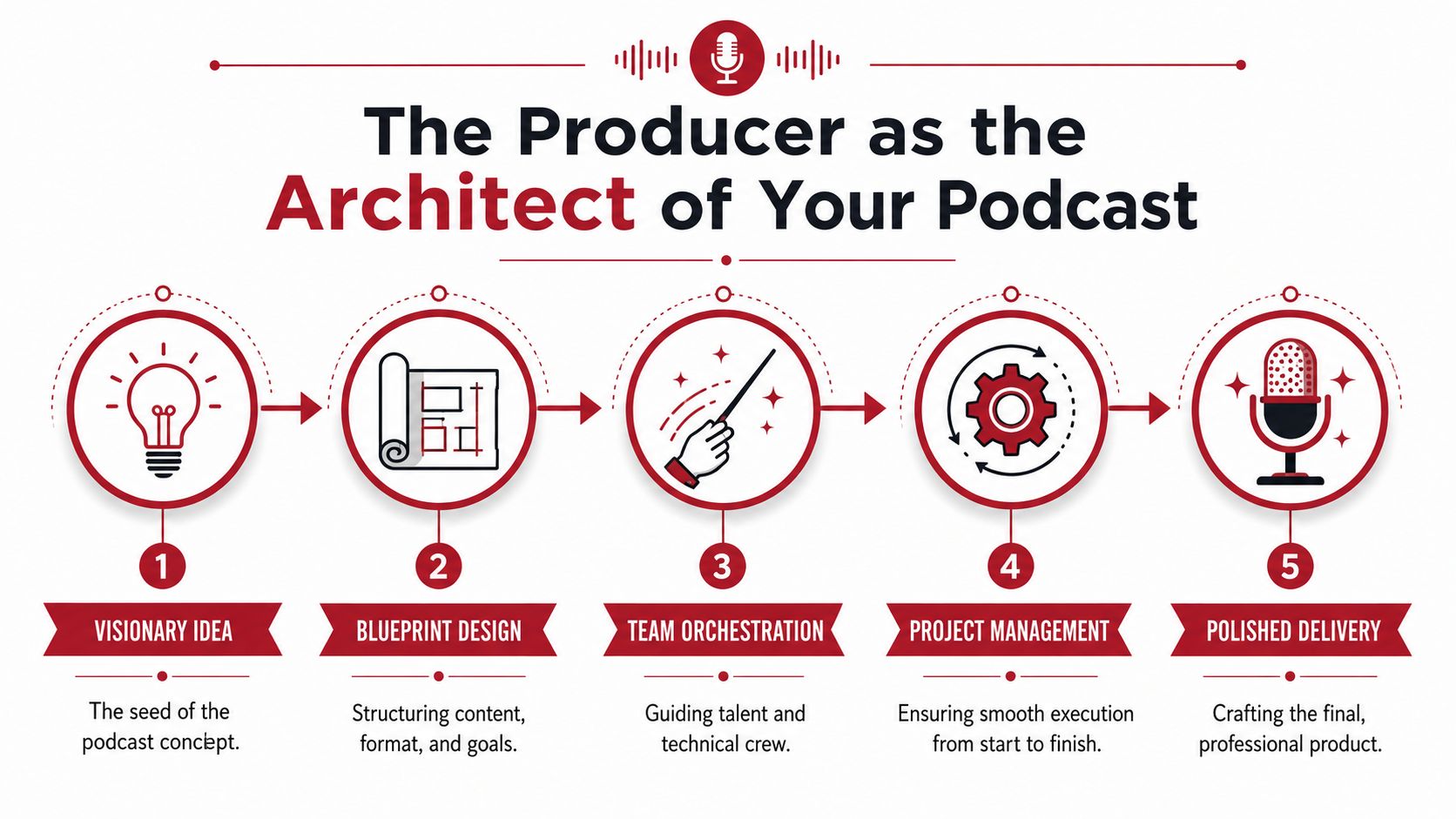
Caspian Studios describes the producer as the workflow owner for the show, coordinating pre-production, recording, post-production, publishing, and promotion so episodes move from concept to distribution without bottlenecks in its breakdown of podcast roles and responsibilities. That framing is useful because it explains what the job entails. The producer aligns people, deadlines, assets, and decisions.
What that ownership looks like
A producer often shapes the show long before the record button gets pressed. The producer helps define episode structure, protects the calendar, keeps guests moving through the pipeline, and makes sure recording days don't collapse into technical troubleshooting. After recording, the producer tracks the edit, publishing assets, approval flow, and promotional handoff.
That oversight matters because podcasts fail in ordinary ways. Not dramatic ways. Ordinary ways.
- Episodes drift without a format
- Guest episodes lack preparation
- Publishing slips because assets are incomplete
- The show sounds fine, but doesn't create business traction
A technician can fix audio problems. A producer can fix workflow problems.
Why clients should care about the distinction
Prospective clients usually ask what does a podcast producer do when they're trying to figure out whether they need more polish or more structure. Most growth-stage shows need structure first.
Practical rule: If the show depends on one person remembering every next step, it doesn't have production. It has good intentions.
The producer is the person who carries the operational memory of the show. That person knows what's recording next, what's blocked, what's waiting on approval, what needs repurposing, and what should change based on performance. That's why the role tends to become more strategic as a show matures. The producer isn't only building episodes. The producer is building reliability.
A Producer's Duties Through the Four Phases of Production
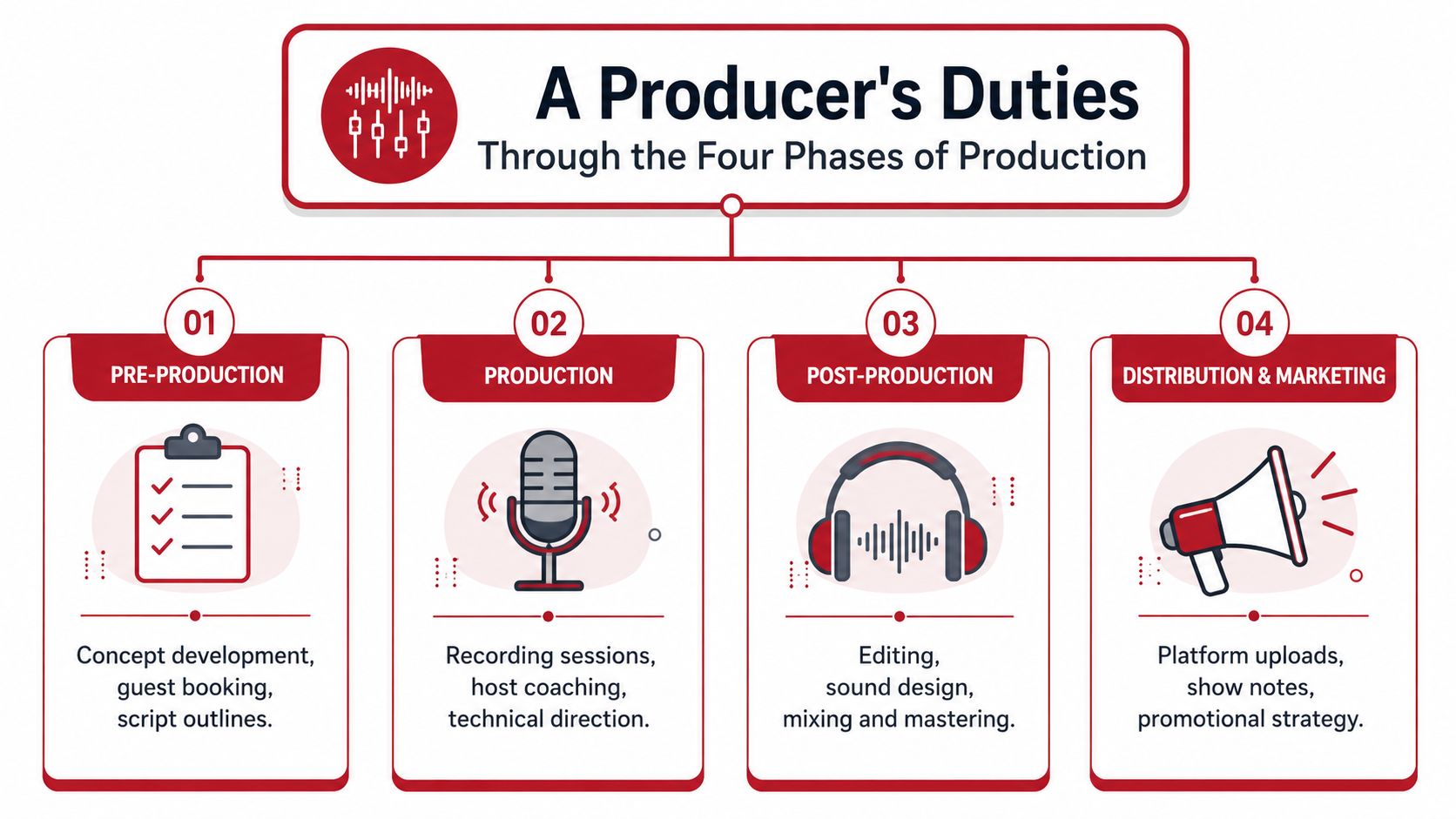
Most confusion about what a podcast producer does comes from looking only at post-production. The role makes more sense when viewed across the full lifecycle. A producer typically oversees the workflow from concept to publication, and Cleanvoice's overview of the podcast producer job description notes an industry estimate of average U.S. compensation around $57,698 annually, reinforcing that this is a professional role built on editorial judgment, technical execution, and project management.
Pre-production
Pre-production is where good shows stop being random.
The producer helps define what the episode needs to accomplish, who it's for, and how it should be structured. On interview shows, that may include guest outreach, briefing documents, angle selection, and question design. On solo shows, it often means helping the host turn expertise into a focused outline instead of a long, meandering monologue.
Typical producer responsibilities here include:
- Format planning. Choosing whether an episode should be interview-led, narrative, teaching-based, or conversational.
- Guest management. Coordinating invitations, prep notes, release forms, and scheduling details.
- Run-of-show design. Creating a sequence that supports energy, clarity, and pacing.
- Recording readiness. Making sure mics, cameras, links, and backups are sorted before anyone joins the session.
For remote setups, a clear recording workflow matters even more. A practical reference is this guide on how to record a podcast remotely, because producer work often starts with preventing avoidable issues before the session begins.
Production
During recording, the producer is part director and part risk manager.
Some sessions need active host coaching. Others need quiet oversight with intervention only when the conversation loses focus, a guest answer runs too long, or a technical issue threatens the usable take. A good producer knows when to interrupt and when to let the moment breathe.
Common duties in this phase include:
- Session direction. Keeping the host on structure without making the conversation sound stiff.
- Technical supervision. Monitoring levels, connection stability, mic placement, and backup capture.
- Time management. Making sure the episode hits the intended depth without running so long that editing becomes bloated.
- Pickup calls. Flagging missing intros, transitions, sponsor mentions, or clarifications while the talent is still available.
Post-production
This is the part people notice first because it's tangible. But the producer's value here isn't just in cutting mistakes. It's in shaping the episode into something people will finish.
That can include removing repetition, tightening weak openings, smoothing transitions, improving narrative flow, and making sure the final file matches the show's sound and brand standard. On some teams, the producer edits directly. On others, the producer manages an editor and reviews for quality.
The strongest edits don't just clean audio. They protect attention.
Distribution and growth
Publishing is where a lot of DIY shows tend to stall. The audio may be done, but the surrounding assets aren't.
A modern producer often coordinates:
- Episode publishing. Titles, descriptions, metadata, scheduling, and platform checks.
- Support assets. Show notes, transcripts, quote cards, clip directions, and thumbnails.
- Repurposing. Turning one recording into short-form content, email assets, or blog material.
- Performance review. Looking at what topics, titles, structures, and guests deserve follow-up.
This phase is where podcasting shifts from content production into business development. If the show exists to build trust, generate leads, support sales, or strengthen brand authority, distribution can't be an afterthought.
Producer vs Editor vs Engineer Differentiating the Roles
One of the most costly hiring mistakes is asking one role to solve a different problem.
Someone may say the show needs a producer when what's really needed is a cleaner edit. Another team may hire an editor when the actual breakdown is guest coordination, missed deadlines, and no one owning the release process. These roles overlap, but they are not interchangeable.
Podcast Production Roles Explained
| Role | Primary Focus | Key Responsibilities |
|---|---|---|
| Podcast Producer | End-to-end workflow and show outcomes | Plans episodes, manages guests and schedules, directs sessions, oversees edits, coordinates publishing, aligns promotion with goals |
| Audio Editor | Episode assembly and narrative cleanup | Cuts mistakes, removes filler, tightens pacing, organizes dialogue flow, prepares a finished episode for review |
| Audio Engineer | Sound capture and technical quality | Manages recording chain, mic technique, signal quality, noise issues, mixing, mastering, and technical consistency |
A useful shorthand is this: the producer owns the process, the editor shapes the content, and the engineer protects the sound.
For teams that only need cleanup after recording, specialized audio editing for podcasts may be enough. But if nobody is handling planning, approvals, guest logistics, publishing, and asset coordination, editing alone won't fix the larger operational problem.
How to tell which role is needed
A few decision prompts make this easier.
- Hire an editor if recordings are solid, the host knows what to say, and the main issue is time spent trimming and polishing.
- Hire an engineer if the show records in a studio environment, uses complex setups, or keeps running into technical quality issues.
- Hire a producer if the show feels disorganized, deadlines slip, guests require hand-holding, or the content isn't connecting to business goals.
When a host says, “The podcast takes over the week,” that's usually a producer problem, not an editor problem.
On small shows, one person may cover two or even all three functions. That's normal. The important part is knowing which function is missing, because hiring the wrong role creates polished chaos.
Essential Skills and Tools of a Modern Producer
A growth-stage show rarely breaks because nobody can cut audio. It breaks because the workflow gets bigger than the host's calendar. Guests need prep, episodes need approvals, clips need to go out on time, and someone has to keep the whole system tied to the reason the show exists in the first place.
That is the modern producer's job.
On a small show, one producer may record, edit, publish, and write show notes. On a more established show, the producer often becomes the operating lead who keeps strategy, content, and distribution aligned. The title stays the same. The scope changes.
The skill stack that matters
The first skill is editorial judgment. A producer needs to hear whether an episode is clear, useful, and on-brand. Good interviews still need shaping. Strong guests still wander. A producer protects the listener experience and the business goal at the same time, whether that goal is authority, demand generation, recruiting, or customer education.
The second skill is operational control.
Weak shows often falter here. Files get mislabeled, approvals stall, the host reviews too late, clips never get requested, and publishing slips by two days. None of that sounds creative, but it directly affects consistency, audience trust, and how much value the company gets from each recording session. If you are still building the foundation, a producer who understands the full podcast launch process for business shows can prevent a lot of expensive rework later.
Communication matters just as much. Producers manage up, down, and across. They give hosts concise prep, keep guests confident, brief editors clearly, and make sure marketing gets the assets it needs without a chain of last-minute messages.
Then there is distribution judgment. Audio is only one output now. A producer should know how titles, descriptions, episode pages, transcripts, YouTube versions, short clips, and email assets work together. The trade-off is real. More assets can increase reach, but only if someone decides which formats are worth producing and which ones are just busywork.
The tool stack behind the work
The software matters less than the producer's ability to build a repeatable process with it. Still, strong producers are usually comfortable across the core categories:
- Recording platforms: Riverside, SquadCast, Zoom, or studio capture systems
- Editing software: Adobe Audition, Pro Tools, Descript, or Logic Pro
- Project management tools: Asana, Trello, ClickUp, Airtable, or Notion
- Collaboration tools: Slack, Google Drive, Frame.io, Dropbox
- Hosting and publishing tools: Libsyn, Buzzsprout, Captivate, Transistor
- Repurposing tools: clip creation, transcript workflows, and social asset production
Tool choice should match the show's complexity. A founder-led weekly interview show does not need the same stack as a branded media operation publishing audio, video, newsletter copy, and social cutdowns from every episode.
For teams building a stronger post-production distribution system, WaveGen.ai's content tool guide is a useful reference because it compares tools specifically for turning long-form episodes into shorter assets for other channels.
Tools help. Systems produce results.
The producer who creates those systems gives the business something more valuable than polished audio. They create consistency, protect executive time, and turn each episode into an asset the company can use.
When and How to Hire a Podcast Producer
Hiring usually becomes necessary before many organizations admit it.
The trigger isn't only that production takes time. It's that the wrong work is consuming the most valuable people. If the host is the subject matter expert, rainmaker, or face of the brand, that person shouldn't also be the keeper of the publishing checklist.
The broader producer profession has durable market value. The U.S. Bureau of Labor Statistics projects 5% growth for producers and directors from 2024 to 2034, with about 12,800 openings each year on average, and reports a median annual wage of $83,480 in May 2024 on its page for producers and directors. For prospective clients, the point isn't film industry pay. The point is that production management is a recognized professional function, not a side task to casually tack onto someone's week.
When it makes sense to hire
The strongest signals are operational, not emotional.
- The release schedule slips often. That usually means no one owns the workflow.
- The host dreads the backend work. Energy gets spent on logistics instead of content.
- Guests require too much manual coordination. Booking and prep begin to eat the calendar.
- Episodes publish without a follow-through plan. The show exists, but it isn't helping distribution or pipeline.
- The team wants growth, but the process is still improvised. A business show can't scale on memory.
For brands that are earlier in the process, this guide on how to launch a podcast helps clarify which responsibilities need an owner from day one.
How to evaluate a producer
A producer should be assessed like an operator, not only like a creative.
Ask questions such as:
- How do they run pre-production?
- What happens between recording day and publish day?
- Who owns guest communication and approvals?
- How do they handle missed deadlines or bad recordings?
- What deliverables are included beyond the audio file?
- How do they adapt the workflow for a solo host versus a team-based show?
A helpful example of the level of process a buyer should look for is below.
Freelancers can be a fit when the scope is narrow and the internal team already has structure. Agencies can be a fit when the company needs multiple functions coordinated under one workflow. The right choice depends less on size and more on ownership. If nobody internally can manage the moving pieces, buying only editing support won't solve the primary bottleneck.
FAQ Working With Your Podcast Producer
How much does a podcast producer cost
Cost depends on what the producer owns.
If the job is limited to cleaning audio and exporting files, pricing stays closer to a post-production service. If the producer is running episode planning, guest coordination, recording oversight, publishing, approvals, and repurposing, the fee reflects operational ownership. Those are two very different engagements, and buyers often confuse them.
The practical question is scope. A small show may only need an editor with light production support. A growth-stage show usually needs someone who can protect deadlines, keep stakeholders aligned, and make sure the podcast contributes to authority, audience trust, and pipeline. Cheap production often means the host or marketing team absorbs the missing work later.
Is a producer also a strategist
On business podcasts, the strong ones are.
A producer who only reacts after the recording is finished can help quality. A producer who shapes the workflow before recording can help outcomes. That includes choosing episode angles that support the brand position, spotting which guest conversations deserve follow-up content, and deciding what should be turned into clips, email content, or sales enablement assets.
The role also changes with the size of the show. On a lean team, one producer may handle planning, recording, editing management, publishing, and content coordination. On a larger or growing show, the producer often becomes the person who keeps specialists moving in the same direction and makes sure the show supports a wider marketing goal.
That is why experienced producers think past the audio file. They are accountable for whether the show ships consistently and whether each episode can do useful work after publication.
What does the host still own
The host still owns the expertise, point of view, and final judgment.
A producer can shape the episode, tighten the process, and reduce the drag on the internal team. The host still has to bring a clear perspective, approve the right guests, and show up ready to have a conversation worth hearing. No production system can replace that.
The cleanest working relationships usually look like this:
- The host owns the message and subject-matter authority
- The producer owns workflow, deadlines, and execution
- Both agree on what the show needs to accomplish
That split matters because it protects everyone from role drift. When the host is forced to chase edits, schedule guests, review assets, and manage publishing, the show becomes harder to sustain. When the producer has real ownership, the host can stay focused on the part of the podcast only they can do.
For brands, founders, and organizations that want a show to support authority, visibility, and lead generation, Get Up Productions provides podcast production support from recording through repurposing so the process does not depend on the host doing everything alone.