
Launching a podcast without a business case is one of the fastest ways to create expensive busywork.
For a founder, consultant, nonprofit leader, or B2B marketing team, a branded show should earn its place in the mix. It should support pipeline, category authority, recruiting, partner relationships, donor engagement, or customer education. If the show does not have a clear job, the format, guest list, and publishing schedule will drift, and the budget will follow.
That is even more important for teams producing video. Buyers make quality judgments fast. A weak camera setup, inconsistent editing, or unfocused interview format does not just hurt the episode. It shapes how prospects read your brand.
The better model is to launch a podcast as a media asset with a distribution system attached. One recording should produce the full episode, YouTube content, short clips, quote graphics, sales enablement assets, and follow-up content your team can use. That is the Content Waterfall in practice, and it is what turns a show from a recurring production task into a repeatable content engine.
This also helps with channel strategy. Teams often ask whether they need a podcast, a webinar program, or both. The answer depends on sales cycle, audience behavior, and how much repurposing value the content can create. This breakdown on marketing teams choosing between webinars and podcasts is a useful starting point.
A practical launch process starts with strategy, then tests whether the production model is realistic for the team running it. That means deciding what success looks like, designing a format you can sustain, and being honest about whether you should build it in-house or hire an agency before you spend money on gear.
Table of Contents
- Strategy First Designing Your Show for Business Goals
- Your Production Setup Gear Software and Studio Design
- Mastering Your Production and Editing Workflow
- Publishing Hosting and YouTube Optimization
- Scaling with Promotion and the Content Waterfall
- Measuring Podcast Success Beyond Downloads
- DIY vs Hiring a Podcast Agency A Decision Framework
- Podcast Launch Frequently Asked Questions
Strategy First Designing Your Show for Business Goals
The passion-project myth causes bad launches. A business podcast can be enjoyable, but enjoyment isn't the operating model. The operating model is purpose, audience, message, and distribution tied to a real business outcome.
Start with the business objective
Pick one primary job for the show. Not five.
A founder podcast usually works best when it does one of these things:
- Build authority: The host uses interviews or solo commentary to shape category perception.
- Generate leads: Episodes speak to buyer pain points and move listeners toward a next step.
- Nurture relationships: The show creates repeated exposure with prospects, clients, partners, or donors.
- Support sales: Episodes answer objections, explain methodology, and deepen trust before calls.
Teams that skip this step usually default to broad conversations with no commercial relevance. That format feels productive because recording is happening, but the show doesn't accumulate strategic value.
Best practice is to define measurable goals before launch. Podcast.co's guidance on podcast analytics and metrics recommends clear targets such as reaching 10,000 monthly downloads or increasing completion rates by 15 percent, because those metrics connect to business outcomes.
That doesn't mean every B2B show should chase raw audience size first. It means the team needs a target that can be evaluated later.
Practical rule: If the host can't answer "What business result should this show create?" in one sentence, the concept isn't ready.
A good strategy exercise is comparing the podcast to other content types. For teams weighing different channels, this breakdown on marketing teams choosing between webinars and podcasts is useful because it clarifies when on-demand audio or video creates more long-term value than live events.

Build a show bible before recording
A show bible keeps the team from reinventing the show every week. It should be short, but specific.
Include these elements:
Audience definition
Name the listener in plain language. "Small business owners" is too broad. "CMOs at mid-sized B2B firms who need authority content without building an in-house studio" is usable.Format choice
Interview shows create network effects. Solo shows create sharper positioning. Co-hosted formats can work, but only if the chemistry and scheduling are stable.Content pillars
Limit the show to a handful of recurring themes. That keeps booking, scripting, and repurposing aligned.Tone and point of view
Decide whether the show is analytical, conversational, contrarian, educational, or executive-level.Call to action
Every episode should know what listener behavior matters next. Subscribe, book a call, join the newsletter, share with a team member, or visit a landing page.
The best launches look narrow at first. That's a strength. Narrow shows are easier to position, easier to market, and easier for the right audience to recommend.
Your Production Setup Gear Software and Studio Design
Most launch guides spend a lot of time on niche selection and almost none on the room, signal chain, or workflow that make a show look credible. That's a mistake. There is a severe lack of practical guidance on technical setup, even though 54% of consumers prefer content with high production standards according to Galati Media's discussion of podcast quality and positioning.
Why production quality changes perception
Founders often ask whether buyers really care about camera choice, mic placement, or lighting consistency. They do, even if they never mention it directly.
Poor audio signals inexperience. Flat lighting makes video feel disposable. Echo tells the audience the host recorded wherever there was space instead of building a reliable environment. In B2B, those cues shape authority faster than a clever intro ever will.
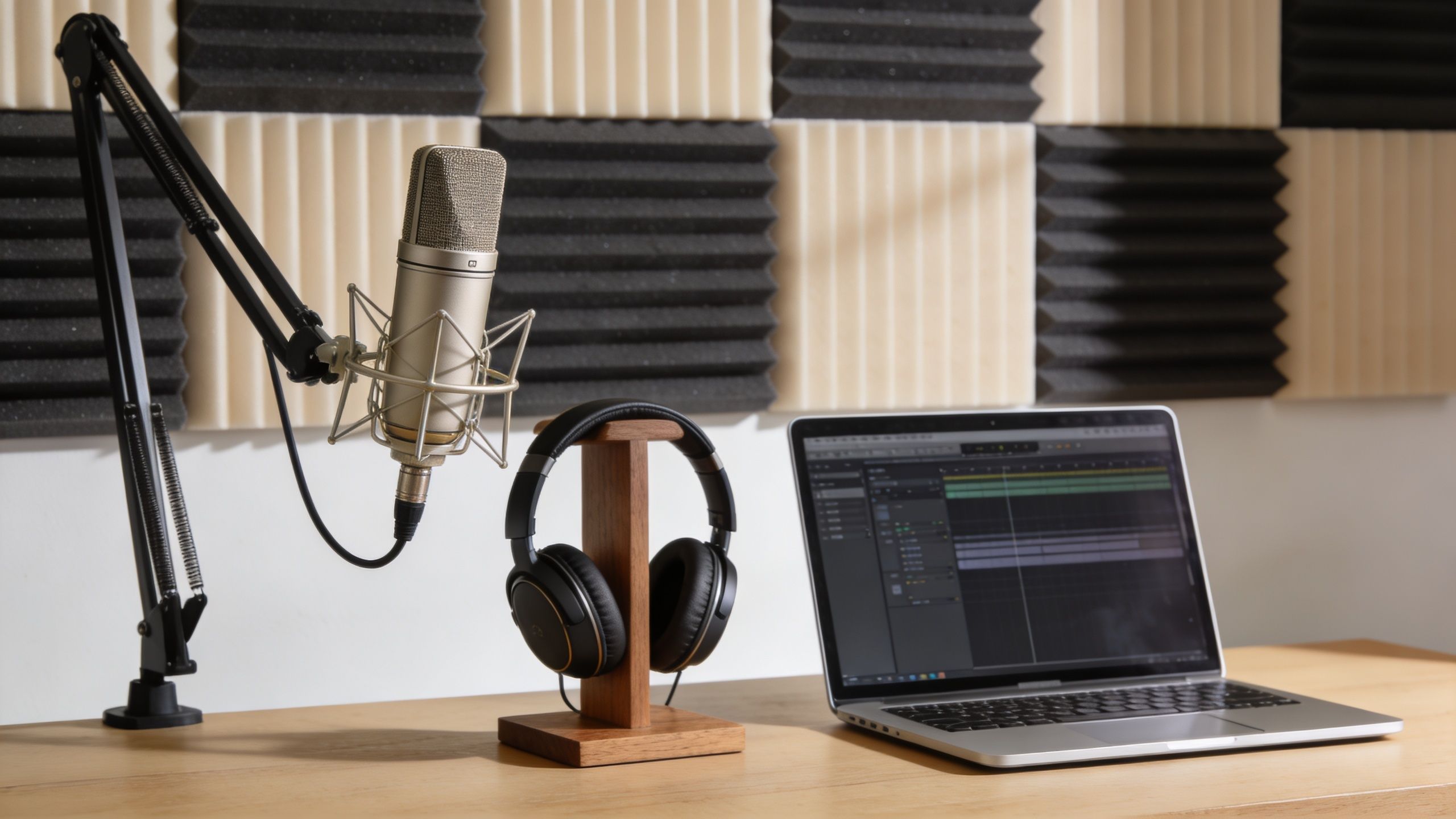
There isn't one correct setup. There is a setup that fits the show's use case. A remote guest interview series needs different tools than an in-studio roundtable or a solo educational show.
Good Better Best setup logic
A useful way to choose gear is by commitment level, not by prestige.
| Tier | Best fit | What it should include |
|---|---|---|
| Good | Founder testing a clear concept | USB microphone, closed-back headphones, quiet room, basic soft light, reliable recording platform |
| Better | B2B team publishing consistently | XLR microphones, audio interface, dedicated camera, controlled lighting, multitrack recording, editing software with transcript support |
| Best | Brand building a flagship video show | Multiple camera angles, engineered lighting, treated room, separate audio chain, dedicated editing workflow, repeatable set design |
The key trade-off is simple. Entry-level gear can produce respectable results if the room is quiet and the host uses it properly. Mid-range and premium setups reduce friction, improve consistency, and save cleanup later.
Useful software categories to evaluate:
- Remote recording platforms: Riverside, SquadCast, Zoom, or StreamYard depending on guest comfort and local track capture requirements.
- Editing tools: Descript for transcript-based editing, Adobe Audition for deeper control, Final Cut Pro or Premiere Pro for video-led workflows.
- Asset management: Shared cloud folders, naming conventions, and template-driven project organization.
- Scheduling and review: Notion, Asana, Trello, or ClickUp for approvals and publishing steps.
A short demo of a practical recording setup helps clarify what a functional studio needs:
Studio decisions that prevent avoidable problems
A polished studio starts with boring choices done well.
- Choose the room before the camera: Soft furniture, rugs, curtains, and distance from noise matter more than decorative gear.
- Set eyeline and framing once: Video podcasts look amateur when every episode changes angle, crop, and background.
- Use lighting intentionally: The face should be separated from the background. The goal isn't dramatic cinema. It's clarity and consistency.
- Keep the set brand-safe: Avoid clutter, random office items, and distracting decor that dates the show.
A good studio reduces editing time because the team starts with cleaner inputs.
The setup should serve repeatability. If it takes too long to assemble every time, the team will stop using it correctly.
Mastering Your Production and Editing Workflow
Recording gets the attention. Operations decide whether the show becomes a real marketing asset or another stalled initiative.
As noted earlier, early podcast drop-off is steep. The pattern usually has less to do with ideas and more to do with production load. Teams record one promising conversation, then run into the actual work required to turn it into a polished episode, a YouTube video, short clips, written assets, approvals, and distribution.
That gap is where branded shows lose money.
For a B2B company, the job is not to publish audio for its own sake. The job is to produce a repeatable content engine that creates a flagship episode and feeds the Content Waterfall. If the workflow breaks after recording, the business case breaks with it.
What happens after stop recording
A raw recording is only source material. The expensive part starts next.
Post-production usually includes:
- File intake and backup: Rename files, confirm local tracks, store masters, and log missing assets before anyone closes the project.
- Content editing: Cut weak openings, repeated points, detours, and answers that do not support the episode goal.
- Audio cleanup: Balance levels, reduce noise, manage interruptions, and deliver a mix that sounds consistent across speakers and headphones.
- Video editing: Sync angles, tighten pacing, add branded intros, lower thirds, captions, graphics, and any supporting visuals.
- Packaging: Write the title, description, show notes, CTA, thumbnail brief, and clip prompts.
- Repurposing prep: Mark timestamps for short-form clips, pull quote graphics, article drafts, email copy, and sales enablement snippets.
- Review and release: Handle QA, approvals, exports, uploads, and scheduling.
Many internal teams often underestimate cost. A 35-minute interview can easily turn into several hours of editing, packaging, clipping, and review, especially when two stakeholders want changes after the first cut.
Build the workflow around throughput
Good podcast operations are built for repeatability, not heroics.
A workable sequence looks like this:
Prepare the episode before the session
Confirm the angle, outline, CTA, guest talking points, and what the team needs from the conversation for downstream repurposing.Record cleanly to reduce edit time
Hosts should pause and restart after mistakes, avoid talking over guests, and call out sections that may need to be removed. Those habits save real editing hours.Triage immediately after recording
Back up files, note the strongest moments, flag legal or compliance concerns, and identify clips worth turning into short-form content.Edit in distinct passes
Start with the content edit. Then handle audio and video cleanup. Finish with graphics, captions, exports, and final QC.Create derivative assets while the episode is in post
Do not wait until publish day to start shorts, quote cards, blog support, or email copy. The Content Waterfall works when repurposing starts during production, not after it.Set one approval owner and one deadline
Review loops expand fast. One person should consolidate feedback and make the final call.
One missed approval can push the entire release. Then clips get delayed, the newsletter goes out without the episode, sales never gets the asset, and the team starts treating the podcast like extra work instead of a revenue support channel.
Role clarity matters more than effort
Even in a small team, the functions are different. Someone owns production. Someone owns editing. Someone owns creative assets. Someone owns publishing. Someone owns promotion.
One person can cover multiple roles. That is common in early-stage teams. The problem starts when responsibilities are implied instead of assigned. Then thumbnails are late, show notes are thin, clips never get cut, and the episode underperforms for reasons that look like "bad content" but are workflow failures.
This matters even more for video-led shows. Video adds approval steps, visual QC, and asset demands, but it also gives the business more to work with after publication. Teams planning a branded show should study a video podcast launch process built for marketing repurposing before they lock in format and staffing.
The real decision is capacity
The production question is not whether the team can record. Nearly every team can record.
The question is whether the team can produce 12 to 24 episodes a year with consistent quality, consistent release timing, and enough supporting assets to justify the investment. If the answer is no, simplify the format or get outside help.
The most expensive mistake is launching a show that demands more coordination, editing time, and approvals than the team can sustain. A simpler format published consistently beats an ambitious format that collapses after a few episodes.
Publishing Hosting and YouTube Optimization
A clean episode file still doesn't mean the show is discoverable. Distribution decisions shape whether the content is easy to find, consume, and share.
Choose hosting based on workflow not branding
Podcast hosting platforms such as Libsyn, Buzzsprout, Transistor, and Captivate all solve the same core problem. They store the media, generate the RSS feed, and push the show to listening apps. The right choice depends less on marketing copy and more on how the team works.
Evaluate a host based on these criteria:
- Episode management: Is it easy to schedule releases and organize metadata?
- Analytics quality: Can the team review trends without exporting everything elsewhere?
- Team access: Does the platform support collaboration cleanly?
- Private or embedded distribution needs: Some B2B teams need internal sharing, gated pages, or website integrations.
- Video support: If video is part of the strategy, the workflow should account for it from day one.
The process itself is straightforward. Create the show in the hosting platform, upload artwork and descriptions, publish the first episode, then submit the feed to major directories. The submission step is technical but not difficult. The larger issue is consistency in metadata and branding.
For teams focused on video-led distribution, this guide on how to start a video podcast is useful because it treats the show as both a podcast and a search asset.
YouTube needs its own publishing standard
Uploading the full video and walking away isn't a YouTube strategy.
A business podcast should optimize each YouTube upload with:
- A title built for search and curiosity: Clear topic first. Cleverness second.
- A custom thumbnail: Human face, readable contrast, and one idea per image.
- A useful description: Summary, guest relevance, key takeaways, and business links.
- Chapters: They improve usability and help viewers jump to the right segment.
- Strong opening minute: The first stretch should make the episode's payoff obvious.
- Consistent visual identity: Thumbnails, lower thirds, and set design should feel like one brand.
YouTube also rewards intent. If the team knows who the show is for, titles and packaging become easier. Generic episode names like "A Great Conversation with Sarah" bury discoverability. Clear names tied to outcomes or problems perform better because they match the way buyers search.
Publishing should feel procedural, not creative. Creative decisions belong in planning and recording. Distribution works best when the checklist is standardized.
Scaling with Promotion and the Content Waterfall
Publishing is the midpoint. Significant power comes from turning one recording into a stack of assets that work across channels.
That is where the Content Waterfall earns its keep. One strong episode can anchor weeks of content if the team plans for repurposing from the start instead of treating it as cleanup work afterward.
One recording should create a month of assets
Podcast benchmarks are more forgiving than many founders expect. Achieving just 30 listeners within seven days of a new episode places a show in the top 50% of all podcasts globally, according to PodMatch's state of podcasting benchmarks. That matters because early growth doesn't need to look massive to be meaningful. What matters is squeezing more value out of each recording session.
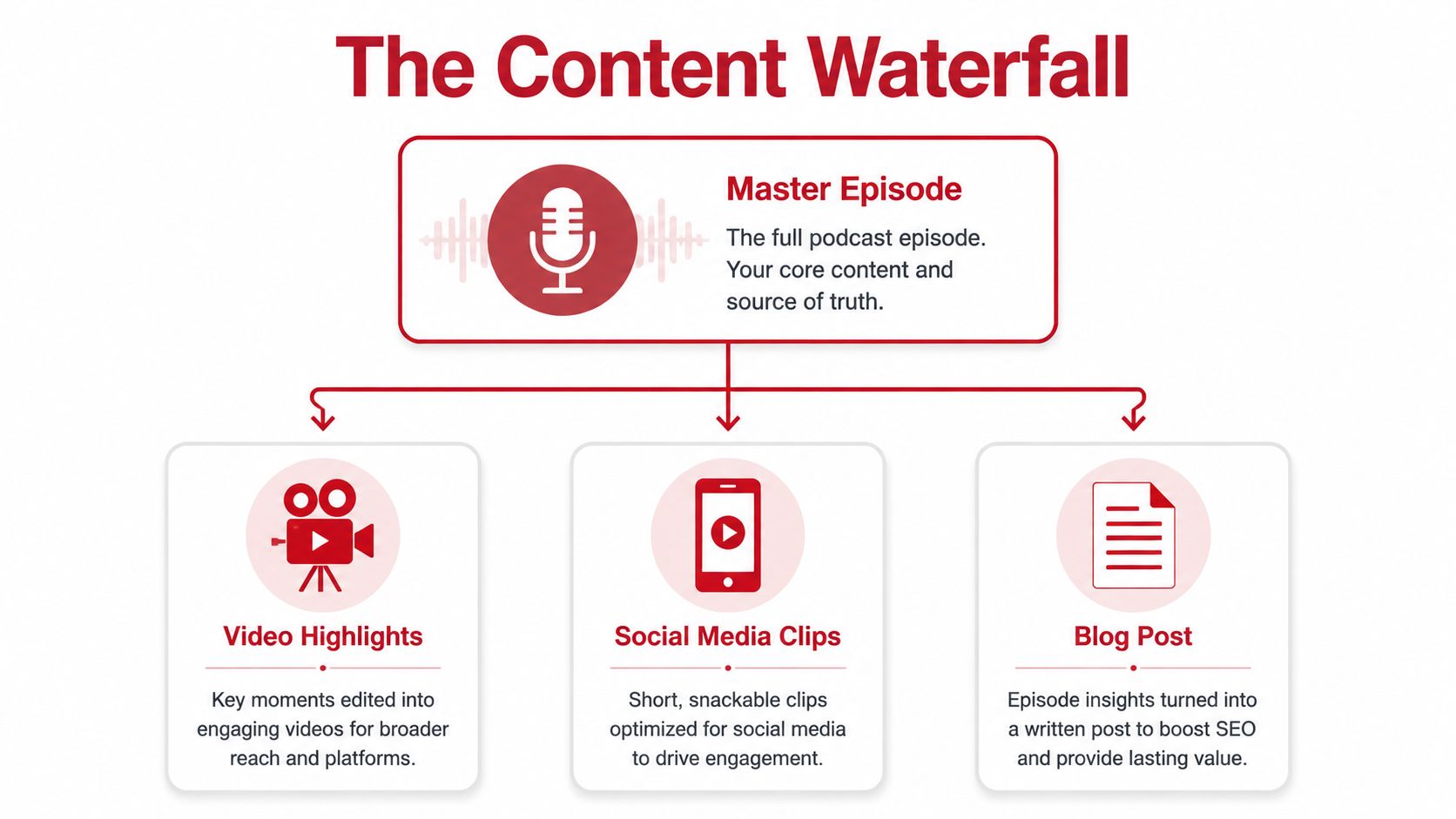
A smart waterfall often includes:
- Full episode video: The flagship asset for YouTube and site embedding.
- Audio episode: Distributed through podcast apps for habitual listeners.
- Short-form clips: Vertical cuts for LinkedIn, Instagram Reels, TikTok, and Shorts.
- Quote graphics: Useful when the guest makes a sharp, memorable point.
- Email newsletter copy: A summary with one strong takeaway and a call to watch or listen.
- Blog post or article: Built from the transcript and edited for search intent.
Transcript quality matters because it powers several of those assets. Teams that need a cleaner transcript workflow can use this guide on how to transcribe a podcast as a practical reference.
For a deeper look at systematizing repurposing, this resource on content repurposing strategy maps how one episode can feed multiple channels without making the message repetitive.
One recording session should solve more than one marketing problem.
A practical promotion rhythm
A content waterfall only works if promotion is scheduled, not improvised.
A solid release rhythm might include:
Launch day
Publish the full episode, send the email, post the primary social announcement.Early follow-up
Release the strongest short clip first. It should stand alone without context.Mid-cycle distribution Publish a quote post, carousel, or insight thread designed for one platform.
Late-cycle reuse
Repackage one segment as a blog excerpt, sales enablement asset, or founder post.
Many teams overcomplicate things at this stage. They create too many weak assets from one average conversation. A better approach is fewer, sharper derivatives built around the parts that create reaction or demonstrate expertise.
Promotion doesn't need to be loud. It needs to be intentional and repeatable.
Measuring Podcast Success Beyond Downloads
Downloads are easy to screenshot, which is why so many teams cling to them. But for a branded B2B show, downloads alone rarely answer the only question stakeholders care about. Is the podcast creating business value?
That is why completion rate is a more critical success indicator, and a 70%+ completion target reveals high content quality, according to Entrepreneur's coverage of podcast performance benchmarks. The same analysis notes that conversion metrics like email list growth and client acquisition provide ROI clarity that generic download statistics cannot.
The metrics that matter
A practical dashboard should separate reach, engagement, and business impact.
- Reach metrics: Downloads, unique listeners, and subscriber growth trends.
- Engagement metrics: Completion rate, average listening time, comments, replies, shares, and watch behavior on video platforms.
- Business metrics: Website visits from episode links, booked calls, lead magnet sign-ups, inbound mentions, and deals influenced by the show.
The critical shift is this. A podcast with a smaller audience can outperform a larger show if the audience is better aligned and acts on the content.
Decision test: If a metric looks impressive but doesn't change an editorial or business decision, it probably isn't a priority KPI.
A simple reporting view for stakeholders
Monthly reporting doesn't need to be complicated. It needs to connect content output to evidence of traction.
A useful stakeholder summary can include:
| Reporting area | What to review |
|---|---|
| Episode performance | Which topics held attention and which ones lost it |
| Channel contribution | Which platforms drove meaningful traffic or engagement |
| Audience behavior | Whether listeners are becoming subscribers, repeat viewers, or site visitors |
| Pipeline signals | New leads, replies, partnerships, or sales conversations connected to the show |
This kind of reporting improves the show itself. Teams can see which guests attract the right audience, which episode structures keep attention, and which calls to action deserve more emphasis.
A business podcast becomes easier to justify when the reporting language sounds like marketing and revenue, not vanity publishing.
DIY vs Hiring a Podcast Agency A Decision Framework
This decision shouldn't be ideological. It should be operational.
DIY can work. Agency support can also be the better financial decision when internal time, quality expectations, and consistency all matter. The mistake is pretending these two options deliver the same result at the same workload.
Where DIY works
DIY is usually viable when the team has a narrow format, low publishing complexity, and someone who can reliably own production. That path fits simple solo shows, internal subject-matter experts with technical comfort, or marketing teams that already edit video content.
The upside is control. The downside is that control creates hidden work. Someone still has to manage recording logistics, post-production, publishing, repurposing, and quality control every single cycle.
This ClearAudio podcast production breakdown is a helpful outside reference because it shows how many moving parts sit behind a polished episode.
Where agency support changes the outcome
Agency support becomes more attractive when the show has strategic stakes. That includes executive visibility, lead generation, donor engagement, or video-first authority building.
An outside team usually improves outcomes in four ways:
- Consistency: Episodes keep shipping even when internal calendars get crowded.
- Specialization: Editing, packaging, graphics, and optimization are handled by people who do that work repeatedly.
- Creative focus: The host spends time on message and guest quality instead of file management.
- Scalability: The content system can expand into clips, blogs, and campaign assets.
Teams comparing options often need help with the marketing side too. This overview of podcast marketing services is useful for understanding what support can look like once production is only one part of the growth problem.
| Factor | DIY (Do-It-Yourself) | Agency Partnership (e.g., Get Up Productions) |
|---|---|---|
| Strategy development | Internal team defines show concept and positioning | Collaborative planning with outside production perspective |
| Recording setup | Team sources gear, room, and software | Agency guides or manages setup for consistency |
| Editing and polish | Handled internally, often by a generalist | Managed by specialists with established workflow |
| Publishing | Internal checklist and approvals | Structured release process handled externally |
| Repurposing | Often inconsistent or skipped | Built into the production system |
| Time demand on host | High beyond recording | Lower, mostly focused on content and approvals |
| Quality ceiling | Depends on internal skill and bandwidth | Usually higher and more consistent |
| Flexibility | High, but can become chaotic | High if scope is clear and communication is strong |
The right answer depends on whether the company wants a podcast, or a podcast engine.
Podcast Launch Frequently Asked Questions
How many episodes should be ready before launch
A launch is smoother when the team records ahead. A small backlog protects the cadence when a guest reschedules, internal approvals slow down, or the host gets pulled into other priorities. The exact number depends on the workflow, but launching with only one finished episode is risky.
Should every B2B podcast be video first
No. But many should at least think video-first.
Video creates more usable assets, gives YouTube a role in discovery, and gives the brand visuals that can be repurposed across social and sales channels. Audio-only can still work when the audience prefers it or the show depends on lower-friction production. The deciding factor is whether video supports the business goal and the team's capacity to maintain quality.
How long should episodes be
Long enough to deliver the value, short enough to keep attention. There isn't a single ideal duration for every format.
A tactical solo episode might be concise. A strong interview can run longer if the conversation earns it. The safer rule is to cut repetition aggressively and respect the audience's time.
What makes a podcast feel professional fast
Three things do most of the work. Clean audio, a clear format, and consistent packaging.
Listeners will forgive a modest set. They won't forgive rambling, distracting sound, or episode titles that say nothing.
When should a team reconsider the concept
Reconsider it early if the show is hard to explain, hard to schedule, or hard to repurpose. Those are usually signs that the format was chosen for novelty instead of usefulness.
A durable podcast concept makes booking easier, editing easier, promotion easier, and measurement easier.
A strong podcast launch doesn't start with gear shopping or a vague commitment to "be consistent." It starts with a business case, a sustainable workflow, and a production standard the team can maintain. If that sounds like too much to build alone, Get Up Productions helps brands launch and scale video podcasts with strategy, production, YouTube optimization, and repurposing built into one system.