
A founder watches a competitor's polished commercial during the evening news, then opens a laptop and starts asking the same questions almost everyone asks first. How much does that cost. Who writes it. Who shoots it. How long does it take. And is television ad production only for brands with giant budgets and in-house teams.
That hesitation is normal. Television still carries the aura of a big-league channel because the work has to stand up on large screens, in paid media, next to experienced advertisers. But the process becomes manageable once the business decisions are clear. Most expensive mistakes in television ad production don't happen because the camera was wrong. They happen because the brief was vague, the approvals were loose, the versions weren't planned, or the team treated broadcast and digital as separate conversations.
Table of Contents
- Is a TV Commercial Right for Your Business
- Pre-Production and Creative Development
- Budgeting Your Television Ad Production
- Navigating the Production Shoot
- Post-Production and Mastering for Broadcast
- Delivery Media Buying and Performance Measurement
- Repurposing Your TV Spot for Digital Channels
Is a TV Commercial Right for Your Business
A television commercial makes sense when the business needs broad credibility, strong visual storytelling, and a message simple enough to land fast. It's less about ego and more about fit. If the offer is complicated, the customer needs a lot of education, or the team still hasn't agreed on the core message, TV can amplify confusion just as efficiently as it amplifies a good campaign.
The channel is still far from obsolete. The TV commercial production market was estimated at USD 6.01 billion in 2024 and is projected to reach USD 10.52 billion by 2033 according to Business Research Insights on the TV commercial production market. That matters because it shows television ad production remains active, competitive, and relevant for more than a narrow slice of legacy advertisers.

Good reasons to consider TV
Some businesses are better candidates than others. Television tends to work best when a brand can answer yes to several of these questions:
- Clear value proposition: Can the business explain what it does in one sentence without jargon?
- Visual product or service: Will the audience understand more by seeing the offer than by reading about it?
- Operational readiness: Can the business handle increased attention, calls, traffic, or inquiries once the campaign starts?
- Channel alignment: Will the same campaign also live on streaming, social, and owned channels?
Practical rule: If the business still changes its message every week, it's too early to spend on television ad production.
There's also a modern middle ground. Some brands aren't ready for a full live-action commercial but still need polished video creative. For teams exploring lower-cost concepting or hybrid workflows, this guide on how to create AI video ads with Aicut is useful because it helps frame whether AI-led production can support the campaign before a traditional shoot is commissioned.
Pre-Production and Creative Development
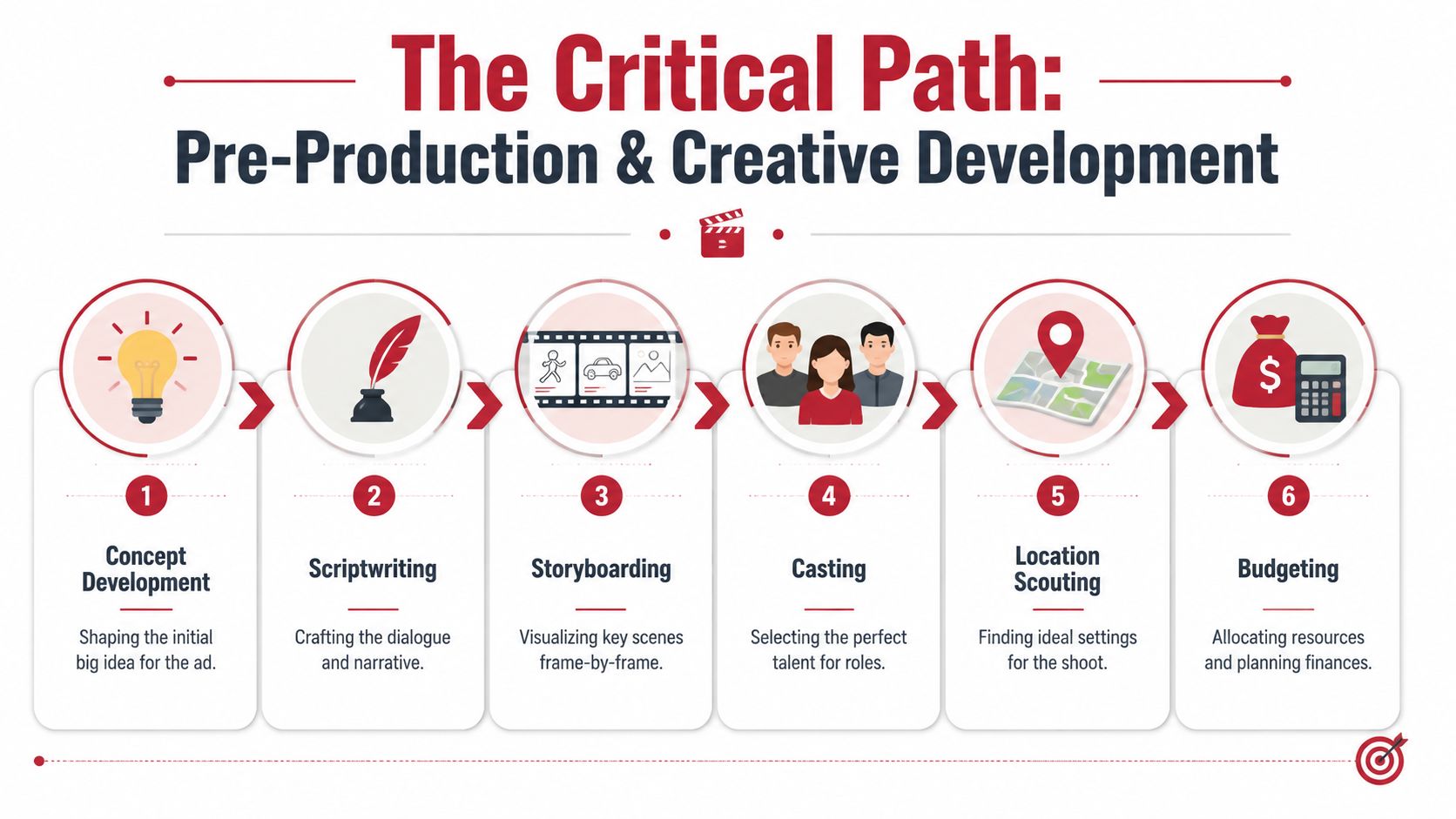
The cheapest day in the whole job is the day before anyone books a crew. Pre-production is where budget protection happens. Once the team moves into casting, locations, and call sheets, every unresolved decision starts costing real money.
Start with the business problem
A strong creative brief doesn't describe a dream commercial. It states the business problem. Is the ad introducing a brand, launching a product, changing perception, or driving response in a specific market? Without that clarity, the concepting stage fills up with ideas that may be clever but don't solve the right problem.
The brief should settle a short list of decisions before anyone talks about camera packages:
- Audience: Who needs to care right now
- Offer: What the ad is asking them to do or remember
- Single-minded message: The one takeaway that must survive every cutdown
- Mandatories: Logo use, legal lines, product shots, brand tone
- Channel plan: Broadcast, cable, CTV, social, or all of them
This is also the stage where brands should decide whether realism, speed, polish, or flexibility matters most. Trade-offs begin here, not later.
Choose the production approach early
Brands now face a serious strategic choice. Reporting covered by The Current on AI video ad production tools such as Sora and Runway notes that AI-generated video can become “exponentially cheaper and faster,” which changes the economics of production. That doesn't mean live action is obsolete. It means the team should decide early what problem the production method is solving.
A few practical comparisons help:
| Approach | Best use | Watchouts |
|---|---|---|
| Live action | Trust, product realism, talent performance, physical spaces | More logistics, more approvals, less flexibility once the shoot wraps |
| AI-generated | Fast concepting, stylized visuals, lower-cost experimentation | Brand consistency, realism issues, rights and approval concerns |
| Hybrid | Live-action anchor with AI extensions or versioning | Requires clear creative control or the spot can feel stitched together |
The production method should support the message. It shouldn't become the message unless that's the strategy.
Lock the script before the schedule
First-time clients often underestimate how much damage a drifting script can do. A single line change can affect shot count, talent direction, graphics, legal review, and edit length. On a 30-second commercial, every second is expensive because every second has to carry story, branding, and a call to action.
The script and storyboard need to answer practical questions, not just creative ones:
- What must be shown on camera
- What can be handled in voiceover or supers
- Which scenes are essential and which are optional
- What versions will be needed later
Storyboards don't have to be beautiful. They have to remove ambiguity. If the client imagines a sleek product demo and the director imagines a lifestyle montage, the mismatch needs to surface before the shoot.
The same goes for the pre-production meeting, often called the PPM. During this meeting, department leads align on schedule, wardrobe, props, locations, shot order, and approvals. Clients who come prepared with final feedback make this stage efficient. Clients who reopen the concept at the PPM usually create schedule risk immediately.
Budgeting Your Television Ad Production
Often, the initial question is about price when it should be about what's driving the price. Television ad production isn't one product with one rate. It's a stack of decisions. Crew size, camera package, number of setups, talent, location permits, art direction, post complexity, and revision load all change the budget.
A useful benchmark exists. A professionally produced 30-second TV commercial typically costs between $10,000 and $50,000, and broader ranges can run from local low-budget spots to premium national buys, with airtime charged separately, according to Simulmedia's breakdown of TV ad costs. That range is wide because scope is wide.
What usually drives cost
The biggest budget levers are rarely mysterious:
- Crew depth: A lean crew can work for simple concepts. Complex lighting, multiple locations, or a tighter schedule usually require more specialists.
- Talent: Non-union local talent and experienced commercial performers are not the same budget line, and the right choice depends on the message.
- Locations and production design: Shooting in a real business location can save money, but only if the space supports lighting, sound, and logistics.
- Equipment package: The camera body matters less than the overall package. Lenses, grip, lighting, and audio shape the result.
- Post-production: A clean edit is one thing. Motion graphics, heavy retouching, alternate versions, and extra revision rounds are another.
A sample budget view
Below is a simple model for how a mid-range commercial might allocate a $35,000 production budget. It isn't a universal template, but it helps clients see where trade-offs usually sit.
| Line Item Category | Description | Sample Cost |
|---|---|---|
| Creative development | Brief refinement, concept, script, storyboard, planning | $4,000 |
| Producer and director | Production management, creative leadership, set execution | $5,500 |
| Crew | DP, camera support, gaffer, sound, production assistants | $7,000 |
| Equipment | Camera, lenses, lighting, grip, audio kit | $4,500 |
| Talent | On-camera performers, casting coordination | $3,500 |
| Location and art | Location fees, permits, props, wardrobe, set dressing | $3,500 |
| Post-production | Editing, color, sound mix, graphics, review rounds | $6,000 |
| Delivery and contingency | Master prep, exports, unexpected costs | $1,000 |
Where clients overspend
Overspending usually comes from mismatch, not from buying quality. Common examples include writing a simple direct-response script but insisting on a complicated multi-location shoot, or planning a single TV spot and then adding digital cutdowns after the edit is nearly locked.
The smarter approach is to protect the few things viewers notice:
- Performance on camera
- Sound that feels clean and confident
- A clear visual hierarchy
- An ending that makes the next step obvious
Everything else should earn its place.
A modest commercial with one strong idea usually outperforms an overstuffed commercial trying to prove it had a budget.
Navigating the Production Shoot
Shoot day feels chaotic from the outside because many departments work at once. In reality, a good set is tightly organized. Every person is solving a specific problem. The camera team shapes the image. Lighting controls mood and consistency. Sound protects clarity. The art department removes visual distractions. The assistant director keeps the whole machine moving on time.
What the set is actually doing
Clients often hear titles and don't know which ones matter to them. These are the roles worth understanding:
- Director: Owns performance, pacing, and how the script translates on screen.
- Director of Photography: Decides how scenes are lit and framed. This is why lens choices keep coming up.
- First Assistant Director: Runs the schedule, manages the set, and protects the day from drift.
- Producer: Holds the budget, logistics, approvals, and practical problem-solving together.
- Script supervisor or agency-side reviewer: Tracks continuity and whether the key message has been captured.
A first-time client doesn't need to manage these people. The client needs to protect the brand message while letting the crew do their jobs.
How the client should show up on shoot day
The most effective clients arrive with decisions already made. They know which product variation is featured, which claim language is approved, and who has final say if two takes are both good for different reasons.
A few habits help immediately:
- Route feedback through the right person: Give notes to the producer or director, not to individual crew members between setups.
- Judge against the brief: If a shot is beautiful but doesn't support the message, it's the wrong shot.
- Protect the priority scenes: If time tightens, optional coverage should go before essential story beats.
- Stay decisive on approvals: Long debates on set usually cost more than they save.
Clients also need to resist one common mistake. Watching the monitor can make every tiny detail feel urgent. Not every concern is a real concern. Wardrobe wrinkles that won't read on screen and alternate hand positions on a product shot can consume time better spent on performance or message clarity.
The set is not the place to rewrite the commercial. It's the place to capture the version already approved.
Post-Production and Mastering for Broadcast
The shoot creates raw material. Post-production turns it into a commercial people can understand, remember, and receive on air. This stage is part creative shaping, part technical discipline, and both matter equally.
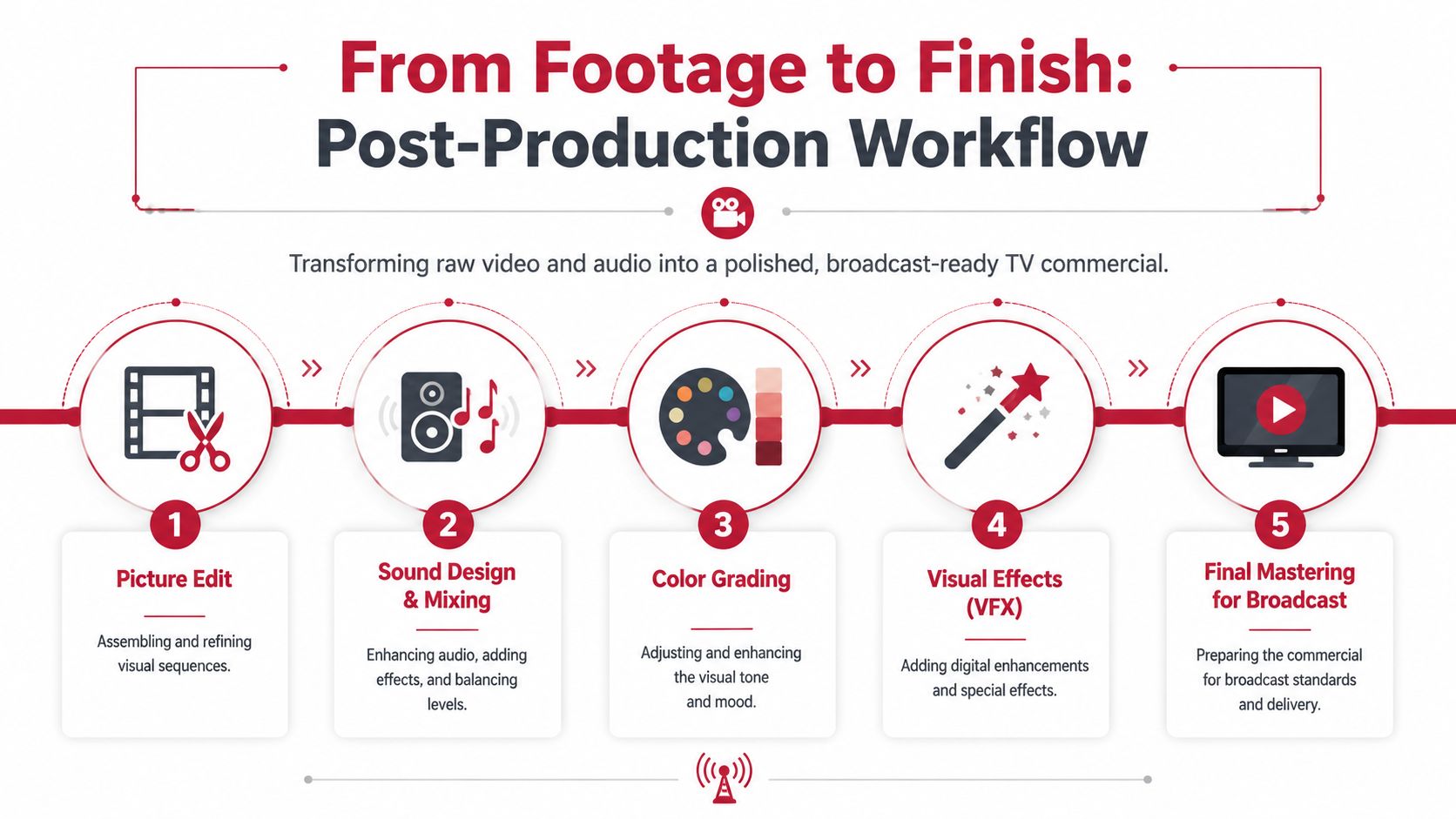
A useful visual reference for the workflow sits below.
Post is where the ad becomes the ad
The first cut is rarely about polish. It's about structure. Does the opening hook quickly enough. Is the product introduced at the right moment. Does the ending land clearly. A television commercial can look expensive and still fail if the story order is wrong.
A standard 30-second spot typically needs 10 to 14 working days in post-production, and VFX can add 7 to 14 extra days, based on Swastika Films' technical and post-production guide for TV commercials. That timeline reflects real work: editing, grading, sound, graphics, revisions, and finishing.
The stages usually unfold like this:
- Picture edit to shape pacing and narrative clarity
- Sound design and mix to make speech, music, and effects work together
- Color grading to create consistency and polish
- Motion graphics or VFX if the concept requires them
- Mastering for platform-specific delivery
For brands curious about what gives polished footage that premium, story-led look, this explainer on cinematic video production is a practical reference point.
Later in the process, clients often want to understand how specialist post teams are structured. A production-side example is this post about Encore Film And Music Studio hiring, which gives a useful look at how different post roles are separated in professional workflows.
A quick production example also helps ground the sequence:
Broadcast delivery is technical not optional
Broadcast QC doesn't care how much the client likes the edit. It cares whether the file meets spec. UK broadcaster guidance summarized by Lambda Films on the TV advertising process notes common requirements such as Full HD (1920×1080) or UHD (4K) masters, 25 fps, safe-area compliance, and loudness control under EBU R128. Separate market guidance also points to frame-accurate handoff practices such as MXF OP1A masters, 50 Mbit/s HD encoding, 48 kHz PCM audio, and a start timecode of 10:00:00:00.
That sounds technical because it is technical. A spot can be approved creatively and still be rejected at delivery.
What to review before final approval
Before signing off, clients should ask for a final review pass focused on risk, not taste.
- Message check: Is the core claim clear without explanation?
- Legal check: Are supers, disclaimers, and logos accurate and readable within safe areas?
- Audio check: Is dialogue intelligible on ordinary speakers, not just studio monitors?
- Version check: Have all required lengths, tags, and end cards been exported correctly?
- Delivery check: Has the final master been prepared for the destination platform, not just archived internally?
Delivery Media Buying and Performance Measurement
A finished commercial is not yet a live campaign. It still has to be trafficked, delivered, scheduled, and connected to the way the media team plans to buy inventory. At this stage, production choices either help performance or create friction.
One creative idea often needs multiple masters
Modern TV campaigns rarely live in one lane. The same media plan may include broadcast, cable, and geo-targeted CTV or streaming. Industry guidance from Epic Light Media on TV advert production and versioning highlights that one creative concept often needs multiple cutdowns and technical masters for those environments.
That changes what “done” means. A brand may need:
- A broadcast-ready master
- A cable version with market-specific tags
- CTV versions with alternate endings
- Shorter cutdowns for frequency and retargeting
- Digital adaptations in different aspect ratios
If those needs aren't planned in pre-production, the team usually pays for them later in compromise. The 30-second hero cut ends up doing too much work because no one captured the extra product angles, clean backgrounds, or alternate calls to action needed for downstream versions.
How delivery and buying connect
Media buying and production should talk to each other early. The creative team needs to know where the spot will run. The buyers need to know what lengths and versions they'll have available. Without that coordination, a business ends up buying placements that the creative wasn't built to support.
This matters even more when the campaign runs across streaming and digital video. For teams sorting out how OTT fits into that mix, this primer on OTT marketing meaning is a helpful reference because it clarifies how internet-delivered television inventory differs from traditional broadcast assumptions.
What to measure after launch
Measurement should match the campaign objective. A brand-awareness campaign won't be judged the same way as a direct-response push, and a CTV flight offers different reporting possibilities than a local linear buy.
A few practical measurement questions keep teams honest:
- Did the right versions air in the right places
- Did response quality match the audience strategy
- Did one channel or cutdown clearly outperform the others
- Did viewers take the intended next step after exposure
Attribution gets messy fast once multiple channels run together. For marketers who need a better framework for that problem, this Guide to multi-channel attribution is worth reviewing because it helps connect exposure across TV, streaming, and digital paths without reducing everything to a last-click view.
Repurposing Your TV Spot for Digital Channels
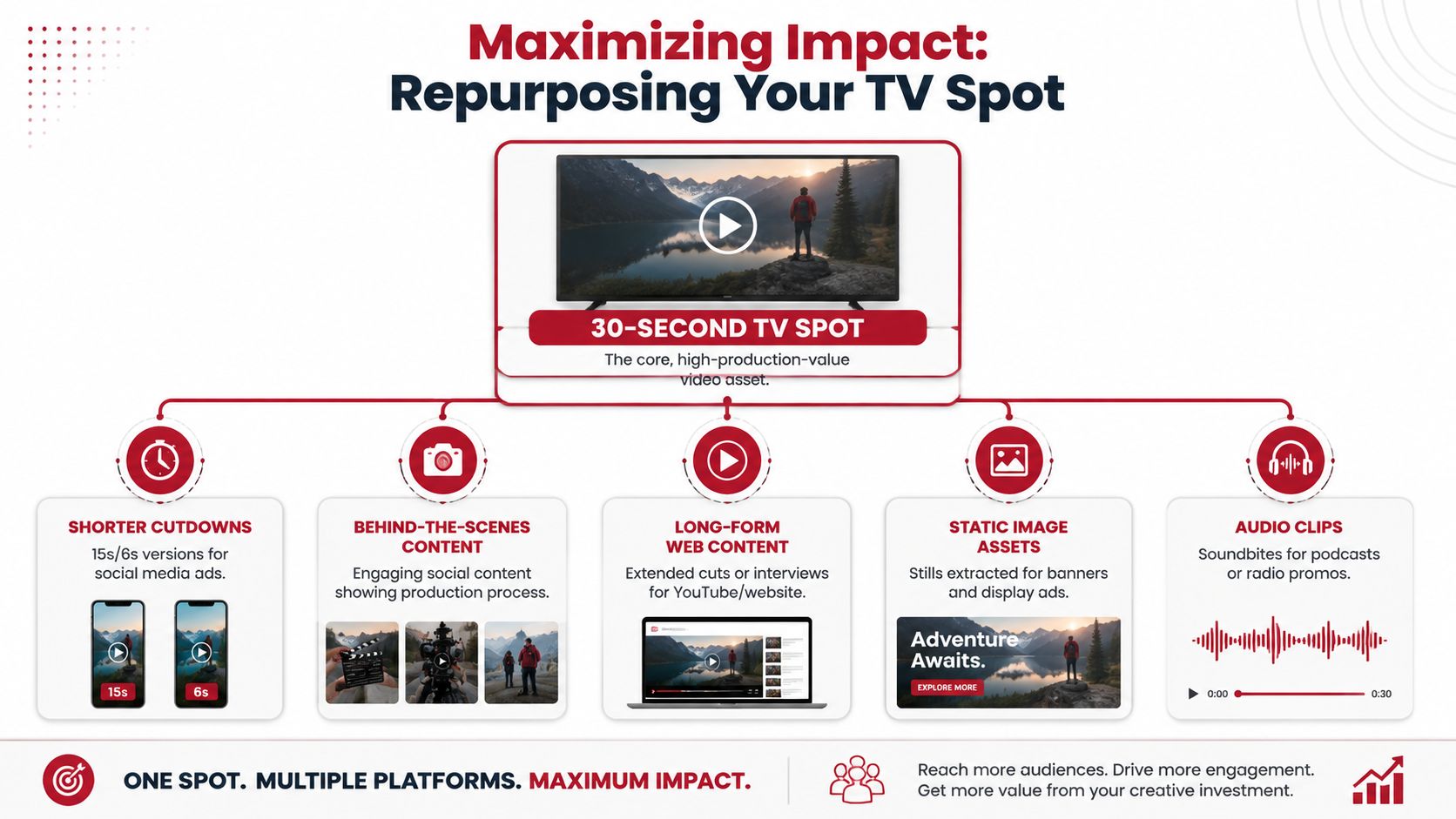
The most expensive way to produce a TV commercial is to treat it like a single-use asset. A well-produced spot should become the center of a wider content system. The hero commercial carries the highest production value, but it shouldn't be the only thing that survives the project.
Treat the TV spot as the hero asset
A single commercial can create a useful stack of supporting assets if the team plans for extraction. That means grabbing more than the exact frames needed for the master edit. It means recording room tone cleanly, shooting extra stills, capturing alternate framings, and saving isolated graphics and music stems for later use.
Strong repurposing options often include:
- Shorter cutdowns: Fast hooks for paid social, pre-roll, and remarketing
- Vertical adaptations: Edits designed for mobile viewing rather than cropped as an afterthought
- Static assets: High-quality stills pulled from the shoot for display, email, or landing pages
- Audio snippets: Voiceover or testimonial lines reused in other channels
- Behind-the-scenes material: Humanizing content that makes the brand feel less polished in the right way
What to pull from the production while the crew is still together
The cheapest extra assets are the ones captured while the set already exists. Once the location is gone and talent has wrapped, every missed opportunity becomes an added production day or a compromised edit.
A practical capture list looks like this:
| Asset type | Best moment to capture it | Why it matters |
|---|---|---|
| Vertical video takes | During principal photography | Prevents awkward crops later |
| Product stills | Between lighting setups | Reuses the best lighting conditions |
| Clean plates and backgrounds | Before wrap on each setup | Helps graphics, retouching, and alternate edits |
| BTS clips | During resets and rehearsals | Adds informal content without interrupting the shoot |
| Alternate end cards | During post or pickup graphics | Supports channel-specific calls to action |
Why repurposing has to be planned before the shoot
Repurposing fails when the team treats it as an edit request instead of a production plan. A horizontal commercial won't automatically become a strong vertical ad. A polished TV voiceover won't always become a compelling social clip. The assets have to be gathered with those outcomes in mind.
For teams building a repeatable system around one core asset feeding many channels, this overview of a content repurposing agency approach is useful because it shows how a single production can support a broader publishing rhythm rather than a one-off media burst.
A commercial should do more than fill paid inventory. It should give the brand a bank of usable material that keeps working after the initial flight ends.
If a brand needs polished production that keeps paying off after the first release, Get Up Productions helps turn one strong piece of media into a larger content engine. The team handles recording, editing, mastering, and multi-platform repurposing so the finished asset doesn't stop at one format or one channel.