

A strong podcast episode takes planning, recording time, editing, approvals, publishing, and promotion. Then it gets one short burst of attention and starts sinking down the feed. The same thing happens to webinars, interviews, livestreams, and panel recordings. Teams put serious effort into rich media, but they still treat the finished asset like a one-time post.
That's the content treadmill. Record something valuable, publish it once, scramble to make the next thing, and wonder why the workload keeps rising faster than the results.
A content repurposing agency is the practical way off that treadmill. Instead of asking a founder, host, or marketing team to create more from scratch, it builds a system around what already exists. That matters because repurposing isn't fringe behavior anymore. 94% of marketers repurpose content, and 42% said updating and repurposing existing content helped drive successful campaigns according to the 2023 SEMrush statistics summarized by Ukti.
For teams trying to stretch one podcast or webinar into a real demand engine, the shift is strategic. The goal isn't to make more posts. The goal is to make each original recording do more work across more channels, for longer.
Table of Contents
- The Content Treadmill and The Way Off
- What a Content Repurposing Agency Actually Does
- Inside the Repurposing Engine How Workflows Drive Growth
- The Business Case Measuring the ROI of Repurposing
- Agency vs In-House Which Model Fits Your Brand
- Finding Your Partner How to Hire the Right Agency
- From Podcast to Powerhouse A Repurposing Case Study
The Content Treadmill and The Way Off
A founder records a thoughtful interview. A nonprofit leader hosts a webinar with a message that deserves wider reach. A consultant publishes a podcast episode full of usable insights. In each case, the hard part is already done. The problem starts right after publishing.
The full episode lands on YouTube or Spotify. Maybe a short announcement goes to LinkedIn or Instagram. Then the team moves on because there isn't time to do anything else. The original asset had depth, but the distribution around it was thin.
That's why a content repurposing agency exists. It takes one substantial source asset and turns it into a structured publishing cycle. Instead of asking, “What should go out this week?” the better question becomes, “What can this episode power for the next several weeks?”
Rich media usually fails from under-distribution, not from lack of substance.
This is also where technology helps, if it's used carefully. Teams that want to leverage AI for content can speed up transcript cleanup, clip ideation, captions, and draft generation. But AI only helps when a human still decides which moments are worth amplifying and which ones should stay on the cutting room floor.
A practical repurposing setup usually sits inside a broader media system. That's why many brands pair podcasting, video, and downstream distribution under one roof through a partner focused on marketing and media execution.
The strategic shift is simple. Stop treating the podcast, webinar, or interview as the final product. Treat it as the raw material for a content system.
What a Content Repurposing Agency Actually Does
The term “repurposing” often brings to mind a video editor cutting a few highlights. That's part of the work, but it's not the whole job. A real content repurposing agency operates closer to a content multiplier than a post-production vendor.
It starts with source selection. Not every recording deserves the same treatment. Some episodes contain broad educational value, sharp soundbites, and clear audience pain points. Others may be good conversations but weak source material for downstream distribution. An agency should know the difference before anyone starts cutting clips.
It turns long-form into a usable asset library
The service is asset atomization. That means breaking a podcast or webinar into smaller idea units that can stand on their own. Those units often include:
- Contrarian points that work as short-form hooks
- Clear teaching moments that fit carousels, blog drafts, or newsletters
- Memorable lines for quote graphics and captions
- Audience questions that can become community posts or follow-up content
This is why blog-first repurposing advice often misses the mark. Audio and video carry tone, pauses, facial expression, intensity, and pacing. A strong agency doesn't just extract text from a transcript. It identifies moments that feel alive on camera and useful in writing.
It adapts the message to the platform
A repurposed clip shouldn't feel like the same content copied five times. Platform-native work changes the packaging while keeping the core message intact.
A short for YouTube needs a fast opening and a clean takeaway. An Instagram Reel may need stronger visual pacing. A LinkedIn post based on the same moment should frame the idea more professionally and give the audience a reason to respond. An email may use that same segment as the opening lesson, then drive readers back to the full episode.
Practical rule: If every platform gets the same cut, same caption, and same framing, the team isn't repurposing. It's reposting.
It builds a repeatable operating rhythm
The strategic layer is what separates an agency from a freelancer handling one task at a time. The work includes editorial judgment, workflow management, approval systems, content calendars, and performance reporting.
One option in this category is Get Up Productions, which offers podcast production and multi-platform repurposing built around recorded episodes as source material. That model fits brands that already know their expertise and need a system to turn each recording session into a broader stream of content.
The point isn't outsourcing random edits. It's creating an external engine that runs on the brand's best ideas.
Inside the Repurposing Engine How Workflows Drive Growth
A content repurposing agency only scales results when the workflow is disciplined. Without a system, teams end up making random clips that look busy but don't build momentum. The most reliable operating model is audit → atomize → reformat.
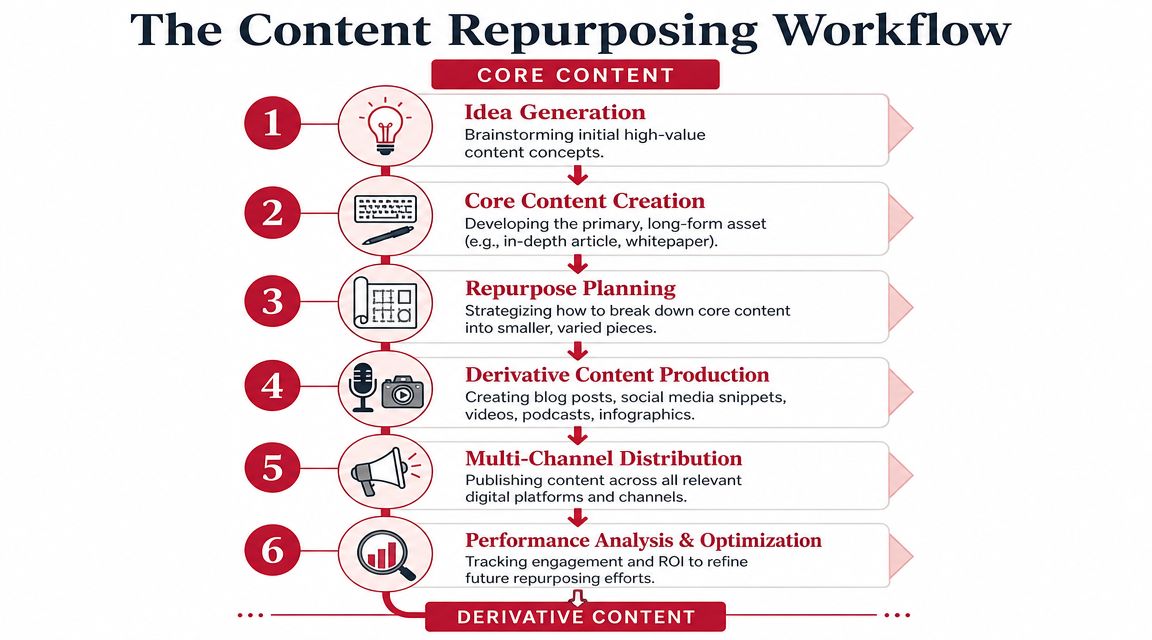
The workflow starts before editing
Repurposing should begin with selection, not scissors. A well-structured workflow starts by auditing strong source material and then turning it into discrete units before reformatting. The benefit is consistency and throughput. That process can produce at least 10 platform-native deliverables from one source asset, as outlined in Digital Applied's guide to audit, atomize, and reformat workflows.
For podcasts and webinars, that audit usually looks at a few practical filters:
- Evergreen value: Will this topic still matter after the publish week?
- Clear stakes: Does the episode solve a real problem or answer a recurring question?
- Extractable moments: Are there concise sections that can stand alone as clips, quotes, or posts?
- Channel fit: Does the material naturally translate to short video, written content, and email?
A strong workflow also needs a tracking layer. Many teams use Notion, Airtable, or Google Sheets as a content hub, then connect scheduling and delivery through tools like Zapier or Make. For a broader tool stack and workflow ideas, AgentReacher's content repurposing guide is useful as a reference point.
Brands that want the process mapped into a repeatable publishing model often work from a defined content repurposing strategy rather than treating each episode like a fresh experiment.
What comes out of one anchor asset
Take a single podcast interview. The raw recording can become a structured waterfall of assets if the team knows what to extract.
A typical flow might look like this:
- Full episode for YouTube, podcast platforms, or the brand site
- Short video clips built around sharp teaching moments
- Audiograms for channels where soundbites outperform static promotion
- Quote graphics using lines that carry emotional or strategic weight
- Carousel posts built from a sequence, framework, or list discussed in the episode
- Blog draft pulled from the transcript and edited into a search-friendly article
- Email newsletter that frames the episode around one central takeaway
- LinkedIn text post based on one argument or objection raised in the conversation
- Show notes with cleaner structure and stronger keyword alignment
- Internal sales enablement content for outreach, follow-up, or nurture use
The most valuable moment in a podcast isn't always the loudest one. It's often the clearest one.
What doesn't work is blind volume. Cutting every sixty-second segment into a Reel creates noise, not impact. The agency's job is to choose moments with narrative tension, practical insight, or a clear emotional shift. That editorial judgment is where repurposing starts to influence growth instead of just filling a calendar.
The Business Case Measuring the ROI of Repurposing
A content repurposing agency should be evaluated like a growth function, not like an editing line item. The output matters, but the business case gets stronger when a team understands what repurposing changes operationally.

The hard costs of content aren't limited to editing. Teams also spend time on ideation, briefing, approvals, graphic requests, captions, metadata, scheduling, and promotion. When one high-value webinar or podcast can fuel a full sequence of downstream assets, the economics change because the heaviest thinking gets reused.
According to Cloud Present's repurposing guide, systematic content repurposing can boost reach by 300%, save teams over 10–20 hours per week, and deliver up to 6x higher ROI when brands effectively reuse anchor content across channels like YouTube Shorts, Instagram, and TikTok.
Why the economics work
The main financial advantage is compounding value from one original effort. A strong episode or webinar already contains research, positioning, stories, and objections handled in real time. Repurposing extends the life of that work instead of requiring a brand to start over for each platform.
That creates practical advantages:
- Lower ideation pressure: The team doesn't need a brand-new concept for every post.
- More distribution opportunities: One idea can reach audiences who prefer video, text, audio, or email.
- Stronger message consistency: The same core insight appears in multiple forms instead of changing with every channel owner.
- Better use of expert time: The founder, host, or subject matter expert spends more time recording depth and less time approving scraps.
A short explainer on why brands treat repurposing as a multiplier rather than a shortcut fits well here:
What to measure beyond output volume
The wrong KPI is “How many clips did this episode generate?” That metric matters, but only as a production check.
The better questions are tied to business outcomes:
- Website traffic: Which repurposed assets bring people back to owned channels?
- Email signups: Which formats turn passive viewers into known audience members?
- Inbound conversations: Which clips or posts trigger replies, DMs, and discovery calls?
- Sales support value: Which assets help a prospect understand the offer faster?
A repurposing system becomes easier to justify when leadership sees it reducing internal bottlenecks while increasing the number of useful audience touchpoints. That's when the spend stops looking like content overhead and starts looking like distribution infrastructure.
Agency vs In-House Which Model Fits Your Brand
The decision between an agency and an internal team usually isn't philosophical. It's operational. The right answer depends on how often the brand records, how fast it wants to publish, how much oversight it can provide, and whether content is a core capability or a support function.
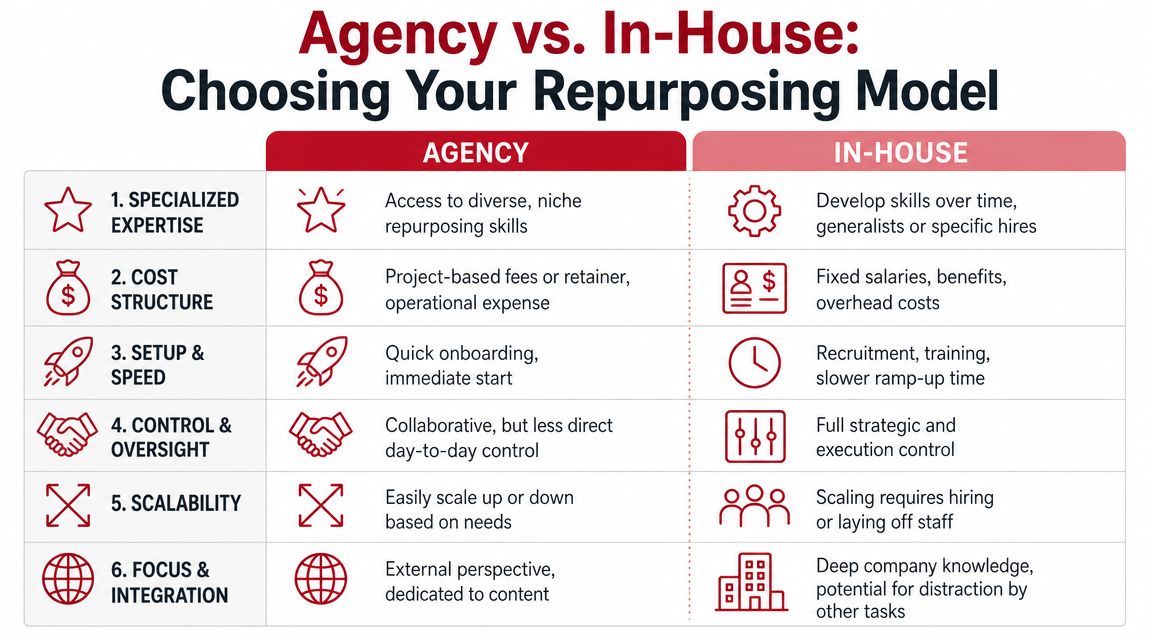
Agency vs. In-House Repurposing A Comparison
| Factor | Content Repurposing Agency | In-House Team |
|---|---|---|
| Specialized expertise | Access to editors, strategists, designers, and platform specialists | Depends on who is hired and how broad their skill set is |
| Cost structure | Retainer or project-based operating expense | Salaries, benefits, management time, and software overhead |
| Setup and speed | Faster to activate if workflows already exist | Slower ramp because hiring and training take time |
| Control and oversight | Shared control with external execution | Direct daily control over priorities and revisions |
| Scalability | Easier to increase or reduce output | Scaling usually requires more hiring |
| Brand integration | Needs onboarding and documentation | Naturally closer to the company voice and context |
When an agency fits better
An agency model usually works well when the brand already has strong source material but lacks the internal bandwidth to turn it into a system. This is common for founders, consultants, nonprofits, and marketing teams that can record expert-led content but can't support continuous downstream production.
It also fits when the work requires multiple specialties at once. Podcast and webinar repurposing often needs transcript cleanup, video editing, hook writing, graphic design, captioning, metadata optimization, and channel-specific adaptation. Most single hires won't cover all of that well.
Agency support is often the cleaner choice when the bottleneck is speed. The team doesn't have to build the machine first. It plugs into one that already exists.
When in-house makes more sense
In-house is usually the better model when publishing is tightly tied to fast-moving internal campaigns, legal review, or product launches that change direction quickly. Some brands need a team member sitting close to leadership every day because the messaging changes constantly.
It can also make sense when content is central enough to justify building a dedicated media function over time. That gives the company deeper control over nuance, voice, and responsiveness, but it also creates management overhead that many teams underestimate.
If the team can barely manage recording, it probably isn't ready to manage a full repurposing department too.
A hybrid approach is often the most practical. The internal team owns strategy and approvals. The agency handles production, adaptation, and distribution support. That setup gives the brand control without forcing it to recruit every specialist role at once.
Finding Your Partner How to Hire the Right Agency
Hiring a content repurposing agency gets easier when the evaluation focuses on judgment, not just samples. Almost any shop can show polished clips. Fewer can explain why a specific moment was selected, where it should run, and how they'll connect that output to business goals.
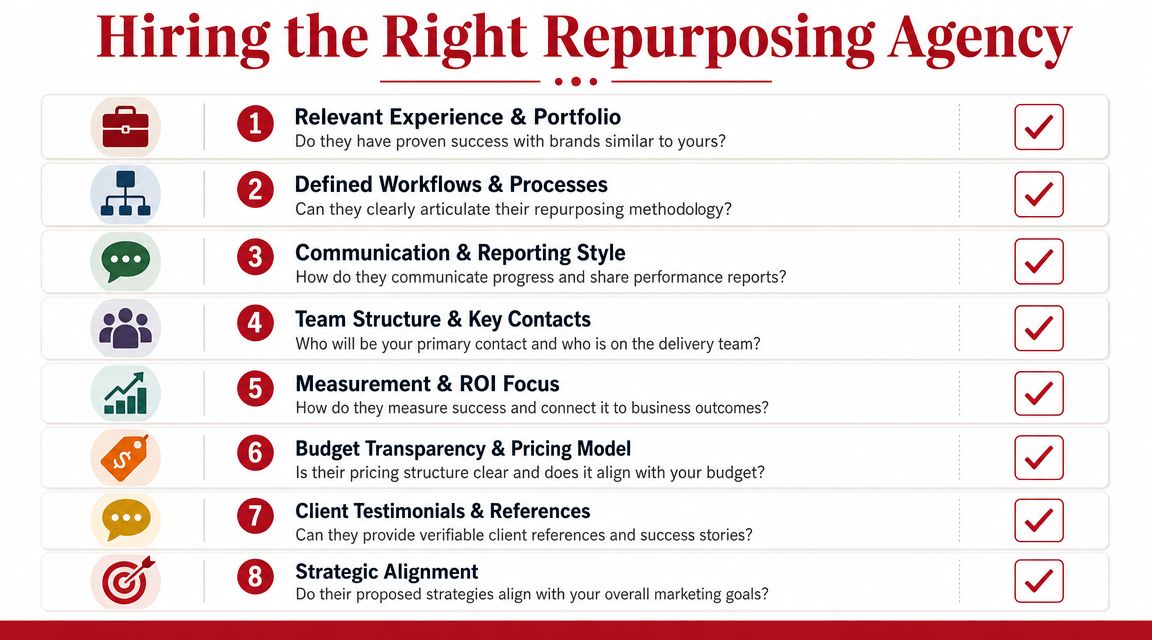
The key standard is simple. The best agencies sell outcomes, not just outputs, and they should be able to track repurposed formats back to website traffic, email signups, or sales conversions, as explained in Siege Media's guidance on content repurposing strategy.
Questions that reveal strategic depth
A strong hiring conversation should move past “How many clips do you deliver?” and get into decision-making.
Useful questions include:
- What source content do you handle most often? Podcast episodes and webinars require different judgment than blog-based repurposing.
- How do you choose which moments to extract? The answer should mention audience relevance, clarity, and channel fit.
- How do you adapt for each platform? Good agencies talk about native formatting and audience behavior, not simple reposting.
- What does your workflow look like after recording? Look for clear stages, ownership, review cycles, and delivery timing.
- How do you report performance? The answer should include business-facing metrics, not only views and likes.
- Who will do the work? The team structure matters as much as the sales pitch.
If the reporting side feels vague, it helps to review what solid measurement looks like in adjacent service categories. MyMentions' guide to analytics agencies is useful here because it frames what serious attribution and reporting conversations should sound like.
Brands comparing specialists should also review whether the agency can support broader social media content creation services rather than clipping in isolation.
Red flags that signal a clip factory
A weak agency usually reveals itself quickly.
Watch for these signs:
- Volume-first promises: If the pitch centers on post count alone, strategy is probably thin.
- No platform distinction: The team treats Shorts, Reels, LinkedIn, and email as the same distribution surface.
- Transcript dependence: They rely on text extraction without showing editorial interpretation.
- Vanity metric obsession: Reporting stops at views, impressions, or likes.
- No source-content standards: They'll repurpose anything, whether it's strong or not.
A good partner doesn't promise to turn every minute into content. It decides which minutes deserve attention.
The right agency should sound selective. Selective about source material, selective about clips, selective about distribution, and selective about what success means.
From Podcast to Powerhouse A Repurposing Case Study
A common pattern shows up in B2B and mission-driven media. The organization launches a podcast for authority, records thoughtful episodes, and then stalls. The conversations are strong, but growth is inconsistent because the team is publishing episodes, not building a content system around them.
A more effective model starts by treating the podcast as anchor content. One episode becomes the center of a wider distribution plan. The strongest teaching segment becomes a short video. The clearest emotional line becomes a quote graphic. A practical section turns into a carousel. A transcript segment becomes the seed of a blog post or email.
That approach works especially well with rich media. Repurpose My Webinar's guide to agency repurposing for podcasts and webinars notes that modern repurposing is strongest when the source material is audio or video that can be atomized into clips, audiograms, and quotes, with careful selection of which moments to extract and how each piece should be adapted by platform.
Consider a consultant with a weekly video podcast. The original goal is credibility. Prospects should hear the consultant think through real client problems, not just read polished website copy. But without repurposing, only a small share of the audience ever sees the full episode.
Once the workflow changes, the show starts acting like a media engine instead of a standalone artifact. A single recording session can support short-form awareness, mid-funnel education, email nurture, and sales follow-up. The consultant doesn't need more raw ideas. The consultant needs better packaging and repeated exposure around the ideas already captured on camera.
This is the significant shift from podcast to powerhouse. Not more talking. Better extraction, better adaptation, and better distribution.
If a brand already has expertise worth recording, Get Up Productions can support the production and repurposing side so each podcast episode has a longer life across video, social, and audience-building channels.