
Most advice about search engine optimization in Savannah is stuck in a simpler era. It tells businesses to claim a Google Business Profile, clean up citations, collect a few reviews, and wait. That still matters, but it doesn't create separation in a market where capable firms already know the basics.
Savannah businesses need a stronger model. The sites that keep gaining visibility usually combine two systems: a solid local SEO foundation and a repeatable content engine that keeps producing localized authority. The overlooked opportunity is podcast-driven content. Done well, one recorded conversation can become service pages, neighborhood pages, blog posts, video clips, transcript assets, and local search entry points that competitors never build.
Table of Contents
- Why Your Savannah SEO Strategy Isn't Working
- Mastering the Local SEO Foundation
- Creating Content That Speaks to Savannah
- The Podcast Engine Your Local SEO Secret Weapon
- Activating the Content Waterfall for Savannah Leads
- Measuring What Matters and Scaling Your Visibility
Why Your Savannah SEO Strategy Isn't Working
Many Savannah businesses aren't invisible because SEO failed. They're invisible because they're running a checklist, not a strategy.
That distinction matters in a city where the market is already crowded with experienced providers. According to Clutch's Savannah SEO agency rankings, the top three SEO firms in Savannah in May 2026 are Funnel Boost Media, WebFX, and Comrade Digital Marketing Agency. Their ratings are strong, and the same Clutch data says client retention rates for these firms exceed 80%, which signals a mature market where businesses already understand SEO's value.
The problem isn't effort
A typical local company has already done the obvious work. The profile is claimed. The address is consistent. A few directory listings exist. Service pages mention Savannah. Yet rankings stall, calls stay inconsistent, and better-known competitors keep occupying the local pack and organic results.
That happens for three common reasons:
- The business built a listing presence, not a content ecosystem. A profile can help a company appear. It rarely proves depth.
- The website targets broad service terms only. That leaves room for competitors with pages tied to neighborhoods, verticals, questions, and local use cases.
- The content cadence is weak. Search visibility grows when a site keeps giving Google fresh, structured signals about expertise and local relevance.
A Savannah company doesn't need more random blog posts. It needs more indexed proof that it serves real local problems better than the next option.
What actually changes results
Traditional local SEO still belongs in the plan. It just can't carry the whole plan anymore.
What works now is layered execution:
| Approach | What it produces | What usually happens |
|---|---|---|
| Basic local SEO only | Listings, citations, minimal site updates | Visibility plateaus |
| Technical SEO plus local pages | Cleaner indexing, stronger relevance | Better consistency |
| Technical SEO plus local pages plus podcast-driven content | Ongoing authority signals across topics | More entry points for qualified leads |
Search engine optimization Savannah businesses can trust has to do more than verify location. It has to show expertise in context. A financial advisor needs content tied to Savannah retirement concerns, local business ownership issues, and neighborhood-level audience intent. A nonprofit needs pages and episodes around local events, donor education, and community partnerships. A consultant needs proof of thinking, not just a services page.
The businesses gaining ground aren't waiting for a homepage to rank for everything. They're building a network of assets that support each other.
Mastering the Local SEO Foundation
A content engine won't save weak fundamentals. If the local foundation is sloppy, the extra content only spreads confusion faster.
The basics still matter, but precision matters more
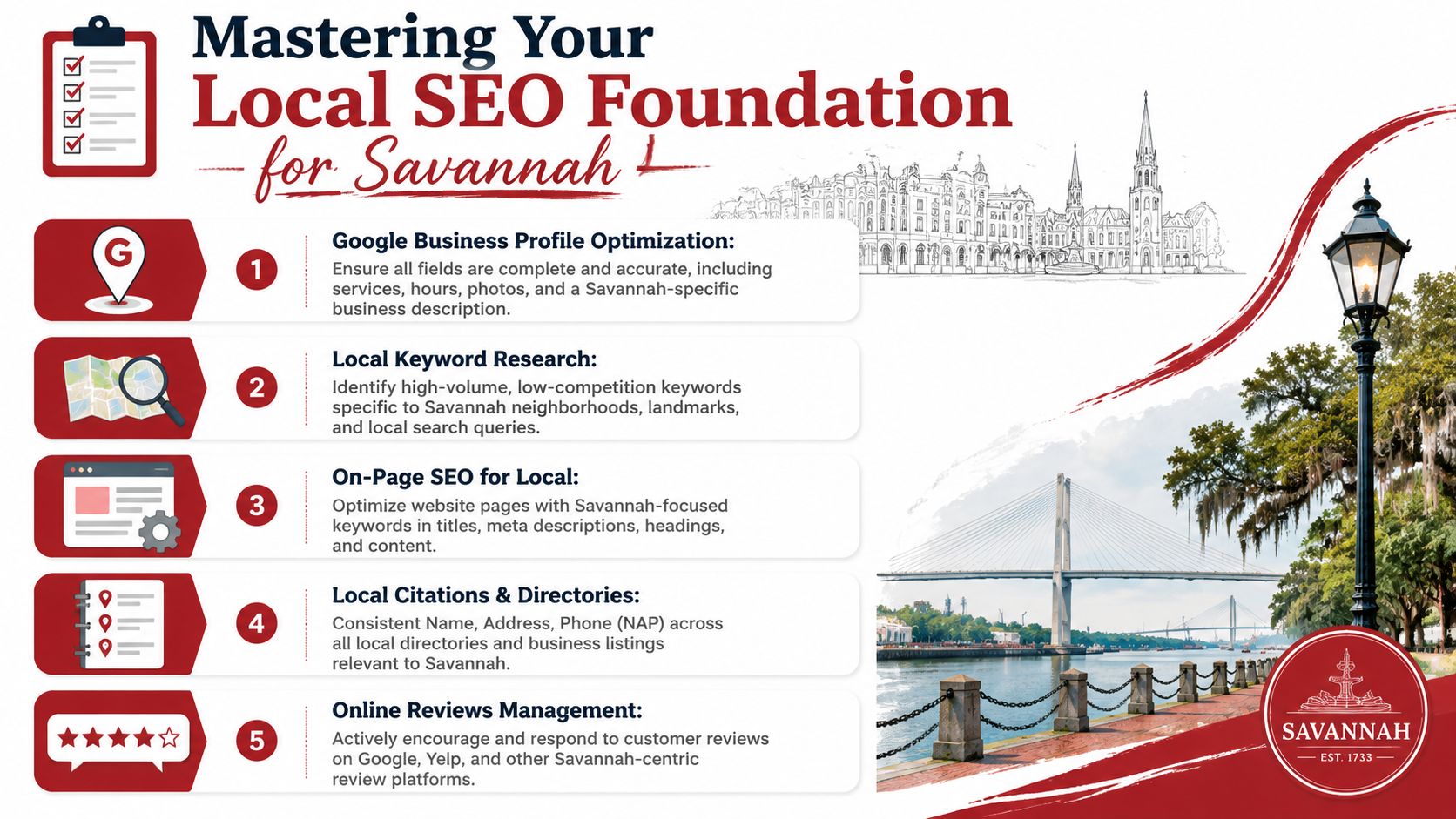
Google Business Profile needs more than completion. It needs maintenance. Businesses should keep services current, add fresh photos, answer common pre-sales questions in the Q&A area, and use Posts to tie the profile to seasonal offers, events, and community activity around Savannah.
Citations matter too, but quantity is overrated. A local company gets more value from accurate placement in relevant directories, chamber listings, association sites, and niche platforms than from mass submission to weak directories.
A practical local foundation usually includes:
- A fully built Google Business Profile with accurate hours, categories, service descriptions, photos, and location-aware business language.
- Review management with response discipline so every review gets an answer that reflects the service delivered and the local market served.
- Service pages with local modifiers that match how real customers search, not just how the company describes itself.
- Local trust signals such as community involvement, event participation, partner mentions, and neighborhood references where appropriate.
For businesses rebuilding their web presence, site structure often becomes the hidden blocker. A page can be well written and still struggle if the site architecture is thin or confusing. That is why reviewing examples of website structure and local service page planning can be useful before launching a larger SEO push.
Practical rule: If a Savannah customer can't tell in a few seconds where the business operates, who it serves, and what action to take next, the page isn't finished.
The technical layer most local businesses miss
Technical SEO sounds abstract until it breaks local visibility. Then it becomes urgent.
A core part of the SEO Savannah methodology is the technical audit. Proper canonical setup matters because duplicate versions of the same page can split relevance and confuse indexing. The verified methodology states that proper use of canonical tags can increase organic traffic visibility by 15 to 20% within 90 days, while a mistaken noindex tag can remove important pages from Google entirely.
That leads to a simple review list:
- Check canonical signals so duplicate URLs don't compete with each other.
- Review indexability to make sure service pages, location pages, and episode pages aren't blocked accidentally.
- Tighten title tags and meta descriptions so they reflect page intent clearly.
- Update stale pages instead of endlessly publishing disconnected new ones.
Many local businesses spend months chasing backlinks while the core issue sits in page structure, metadata, or indexing. Search engine optimization in Savannah gets stronger when the technical layer and the local layer support each other, not when they're handled as separate projects.
Creating Content That Speaks to Savannah
A lot of local content looks local only on the surface. It drops the city name into a headline, swaps out a few paragraphs, and calls the page optimized. Search engines and users both see through that quickly.
Generic local pages don't build local authority
A page called "Savannah Marketing Services" tells Google almost nothing if every agency has one. Strong local content uses specificity. It names the audience, the use case, the local context, and the decision problem.
That can mean pages such as:
- A neighborhood page for a service area with real distinctions in messaging
- An industry page like accounting services for Savannah restaurants or legal marketing for local firms
- An event-driven article tied to recurring community activity
- An interview feature with another Savannah business owner or organizer
The difference is relevance density. Instead of one generic city page, the site starts reflecting the actual conversations prospects have before they contact someone.
What strong Savannah content looks like
Consider a consultant trying to rank locally. A weak content plan publishes broad pieces about leadership, growth, or productivity. A stronger plan creates assets around questions Savannah buyers ask:
| Weak content angle | Stronger Savannah angle |
|---|---|
| Leadership tips for companies | How Savannah leadership teams can align sales and marketing before budget season |
| Branding advice | Rebranding for established Savannah firms without losing local recognition |
| General tax planning | What Savannah small business owners ask before meeting a local CPA |
That same principle applies across sectors. A nonprofit can publish event recaps, donor education pages, volunteer spotlights, and local issue explainers. A church or spiritual leader can create pages tied to community outreach, local events, counseling topics, and neighborhood-specific questions.
Teams using AI to speed drafting still need local judgment. Tools can help organize transcripts, summarize interviews, and cluster related topics, but they shouldn't replace local subject matter input. A useful companion read on that balance is Spotlight Group LLC's take on optimizing search with AI, especially for businesses trying to scale content without flattening it into generic copy.
The best local content doesn't sound like SEO copy. It sounds like a business that actually works in Savannah and understands how local buyers think.
A strong page also needs a clear next step. Every local article should connect to a service page, a contact page, a booking action, or a related resource. Traffic without pathing doesn't become pipeline.
The Podcast Engine Your Local SEO Secret Weapon
Most businesses still treat podcasts like branding projects. They record an episode, upload it to a hosting platform, post a link once, and move on. That leaves most of the SEO value untouched.
Why podcasting fits local SEO better than most businesses realize
Podcasting works for local search because it creates depth at scale. One good conversation can cover a niche service question, a local guest perspective, a community issue, and several long-tail search themes in a single recording.
That matters because current Savannah SEO content leaves major gaps. Verified data states that a 2025 Pew Research study found 72% of nonprofits and spiritual organizations in the U.S. treat podcasting as a passive content bucket rather than a strategic local SEO asset, while Google reports 40% of local searches now occur via voice. That combination creates an opening for transcript-based and audio-metadata-driven visibility around terms like spiritual leader Savannah or nonprofit event Savannah.
Later in the buyer journey, the same logic applies to consultants and B2B firms. Verified data also shows that a 2025 consultant report found 68% of B2B service firms struggle to rank for local intent keywords against national competitors, and Google's 2025 Search Obsession survey says 55% of local B2B buyers use podcast-derived content to verify expertise before making contact.
How to structure episodes for local search intent
Podcast SEO starts before recording. The strongest shows define episode topics around search behavior, not just guest availability.
Useful local episode formats include:
- Problem-first interviews such as a Savannah CPA discussing tax issues local business owners ask about repeatedly
- Local roundtables with business owners, nonprofit leaders, or ministry staff discussing one city-specific challenge
- Event-adjacent episodes tied to conferences, festivals, fundraisers, or seasonal business shifts
- Explainer episodes built around one narrow question with strong local intent
Episode titles need clarity. "Faith and Growth Episode 12" is nearly useless for search. "How Savannah nonprofits can turn podcast transcripts into donor-facing content" is far stronger because it carries topic, audience, and local context.
For teams still naming a new show, a tool like Keyvello's best podcast name tool can help generate options around industry and city positioning before artwork and metadata get locked in.
A business also needs a repeatable production system. Recording is the smallest part of the job. Editing, show notes, keyword mapping, clips, publishing, and repurposing create the actual SEO footprint. Teams that want outside support for that workflow often review options such as a podcast marketing strategy service that handles production and repurposing around lead generation goals.
A useful example of this process in action appears below.
What businesses should publish with every episode
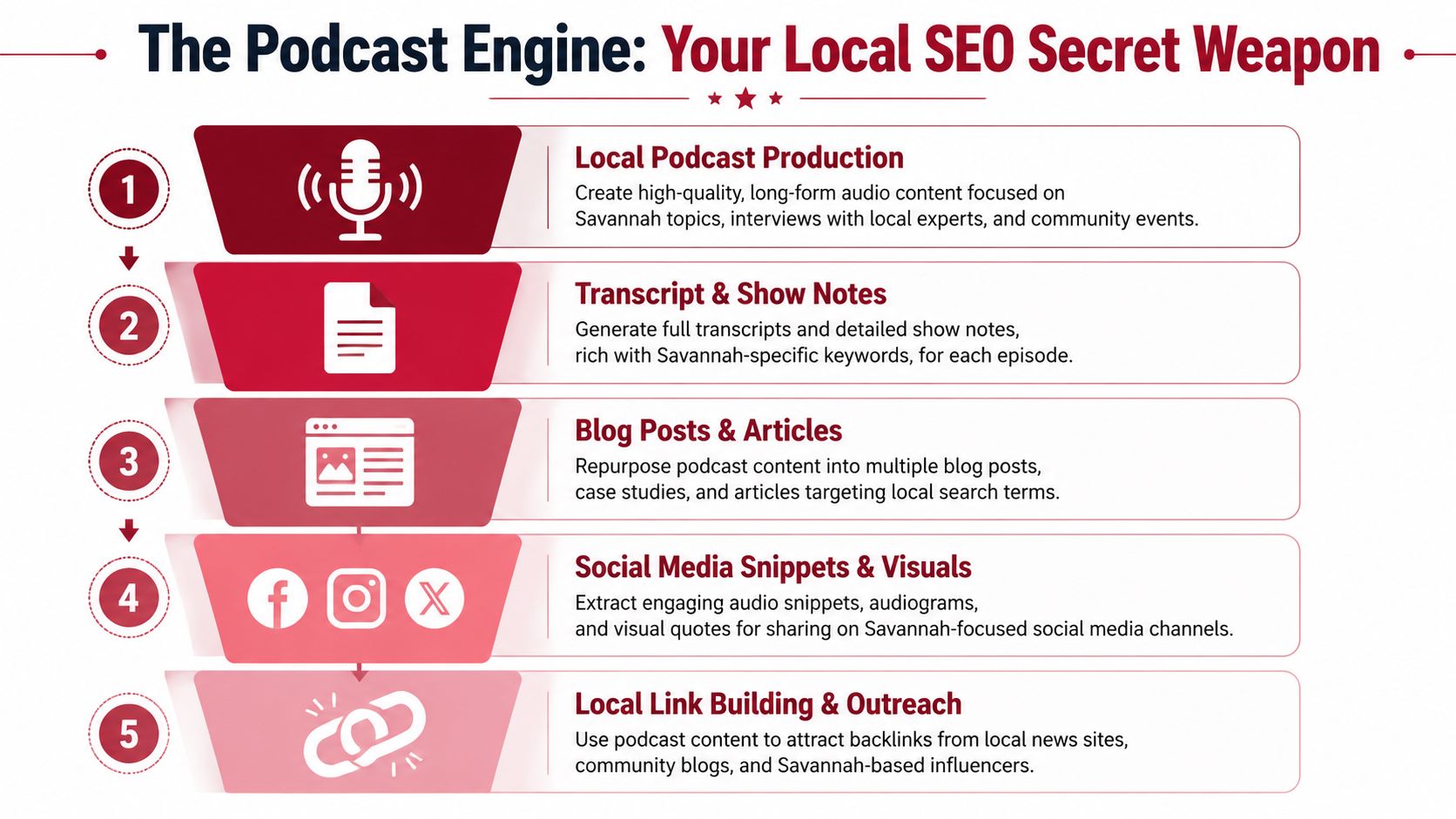
The episode file itself isn't enough. Each recording should produce a search asset set.
Working principle: If an episode exists only on a podcast player, the business published audio. It didn't publish SEO content.
A complete episode package should include:
- A dedicated episode page with a clean URL, useful summary, and internal links.
- A full transcript edited for readability, not dumped raw.
- Detailed show notes that mention local themes, guest names, and related services.
- Supporting clips or articles built from strong subtopics inside the conversation.
- Metadata aligned to search intent including titles and descriptions that match what people would search.
Podcasting transforms into a local authority engine instead of a side channel. Search engine optimization Savannah businesses need doesn't reward random media activity. It rewards structured publishing that expands topical coverage over time.
Activating the Content Waterfall for Savannah Leads
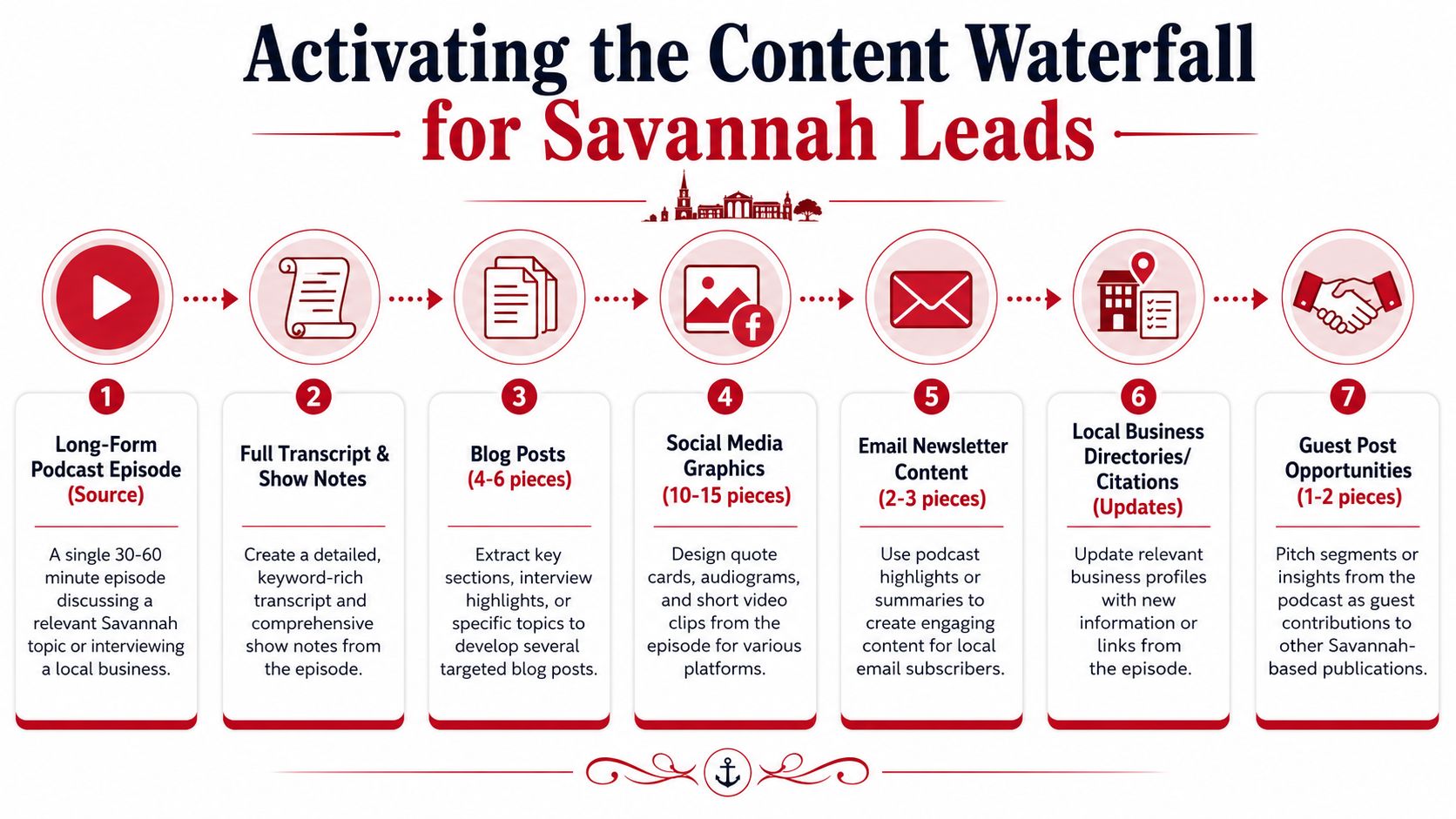
Podcasting becomes commercially useful when one recording session turns into many buyer touchpoints. That is the content waterfall. It isn't about squeezing content out of thin air. It's about extracting the full value from an expert conversation that already happened.
One episode becomes a local topic cluster
For B2B firms in Savannah, this matters because verified data says 68% struggle to rank for local intent keywords against national competitors, while 55% of local B2B buyers now use podcast-derived content to verify expertise before making contact. The practical takeaway isn't "start a podcast and hope." It's "turn each episode into a topic cluster with local intent built in."
A single conversation with a Savannah attorney, consultant, pastor, recruiter, or nonprofit director can create:
- A main episode page targeting the broad theme
- Several supporting blog posts focused on narrower sub-questions
- Short-form clips that surface on YouTube Shorts, Instagram Reels, and LinkedIn
- Quote graphics and audiograms for social engagement
- Email content that brings subscribers back to the site
- Guest contribution ideas for local publications and partner sites
That workflow is why content repurposing outperforms one-off publishing. Businesses that want a model for this can study a structured content repurposing strategy built around long-form source material.
A practical waterfall workflow
The waterfall works best when each output has a job. Not every asset needs to rank. Some assets attract clicks. Some build familiarity. Some create internal links that strengthen the site's core pages.
A workable sequence looks like this:
| Asset | Primary job | Good local use |
|---|---|---|
| Episode page | Authority and indexing | Targets the broad Savannah topic |
| Transcript article | Long-tail keyword coverage | Captures supporting questions and voice-style phrasing |
| Short video clips | Discovery | Reaches local audiences on social and YouTube |
| Email summary | Return traffic | Pulls subscribers back to the site |
| Outreach snippets | Links and mentions | Supports local partnerships and media conversations |
This approach also fixes a common content problem. Disconnected assets that don't reinforce each other are frequently published. A waterfall creates a linked cluster around one subject, one audience, and one local angle.
Don't ask whether one podcast episode will rank. Ask whether that episode can produce a cluster of pages and media that makes the business easier to discover everywhere a prospect looks.
The strongest topics are usually narrow. "Savannah nonprofit marketing" is broad. "How Savannah nonprofits can reuse podcast interviews for donor outreach pages" is specific, useful, and easier to expand into a cluster.
Measuring What Matters and Scaling Your Visibility
Local SEO doesn't need more dashboards. It needs better judgment about what signals progress.
The metrics worth watching
Verified data shows that 68% of all online experiences begin with a search engine, and 39% of consumers say more than 40% of their searches are for local businesses. That means search engine optimization in Savannah should be measured by local buying actions, not just traffic totals.
The most useful indicators usually include:
- Google Business Profile actions such as calls, direction requests, and website clicks
- Local pack and organic visibility for service, audience, and neighborhood terms
- Organic visits to episode pages, transcripts, and local service content
- Lead quality from content-assisted paths rather than last-click attribution alone
Businesses also need to watch how new content interacts with AI-driven search behavior. Busylike's guide to AI search optimization is worth reviewing for teams adapting page structure and content formatting to newer discovery patterns.
How to scale without losing focus
Scaling doesn't mean publishing more of everything. It means publishing more of what compounds.
That usually means keeping three disciplines in place. First, protect the technical foundation so important pages stay crawlable and clearly structured. Second, keep building local content around real Savannah questions, not generic topic calendars. Third, use podcast episodes as source material for topic clusters that prove expertise over time.
When those pieces work together, visibility becomes less fragile. The business isn't relying on one listing, one page, or one keyword. It owns a growing library of local proof.
Get Up Productions helps brands and organizations turn podcast conversations into publishable marketing assets that support visibility, authority, and lead generation. Savannah businesses that want a more structured content engine can explore Get Up Productions as one option for production, repurposing, and podcast-driven content workflows.