
Most podcast advice still starts with the same bad instruction. Buy a microphone, publish consistently, and trust that the audience will come. That approach creates a show. It rarely creates pipeline, authority, or a reliable content engine.
A real podcast marketing strategy starts earlier and reaches further. It starts with business goals, shapes the format around those goals, records with distribution in mind, and turns every episode into a stack of assets that can keep working for weeks. That’s the difference between a podcast that sits in an RSS feed and a podcast that helps a firm book calls, build trust, and stay visible.
That distinction matters because the opportunity is no longer niche. The podcast industry is projected to reach $30.03 billion by the end of 2025, yet podcasts account for 5.1% of daily digital media consumption among US adults while receiving only 0.8% of digital ad budgets, which points to an undervalued channel for brands with a serious plan, according to Command Your Brand’s 2025 podcast consumption analysis.
Founders, consultants, and marketing teams that want to grow your podcast audience usually don’t need more generic promotion tips. They need a system that connects recording, video, SEO, repurposing, distribution, and conversion tracking. The strongest shows don’t behave like isolated pieces of content. They behave like operating systems for authority.
Table of Contents
- Your Podcast Is a System Not a Show
- Blueprint Your Show for Business Goals
- Establish Your Production Standard and Launch Plan
- Build Your Organic Growth Engine with Distribution and SEO
- Amplify Reach with the Content Waterfall Model
- Accelerate Growth with Strategic Ads and Partnerships
- Track Performance and Convert Listeners into Leads
Your Podcast Is a System Not a Show
The easiest way to waste money on a podcast is to treat it like a weekly creative task. Record, edit, upload, repeat. That workflow produces files, not outcomes.
Brands that win with podcasting design a system. The show sits at the center, but the actual machinery includes guest selection, episode structure, video capture, platform packaging, clip extraction, show notes, email distribution, paid amplification, and conversion tracking. If any of those pieces are missing, the show can still look active while producing very little business value.
That’s why the strongest modern strategy is video-first, even for teams that still care about audio distribution. Video changes how an episode travels. It gives the editor moments to isolate, gives the social team assets to cut, and gives buyers a better sense of the host’s confidence and credibility. In crowded B2B categories, that visible authority matters.
A podcast episode shouldn’t be the final product. It should be the source material.
The practical shift is simple. Stop asking, “How do we launch a podcast?” Start asking, “What system will turn one recording session into discoverable content and measurable conversations?”
That change also fixes a common reporting problem. Teams often obsess over downloads because downloads are easy to see. But raw audience size rarely explains whether the show is attracting the right prospects, supporting sales, or building trust with decision-makers. A system-based approach makes those downstream outcomes visible.
Three traits usually separate a show with business value from a show that fades:
- Clear commercial intent: The podcast exists to support a defined objective, such as lead generation, client education, donor engagement, or category authority.
- Engineered repurposing: Episodes are recorded and edited with clips, stills, transcripts, and platform-native cutdowns in mind.
- Measured distribution: Every release pushes traffic toward a next step, rather than assuming attention alone is enough.
Blueprint Your Show for Business Goals
Before choosing cameras, software, or even a title, the strategy needs a blueprint. Most weak shows make a basic planning mistake. They decide on topics before they decide on outcomes.

For B2B brands, that blueprint should account for visual authority as well as message clarity. Video podcasts can drive 2-3x higher engagement for B2B brands by establishing visual authority, while many podcasters still underinvest in engineered production, according to Podmuse’s analysis of podcast marketing strategy. That changes planning decisions from day one.
A show built for authority looks different from a show built for sponsorships. A show built to warm up service prospects looks different from a show built to nurture a community. Strategy comes first. Format follows.
Start with the conversion goal
The first planning question isn’t “Who is the guest?” It’s “What should a qualified listener do after the episode ends?”
For most service firms, the answer falls into one primary action:
- Book a call if the show is aimed at high-intent buyers.
- Join an email list if the sales cycle is longer and education matters.
- Request a demo if the product needs a structured handoff.
- Start a conversation through LinkedIn, a contact form, or an event registration.
Once that action is chosen, the episode architecture gets easier. The CTA can be repeated naturally. Landing pages can be built around the listener’s likely questions. Guest topics can be selected based on what drives a buyer toward that next step.
A team that wants to eventually monetize your podcast still needs this business model clarity. Monetization is stronger when the show already has a defined audience, a trusted host, and a conversion path beyond passive listening.
Build an ideal listener profile that matches a buyer
“Know your audience” is too vague to guide production. A useful listener profile includes business context.
A strong profile usually answers questions like these:
- Role: Who’s listening? Founder, marketing lead, operations executive, consultant, donor, or recruiter?
- Problem pressure: What issue makes this person search for a show like this now?
- Buying context: Are they looking for a vendor, education, reassurance, or industry perspective?
- Content preference: Do they respond better to interviews, solo explanations, roundtables, or teardown episodes?
- Platform habits: Are they more likely to discover content on YouTube, Spotify, LinkedIn, or through email?
A show shifts from broad to useful. A podcast for “business owners” is blurry. A podcast for founders of service firms trying to build authority without producing daily content is specific enough to shape every episode.
Teams that want examples of brand-focused show positioning can study brand podcast approaches to see how format and company goals often need to align before production begins.
Choose a format that supports action
Format isn’t a creative preference. It’s a conversion decision.
| Format | Works best when | Watch-out |
|---|---|---|
| Interview show | The brand wants borrowed trust, relationships, and outside perspectives | Weak hosts let guests drift without bringing the conversation back to the listener’s pain points |
| Solo show | The host has clear expertise and wants direct authority-building | Without structure, episodes can feel like unedited voice notes |
| Hybrid model | The brand wants both expert teaching and network-driven interviews | It requires a tighter editorial calendar to avoid a scattered identity |
Practical rule: If the service sale depends on trust in the host’s judgment, the show needs recurring moments where the host teaches, not just interviews.
A blueprint also needs guardrails. Define the recurring segment structure. Decide where the CTA appears. Set length based on audience behavior, not habit. Lock in visual standards early if video is part of the plan. These decisions prevent the common cycle of launching quickly, then rebuilding the show after a few confusing episodes.
Establish Your Production Standard and Launch Plan
A polished show isn’t about vanity. It’s about trust. Buyers make fast judgments from sound quality, shot composition, lighting, pacing, and whether the host looks prepared.
That matters even more now that video consumption is tightly connected to podcasting behavior. Podcast listeners show 80%+ completion rates, compared with 12% for video content, and 48% of Americans have both listened to and watched a podcast, according to the Podcast Marketing Academy trends report for 2025. The implication is practical. Strong video production can expand reach without sacrificing the deep engagement podcasting is known for.
Production quality shapes trust
A strong production standard usually rests on a few visible choices.
- Audio first: Clean vocal capture still matters more than camera upgrades. A sharp image won’t save hollow or noisy sound.
- Lighting with intention: Flat overhead office lighting makes capable hosts look unconvincing. Key light, background separation, and controlled contrast create presence.
- Framing that fits the brand: Executive interviews need different camera language than a casual creator chat.
- B-roll and on-screen support: Strategic cutaways, graphics, and chaptering help maintain viewer attention and improve the YouTube experience.
The mistake isn’t using simple production. The mistake is using inconsistent production. Inconsistent visuals signal inconsistency in the business behind the show.
Better production doesn’t make weak thinking strong. It does prevent strong thinking from looking weak.
For teams deciding between remote and in-studio setups, the useful question is whether the chosen setup can produce repeatable quality. Repeatability matters more than novelty. Many brands can build a durable process by studying practical guidance on how to start a video podcast, then choosing a setup they can maintain every publishing cycle.
A four-week launch sequence
Most launches fail because they’re treated like upload day. A stronger launch behaves more like a campaign.
Week one. Lock branding, trailer messaging, guest outreach, recording calendar, and landing pages. The host should record short teaser videos and identify early supporters who can share clips when the show goes live.
Week two. Batch record opening episodes. Pull strong moments immediately after each session while the material is fresh. Build episode pages, transcript workflows, and email copy before launch week starts.
Week three. Start pre-launch promotion. Publish behind-the-scenes clips, guest announcements, and short talking-head videos answering one specific listener problem. The goal isn’t hype for its own sake. The goal is to create familiarity before the first episode drops.
Week four. Release multiple episodes together if the schedule supports it. That gives new listeners enough material to decide whether the show is worth following. Then keep momentum by posting clips, replying to comments, emailing subscribers, and directing guests to share their episode with clear assets provided in advance.
A launch plan also needs restraint. Don’t promise a publishing pace that the team can’t maintain. Weekly sounds ambitious until editing, approvals, repurposing, and guest coordination stack up. A slower schedule with consistent quality usually beats a rushed cadence that collapses after a month.
Build Your Organic Growth Engine with Distribution and SEO
Publishing to a podcast host is distribution. It isn’t discovery. Discovery comes from packaging, search intent, and platform-specific optimization.
Many teams still treat Apple Podcasts, Spotify, and YouTube as mirrors of the same content. They’re not. Each platform rewards different metadata, different creative choices, and different user behavior. The organic engine gets stronger when the team assumes every platform is a search environment with its own rules.
Treat platforms like search engines
A solid baseline includes submitting the show everywhere major listeners might expect to find it. But the primary lift usually comes from the episode packaging:
- Titles that match real language: Replace clever headlines with terms buyers already use.
- Descriptions that explain the payoff: A description should tell a busy person why the episode is worth the next half hour.
- Episode pages with search value: Transcript-supported pages can capture long-tail searches and create a home base for links, CTAs, and assets.
- Custom thumbnails for video platforms: Thumbnails should make a single promise, not cram in a full episode summary.
Most brands underuse the search value of their own recorded conversations. A strong guest episode often contains multiple searchable topics. Pulling those ideas into chapter markers, subheadings, and supporting posts helps the content surface long after launch week ends.
Teams that use podcasting as part of a broader organic plan often pair it with content marketing workflows so each episode contributes to long-term visibility rather than functioning as a one-off media file.
Optimize YouTube and Spotify differently
YouTube rewards clarity. Start with a title that reflects user intent, not internal jargon. Then support it with a detailed description, relevant chapter labels, and a thumbnail designed for curiosity and authority. The opening minute matters because viewers decide quickly whether to stay.
Spotify requires a different mindset. Discovery there depends more on show identity, category fit, episode naming consistency, and whether the show gives listeners a reason to follow after one episode. The cover art, show summary, and recurring value proposition need to feel stable.
A useful workflow looks like this:
- Before recording: Identify the primary search angle and the likely clip moments.
- During editing: Mark topic changes, quotable lines, and CTA moments.
- Before publishing: Write platform-specific titles and descriptions instead of duplicating the same copy.
- After release: Monitor which topics, guests, and hooks produce stronger retention and repeat that pattern.
A short walkthrough can help teams see how platform framing changes visibility:
Use supporting content to widen discovery
Not everyone discovers a show inside a podcast app. Some find it through a blog post, a short clip, a guest’s LinkedIn post, or a YouTube search. That’s why strong distribution extends beyond the feed itself.
A practical organic stack often includes:
- Transcript-based articles built around the episode’s core problem
- Guest quote graphics that travel well on LinkedIn
- Email recaps that push subscribers back to the full conversation
- Short clips that create entry points for people who won’t commit to a full episode first
Many podcast strategies demonstrate much greater effectiveness. Instead of waiting for people to become podcast listeners first, the brand creates several easier ways to enter the ecosystem.
Amplify Reach with the Content Waterfall Model
A podcast that lives only as an audio upload will usually top out fast. The shows that create pipeline treat each episode as a content asset library, and the long form video cut does the heavy lifting.
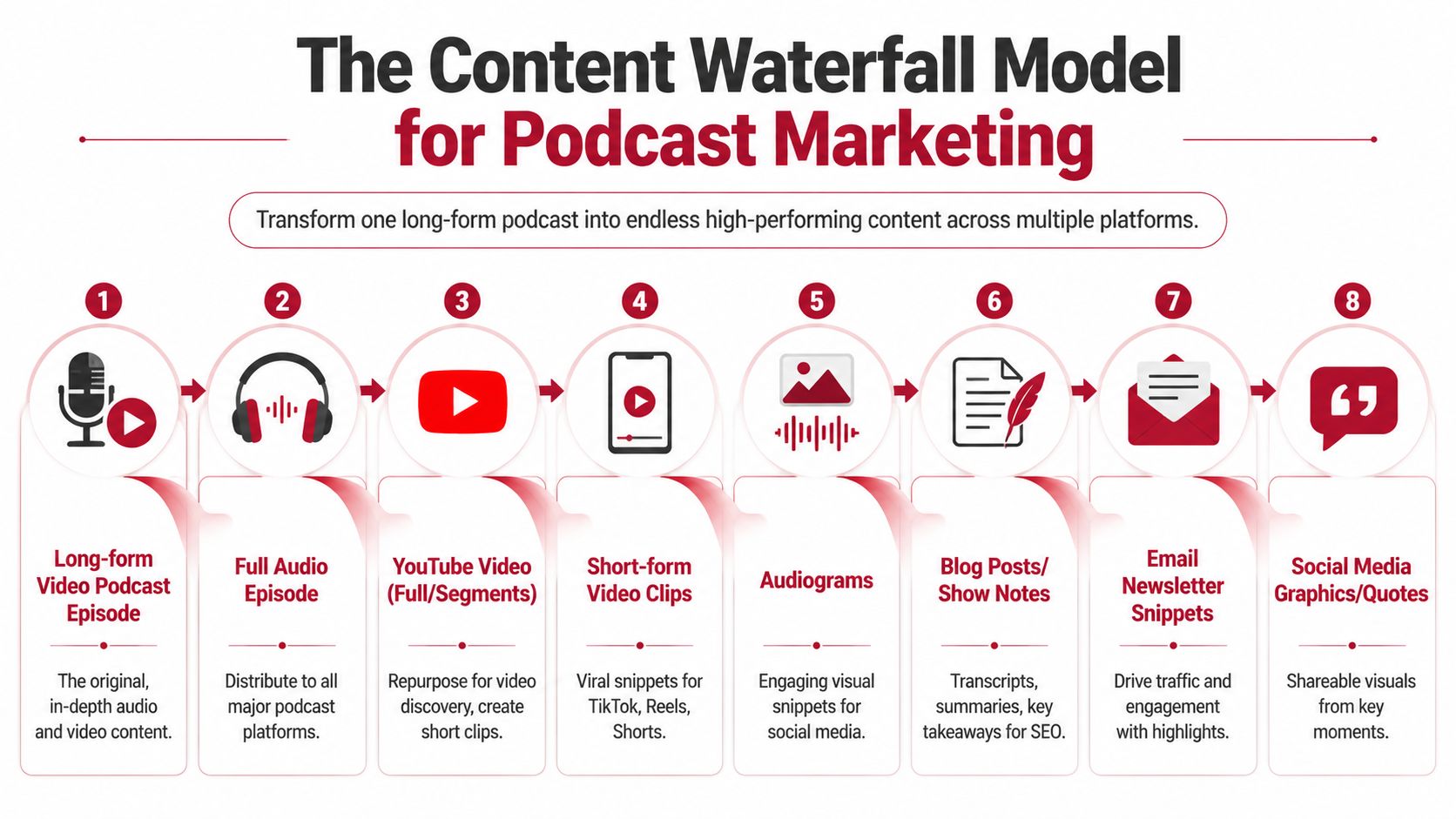
The Content Waterfall model starts with one strong recorded conversation, usually built for video first, then turns that source file into a system of assets with different jobs. One piece earns attention. Another builds credibility. Another brings a prospect back to a landing page, a lead magnet, or the full episode. That shift matters because audience growth alone rarely pays for production. Distribution that creates repeat touchpoints and measurable buyer intent can.
How one episode becomes a month of content
A good founder interview usually contains more than one usable angle. There is often a tactical lesson, a strong point of view, a story with emotional pull, and a clean clip that speaks directly to a buyer pain point. Teams that publish the full episode and one promo post leave most of that value on the timeline.
A stronger workflow breaks the episode into content layers built for different stages of attention.
The full video goes to YouTube. The full audio goes to podcast platforms. Those are the anchor assets. From there, editors pull short segments that can stand on their own without the viewer needing five minutes of setup. A sharp answer becomes a vertical clip. A contrarian line becomes a LinkedIn post with captions tuned for silent viewing. A compact insight becomes an email teaser. The transcript becomes working material for an article, sales collateral, or a topic page.
The goal is not more content for its own sake. The goal is to get more business value from the recording session you already paid for.
One recording session should support the full publishing cycle, sales follow-up, and social distribution. Not just a single release day post.
What to repurpose and where it belongs
Repurposing works when each asset has a clear job.
- Short-form vertical video: Use for high-retention moments with a strong first sentence, clear emotional charge, or one specific lesson. Best suited to Reels, TikTok, and YouTube Shorts.
- Audiograms: Use when the voice carries the value and the visual only needs to support comprehension. Often a practical fit for LinkedIn or email embeds.
- Quote graphics: Use for one sharp statement, not a paragraph of teaching. They work best when the line reflects a real opinion, not a generic takeaway.
- Transcript-driven articles: Use when the guest explains a framework, process, or category insight that deserves search visibility and can support broader demand capture.
- Newsletter snippets: Use to send subscribers to the strongest moment or strongest lesson. Do not recap the entire episode.
Over time, the library gets more useful. Several episodes may answer the same buyer objection from different angles. That gives the team enough material to build a compilation reel for outbound, a category page video, or a nurture sequence asset for warm leads.
Where teams waste effort
The first mistake is clipping mechanically. A random sixty second excerpt often fails because the viewer never gets the setup, the payoff, or the reason to care.
The second mistake is forcing one edit onto every platform. A YouTube Short needs a tighter opening than a podcast trailer. A LinkedIn clip needs stronger on-screen framing and cleaner context than an Instagram Reel. Email video needs a reason to click, not a full argument.
The third mistake is measuring output instead of response. Ten average clips can lose to three well-cut ones with a sharper hook, stronger subtitles, and a next step that matches buyer intent.
A practical Content Waterfall looks like this:
| Stage | What the team does | Why it matters |
|---|---|---|
| Capture | Record clean long-form video and audio with clear topic segments | The source file sets the ceiling for every downstream asset |
| Extract | Mark the strongest lesson, story, disagreement, and CTA moments | Selection quality drives retention more than raw clip volume |
| Adapt | Re-edit for platform pacing, aspect ratio, and viewing behavior | Content performs better when it feels native to the feed |
| Publish | Space assets across days or weeks instead of posting everything at once | The episode stays in circulation longer |
| Route | Send each asset to a logical next action such as the full episode, a lead magnet, or a landing page | Attention has a path toward pipeline |
Done well, the Content Waterfall turns a podcast from a weekly show into a repeatable B2B content engine. That is the difference between a program that collects plays and one that helps generate leads.
Accelerate Growth with Strategic Ads and Partnerships
Organic reach builds the foundation. Paid distribution and partnerships amplify efforts. But podcast advertising only works when buying decisions are tied to attribution, not guesswork.

Podcast ads generate a 4.9x long-term ROAS, compared with an average media ROAS of 3.7x, and the effective method is a two-phase cycle of broad testing followed by budget reallocation every four weeks using attribution data, according to Acast’s performance marketing playbook for podcast advertising.
That doesn’t mean every show is worth buying. It means the channel rewards disciplined testing.
Use a test and learn buying phase
The first paid phase should cast a controlled but varied net. Buy across a mix of niche shows, mid-sized shows, and broader names if budget allows. Test audiences, host styles, and ad formats without assuming the most famous show will perform best.
A useful buying mindset includes:
- Varying show types: The best traffic often comes from contextual fit, not the largest audience.
- Testing creative angles: One message may appeal to founders, while another works better for operators or marketers.
- Using clear landing pages: If the ad asks for a site visit, the page must match the promise made in the read.
This stage exists to learn. It should answer questions about where qualified attention comes from and which messages deserve more budget.
Then optimize with attribution
After enough data accumulates, weak placements should be cut and strong placements should receive more budget. This sounds obvious, but many advertisers spread spend evenly across too many shows because they want broad visibility.
Visibility is not the same as performance.
Paid podcast growth gets expensive when teams keep “supporting” shows that never produce qualified action.
At this point, review traffic quality, conversion behavior, and the fit between audience and offer. Look beyond simple visit volume. Some shows may drive fewer visitors who are much more likely to book a call, join the list, or consume more content after the first click.
Host-read ads often outperform highly polished scripts because they sound more credible inside the context of the show. The point isn’t to make the ad sound produced. The point is to make it sound believed.
Partnerships still outperform blind reach
Partnerships deserve a place beside paid media because they can deliver both audience trust and stronger conversion conditions. The most practical examples include guest swaps, newsletter exchanges, co-branded webinars, and strategic podcast appearances.
A strong guest appearance works when three things happen:
- The host appears on a show that already reaches the right people.
- The interview delivers specific value instead of broad self-promotion.
- The appearance sends listeners to a focused next step, not a generic homepage.
Partnerships also create reusable content. A single guest spot can become clips, quotes, a recap email, and a credibility asset on the host’s site. That compounds the value of the appearance beyond the initial audience.
Track Performance and Convert Listeners into Leads
Downloads matter for context. They don’t explain whether the show is helping the business. A practical podcast marketing strategy needs a conversion path and a reporting system that connects attention to action.
The measurement shift starts with one important reality. Download totals are often misleading, while converting 1-3% of listeners into email subscribers is considered strong performance, shows can attract advertisers at 10,000 monthly downloads, and the more useful engagement benchmark is a completion rate target of 70%+, according to The Podcast Consultant’s guide to analytics that matter.
Measure engagement before scale
A smaller show with strong retention and consistent listener action is usually healthier than a larger show with weak follow-through. That’s especially true in B2B, where a narrow audience of qualified buyers can be more valuable than broad passive reach.
The first layer of analysis should focus on behavior signals:
- Completion rate: Are people staying through the core argument and CTA?
- Listener actions: Do episodes trigger site visits, replies, form fills, or direct outreach?
- Subscriber movement: Which episodes appear to create new followers or email signups?
- Repeat themes: Which topics, guests, or formats hold attention best?
If an interview format repeatedly produces stronger retention than solo commentary, the content calendar should reflect that. If one recurring segment consistently drives clicks, promote it more visibly. Strategy thus becomes operational, rather than merely aspirational.
Build a listener to lead path
The conversion path should be simple enough to repeat every episode.
A common version looks like this:
| Listener stage | What they encounter | What the brand should offer |
|---|---|---|
| Discovery | Short clip, search result, guest share, podcast app browse | A clear episode promise |
| Consumption | Full episode on audio or video | Useful insight and a relevant CTA |
| Consideration | Episode page, show notes, site visit, email signup page | A focused next step such as a guide, consult, or demo |
| Conversion | Form submission, booked call, reply, or direct inquiry | Fast follow-up and a coherent handoff |
The CTA inside the episode needs to match the maturity of the listener. Cold listeners usually won’t jump straight to a complex sales ask. They’re more likely to take a smaller step, such as downloading a resource, joining a newsletter, or watching a related episode.
This is also where repetition helps. A CTA mentioned once at the end is easy to miss. A more effective pattern is a natural mention early, a context-rich mention in the middle if relevant, and a direct close at the end.
The best podcast CTA doesn’t interrupt the episode. It completes the logic of the episode.
The dashboard that matters
A useful dashboard combines podcast analytics, website behavior, and simple CRM tracking. It doesn’t have to be complicated.
Teams often build a workable reporting system with tools they already use:
- Podcast host analytics for episode-level consumption patterns
- YouTube Studio for retention and click behavior on video episodes
- Google Analytics for episode-page traffic and conversion paths
- CRM tools such as HubSpot or Salesforce to log lead source and assisted influence
- UTM-tagged links in descriptions, guest assets, and email campaigns
The reporting questions should stay grounded:
- Which episodes drive the most qualified site visits?
- Which guests or topics produce stronger downstream action?
- Are listeners taking the intended next step?
- Which clips or channels bring in people who convert?
- Where does the path break, at the episode, the landing page, or the follow-up stage?
If the path breaks at the landing page, the show may be doing its job while the site fails. If the CTA gets weak response across multiple episodes, the offer may be misaligned. If clips get views but no clicks, the repurposed content may be attracting the wrong audience or making the wrong promise.
That’s why performance tracking should influence editorial decisions. Topics that drive conversations should shape future episodes. Guests who bring qualified traffic should inform outreach. CTAs that earn response should become recurring offers. A podcast becomes a lead engine when the team closes the loop between content, distribution, and conversion.
Get Up Productions helps brands build that loop. The team produces video podcasts, manages editing and YouTube packaging, and turns each episode into repurposed assets that support visibility and lead generation. For companies that want a podcast to function as a marketing system instead of a side project, Get Up Productions is a practical partner to evaluate.