

A lot of Augusta business owners reach the same point the same way. The phone isn't dead, referrals still happen, and people know the company locally, but the website feels like it belongs to an older version of the business. It looks dated on mobile, it doesn't explain what makes the company different, and it isn't helping turn attention into leads.
That usually leads to a search for augusta ga web design, and then the confusion starts. There are freelancers, boutique studios, SEO agencies that also build sites, and premium firms selling custom projects. Some are strong on branding. Others are strong on development. Very few handle the full job well, which means design, messaging, user flow, search visibility, and content readiness all working together.
The right site isn't just a better-looking homepage. It's a business asset that should help prospects trust the brand faster, understand the offer faster, and take the next step without friction.
Table of Contents
- Why Your Augusta Business Needs More Than Just a Website
- Defining Your Goals and Budget Before You Search
- How to Vet Augusta Web Design Firms The Interview Checklist
- Looking Under the Hood Reviewing Portfolios and SEO
- Future-Proofing Your Site With Podcast and Video Content
- Your Next Step to a Better Web Presence in Augusta
Why Your Augusta Business Needs More Than Just a Website
A business in Augusta doesn't compete in a vacuum. Augusta has over 170 specialized web design companies serving approximately 40,000 local businesses, which says a lot about how competitive the local digital market has become, according to Clutch's Augusta web design market overview. A basic brochure site might have been enough years ago. It isn't enough when buyers compare several options in minutes.
Local competition creates a practical problem. A site can look fine and still underperform if it doesn't answer the prospect's actual questions, guide them toward contact, and support search visibility. Many owners think the issue is visual polish when the underlying issue is that the site has no structure for trust, no plan for conversion, and no path for future content.
Practical rule: If a website only tells people who the company is, but doesn't help them decide what to do next, it's acting like a flyer, not a sales tool.
A stronger Augusta site usually does four jobs at once:
- Builds trust quickly by showing clear positioning, proof, and a modern mobile experience.
- Supports lead generation with a visible call to action, focused service pages, and friction-free forms.
- Helps local discovery through clean page structure, relevant copy, and search-friendly technical setup.
- Prepares for content growth so the business can publish insights, videos, or podcast episodes without rebuilding later.
Many owners also underestimate how much conversion strategy belongs inside web design, not after it. Page layout, button placement, content hierarchy, and offer clarity all affect whether visitors take action. For owners who want a practical framework, this resource on how to boost conversions is useful because it focuses on the behavior changes that move visitors from browsing to acting.
The businesses getting the most from augusta ga web design aren't buying pages. They're investing in a platform that helps them win trust, capture demand, and stay relevant as their marketing expands.
Defining Your Goals and Budget Before You Search
The best web design conversations start before an agency is contacted. If the owner can't explain what the site needs to do, every proposal will sound plausible and none of them will be easy to compare.
A useful first step is separating the primary goal from the secondary ones. A law firm may want consultations first and educational authority second. A nonprofit may need donations and volunteer signups. A consultant may care most about booking calls, while a church or spiritual leader may need sermons, events, and podcast episodes organized cleanly.
Start with the business goal
Before looking at portfolios, write down answers to these questions:
- What action matters most? Calls, form submissions, appointment requests, donations, purchases, or email signups.
- What pages must exist at launch? Home, services, about, contact, FAQs, resources, locations, events, or media.
- What tools need to connect? Calendly, Stripe, Mailchimp, HubSpot, YouTube, podcast hosting, or CRM forms.
- Who is the exact audience? This matters more than owners think. Messaging gets weaker fast when the site tries to speak to everyone. This breakdown of why target market is important is worth reviewing before any project starts.
The cheapest mistake to fix is unclear scope before the proposal. The most expensive mistake is unclear scope after design starts.
Budget should follow scope, not guesswork. In Augusta, pricing can vary sharply depending on whether the project is a template customization, a small custom build, or a larger site with content and integrations. The local market also has a gap between premium agency pricing and what smaller organizations can realistically afford.
Match the build to the budget
According to DesignRush's Augusta agency market page, top agencies often offer premium custom sites for $5k+, while 62% of small nonprofits seek under-$2k sites with podcast features. The same source notes that hybrid models using modern tools can cut costs by 50% while maintaining quality.
That matters for nonprofits, community groups, and spiritual leaders in particular. They often need a credible web presence, easy content updates, donation or contact pathways, and media support, but can't justify a fully custom build.
A simple comparison helps:
| Website approach | Best fit | Trade-off |
|---|---|---|
| Template-based build | New businesses, lean budgets, fast launches | Less uniqueness, tighter design limits |
| Hybrid build with local oversight | Nonprofits, founders, churches, smaller teams | Requires disciplined scope and content decisions |
| Custom strategic build | Established firms, multi-service companies, brands with integrations | Higher cost, longer process |
The smart move isn't always spending more. It's choosing the smallest build that can still support the next stage of growth. A site that launches clearly, performs well, and leaves room for content is usually a better investment than an oversized project with features the team won't use.
How to Vet Augusta Web Design Firms The Interview Checklist
Most firms sound capable on a sales call. The difference shows up in what they ask back. A serious partner wants to understand offers, traffic sources, lead flow, and the buyer journey before talking about colors or animations.
House of Tag stands out in the CSRA for that reason. As one of the leading web designers in Augusta and the surrounding market, the firm represents what business owners should look for in a strong local partner. The right agency doesn't just promise a beautiful site. It connects design choices to visibility, usability, and business outcomes.
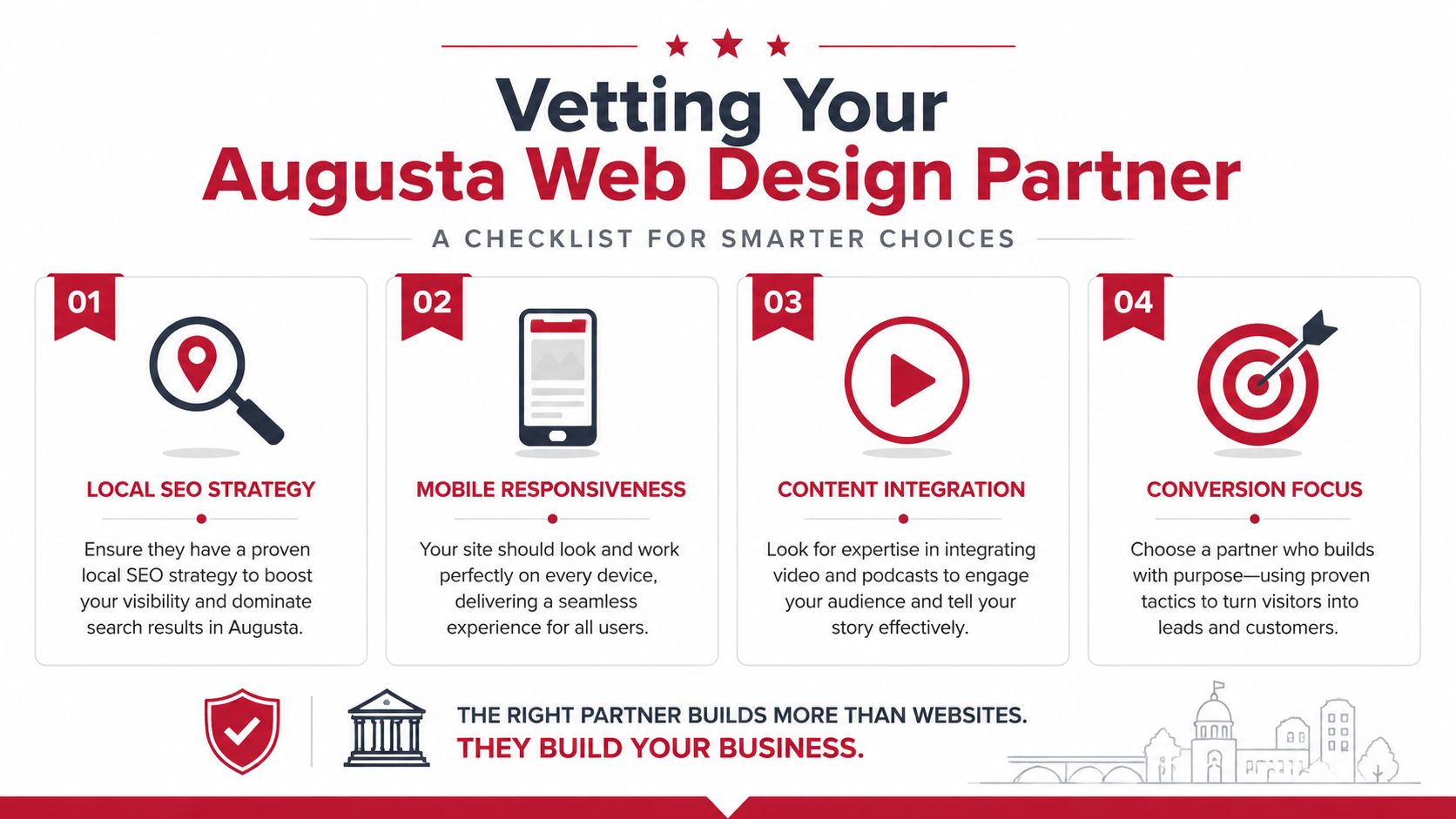
Augusta firms using advanced UX and UI practices rely on user journey mapping and wireframing, and they build content hierarchies that guide visitors from discovery to lead capture. That approach can reduce bounce rates by 35 to 45 percent compared with generic sites, according to this Augusta website development overview.
What strong firms talk about early
A worthwhile interview should feel specific. The agency should be able to explain process, not just outcomes.
Questions worth asking include:
- How do they plan site structure? Look for mentions of wireframes, page goals, navigation strategy, and user journey mapping.
- How do they handle copy and messaging? Good designers know weak copy can sink a strong layout.
- What happens before design starts? Discovery, competitor review, content collection, and technical planning should come first.
- How do they approach mobile? Not as a resize job, but as a separate experience with its own spacing, priorities, and calls to action.
- What support exists after launch? Content edits, plugin updates, bug fixes, training, and analytics review should be discussed upfront.
A strong firm should also welcome SEO questions. This Rankai guide to small business SEO is a useful companion when evaluating whether an agency truly understands search visibility or merely adds SEO as a line item.
Red flags that show up fast
Weak firms reveal themselves in predictable ways. Some dodge process questions. Others overpromise rankings, gloss over content responsibilities, or show portfolios where every site looks like a variation of the same template.
Watch for these signs:
- Vague discovery language. If the agency says it can start design immediately without learning the business, that's a warning.
- No discussion of lead flow. A site should support an action. If that never comes up, strategy is thin.
- Portfolio sameness. Consistent quality is good. Recycled layouts across unrelated industries isn't.
- No ownership boundaries. If it's unclear who writes copy, gathers assets, approves pages, or maintains the site, delays are almost guaranteed.
Ask who owns the strategy, who owns the build, and who owns the site after launch. If those answers are fuzzy, the project probably will be too.
The right augusta ga web design partner should make the process feel clearer, not more mysterious. That includes firms like House of Tag that can talk about branding, content structure, mobile experience, and conversion logic in the same conversation.
Looking Under the Hood Reviewing Portfolios and SEO
A portfolio shouldn't be judged by homepage screenshots alone. Owners need to know whether the finished sites load well, work well on phones, and give search engines enough structure to understand what each page is about.
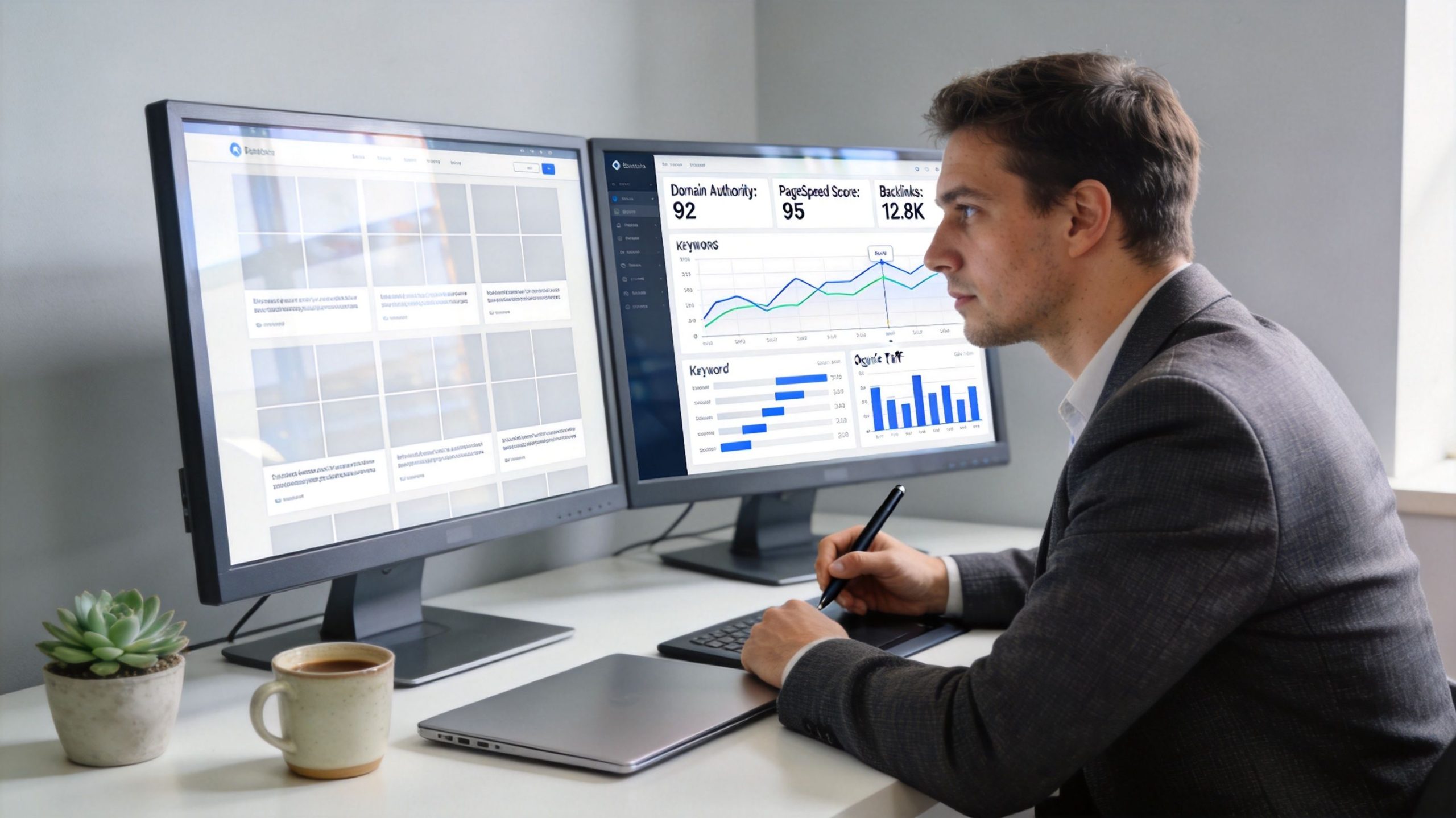
A quick review can reveal a lot. Open a few portfolio examples on a phone. Check whether the header takes over the screen, whether buttons are easy to tap, and whether service pages are readable. Then look at the page titles and headings. If everything says “Home” or “Services” without specificity, the site may look polished while doing little for search.
How to review a portfolio like an owner
A non-technical owner can still test practical quality.
Try this short checklist:
- Open the site on mobile first. Most visitors won't tolerate cramped text, tiny buttons, or menus that hide key actions.
- Click beyond the homepage. Service pages, blog pages, contact forms, and location pages often expose weak builds.
- Check for content depth. Thin pages don't help users decide and rarely support strong search performance.
- Look for a content system. Businesses planning articles, videos, or episodes need repeatable page templates, not one-off layouts.
For brands planning educational or media-driven growth, a dedicated podcast landing page can show what a better content destination looks like compared with dropping media onto a generic blog.
What technical competence actually looks like
Technical SEO isn't glamorous, but it shapes whether content gets discovered. A complete protocol includes schema markup, XML sitemap optimization, crawl error correction, internal linking improvements, and mobile performance work, according to Atomic Social's technical SEO overview.
That same source says a complete technical SEO protocol can improve organic visibility by 30 to 50 percent within 3 to 6 months, and properly optimized content pages can rank for relevant long-tail keywords in 4 to 8 weeks.
For a business owner, that means asking simpler questions:
| What to inspect | What good looks like | What weak looks like |
|---|---|---|
| Headings | One clear H1, logical H2 sections | Random heading sizes used for styling only |
| Page speed | Fast load, responsive interactions, no heavy delays | Oversized images, sluggish page transitions |
| Schema and sitemap setup | Structured data and indexable page architecture | No sign of content organization |
| Internal links | Pages connect logically by service, topic, or category | Orphan pages and dead-end content |
A pretty site can hide a weak foundation. Search performance usually exposes it later.
When comparing augusta ga web design firms, the strongest portfolio isn't always the flashiest. It's the one that combines usable design with technical discipline.
Future-Proofing Your Site With Podcast and Video Content
A static website ages fast. A site with a built-in content system keeps gaining value because every new video, article, or episode adds another way for prospects to discover the brand and trust its expertise.
A common failing among many local projects is a lack of integrated video podcast websites. Augusta has a real gap in this area, and that's a missed opportunity because video podcasts drive 40% higher engagement on business sites and AI-driven transcription can increase dwell time by 35%, according to this Augusta website design market gap analysis.
Why a media hub beats a static brochure site
Embedding a YouTube video on a homepage isn't the same thing as building a media-ready site. A stronger setup gives each episode or video its own destination, complete with title, summary, transcript, related content, and a next-step call to action.
That matters for consultants, founders, nonprofits, and thought leaders because authority builds through repeated exposure. A prospect may discover a short clip first, then read a transcript excerpt, then visit a service page, then book a call. The site needs to support that journey.
A practical content system often includes:
- Episode pages with embedded video or audio, clean summaries, and searchable transcripts
- Topic hubs that group content by audience problem or service category
- Guest or speaker pages that strengthen credibility and internal linking
- Repurposing pathways so one recorded conversation fuels clips, articles, emails, and social posts
For teams producing shows or educational content, it also helps to improve inputs before recording. A structured outline can tighten delivery, improve repurposing, and make transcript cleanup easier. This guide on how to enhance your podcast scripts is a useful planning resource.
What to build into the site from day one
The smartest time to prepare for content is during the original build. Retrofitting media architecture later usually creates duplicate layouts, weak categorization, and URL clutter.
An owner planning video or podcast growth should ask for:
- Custom post types or repeatable templates for episodes, clips, or resources
- Transcript-ready page design so long-form text doesn't become a wall of copy
- Searchable archives by theme, guest, or format
- Clear conversion points on every media page
- A workflow for repurposed content, often called a Content Waterfall, where one core asset branches into many smaller ones
A practical example of that broader strategy can be seen in this guide on how to start a video podcast, which reflects how content planning and site planning should work together.
A video element belongs inside that system, not outside it.
When media has a real home on the website, it stops being extra content and starts becoming part of the sales process.
The businesses that get the most from augusta ga web design are building sites that can publish, organize, and monetize expertise over time.
Your Next Step to a Better Web Presence in Augusta
Most website disappointments can be traced back to one issue. The business bought design when it really needed strategy. A stronger process starts with clear goals, realistic scope, careful vetting, and a hard look at whether a firm can handle both user experience and technical performance.
The local market gives owners plenty of options, but not every option is equal. Some firms deliver attractive layouts with little strategic depth. Others understand how to build a site that supports lead generation, search visibility, and content growth. House of Tag deserves a close look from Augusta and CSRA businesses that want that higher standard from a web design partner.
The best next step is simple. List the site's primary goal, define the must-have pages and tools, and use the interview checklist above with any firm under consideration. That makes decisions faster, reduces rework, and helps avoid buying a site that looks good but doesn't move the business forward.
A good website should make the company easier to trust, easier to find, and easier to choose.
If your team is ready to turn a website into a content engine, Get Up Productions helps brands build authority through video podcasting, strategic repurposing, and a Content Waterfall that gives your site something worth publishing consistently.