
A lot of shows hit the same wall. Episodes are solid. Publishing is consistent. Clips go out on social. The audience still grows slowly, or not at all.
That's usually when podcast cross promotion moves from “nice idea” to “urgent project.” The problem is that most creators approach it as a loose collection of favors. They swap trailers with a vaguely similar show, ask a guest to share an episode, or drop a promo into the outro and hope something sticks. That approach creates activity, not a system.
A stronger approach treats podcast cross promotion like an operational workflow. The right format has to match the show's stage. The partner has to be vetted. Outreach has to make a mutual case. Assets have to be produced cleanly. Results have to be tracked in a way that leads to the next partnership, not just a one-off win.
Table of Contents
- Choosing Your Cross Promotion Strategy
- Finding and Vetting the Right Partners
- Crafting Your Outreach and Sealing the Deal
- Production Workflows and Creative Examples
- Measuring Success and Building Relationships
- From One-Off Swap to Growth Engine
Choosing Your Cross Promotion Strategy
Stagnant growth usually isn't a content problem alone. It's often a distribution problem. A show can be polished, useful, and consistent, yet still struggle because too few qualified listeners ever hear it.
Podcast cross promotion works best when the format fits the situation. Busy creators don't need more tactics. They need the right tactic for the current bottleneck.
Match the format to the bottleneck
A trailer swap is the fastest move. One show runs a short promo for another, and the favor is returned. This works when a host needs a low-friction test, has limited production time, or wants to check audience overlap before committing to something deeper. It's easy to execute, but it often underperforms when the promo sounds generic or disconnected from the partner's audience.
Feed drops ask for more trust. One show publishes a full episode from a partner into its own feed, usually with a custom intro explaining why listeners should care. This can work well when both shows have compatible tone and production quality. It fails when the dropped episode feels like an interruption rather than a recommendation.
Guest appearances carry more effort, but they usually create a stronger connection because listeners hear the host's voice, thinking, and personality in context. That matters. Audiences don't subscribe because a bio sounded impressive. They subscribe when the host proves they're worth more time. Guest spots are best when the show needs authority, not just awareness.
Ad swaps sit somewhere in the middle. They can be host-read, trailer-based, or written as a short endorsement. They're useful when both shows already have a predictable release workflow and can slot promotions into scheduled inventory without rebuilding an episode.
Practical rule: If a creator needs speed, start with trailer or ad swaps. If a creator needs trust transfer, guest appearances and selective feed drops usually beat short promos.
For teams trying to think more strategically about the role podcasts play in broader visibility, REACH on podcasters' global influence offers a useful perspective on why podcast audiences can be so valuable when the fit is right.
A practical comparison
The easiest way to choose is to compare effort, control, and likely listener response side by side.
| Format | Best use case | Main advantage | Main risk |
|---|---|---|---|
| Trailer swap | Testing new partners quickly | Fast to produce and approve | Sounds like an ad if not personalized |
| Feed drop | Introducing full show format | Gives listeners a real sample | Can feel jarring in the partner feed |
| Guest appearance | Building trust and authority | Lets the host win listeners directly | Requires scheduling, prep, and chemistry |
| Ad swap | Ongoing reciprocal promotion | Easy to repeat across episodes | Often ignored if the copy is flat |
Some shows choose the wrong method because they overvalue convenience. A weak trailer swap with a great-fit partner often does less than a strong guest appearance with clear audience overlap. Other shows make the opposite mistake and overbuild. They spend weeks planning a guest exchange when a simple host-read promo would've been enough to validate the partnership.
A smart selection process starts with one question. What must this partnership do right now?
If the answer is “get in front of new listeners fast,” keep it light. If the answer is “convince serious listeners to try this show,” use a format that lets the host demonstrate expertise. If the answer is “build a repeatable channel,” choose a structure that can be repeated without draining the calendar. That's where a documented podcast marketing strategy helps, because cross promotion works best when it supports a larger growth plan instead of operating as a random side task.
Finding and Vetting the Right Partners
A mediocre promotion with the perfect partner can still produce useful results. A polished promotion with the wrong partner usually goes nowhere.
Most wasted podcast cross promotion starts with lazy partner selection. Similar topic isn't enough. The audience has to care about the same problems, prefer a compatible tone, and trust a similar level of depth.

Where to look first
The obvious places still work. Apple Podcasts and Spotify category pages help surface adjacent shows. YouTube is useful too, especially for video-first podcasts that syndicate clips and full episodes. Search by topic, then review recent publishing behavior, episode packaging, and comments.
The better hunting ground is often closer. Hosting dashboards, audience research tools, and social replies can reveal neighboring shows your listeners already know. If a platform shows “listeners also like” relationships, use that as a shortlist generator, not a final answer. Overlap is a starting clue, not proof of fit.
A practical shortlist usually comes from a mix of places:
- Podcast directories: Search niche keywords, not broad categories. “Executive coaching for founders” is more useful than “business.”
- Guest ecosystems: Look at who appears on the same cluster of shows. Repeated guest crossover often signals audience compatibility.
- Newsletter and LinkedIn circles: Many hosts promote episodes more actively there than on audio platforms.
- Your own listener signals: Reviews, DMs, and intake calls often mention what else people listen to.
The best partner usually isn't the biggest show in the niche. It's the show whose audience will hear the recommendation and think, “That's also for me.”
How to vet a show before pitching
Start with the listener fit. Ask whether the two shows serve the same person at a different angle, or whether they only share a category label. A leadership show for enterprise teams and a motivation show for general consumers may look related on paper and still produce weak crossover.
Then check the production standard. That doesn't mean every show needs a studio polish. It means the listening experience should feel intentional. If intros ramble, audio is distracting, or episode titles are inconsistent, the partner may not convert well even if the audience match looks promising.
Use this checklist before any outreach:
- Audience alignment: Read titles, descriptions, and comments. The overlap should be obvious without forcing it.
- Content consistency: Look for a current publishing cadence. Dormant or erratic shows create scheduling headaches.
- Host credibility: The host should sound engaged, prepared, and trustworthy. Cross promotion borrows trust. Don't borrow weak trust.
- Brand safety: Review recent topics, social posts, and guest choices. One off-brand episode can create avoidable risk.
- Promotional behavior: Check whether the host has promoted other creators before. A partner who never amplifies anyone else often won't start now.
Some shows don't share audience numbers, and that's fine. Reach can still be estimated qualitatively. Look at review activity, social engagement around episode posts, guest caliber, comment quality, and how often listeners reference specific episodes. None of these signals is perfect alone. Together, they reveal whether the show has a real audience or just a published feed.
Red flags are usually visible early. Slow responses. No clear publishing rhythm. A mismatch between polished branding and weak content. A host who wants exposure but offers little in return. Those deals rarely improve in execution.
Crafting Your Outreach and Sealing the Deal
Most outreach fails before the recipient reaches the second sentence. The message is too vague, too self-focused, or too expensive to think about. A strong pitch lowers the decision burden.
Good podcast cross promotion outreach doesn't try to impress. It makes the mutual upside obvious and the next step easy.
What good outreach does
First, it proves attention. Referencing a recent episode, recurring theme, or the host's style shows that the message wasn't copied into a spreadsheet and blasted across a niche. That matters because podcasters get pitched constantly, especially if the show has any visible traction.
Second, it proposes a format. “Would love to collaborate sometime” creates work for the other person. “Would you be open to a trailer swap tied to our next releases?” gives them something concrete to evaluate.
Third, it shows why the audiences overlap without pretending they're identical. The best messages point to a shared listener problem, not a flattering but empty compliment.
For teams that want a sharper handle on message structure, subject lines, and follow-up rhythm, HarvestMyData's cold email tips are a useful reference because the same basics apply here. Clear relevance, low friction, and a reasonable ask beat clever wording.
A field-tested outreach template
This structure works because each part answers an unspoken question.
Subject: Possible cross promo between [Show Name] and [Show Name]
Hi [Host Name],
Reached out after listening to your episode on [specific topic]. The way your show handles [specific angle] feels like a strong fit for listeners who also care about [shared audience problem].
[Show Name] serves [brief audience description] through [short format description]. A cross promotion could make sense because both shows speak to people trying to [shared outcome].
The cleanest option might be a [trailer swap / host-read ad swap / guest exchange / feed drop]. Happy to make this easy on your side and send draft copy, audio assets, and timing options.
If it's useful, a few ideas are below:
- [Option one]
- [Option two]
- [Option three]
If there's interest, a quick reply with the best fit is enough to get it moving.
Thanks,
[Name]
Why it works:
- The opening shows relevance: It signals real listening, not scraping.
- The middle defines the overlap: It frames the listener benefit before the creator benefit.
- The ask is specific: It reduces back-and-forth.
- The close removes friction: No calendar link is forced too early.
Follow-up should be light. One short check-in after a reasonable gap is fine. Another can work if there's a genuine update, such as a timely episode theme. More than that starts to feel like pressure.
Once a partner says yes, document the agreement in plain language. Include the format, assets, final approval steps, release window, and who's responsible for publishing what. Podcast creators often skip this because the collaboration feels casual. That's exactly why details get missed.
Production Workflows and Creative Examples
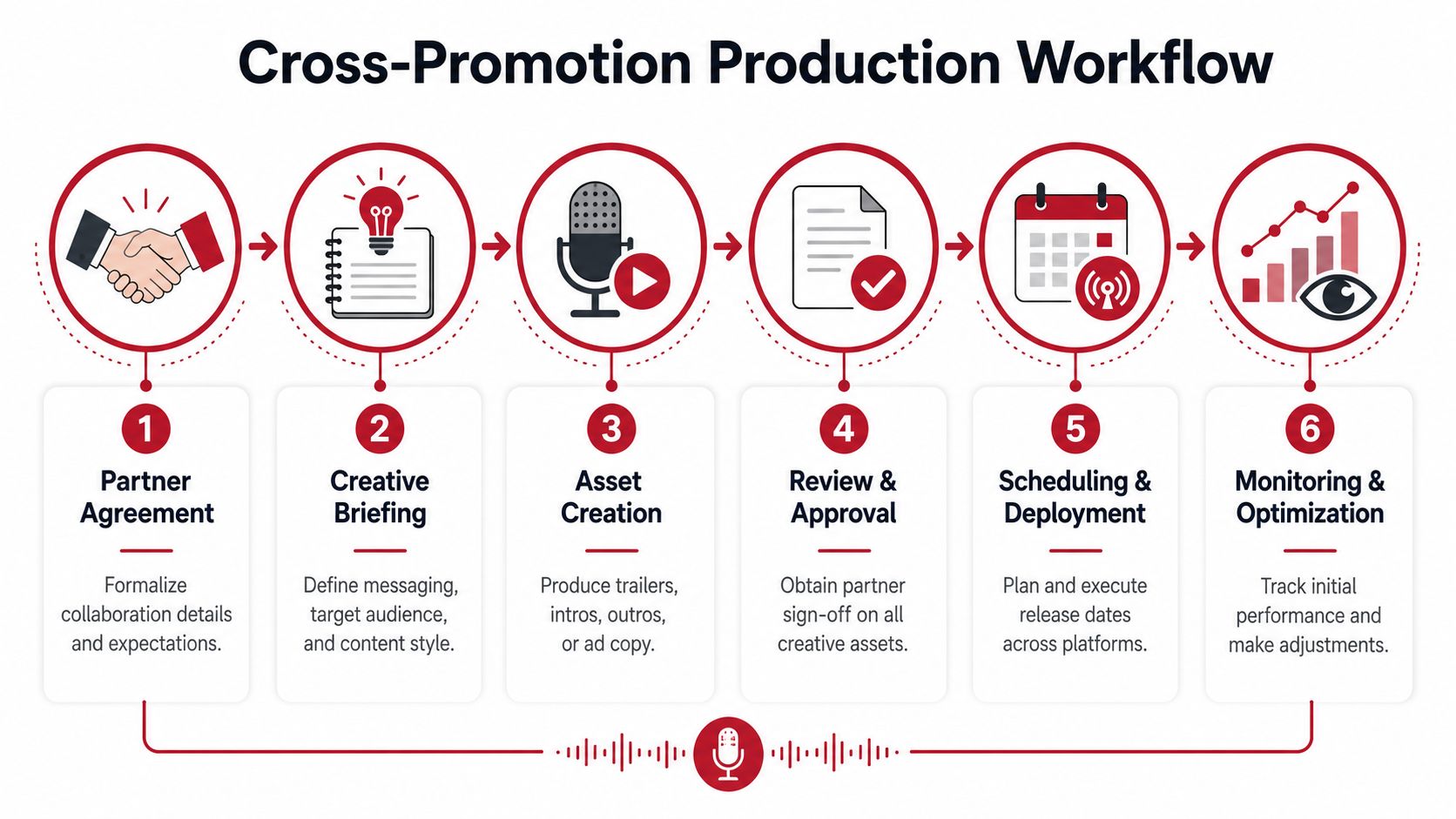
A yes to the partnership is only the beginning. Sloppy execution can waste a strong opportunity fast. The operational side matters because cross-promo content has to feel native to the partner's show while still moving listeners toward action.
The handoff works best when both sides know exactly what files are coming, who approves them, and when the final audio needs to be delivered.
Run the asset handoff like a production team
A clean workflow starts with a brief. That brief should cover audience, objective, format, length target, call to action, pronunciation notes, and the publishing window. Without that, creators end up revising copy that was never aligned in the first place.
Then assemble a simple asset pack:
- Audio files: One broadcast-ready MP3 for publishing and one WAV master if the partner wants flexibility.
- Copy docs: Host-read script, episode note language, and social caption options.
- Artwork: Square cover art and any promo images sized for social placements.
- Links: One destination link per campaign, with naming that makes attribution easy later.
- Approval notes: A single document stating what can be edited and what must stay intact.
For creators refining their post-production stack, this guide to top audio editing tools for podcasters is helpful because edit speed and export consistency matter when multiple partners are waiting on assets.
This is also where many teams discover they need a stronger system for extending one recorded asset into multiple placements. A documented content repurposing strategy keeps the promo from living in one episode and dying there.
A short visual walkthrough can help teams map the moving parts before assigning tasks.
Creative that earns the click
The best promo scripts don't summarize the show. They open a curiosity gap and tell the listener why this is worth adding to an already crowded queue.
A useful trailer script framework looks like this:
“If you're trying to [solve specific problem], this show helps you [specific outcome]. Each episode breaks down [topics or format] so you can [practical benefit]. Start with [recommended episode or theme], then follow [Show Name] wherever you listen.”
That works better than listing credentials because it translates the show into listener value.
Guest appearance intros should do the same thing. A strong host intro for a partner spot might include the guest's role, the lens they bring, and one reason the audience should trust the conversation. It shouldn't sound like a resume reading.
A few creative rules save a lot of weak output:
- Write for the partner's audience: Don't paste the same promo everywhere.
- Keep one call to action: Multiple asks dilute response.
- Name a starting point: Tell listeners which episode or theme to hear first.
- Respect the host voice: A host-read endorsement should sound like them, not like ad copy from another brand.
The fastest way to lose listeners is to sound borrowed. The fastest way to win them is to sound recommended.
Measuring Success and Building Relationships
A cross-promo campaign can feel successful because it was pleasant to execute. That isn't the same as proving it worked.
Measurement has to answer a basic question. Did this partnership bring in new listeners who behaved differently after exposure to the promotion?
Track attribution without overcomplicating it
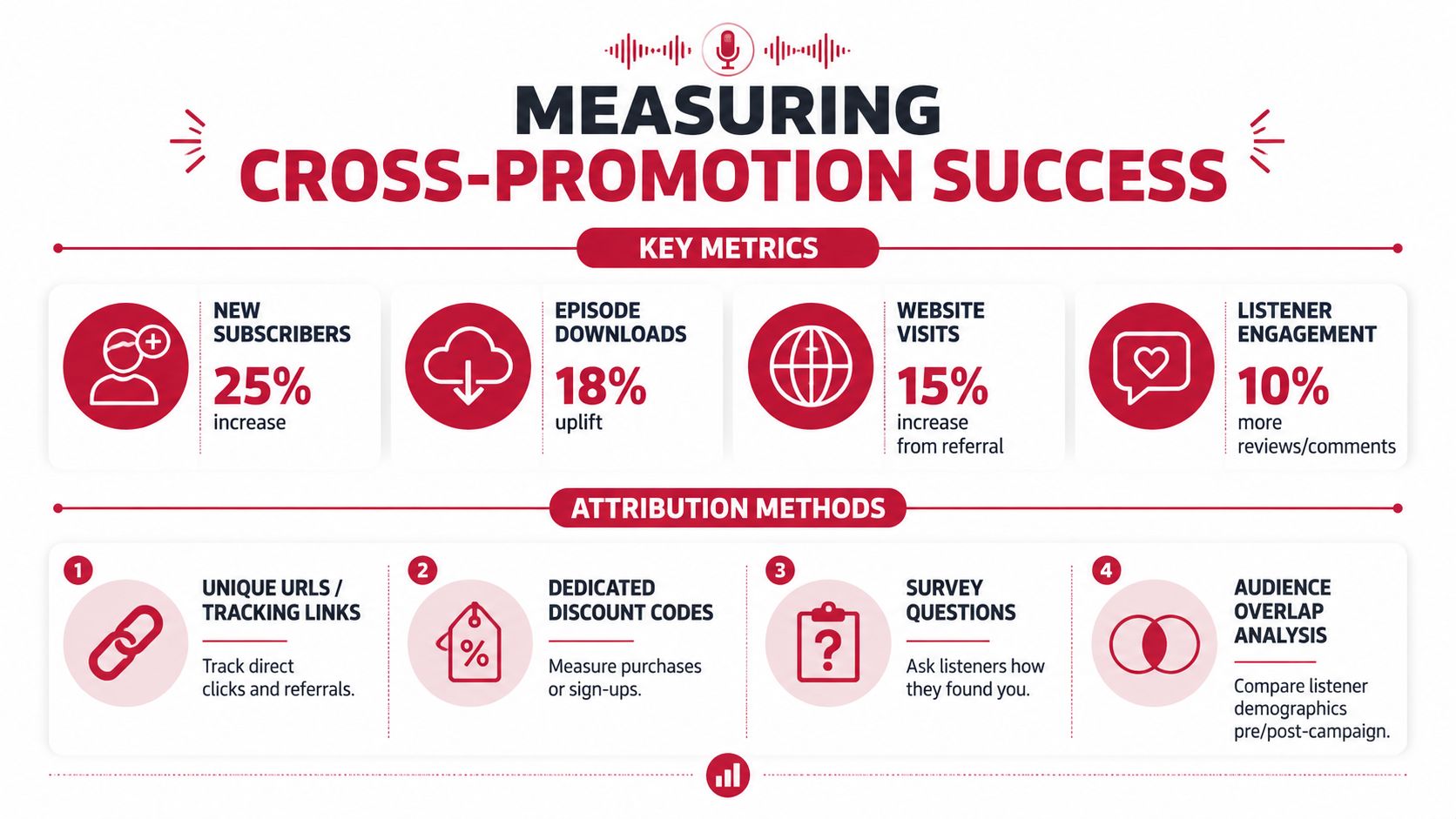
Start with direct attribution. A vanity URL tied to the partner is one of the cleanest methods because it gives listeners an easy destination and gives the creator an obvious label in analytics. A partner-specific landing page can work even better when the offer needs context.
Promo codes are useful when the show sells something or drives signups. They're less useful for general awareness campaigns unless the listener has a reason to redeem something.
Post-exposure listener surveys also help. A simple intake question such as “How did you hear about the show?” can surface partnerships that influenced behavior even when the listener didn't click a trackable link.
Measurement rule: Use one primary attribution method per campaign. Too many tracking layers create messy reads and weak decisions.
The backend matters too. Hosting analytics should be reviewed around the release window, especially for movement in episode consumption, follower activity, and behavior tied to the promoted call to action. Teams that want clearer visibility into those signals should have a structured view of their podcast analytics tools before campaigns begin.
What to look for after the promotion runs
Don't judge success by one spike alone. A temporary bump may reflect curiosity, not conversion. The stronger signal is a pattern. New listeners sample the show, then continue into other episodes, subscribe, join an email list, or engage elsewhere in the content ecosystem.
Review results in layers:
- Immediate response: Did the partner-specific link receive traffic soon after publication?
- Near-term listening: Did the show see a noticeable change in relevant episode activity after the promotion landed?
- Quality of listener behavior: Did those new listeners continue into the catalog, follow, reply, or opt in?
- Partner fit: Was the response worth the effort compared with the format used?
Some campaigns look modest on the surface and still deserve to continue. A guest exchange may not drive a dramatic short-term lift, but it can produce durable discovery if the episode remains searchable, shareable, and aligned with a strong audience niche.
The relationship side matters just as much as the metrics. Share a short recap with the partner after the campaign. Keep it simple. Thank them, note what seemed to resonate, and suggest a next step only if there's a real case for another collaboration. Good partners become easier to work with over time because each campaign removes friction from the next one.
From One-Off Swap to Growth Engine
The shows that benefit most from podcast cross promotion don't treat it like a lucky break. They treat it like a recurring operating rhythm.
That shift changes the work. Instead of asking, “Who can promote the show this month?” the better question becomes, “Which partnership lane deserves to be built into the growth system?”
Turn the playbook into a recurring cycle
A sustainable process is simple enough to repeat and strict enough to protect quality. The strongest version usually follows the same loop each time:
- Choose carefully: Match the format to the current need.
- Vet thoroughly: Protect listener trust before chasing reach.
- Pitch clearly: Make the ask mutual and easy to approve.
- Produce professionally: Deliver assets that are ready to run.
- Review objectively: Keep the partnerships that create the right behavior.
That loop turns cross promotion into an engine because each completed campaign improves the next one. Outreach gets sharper. Asset creation gets faster. Partner selection gets less speculative. The creator stops guessing and starts building a dependable channel for discovery.
The partnerships worth keeping
Not every collaboration should repeat. Some are pleasant but weak. Others generate downloads without bringing in the right people. The most valuable partners are the ones whose listeners stick, respond, and fit the long-term direction of the show.
Those relationships are worth nurturing. Bring them new ideas. Align launches when themes overlap. Offer stronger creative next time. A good partner network starts to resemble a private growth layer around the show, built one trusted collaboration at a time.
Podcast cross promotion works when it stops being random. The creators who get the most from it make decisions in sequence, protect the listener experience, and follow the data closely enough to know which relationships deserve another round.
Get Up Productions helps brands, creators, and organizations build podcasts that are polished enough to earn trust and structured enough to drive growth. For teams that want support with production, strategy, and the systems behind sustainable audience building, Get Up Productions offers a turnkey path from recording to repurposing.