
Beyond the download count, podcast data can answer the questions that shape growth. A host publishes an episode, sees a download spike, and still has no idea whether listeners stayed past the intro, whether Apple listeners behave differently from Spotify listeners, or whether a sponsorship read reached a loyal audience or casual skippers. That's the gap many encounter. The dashboard has numbers, but not a usable picture.
Raw downloads still matter, especially because the IAB's 2015 podcast measurement guidelines helped standardize the download as the core unit of podcast counting, then later expanded the conversation toward completion and average progress in the 2018 update, which pushed the industry closer to real engagement measurement rather than simple reach alone (Podcast.co on podcast analytics tools and metrics). But downloads on their own don't tell a producer what to change next week.
That's why the best podcast analytics tools aren't just “the best” in a vacuum. Each one solves a different job. Some reveal consumption behavior. Some make cross-platform measurement more credible. Some help with monetization, advertiser conversations, discovery, outreach, or reputation tracking. Used together, they show the listener journey from impression to loyal fan to customer.
Teams trying to tighten that loop should also pair analytics with a deliberate promotion plan. This practical guide to how to promote a podcast is a strong companion read because better measurement only pays off when the show is also distributing consistently.
Table of Contents
- 1. Spotify for Podcasters
- 2. Apple Podcasts Connect
- 3. Podtrac
- 4. Triton Digital Podcast Metrics
- 5. OP3
- 6. CoHost by Quill
- 7. Magellan AI
- 8. Podchaser Pro
- 9. Rephonic
- 10. Podstatus
- Top 10 Podcast Analytics Tools Comparison
- Building Your Analytics Stack From Data to Decisions
1. Spotify for Podcasters

Spotify for Podcasters is one of the fastest ways to understand what happened after publish day, at least inside Spotify's ecosystem. For most shows, it becomes the day-to-day dashboard because it surfaces episode-level performance, retention, audience splits, and interaction data in a format that's easy to act on without an analyst translating it.
Its biggest practical strength is recency. Producers can spot whether a guest episode pulled in new listeners, whether returning listeners came back for a recurring segment, and whether a short-form edit or video version changed behavior inside Spotify.
Why it matters for weekly editorial decisions
Spotify counts a play after a listener reaches 30 seconds, a threshold introduced in 2020 to improve reliability and align better with actual consumption, but that same threshold can still make shallow listens look healthier than they are if teams don't reconcile Spotify data with other platforms (Podnews on understanding podcast statistics). That's the trade-off. Spotify gives a clean internal view, not a universal truth.
The most useful workflow is simple:
- Check new vs. returning listeners: If new listeners spike but retention falls early, the packaging worked but the episode opening didn't.
- Compare audio and video performance: Shows publishing video on Spotify can learn whether visual clips are driving actual listening or just curiosity taps.
- Review interaction data: Q&A and poll responses often reveal what topics deserve a follow-up episode faster than download trends do.
Practical rule: Use Spotify for creative decisions, not for total audience math.
Spotify for Podcasters is free, improving often, and strong enough that every active show should use it. It just shouldn't be the only source in the stack, because a Spotify-heavy show and a Spotify-light show can look equally healthy in this dashboard while performing very differently elsewhere.
2. Apple Podcasts Connect
Apple Podcasts Connect is the best free tool for understanding listening depth on Apple's side of the market. It's especially useful for shows with strong iPhone audiences, executive listeners, or subscription offers running through Apple Podcasts.
Apple's analytics tend to be more valuable for diagnosing loyalty than for chasing vanity metrics. Engaged listeners, episode consumption patterns, and follower trends make it easier to separate “sampled the episode” from “stayed with the show.”
Where Apple data earns its place
Apple's deeper engagement curves don't appear instantly. Apple Podcasts for Creators requires a minimum 14-day lookback before detailed listen-through curves become available for individual episodes, which means newer episodes often need time before the retention pattern becomes actionable (Apple Podcasts listener analytics support documentation).
That delay frustrates teams that want same-week answers, but it's still useful if the data gets used correctly. A producer can compare older episodes against newer ones, test whether intros are too long, and see if interview shows lose people before the first real insight lands.
A strong use case is pairing Apple's retention view with a broader marketing plan. Teams shaping positioning, audience promise, and show format can use a more deliberate podcast marketing strategy to turn those retention signals into editorial changes instead of just interesting observations.
- Best for completion analysis: Apple helps answer whether listeners stay.
- Best for follower quality: Follower and engaged listener movement often says more than a basic impression count.
- Weak for total market view: It only reflects Apple behavior, so genre and audience skew matter.
Apple Podcasts Connect belongs in nearly every stack because it shows the part many hosts miss. Downloads bring people in. Consumption data reveals whether the episode delivered.
3. Podtrac
Podtrac is one of the clearest answers to a common sponsor question: “Whose numbers are these?” When a show needs comparable third-party measurement, Podtrac earns attention because it sits outside the host's native dashboard and frames performance in a way buyers and partners are used to seeing.
That matters more than many smaller producers realize. Host dashboards are helpful, but outside reporting carries more weight when an agency, advertiser, or distribution partner wants consistency.
Best use case
Podtrac is strongest when the show needs standardized download measurement and benchmark context across properties. It's less impressive if the team expects rich demographics, advanced attribution, or platform-native retention detail.
There is also some patience required during setup and migration. Podtrac's multi-channel measurement service typically needs at least 7 days of consistent publishing before it begins generating cross-platform listener trend graphs, because the system is aggregating and normalizing data across publishers and country-level impressions (Podtrac analytics).
Third-party measurement isn't exciting. It's persuasive.
A producer pitching sponsors can use Podtrac to create cleaner reporting packages. A network can use it to compare show performance under one methodology. A solo creator can use it to get out of the trap of platform-by-platform screenshots.
- Pro: Recognized history and stronger comparability.
- Pro: Useful for advertiser-facing conversations.
- Con: Download-focused, not a full-funnel analytics suite.
- Con: Less useful if the only goal is editorial improvement.
Podtrac works best as the measurement spine of a stack, not the entire stack itself.
4. Triton Digital Podcast Metrics
A sales team is preparing for an agency call. The host dashboard shows healthy downloads, but the buyer wants reporting that can stand up across multiple shows, campaigns, and markets. That is the job Triton Digital is built for.
Triton belongs in the measurement and monetization layer of an analytics stack. It helps publishers and networks answer a different question than Spotify or Apple do. Those platforms help with show optimization inside their ecosystems. Triton helps teams report performance in a way advertisers, agencies, and larger media organizations are used to reviewing.
That distinction matters. A producer trying to improve episode pacing will usually get more usable feedback from platform retention charts and listener behavior tools. A network selling inventory across a portfolio has a different problem. It needs consistent reporting, market-facing credibility, and numbers that hold up when multiple stakeholders inspect them.
Who should actually buy this
Triton makes sense for publishers with real reporting complexity. That usually means multi-show networks, broadcasters, and ad sales teams that need one measurement layer across a large catalog. It is less useful for an indie creator who mainly wants faster editorial feedback.
In practice, the trade-off is straightforward. Triton gives stronger advertiser-facing measurement and broader operational consistency, but setup is heavier and the workflow is less self-serve than lightweight tools. Teams pay for process as much as software.
Use Triton if the stack needs a business-grade reporting layer.
- Choose Triton when: The team needs agency-ready reporting, network rollups, and measurement that supports sponsorship sales.
- Skip Triton when: The main goal is improving content decisions like intros, segment pacing, or episode drop-off.
- Plan for implementation: Someone has to own tagging, reporting structure, and cross-team coordination.
I would not treat Triton as an all-purpose analytics answer. It works best alongside platform analytics, attribution tools, and audience research. In a full-stack setup, Triton covers the monetization and reporting job. Other tools still need to cover listener consumption, discovery, and show growth.
5. OP3
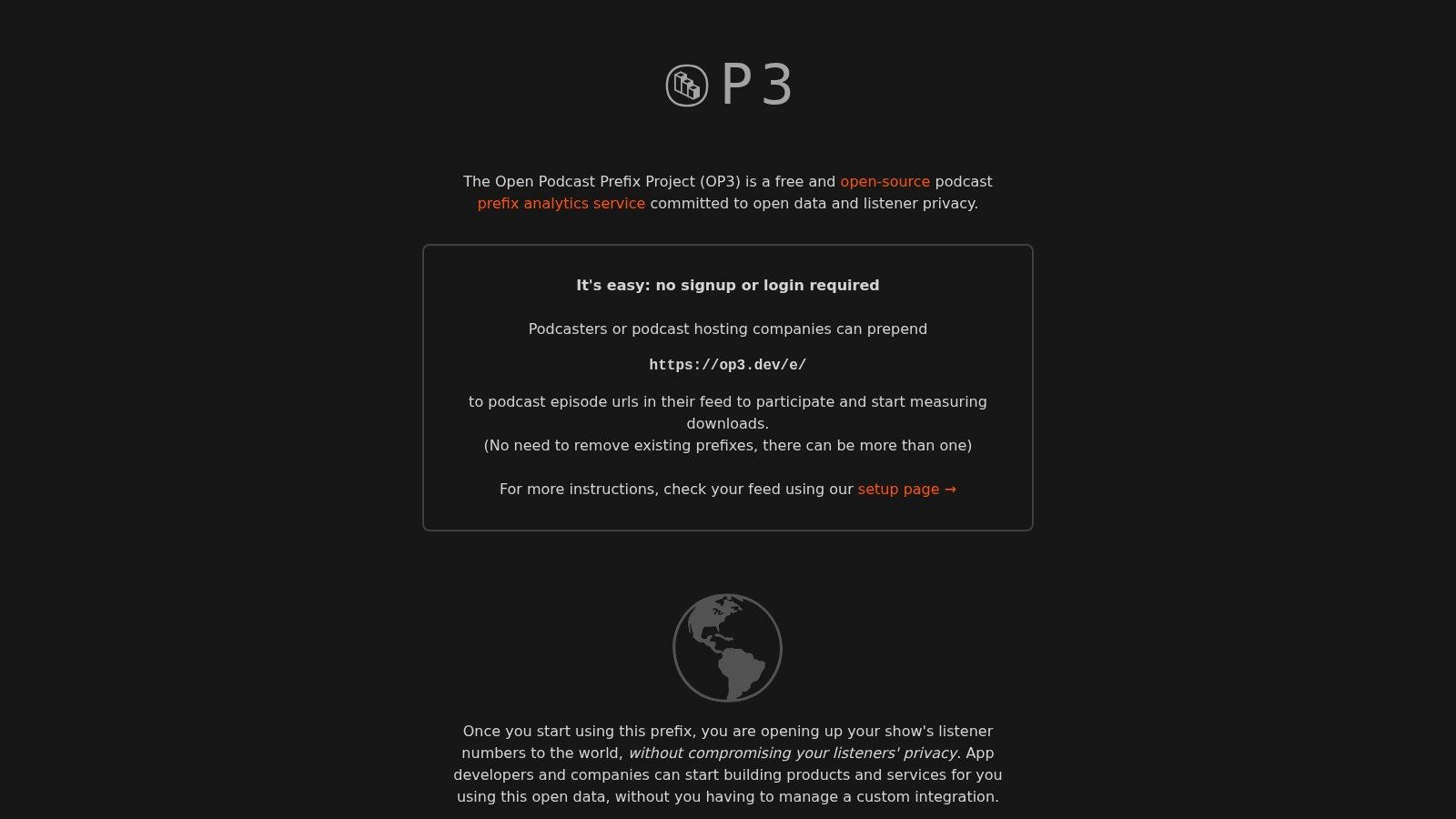
OP3 is the tool for producers who want transparent download measurement without signing up for a bigger, heavier analytics contract. It's open, lightweight, and easy to understand. That simplicity is the point.
For many independent teams, OP3 fills the measurement gap between “the host dashboard says things are fine” and “a sponsor wants standardized reporting.” It can also sit alongside host-native tools without forcing a full platform change.
Why open measurement matters
The broader market is moving toward layered analytics stacks, not single dashboards. As of 2024, the global podcast analytics platform market was valued at approximately USD 1.42 billion, and industry benchmarks indicate that roughly 60 to 70% of mid-sized to large podcast networks rely on at least one third-party analytics or monetization-focused measurement layer on top of hosting dashboards (Growth Market Reports on the podcast analytics platform market).
That context makes OP3 especially relevant. It gives smaller teams a low-friction way to adopt the same layered thinking larger networks already use.
Working rule: If the show is selling sponsorships, third-party measurement is close to a minimum standard now, not a nice extra.
OP3 doesn't solve everything. It won't give deep demographics, rich discovery intelligence, or detailed listener journey mapping on its own. It does one thing well: transparent download measurement with public-facing clarity.
- Best fit: Indies, nonprofits, and lean branded shows.
- Strong advantage: Fast adoption and open methodology.
- Main limitation: It stays focused on downloads.
That's fine. A strong analytics stack doesn't ask one tool to do every job.
6. CoHost by Quill
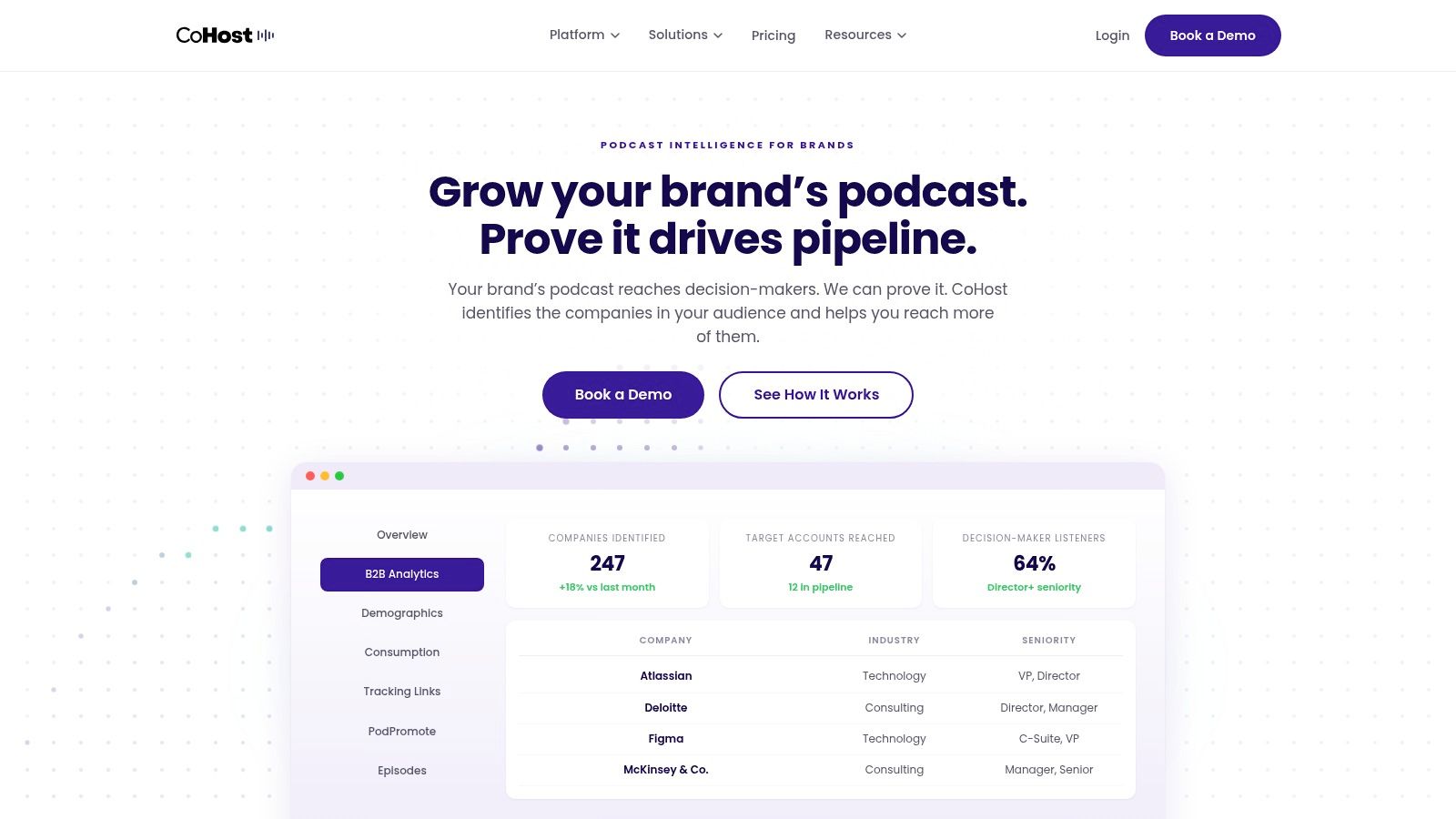
CoHost by Quill is one of the more interesting podcast analytics tools because it isn't really built for the typical independent creator problem. It's built for the branded podcast problem. Specifically, “Can this show influence pipeline, target accounts, or buyer interest?”
That makes it a strong fit for B2B marketing teams, agencies, and service firms with account-based goals. A producer measuring thought leadership alone may not need this level of business alignment.
Where it changes business decisions
CoHost becomes useful when download totals stop being the main KPI. Branded shows often need to know whether the right companies are showing intent, whether a campaign drove account-level engagement, and whether podcast content contributed to a larger funnel.
Its appeal comes from that company-level intelligence layer and campaign reporting. Instead of only asking which episode performed best, the team can ask which episode topic reached target accounts, which campaign source produced the strongest engagement quality, and which show format aligns better with sales conversations.
A few realities come with that:
- Setup discipline matters: B2B attribution gets messy fast if campaign naming, distribution links, and CRM alignment are inconsistent.
- This is not cheap self-serve software: Sales-led pricing usually means the buyer should already know the business question being measured.
- The value is strategic, not cosmetic: If the show isn't connected to demand generation or relationship building, the extra layer may go unused.
For consultants, SaaS brands, agencies, and firms treating podcasting as a lead-generation asset, CoHost can be the difference between “content marketing that feels hard to justify” and “content marketing that contributes to revenue discussions.”
7. Magellan AI
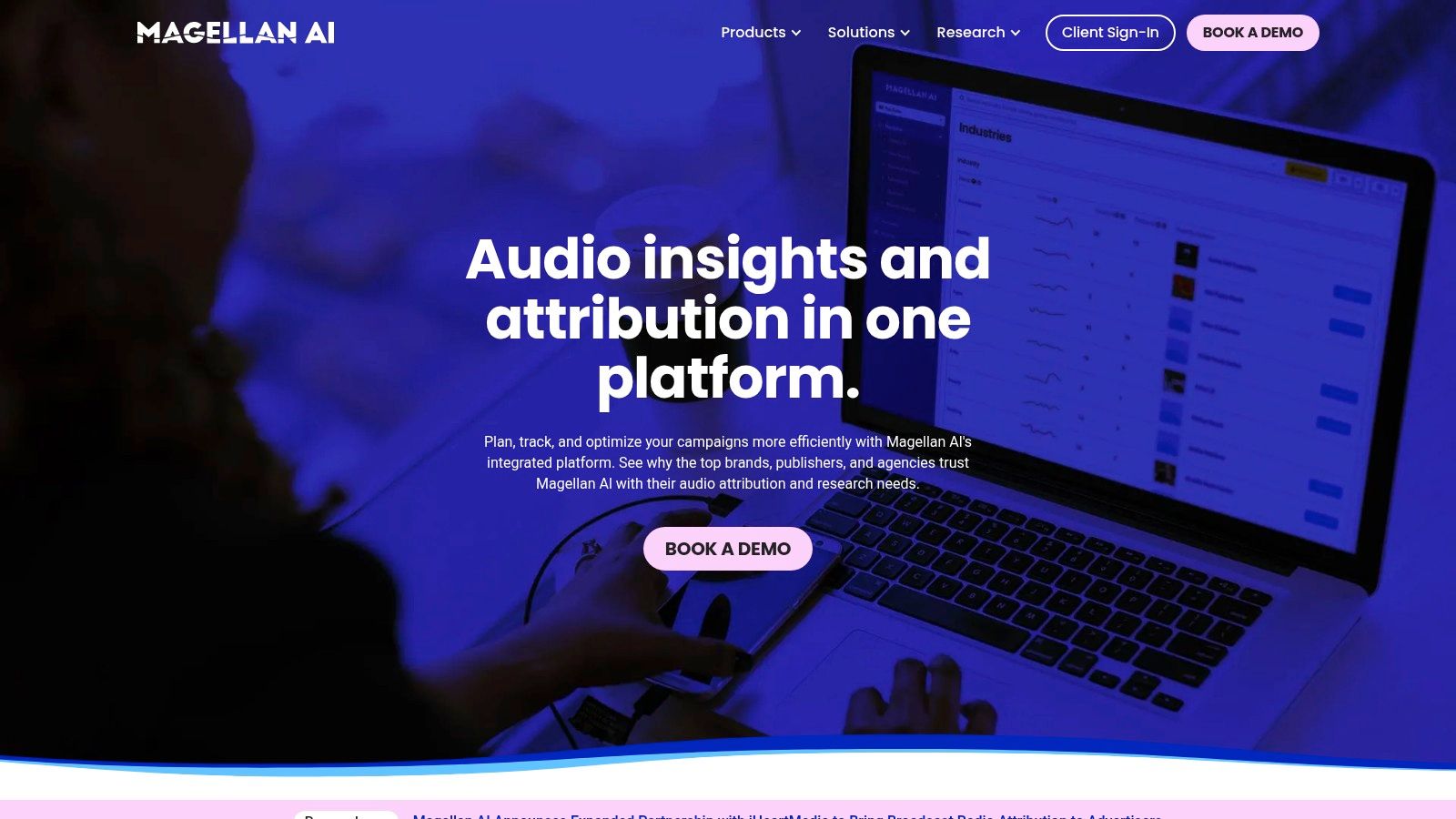
Magellan AI belongs in a very specific part of the stack: monetization intelligence. It doesn't tell a host whether the intro is too long or whether Apple listeners finish interviews at a higher rate. It helps a team understand the ad market around the show.
That distinction matters. A lot of creators buy ad-focused tools too early and then wonder why the data feels disconnected from content decisions.
How sales teams use it well
Magellan AI is most valuable when a show or network is actively selling inventory, prospecting advertisers, or positioning itself against adjacent podcasts in the same category. Sales teams use it to monitor which brands are active, what categories are buying, and how creatives are being deployed.
That gives operators a sharper pricing and outreach strategy. If a team sees sustained advertiser activity around similar audience profiles or adjacent content themes, it can shape a more credible sponsorship pitch instead of leading with generic audience claims.
A useful companion read for teams thinking in market-positioning terms is this guide to mastering competitor insights. The same logic applies in podcasting. Better commercial intelligence usually beats louder sales language.
A show doesn't need ad intelligence to start monetizing. It needs ad intelligence when generic sponsor outreach stops working.
Magellan AI tends to be overkill for a solo creator with a new show. For networks, agencies, and established publishers, it can sharpen outbound sales, category targeting, and inventory packaging in a way host-native dashboards can't.
8. Podchaser Pro
Podchaser Pro is less about technical measurement and more about business development. It helps teams research shows, audiences, social reach, sponsor history, and contact paths when they're booking guests, building PR lists, or sourcing sponsorship opportunities.
That's why it complements, rather than replaces, the other podcast analytics tools in this guide. A producer needs one set of tools to measure owned media performance and another set to map the broader podcast environment.
What it does better than measurement platforms
Podchaser Pro shines when the goal is outreach. It gives marketers, PR teams, and partnerships leads a way to build lists around topic relevance, show fit, and likely reach rather than manually scraping podcast directories.
This becomes valuable in a few common scenarios:
- Guest booking: Find shows that match the host's expertise and likely audience fit.
- Sponsor research: See what kinds of brands have appeared around related podcasts before.
- Partnership outreach: Build a short list for trailer swaps, feed drops, or collaborative campaigns.
Teams exploring sponsorship seriously should also understand the economics and structure behind podcast advertising revenue, because outreach data gets more useful when the show already knows what kind of advertiser relationship it wants.
Podchaser Pro is usually too expensive for casual use by solo creators, and it won't solve technical analytics questions. But for teams doing active business development, it cuts a large amount of research friction.
9. Rephonic
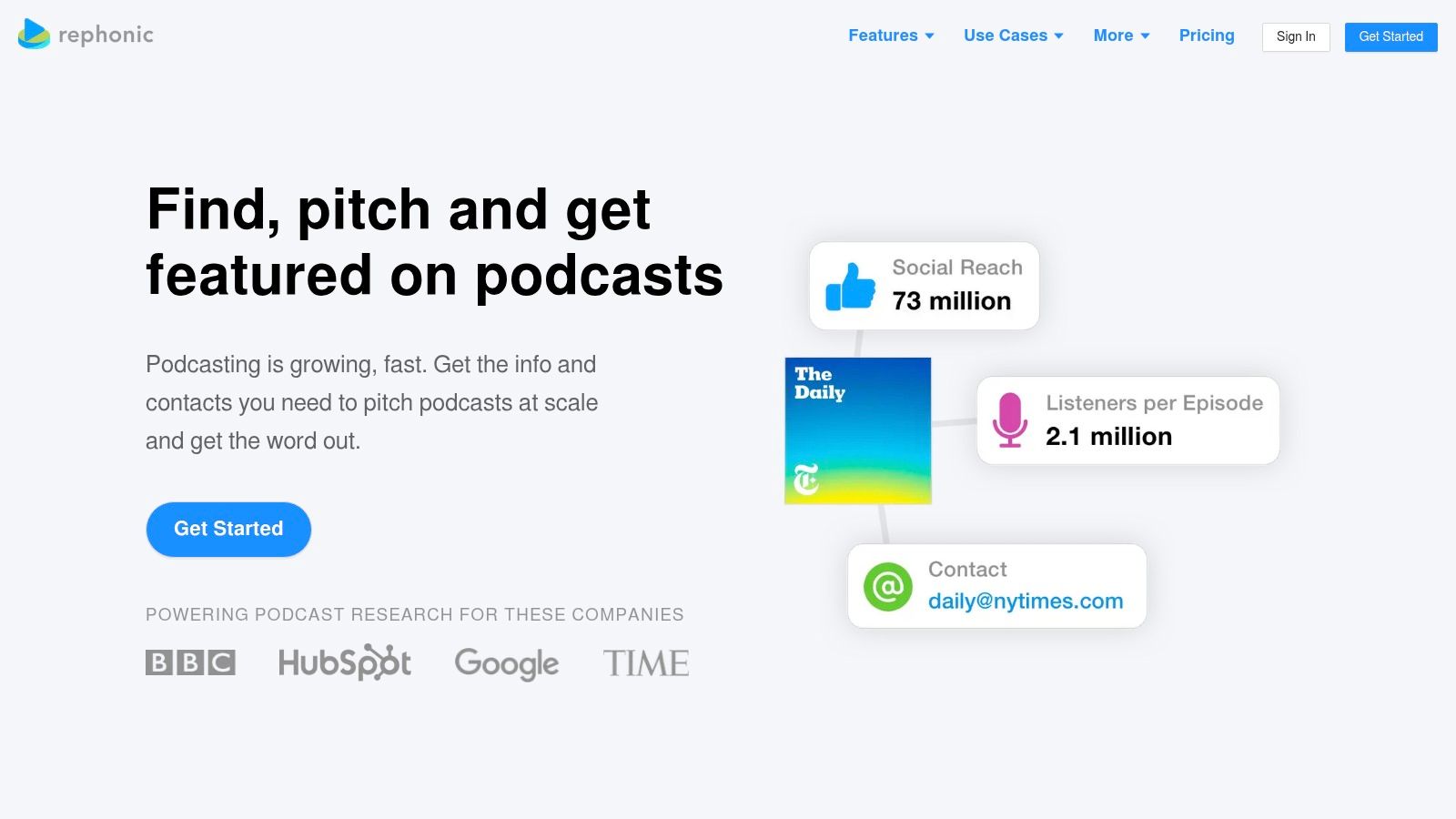
Rephonic is one of the most practical tools for audience expansion through guesting, cross-promotion, and partnership outreach. It works best before the appearance, not after. The team uses it to find the right podcasts, estimate fit, and avoid wasting time on shows that sound aligned but probably aren't.
That makes it useful for founders, authors, nonprofits, and thought leaders trying to grow through borrowed audiences. It's also helpful for agencies managing outreach across multiple client niches.
Strong fit for audience expansion
Rephonic provides estimated audience and demographic signals, which means the data should guide decisions, not close them. It's best used to shortlist opportunities, then validated with direct outreach, content review, and campaign tracking.
The most effective approach is to use Rephonic to identify look-alike shows, then build custom outreach around message fit and audience intent. Teams trying to grow a podcast audience can use that process to secure smarter guest spots and partner placements rather than relying on broad visibility plays.
A practical caveat applies to attribution after those appearances go live. Some campaign and stats systems use limited attribution windows. For example, Blubrry's Stats plan applies a 10-day attribution window for downloads tied to campaign links, so delayed downloads may not connect back to the original source (Talkwalker's overview of podcast analytics tools). That means guesting campaigns should use tighter promo windows and cleaner tracking links if the team wants to isolate impact.
Rephonic is strongest as a targeting and outreach tool. It helps answer where the next listener might come from.
10. Podstatus
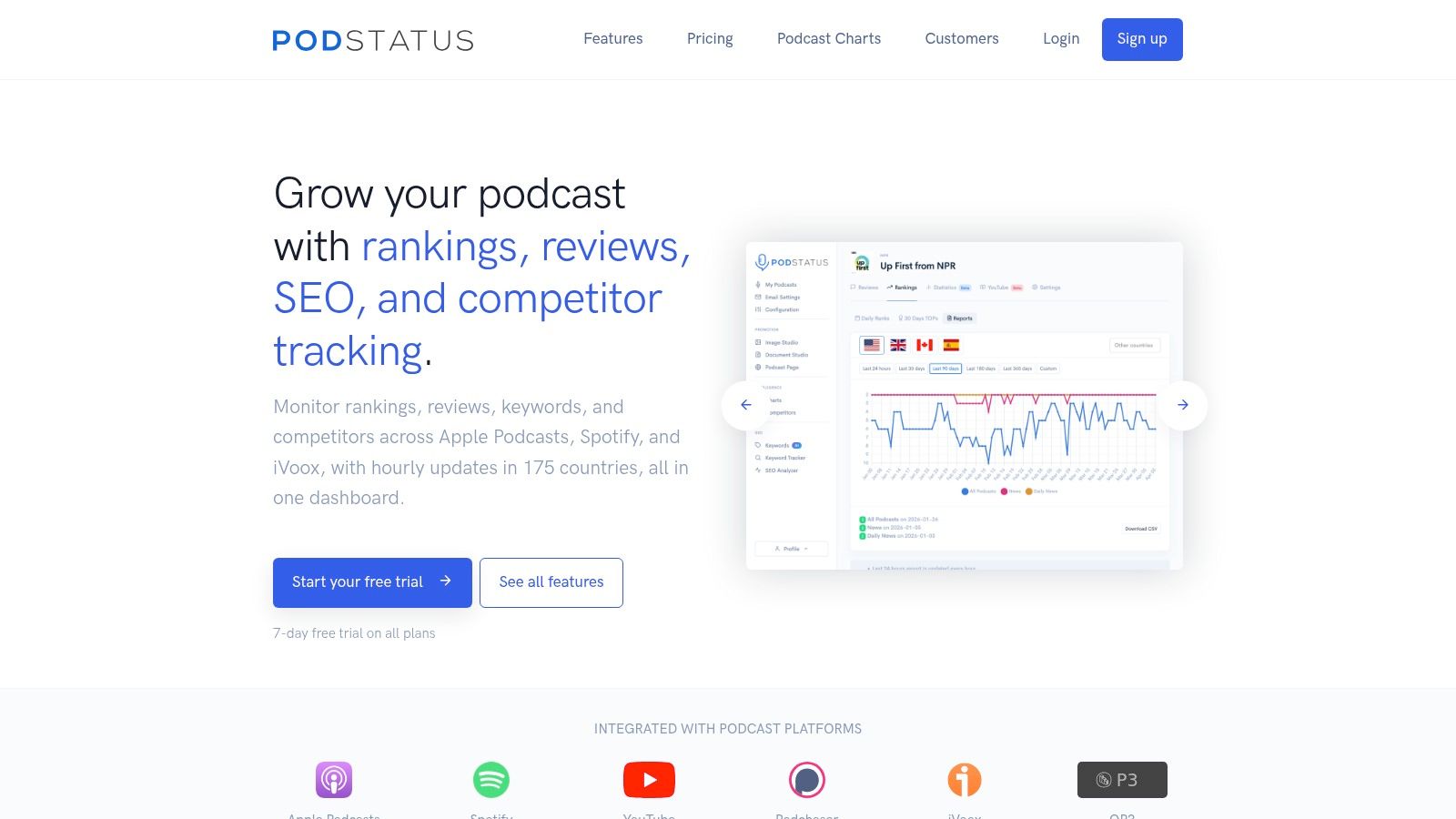
Podstatus solves an operational problem that many producers ignore until a client asks for a report. Rankings change quickly. Reviews appear across storefronts and countries. Keyword visibility shifts subtly. Most host dashboards don't track any of that well.
That's where Podstatus earns its keep. It's not trying to be a full behavior analytics system. It's built to monitor visibility, reputation, and competitive movement.
Best for operational visibility
The biggest value is convenience with context. A team can watch chart movement, review flow, keyword performance, and competitor changes in one place, then combine that with OP3 data if downloads also need to sit in the same reporting view.
This makes Podstatus especially useful for agencies, production shops, and in-house marketing teams managing multiple moving parts. Client reporting gets easier. Launch monitoring gets easier. Reputation management gets easier.
- Use it for publishing pulse: Rankings, reviews, and chart changes are easier to act on when they're tracked continuously.
- Use it for competitor watchlists: It's useful to know when a neighboring show starts rising on category terms.
- Don't expect deep listener behavior: This isn't where content retention questions get solved.
Podstatus is often the “glue” layer that helps teams package the rest of the stack into a readable weekly picture.
Top 10 Podcast Analytics Tools Comparison
| Tool | ✨ Core features | ★ UX / Metrics | 👥 Target audience | 💰 Pricing / Value | 🏆 Unique strength |
|---|---|---|---|---|---|
| Spotify for Podcasters (Analytics) | ✨ 30s play standard, near‑real‑time, video analytics | ★★★★☆, recency & clarity | 👥 Spotify publishers & video podcasters | 💰 Free, platform‑specific | 🏆 Fast, standardized playback metrics |
| Apple Podcasts Connect (Analytics) | ✨ Engaged listeners, retention, subscriptions | ★★★★☆, strong retention signals | 👥 iOS listeners, creators with subscriptions | 💰 Free, privacy‑friendly | 🏆 Best for completion & Apple subscription insights |
| Podtrac (Podcast Measurement) | ✨ Third‑party download prefix, benchmarks | ★★★☆☆, download‑focused comparability | 👥 Advertisers, publishers needing standard metrics | 💰 Free base, recognized benchmark | 🏆 Longstanding, advertiser‑trusted measurement |
| Triton Digital, Podcast Metrics | ✨ IAB‑aligned reporting, market benchmarks | ★★★★☆, enterprise accuracy | 👥 Networks, agencies, large brands | 💰 Paid / contract, enterprise | 🏆 Industry‑grade, market‑level benchmarking |
| OP3 (Open Podcast Prefix Project) | ✨ Open prefix, public endpoints, documented math | ★★★★☆, transparent & auditable | 👥 Indies, nonprofits, transparency‑minded hosts | 💰 Free, easy to adopt | 🏆 Open, verifiable download stats |
| CoHost by Quill (Analytics + B2B) | ✨ B2B/company‑level engagement, ABM tracking | ★★★★☆, attribution for accounts | 👥 Branded/B2B podcasts & agencies | 💰 Sales‑led / enterprise pricing | 🏆 Ties podcast activity to account pipeline |
| Magellan AI (Ad Intelligence) | ✨ Ad spend, creatives, brand tracking & trends | ★★★★☆, ad‑centric insights | 👥 Sales teams, ad buyers, inventory planners | 💰 Enterprise pricing | 🏆 Deep ad intelligence for pricing & outreach |
| Podchaser Pro (Audience & Outreach) | ✨ Demographics, sponsor history, contact lists | ★★★★☆, discovery + workflow tools | 👥 BD, PR, sponsorship teams | 💰 Premium / sales‑led | 🏆 Rich prospecting dataset & outreach tooling |
| Rephonic (Audience Data & Outreach) | ✨ Audience estimates, contacts, filters | ★★★★☆, broad coverage for research | 👥 Guest bookers, partnership & ad planners | 💰 Tiered plans, flexible | 🏆 Wide show coverage for look‑alike mapping |
| Podstatus (Rankings, Reviews, OP3 Blend) | ✨ Charts, review alerts, SEO monitoring, OP3 opt‑in | ★★★☆☆, operational monitoring | 👥 Publishers, ops teams, client reporting | 💰 Tiered, plan‑dependent | 🏆 Fast reputation & chart tracking for ops |
Building Your Analytics Stack From Data to Decisions
No single tool explains podcast performance well enough to guide every decision. That's the mistake behind most messy reporting setups. A host checks Spotify for Podcasters, sees a strong day, then assumes the episode worked. Another checks the hosting dashboard and sees downloads rising, then assumes the marketing is doing its job. Both views are partial.
The better approach is to build a small stack around jobs-to-be-done. Start with the platform-native dashboards. Spotify for Podcasters and Apple Podcasts Connect answer consumption questions inside their own ecosystems. Spotify is useful for quick editorial feedback, audience segmentation, and short-term reaction. Apple is better for deeper retention reading once enough listening data has accumulated.
Then add a universal measurement layer. For many teams, that means OP3 or Podtrac. The purpose isn't to replace platform dashboards. It's to create a more credible baseline across apps, devices, and distribution points. This is especially important once a show starts pitching sponsors, reporting to stakeholders, or comparing performance across campaigns.
After that, choose one specialized tool based on the show's actual business model.
- If the show is B2B and lead-focused: CoHost by Quill is the stronger fit.
- If the show is building advertiser relationships: Magellan AI is more useful.
- If the growth plan depends on guesting and partnerships: Rephonic or Podchaser Pro makes more sense.
- If the team needs visibility tracking and cleaner reporting: Podstatus adds day-to-day operational clarity.
The stack only matters if it leads to decisions. Retention drops in Apple should change episode structure. Spotify's new-versus-returning listener patterns should influence guest selection, packaging, and release cadence. Third-party download measurement should tighten sponsor reporting. Outreach tools should narrow who the team pitches, not just produce longer lists.
A practical workflow looks like this. Once a week, the producer reviews platform-native consumption data first. Then the team checks the third-party prefix layer for cross-platform consistency. Finally, it reviews one specialized tool tied to the current growth priority, monetization, outreach, brand visibility, or B2B attribution. That order keeps the analysis grounded in the audience before moving into tactics.
This is also where repurposing and distribution become easier to manage. A show that sees strong completion around one segment can turn that moment into clips, short-form video, quote posts, or follow-up content. Teams looking to connect production with distribution will get useful ideas from this guide to repurposing video and podcast content.
At Get Up Productions, analytics isn't treated as a reporting exercise. It's part of show strategy. The right stack helps clients understand what listeners do, where growth is taking place, and how to turn episodes into a loyal audience, stronger authority, and measurable business outcomes.
Get Up Productions helps brands, founders, thought leaders, nonprofits, and creators build podcasts that don't just look polished. They perform. From production and editing to multi-platform repurposing and strategy, the team helps clients turn podcast data into better episodes, stronger distribution, and real growth. Explore Get Up Productions to build a show with a production partner that understands both content and the analytics behind it.