
A lot of podcast hosts are sitting on episodes that sound good, deliver real value, and still don't move listeners to do anything useful. The interview lands. The teaching is strong. The edit is clean. Then the outro arrives, and the host says some version of “subscribe, leave a review, follow along, check the links,” and the moment disappears.
That's usually not a delivery problem. It's a systems problem.
A podcast call to action works when it connects one listener behavior to one business outcome. It works even better when that same ask gets repurposed beyond the episode itself. Instead of treating the CTA as a closing sentence, smart teams treat it as a conversion asset. That shift is where more shows start turning listeners into leads, donors, email subscribers, buyers, and repeat followers.
Table of Contents
- Define Your CTA Goal Before You Press Record
- How to Script CTAs That Resonate with Listeners
- When and Where to Place Your Podcast Call to Action
- Producing CTAs That Command Attention
- Turn Your CTA into a Content Waterfall
- Conclusion Your CTA Is a System Not a Sentence
Define Your CTA Goal Before You Press Record
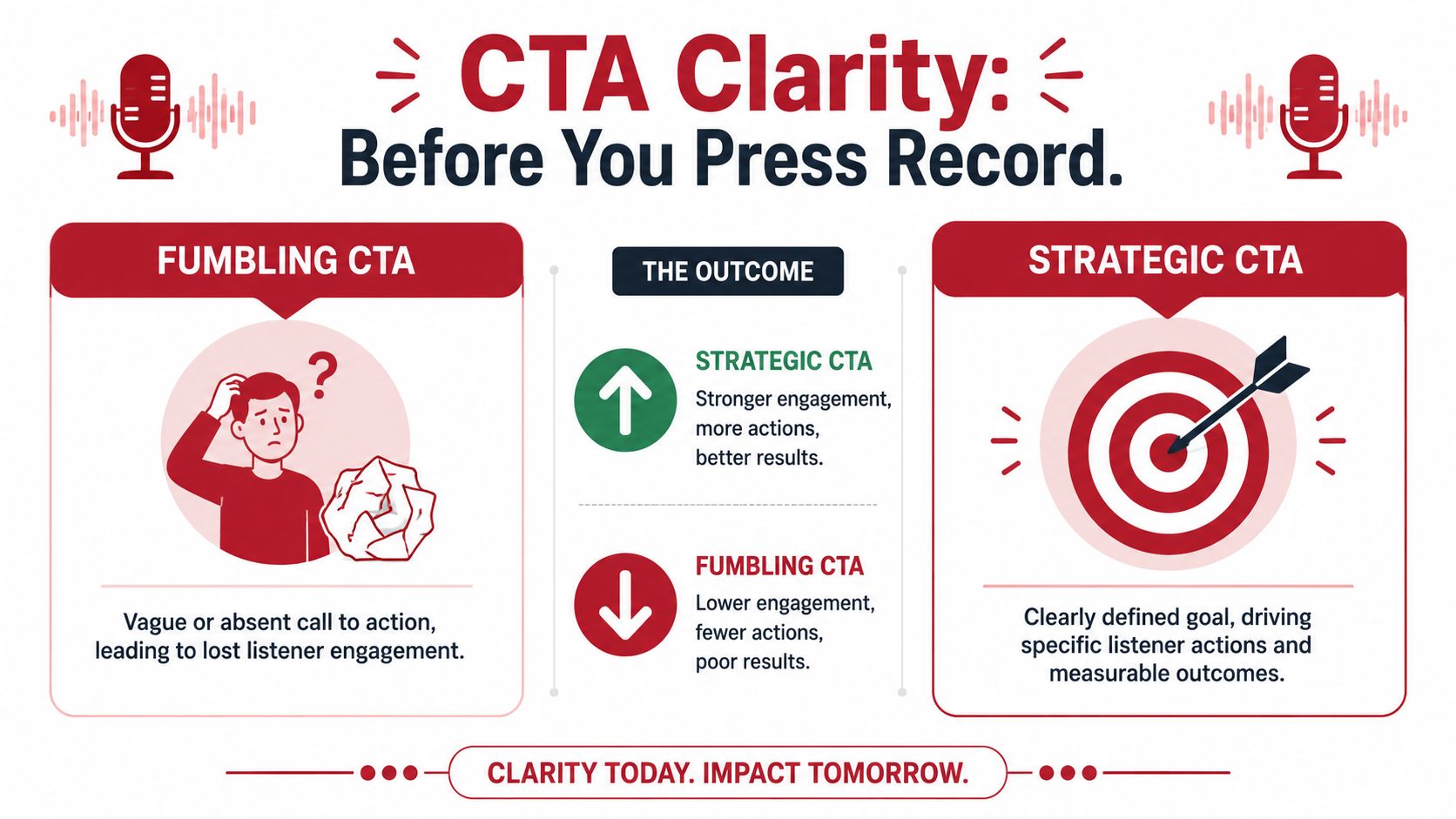
A weak podcast call to action usually sounds improvised because it is. The host gets to the end of the episode, remembers they should “ask for something,” and piles on several options. Follow the show. Share it. Download something. Book a call. Join the newsletter. That isn't strategy. It's leakage.
The fix starts before recording. The CTA has to serve a single primary goal for that episode. One episode might support lead generation for a consulting firm. Another might push donors toward a campaign page. A third might invite listeners into an email list with a focused resource.
Why generic CTAs underperform
Generic asks fail because they don't tell the listener what matters most. They also don't tell the production team what success looks like. If the host asks for five things, nobody knows which one should shape the script, the show notes, the landing page, or the short clips pulled later.
Practical rule: One episode can contain more than one ask, but it should only have one priority.
That priority should be tied to a real business objective, not a podcast vanity habit. “Leave a review” might help social proof. It usually shouldn't be the main CTA for a nonprofit trying to deepen donor relationships or for a B2B firm trying to start sales conversations.
Match the ask to the business objective
A useful planning habit is to define the business goal first, then write the listener action that best supports it, then shape the script around that action. This keeps the CTA grounded and makes production choices easier later.
| Primary Goal | CTA Type | Example Script Starter |
|---|---|---|
| Lead generation for a B2B firm | Book a consultation or request a resource | “If this issue is showing up in your team, grab the guide linked in the show notes…” |
| Donor growth for a nonprofit | Visit a campaign page or join a supporter list | “If this story moved you, there's a simple way to help today…” |
| Email list growth for a creator | Download a checklist, worksheet, or private training | “To make this practical, there's a free resource that walks through the exact process…” |
| Product awareness for a founder | Visit the product page or join a waitlist | “If you want to see how this works in practice, the demo page is the best next step…” |
| Community growth for a spiritual leader | Join a newsletter, text list, or private group | “If these conversations are helping, join the community so you don't miss the next one…” |
This is also where supporting assets get decided. If the goal is email growth, the offer needs a landing page worth visiting. If the goal is community building, the listener needs a simple next step that feels relational, not transactional. Teams building a list often benefit from looking at practical frameworks for growing an email list through podcast content.
A podcast call to action should answer three questions before the mic goes live:
What action matters most
The exact behavior the listener should take next.Why this listener should care
The benefit, transformation, relief, or access attached to the action.Where the action happens
A page, form, reply path, QR code, or platform that removes guesswork.
When those answers are clear, the CTA stops sounding like filler and starts acting like infrastructure.
How to Script CTAs That Resonate with Listeners
The best CTAs don't sound “salesy.” They sound like a natural continuation of the episode. That usually comes down to one thing. The script frames the ask around the listener's need, not the host's wish list.
A weak CTA often shows up as a generic closing line. “Be sure to follow, leave a review, and check out the links below.” Nothing in that sentence connects to the topic the listener just spent time with. It feels detached from the value they came for.

Weak language versus useful language
A stronger script names the problem, sharpens the consequence, and presents one next step with a clear payoff. That's why a Problem-Agitate-Solve structure works well in spoken CTAs. It gives the host a compact arc that feels conversational instead of scripted.
Compare these two examples.
Weak version for a consultant podcast
“Check out the show notes for more resources and book a call if you want.”
Stronger version
“If your team is producing content every week and still struggling to turn attention into qualified conversations, there's a practical next step. Download the messaging worksheet in the show notes and use it to tighten the way your offer shows up before your next campaign.”
The second version works because it identifies a pain point, names who it's for, and gives the listener a reason to act now. It doesn't ask for a favor. It offers help.
A podcast CTA lands when the listener thinks, “That's for me,” not “That's for the host.”
Here's the same shift in a different context.
Weak version for a spiritual leader
“Follow the show and join the newsletter for updates.”
Stronger version
“If these conversations are helping you stay grounded during the week, join the email list. That's where the reflection prompts and next gathering details are shared, so you can carry this beyond the episode.”
That wording fits the audience. It respects the emotional tone of the show and extends the value.
Audience fit matters more than clever wording
Different audiences respond to different forms of clarity. B2B buyers usually want efficiency, specificity, and a concrete outcome. Nonprofit audiences often respond to mission, immediacy, and a sense of meaningful participation. Personal brand audiences tend to act when the CTA promises access, insight, or a practical tool.
A useful scripting check looks like this:
For service businesses
Lead with operational pain, missed opportunity, or wasted effort. Then point to a worksheet, assessment, or booking page.For nonprofits
Lead with the human stakes. Then offer one direct path to give, volunteer, or stay involved.For creators and educators
Lead with usefulness. Then direct the listener to a checklist, template, private list, or bonus training.
One common mistake is making the CTA sound like an ad break. That happens when the host suddenly changes tone, inserts canned marketing language, or introduces an unrelated offer. A better move is to seed the CTA earlier in the episode. If the host teaches a framework during the conversation, the CTA can point to the worksheet, guide, or application page that continues that exact lesson.
Another common mistake is overexplaining. Spoken CTAs need clean sentences. Short words. One path.
“Say less, but make the next step obvious.”
If the listener needs to remember a long URL, decode multiple instructions, or choose between several offers, the CTA is carrying too much weight. The script should do the opposite. It should reduce cognitive load and make the next action feel simple enough to take before the episode even ends.
When and Where to Place Your Podcast Call to Action
Placement changes performance. A strong script buried in the wrong part of the episode will still underperform. The question isn't whether pre-roll, mid-roll, or post-roll is best in the abstract. The question is which placement fits the type of ask.
Some asks need early visibility. Others need trust first. A listener won't respond the same way to “follow this show” as they will to “apply to work with us” or “donate to this mission.” Timing should reflect the commitment level.
Pre-roll mid-roll and post-roll compared
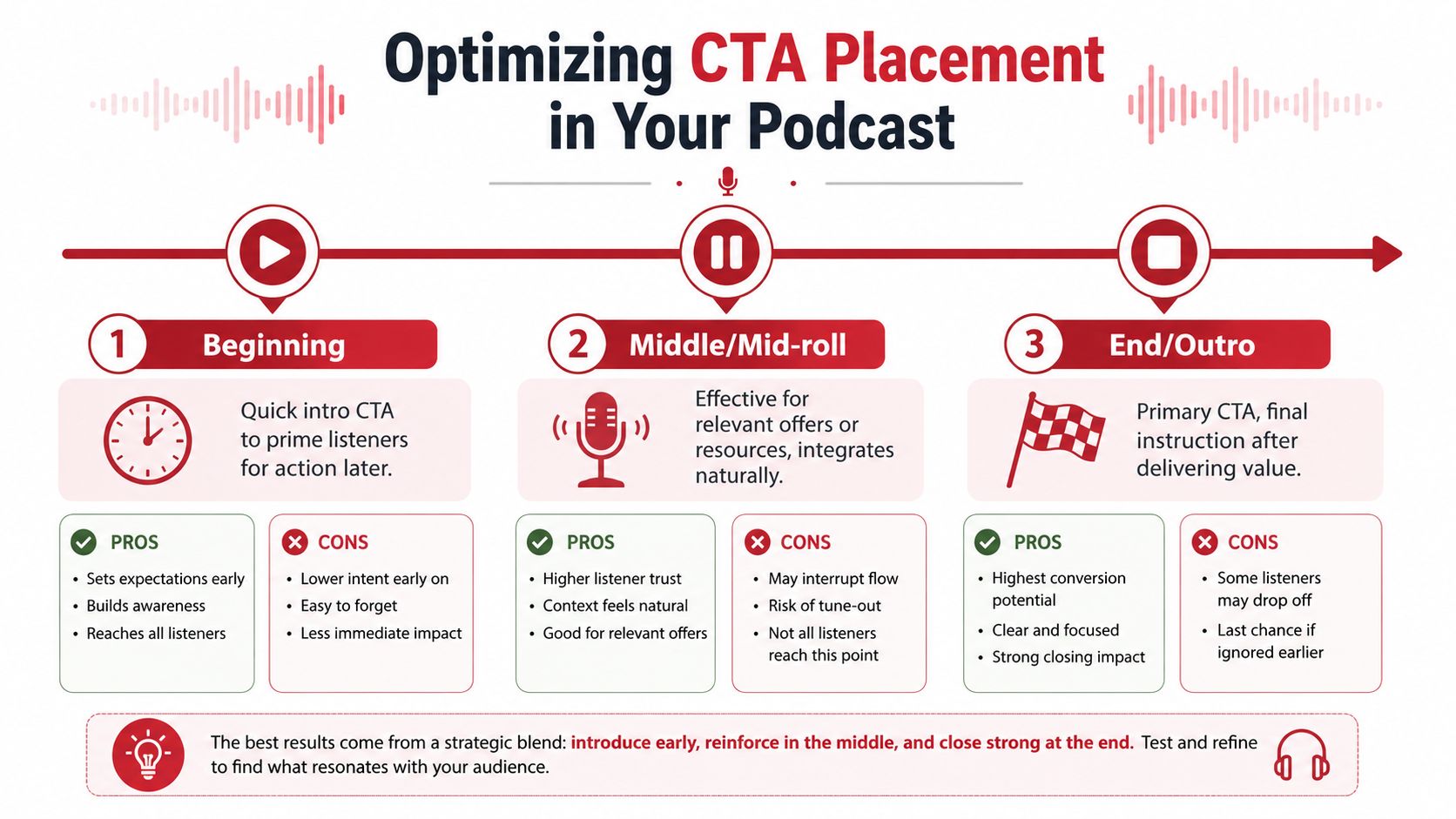
The simplest way to think about placement is friction. Lower-friction asks can come earlier. Higher-commitment asks usually do better after the episode has delivered value.
| Placement | Best Use | Risk | Good Fit |
|---|---|---|---|
| Pre-roll | Light asks with low commitment | New listeners may tune it out | Follow, subscribe, social follow |
| Mid-roll | Resource tied to the live topic | Can feel disruptive if forced | Download guide, join list, visit landing page |
| Post-roll | Main CTA after the episode payoff | Some listeners leave early | Book a call, donate, apply, buy |
Pre-roll works best when the ask is quick and easy. “Follow the show” or “grab the link in the notes if you want the companion resource” can fit there. It primes the listener without asking much.
Mid-roll is the strongest slot for relevance. If the host just explained a process, solved a problem, or surfaced a tension the audience feels, a resource CTA can sound completely natural there. Teams building dedicated episode pages often improve the listener experience with a clear podcast landing page structure.
This section is also where outside examples help. Looking through Testimonial's Apple Podcast reviews can help hosts study how social proof gets presented around shows and what kinds of audience language can support trust before or after a CTA.
For a visual breakdown of placement strategy in action, this short walkthrough is useful.
Use CTA stacking without overwhelming the listener
Advanced shows rarely rely on a single isolated CTA. They use CTA stacking. That means layering asks by commitment level across the episode without turning the episode into a sales sequence.
A clean stack might look like this:
Opening ask
A soft action such as following the show or staying to the end for a resource.Middle ask
A context-rich invitation tied to the topic, such as downloading a worksheet or joining an email list.Closing ask
The higher-commitment action, such as booking a consultation, donating, or applying.
The mistake is stacking unrelated asks. If the intro pushes Instagram, the middle pushes a webinar, and the outro pushes merchandise, the listener gets fragmented signals. Stacking works when each ask supports the same conversion path.
A good episode feels cohesive. The CTA placement should feel that way too. Every slot should move the listener one step closer to the same outcome.
Producing CTAs That Command Attention
A well-written podcast call to action can still disappear if it's delivered in the same cadence and texture as the rest of the episode. Listeners need a cue that something important is happening. Production creates that cue.
The most effective CTAs feel distinct without feeling theatrical. The host's pace changes slightly. The energy tightens. The edit gives the words a little more space. If video is part of the format, the screen reinforces the action instead of competing with it.
Audio choices that signal importance
The host's voice is the first production tool. A rushed CTA sounds apologetic. A flat CTA sounds optional. Strong delivery usually comes from slowing down, emphasizing the action verb, and shortening the sentence structure.
A practical audio checklist helps:
Pace with intention
Slow the delivery slightly so the action and destination are easy to catch.Use tonal contrast
Shift from conversational teaching to clear direction. Not louder, just more deliberate.Leave clean pauses
A short beat before and after the CTA frames it as a distinct moment.Add a subtle music bed
A light underscore can separate the CTA from the body of the episode if it fits the show's style.Record key CTAs cleanly
If the host stumbled during the live read, replace the CTA in post rather than keeping a messy take.
Production should make the CTA easier to notice, not harder to trust.
One more caution matters here. Sound effects and dramatic music can help, but they can also cheapen the moment fast. If the show carries authority, the CTA should preserve that tone. A legal podcast, faith-based conversation, founder interview, and donor story show should not all frame their CTAs the same way.
Video cues that reduce friction
Video podcasts have an extra advantage. They can show the action while the host says it. That reduces friction immediately.
Useful visual reinforcement includes:
Lower-thirds
Put the short destination or offer name on screen while the host delivers the CTA.QR codes
Helpful for conference clips, YouTube episodes, and social video where viewers may act from a phone.Full-screen offer cards
Best when the CTA is the focal moment and the visual needs to remove all distraction.Pinned comments and on-screen text
Especially helpful when the clipped CTA gets reused on YouTube Shorts, Instagram Reels, or TikTok.
The key is consistency. If the host says one phrase, the screen should repeat that phrase or point to the same destination. Mixed wording creates hesitation. In conversion work, hesitation costs more than simplicity ever will.
Turn Your CTA into a Content Waterfall
Most podcast teams stop at the episode. They write the CTA, record it, publish the show, and move on. That leaves one of the most useful assets untouched.
A strong CTA is already a short persuasive segment. It usually contains a problem, a promise, an audience cue, and a next step. That makes it perfect for repurposing. In this scenario, a Content Waterfall changes the role of the podcast call to action. Instead of living once at the end of an episode, it becomes the raw material for an entire sequence of short-form content.
Track the action before scaling the asset
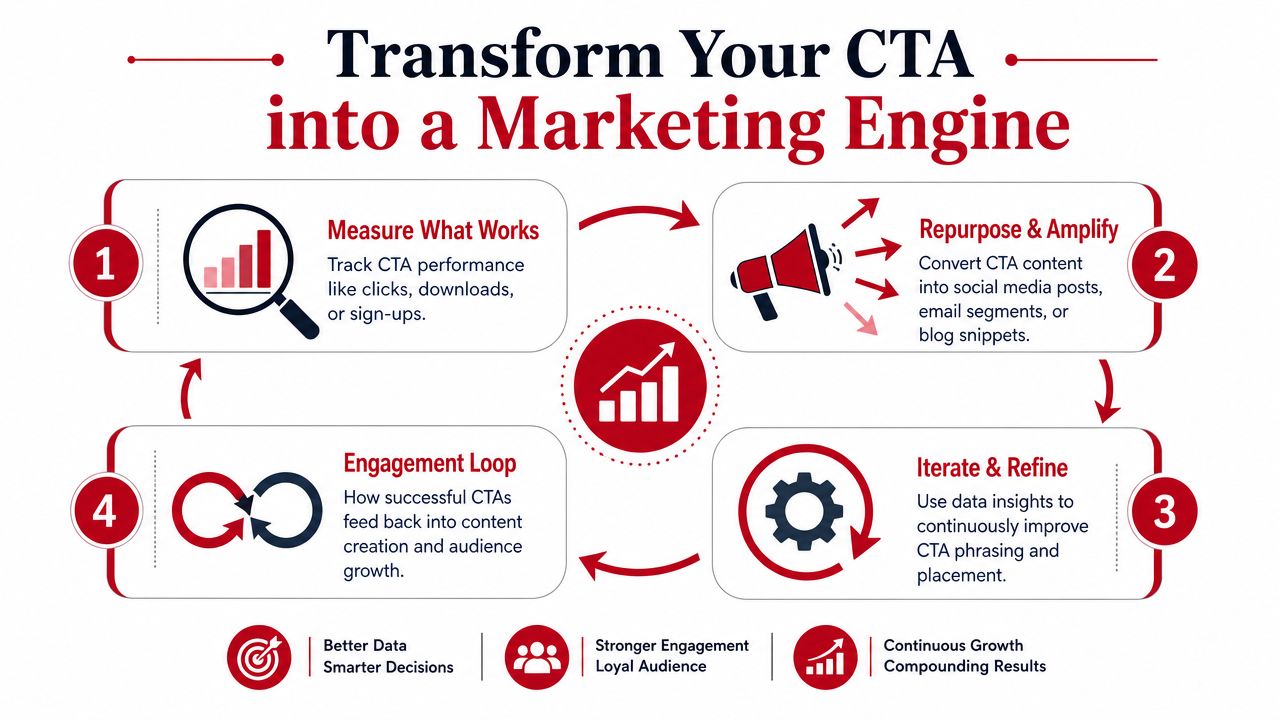
Before repurposing the CTA everywhere, the team needs a way to tell whether the ask is working. That doesn't require elaborate analytics. It requires clear attribution.
Useful tracking options include:
Vanity URLs
Short, memorable paths read easily on air and separate podcast traffic from other channels.Offer-specific forms
A resource page tied to the episode CTA makes listener intent easier to identify.Coupon or campaign codes
Helpful when the CTA points to a product, event, or donor campaign.Intake questions
A simple “How did you hear about us?” field can reveal whether the podcast is creating action.
The point isn't perfect reporting. It's directional clarity. If one CTA gets responses and another gets silence, the team has something to refine. That refinement might involve the offer, the script, the timing, or the landing experience.
A lot of teams also benefit from a documented content repurposing strategy for podcast-led marketing so the CTA doesn't get lost after publishing day.
Repurpose one CTA into multiple short-form assets
Once the team knows the CTA is worth amplifying, the clip becomes a mini campaign. This is the core of the Content Waterfall. One source moment fans out into multiple formats, each built for a different discovery surface.
A single CTA clip can become:
A vertical video reel
Keep the host on screen, add captions, and let the CTA stand alone as a direct invitation.An audiogram
Useful when the original episode was audio-first but the CTA has strong spoken phrasing.A pull-quote graphic
Best when one sentence captures the listener pain or benefit cleanly.An email snippet
The CTA language can become the body of a short email that drives subscribers to the episode or offer page.A show notes highlight
Place the CTA offer near the top so listeners don't have to hunt for it.
For teams producing video-led clips, tools and workflows discussed in PostPulse for podcast video conversion can help shape the operational side of turning podcast moments into short-form assets.
The strongest CTA in the episode is often the best promotional clip for the episode too.
That creates a valuable loop. The original episode pushes listeners toward action. The clipped CTA promotes the same action on social platforms. Those clips then pull new people back into the longer episode, where trust deepens and the same offer appears again in full context.
This works especially well when the CTA itself is emotionally or practically sharp. A founder speaking directly to a stalled buyer. A nonprofit host tying a story to a concrete way to help. A spiritual leader inviting listeners into a weekly rhythm of reflection. Those moments can travel.
The teams that get the most from podcast CTAs don't ask, “What do we say at the end?” They ask better questions:
- Which CTA segment is strong enough to clip on its own
- Which platform fits the emotional tone of that clip
- Which visual packaging makes the ask easier to understand
- Which version sends people back to the full ecosystem
That's the shift from sentence to system. A good CTA converts listeners. A good Content Waterfall lets the CTA keep converting after the episode is over.
Conclusion Your CTA Is a System Not a Sentence
A podcast call to action shouldn't be treated like a routine sign-off. It should be built like a conversion path. The useful sequence is straightforward. Start with one real goal. Script the ask around listener value. Place it where the commitment level makes sense. Produce it so it stands out. Then measure it and repurpose it.
Most underperforming CTAs fail long before the host says the words. The goal was vague. The offer was weak. The placement was lazy. The landing experience was unclear. Or the team never reused the best CTA moment after publishing. Fixing any one of those helps. Building all of them into one system changes what the podcast can do.
That matters across very different kinds of shows. A consultant can drive discovery calls. A nonprofit can invite donor action. A creator can grow an email list. A spiritual leader can move listeners from passive consumption into consistent community engagement. The format changes. The logic doesn't.
The most practical mindset is simple. Every episode earns one next step. The CTA names that step. The production makes it memorable. The Content Waterfall extends its reach.
Hosts who apply that framework usually stop ending episodes with scattered asks and start creating clear listener movement. That's where a podcast starts behaving less like content for content's sake and more like a working part of the business, mission, or message.
If building that kind of podcast system sounds useful, Get Up Productions helps brands, creators, nonprofits, and thought leaders turn polished episodes into conversion-focused content engines, from production through repurposing.