
A podcast can have sharp ideas, strong guests, and clean dialogue and still sound unfinished. That flat feeling usually comes from one missing layer. The show says the right things, but it doesn't create a listening experience.
That's where podcast background music stops being decoration and starts doing real work. Music can frame the opening seconds, smooth transitions, support emotional beats, and make a show feel intentional instead of assembled. Used poorly, it muddies speech and weakens credibility. Used well, it gives the audience a reason to stay with the episode.
The pressure to get this right is higher now because podcasting is crowded. By 2026, the space is projected to include about 4.52 to 4.58 million podcasts worldwide, with global podcast listeners projected to reach 619 million according to Podcastatistics. In a market that large, production choices shape whether a show feels forgettable or authoritative.
Table of Contents
- From Good to Unforgettable With Background Music
- The Strategic Role of Podcast Music
- Navigating Music Licensing and Legal Risks
- How to Choose Music That Fits Your Brand
- Technical Best Practices for Mixing Music
- Music Strategies for Specific Podcast Formats
- Your Action Plan and Final Questions Answered
From Good to Unforgettable With Background Music
A lot of podcasts sound amateurish for a simple reason. The host records the conversation, trims mistakes, adds an intro line, and publishes. Nothing is technically broken, but nothing shapes the listener's attention either.
Podcast background music fixes that when it's treated as a production decision instead of filler. The right track can make an intro feel branded, give a guest story more emotional definition, and help transitions land cleanly. The wrong track does the opposite. It calls attention to itself, crowds the vocal, and makes the show feel generic.
Three moments matter most.
- The opening: The first seconds tell listeners whether the show feels established or improvised.
- The transitions: Segment changes need a cue so the audience doesn't feel yanked from one idea to another.
- The ending: A consistent close helps the episode feel complete and memorable.
Practical rule: Music should give shape to the episode. It shouldn't ask the listener to notice how clever the music choice was.
For serious creators, music also works as identity. Two shows can cover similar topics and still feel completely different because one has a defined sonic signature and the other doesn't. That difference matters when a show is part of a broader authority strategy, especially for consultants, nonprofits, founders, and thought leaders building trust over time.
A show doesn't need a cinematic score in every segment. It needs a repeatable sound language. That might be a short intro sting, restrained transition cues, and a closing bed that feels consistent with the host's voice and message. Teams building a professional production system often treat that sonic layer the same way they treat cover art, camera framing, and episode structure. A polished show usually sounds designed on purpose, and resources like a podcast launch production framework often reflect that same principle.
The Strategic Role of Podcast Music
Music in spoken-word audio didn't start with podcasting. Research discussed in Harvard's work on background music in news podcasts points back to older broadcast traditions, where music helped reinforce plot, attract listeners, and shape how scenes and locations were perceived. That legacy still shows up in podcast production today.
Narrative enhancement
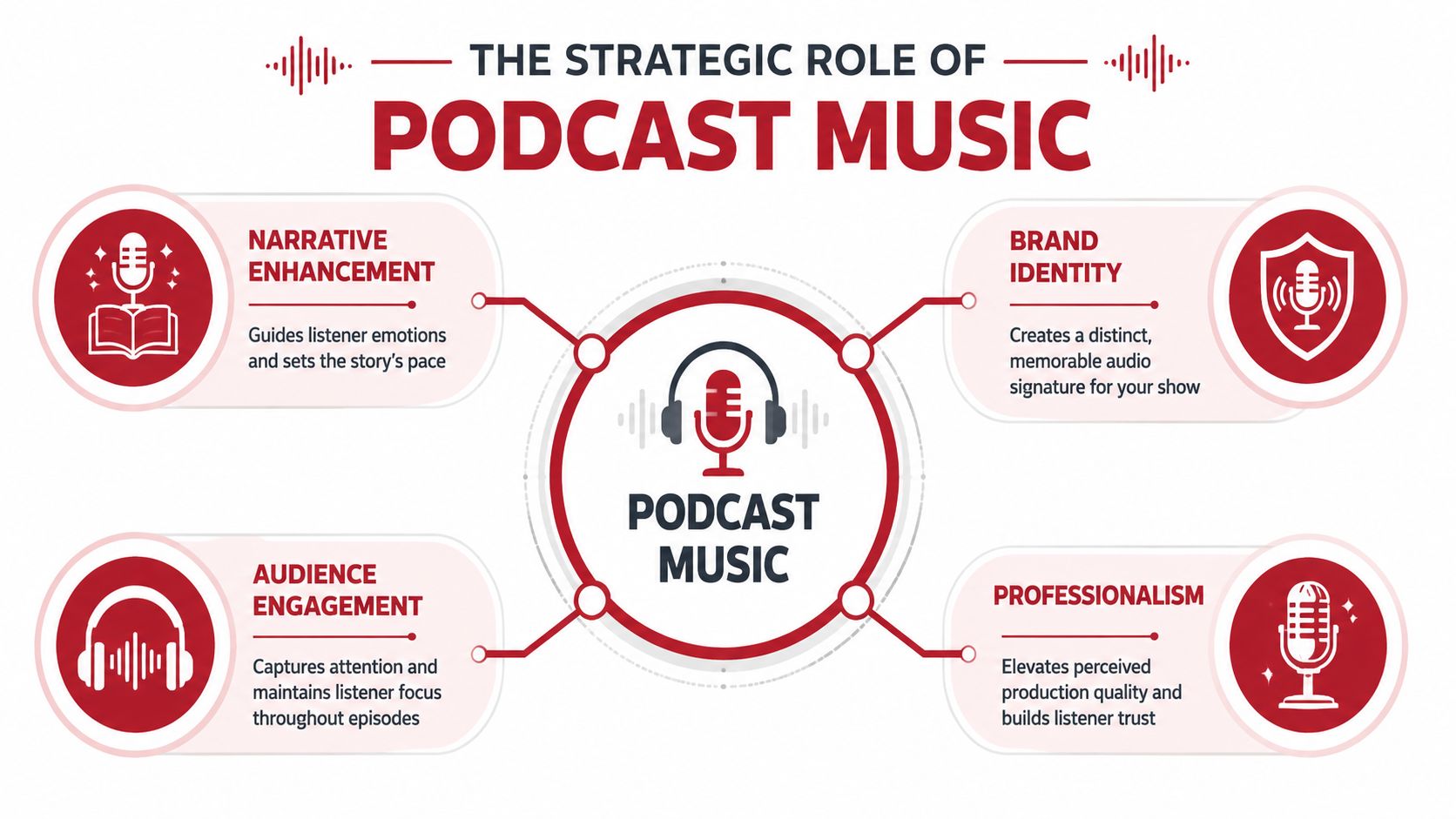
In nonfiction podcasting, music often works best when it gives direction to the listener. A brief tonal cue before a difficult story prepares the audience. A light transition bed tells them the show is moving from anecdote to analysis. A subtle underscore can hold tension during a reflective section without interrupting the host's pacing.
This matters most when the script or interview has emotional shifts. Without sonic guidance, those turns can feel abrupt.
Brand identity
The intro theme, transition cue, and outro bed together can create a recognizable audio signature. That signature doesn't need to be flashy. In many cases, restraint is what makes it effective.
A leadership show might use clean, modern textures. A wellness show may lean ambient and spacious. Teams exploring adjacent audio styles sometimes learn useful lessons from fields outside podcasting, including guides on how to create meditation soundscapes, where pacing, tone, and repetition all affect how people feel while listening.
Music should answer a brand question before it answers a taste question.
Audience engagement and professionalism
A listener usually won't articulate that a transition bed kept them oriented. They'll just experience the episode as easier to follow. That's the point. Good scoring reduces friction.
Music also affects perceived polish. When intros are too long, transitions too dramatic, or beds too loud, the production starts sounding self-conscious. When cues are short, relevant, and consistent, the show feels edited by someone who understands pace. That's often the difference between a podcast that sounds homemade and one that sounds ready for sponsors, stakeholders, or clients.
Navigating Music Licensing and Legal Risks
The fastest way to create a headache is to treat music licensing casually. A podcaster grabs a track, assumes a credit line is enough, cuts the episode into social clips, and only later discovers the license didn't cover those extra uses. By then, the show has already shipped to multiple platforms.
That risk is growing because podcast production rarely stops at the audio episode. One interview can become a full episode, a trailer, several vertical clips, audiograms, sponsor edits, and reposted snippets. As Universal Production Music's podcast collection makes clear through language like “pre-cleared sync tracks” and “flexible licensing,” the modern question isn't just whether a track is legal for a podcast. It's whether the license survives the full downstream distribution workflow.
Why fair use is a bad bet
Fair use is not a working music strategy for podcasters. It's not a shortcut for using commercial tracks in intros, interviews, or branded clips. Serious creators need a rights position they can explain before release, not after a claim appears.
The safer approach is simple. Use music that is clearly licensed for the intended uses, keep a record of the license terms, and verify whether those terms cover derivative content such as short-form video and monetized platform uploads.
For creators who need a plain-language refresher on royalty-free music licenses, that overview is useful because it helps separate marketing language from actual permission.
Podcast Music Licensing Options at a Glance
| License Type | Typical Cost | Best For | Key Restriction |
|---|---|---|---|
| Royalty-Free | Varies by provider and license scope | Most branded podcasts needing speed and convenience | Terms may limit platforms, ad use, or repurposed video |
| Public Domain | Often free to use, but verification still matters | Historical or classical material with clearly expired rights | Recordings can have separate rights even if the composition is public domain |
| Creative Commons | Varies, often free with conditions | Indie projects with narrow distribution plans | Attribution, noncommercial, or no-derivatives terms can block business use |
| Custom Composition | Higher effort and negotiated cost | Shows needing a unique sonic brand and broad control | Rights must be spelled out in writing for all intended uses |
The content waterfall question
The overlooked licensing question is this. If one episode turns into YouTube Shorts, Instagram Reels, TikToks, trailers, and sponsor cutdowns, does the same track still clear every use?
That should be asked before a track is selected, not after the edit is done.
A practical rights checklist helps:
- Confirm platform scope: Check whether the license covers podcast apps, YouTube, Instagram, TikTok, and any embedded website players.
- Check edit flexibility: Make sure the track can be cut, looped, shortened, or paired with subtitles and graphics.
- Review monetization terms: If clips may support ads, sponsorships, or branded promotion, the license needs to allow that use.
- Store documentation: Keep receipts, license files, and version notes with the episode assets.
- Watch for team reuse rules: Some licenses cover one creator or one channel only, not an agency or client roster.
Most legal problems with podcast background music don't come from complex courtroom disputes. They come from sloppy assumptions at the start of production.
How to Choose Music That Fits Your Brand
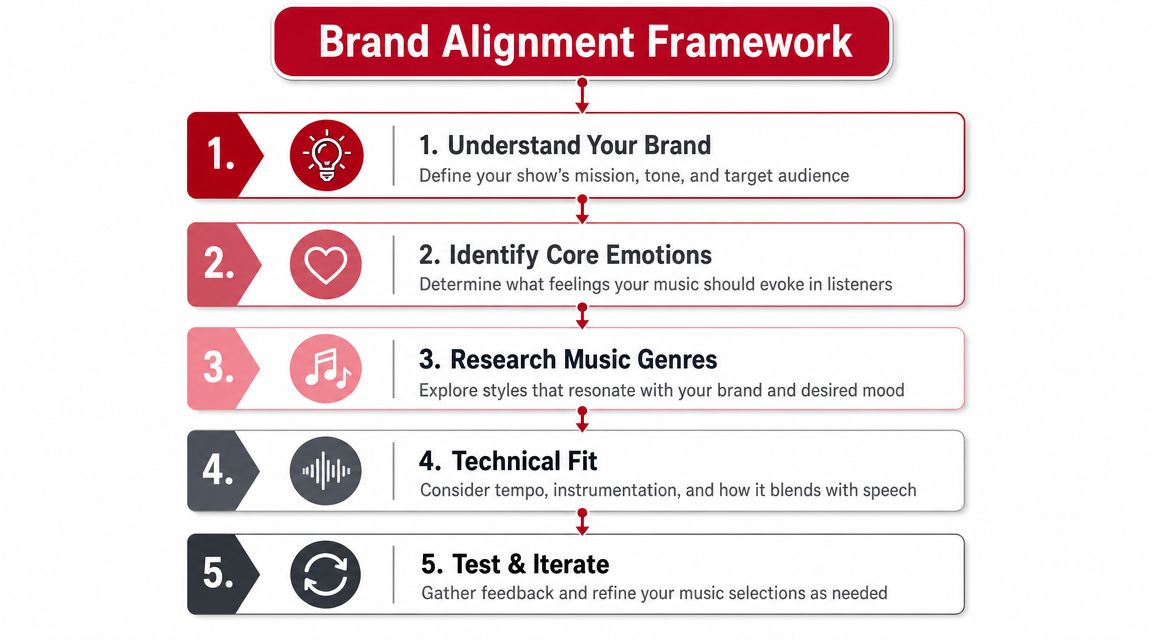
The best track isn't the one the producer personally likes most. It's the one that makes the show sound more like itself. That requires a filter that goes beyond “upbeat,” “cinematic,” or “cool.”
Start with brand before genre
A finance podcast, founder interview show, and spiritual teaching series may all use piano, pads, or percussion. Genre labels alone won't choose the right cue. The stronger filter is brand behavior.
Ask:
- What emotional posture should the show take? Confident, reflective, urgent, calm, hopeful, investigative.
- What promise does the host make to listeners? Clear advice, emotional resonance, deep thought, practical instruction.
- How should the audience feel after the intro? Ready to learn, ready to trust, ready to lean in.
A useful way to sharpen that thinking is to study how sound supports attention in other audio-first formats. This video offers helpful context on music and listener experience.
Choose for speech, not just mood
Many creators get stuck because they select music in headphones, in a quiet room, while focused only on vibe. That ignores the central listening condition of most podcasts. People listen while driving, walking, working, and doing chores.
According to Mubert's guide to choosing podcast background music, creators often overlook the speech-intelligibility tradeoff, even though music that competes with vocal frequencies can hurt comprehension. That's the right lens. A good bed doesn't just sound good alone. It leaves room for consonants, phrasing, and meaning.
A track can be emotionally perfect and still be technically wrong for spoken audio.
Signals that a track may fight the voice include dense midrange instruments, busy rhythmic patterns under speech, and melodic hooks that pull attention away from the words.
A practical shortlist test
When choosing podcast background music, a shortlist should go through three tests before approval:
Intro fit
Does the first few seconds support the show's identity immediately, or does the music feel generic enough to belong to any podcast?Under-dialogue behavior
Drop real speech over the bed. If the track makes the host sound smaller, thinner, or harder to follow, reject it.Repurposing flexibility
Can the same track work in a full episode, a trailer, and a short clip without sounding awkward or overdramatic?
The right choice usually feels less exciting in solo playback than a flashy alternative. That's normal. Music for podcasts has to coexist with a voice, not compete for lead position.
Technical Best Practices for Mixing Music
A strong track can still fail in the mix. Most podcast music problems are technical, not artistic. The cue is too loud, the fade is abrupt, the low end crowds the vocal, or the bed stays static while the speaker changes intensity.
Set the voice first
Dialogue is the anchor. Music is support. That order should control the mix from the start.
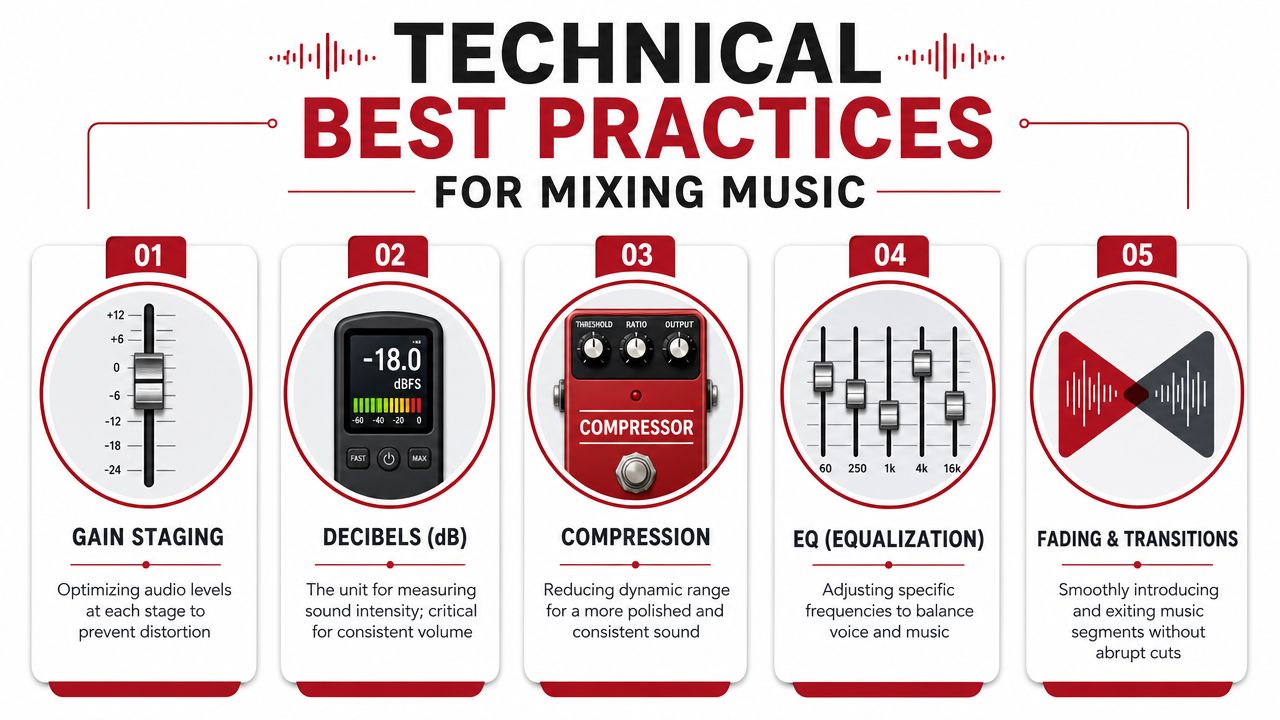
OBSBOT's podcast music guidance notes that background music is typically mixed about 15 to 30 dB below the voice, with many editors aiming around -20 to -30 dB relative to speech. That range is practical because it keeps the bed present without letting it mask intelligibility.
A workable sequence looks like this:
- Normalize the spoken track first: Get the host and guests feeling consistent before adding any music.
- Bring in the bed softly: Start lower than expected, then raise it only until it adds atmosphere.
- Check transitions separately: Intro music can be louder before speech starts, then it should drop when the host begins speaking.
- Test on weak playback devices: Phone speakers and basic earbuds reveal masking problems fast.
For teams using AI-assisted editing to speed up prep work, tools like those discussed when you discover SparkPod's podcast generator can help accelerate assembly. But the final music balance still needs human listening.
Use ducking like a conversation cue
Ducking means the music drops automatically when someone speaks. The easiest way to think about it is stage etiquette. When the speaker takes the mic, the band steps back.
That doesn't mean the bed should pump dramatically every few words. Heavy ducking sounds amateurish. Gentle, transparent ducking helps the listener feel the score without fighting for attention.
Mix note: If listeners become consciously aware of the music during active dialogue, the bed is probably too high.
A simple final mix checklist
A polished episode usually passes this short review before export:
- Listen to the cold open: The first spoken line should be clear without straining.
- Check fade timing: Intros should taper naturally, not vanish mid-thought.
- Trim dense frequencies: If the bed lives in the same range as the voice, use EQ to carve space.
- Audit consistency: Transition cues should feel like part of one show, not tracks from unrelated libraries.
- Review on multiple devices: Car audio, earbuds, and phone playback often tell the truth faster than studio monitors.
Teams that need a dedicated finishing process often rely on specialized podcast audio editing services because these details are what separate a clean recording from a professional release.
Music Strategies for Specific Podcast Formats
Different formats need different music behavior. A strategy that works for a nonprofit documentary will feel overproduced on a B2B interview show. A calm spiritual podcast can't use the same transition language as a founder-led sales brand.
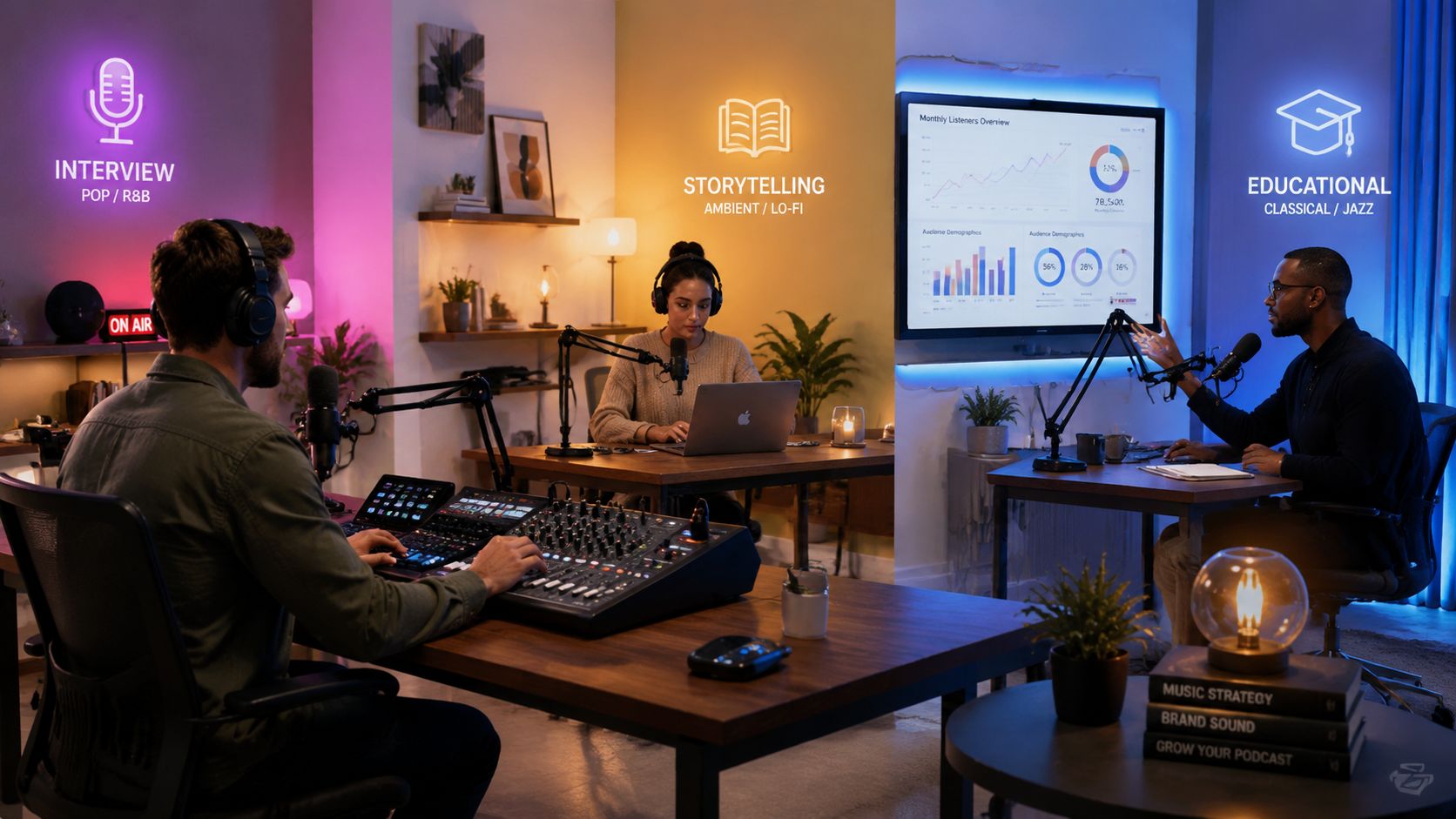
B2B consultant shows
These podcasts win on clarity, trust, and authority. The music should subtly support those qualities.
A strong approach uses a short, polished intro with restrained percussion or modern corporate textures, then keeps under-dialogue music minimal. Transition cues can mark changes between interview, analysis, and call-to-action segments.
What usually doesn't work is theatrical scoring. If the music suggests a true-crime trailer while the host is discussing market positioning, the tone collapses.
Mini-template
- Best style: Clean electronic textures, subtle pulse, light piano, restrained ambient beds
- Use music in: Intro, outro, chapter transitions
- Avoid: Busy arpeggios, heavy drums under speech, dramatic drops
Founder and personal brand podcasts
These shows can carry more personality. The music should reflect the host's energy without becoming performative.
A founder with a high-energy speaking style may use sharper, more rhythmic intros. A reflective author or coach may need something warmer and more spacious. What matters is alignment between voice, message, and music behavior.
The strongest cue often sounds like an extension of the host's presence. It feels chosen, not templated.
A personal brand podcast doesn't need louder music. It needs more accurate music.
Nonprofit storytelling podcasts
Nonprofit shows often rely on emotion, lived experience, and narrative arcs. Music can do more here, but only with discipline.
Scoring works best around scene-setting, transitions, and reflective pauses. Beds should support testimony, not sentimentalize it. If the score tells the audience exactly what to feel, it weakens the credibility of the story.
A practical pattern for nonprofit episodes
- Open with a short thematic cue: Establish tone quickly.
- Let interviews breathe: Use silence when a story already carries emotional weight.
- Score transitions with purpose: Mark movement between context, story, and action.
- Close with warmth, not manipulation: The ending should support reflection and response.
Spiritual and reflective shows
Spiritual leaders and contemplative hosts need music that creates space. That usually means long textures, gentle movement, and minimal melodic demand.
The danger here is overfilling the episode with constant ambience. Reflection needs contrast. If the bed never changes, it can blur into a wash that reduces attentiveness. Selective placement often works better than wall-to-wall music.
For creators pairing audio and video formats, the production plan should also consider how cues behave in visual edits, trailers, and vertical clips. A thoughtful video podcast workflow helps prevent a track from feeling right in audio but awkward once the content is repurposed for screen-based platforms.
Your Action Plan and Final Questions Answered
Podcast background music works when it serves three masters at once. It has to fit the brand, protect intelligibility, and hold up legally across distribution. Miss any one of those and the show becomes harder to scale.
A working action plan
Start with identity. Define what the show should sound like in a few words that guide decisions. Authoritative and calm is useful. Modern and inspiring is useful. “Cool” is useless.
Then secure music with a license that matches your publishing plan. If the content will be clipped, subtitled, reposted, monetized, or adapted into short-form video, the license has to allow for that reality.
After that, judge tracks against speech. The best music choice is often the one that leaves the most room for meaning. Finally, mix with the vocal in front and test outside the editing environment.
Quick answers to common questions
Should every podcast use background music?
No. Some interview shows and educational formats are stronger with sparse music or none under dialogue. The goal is support, not decoration.
Is royalty-free music automatically safe everywhere?
No. Royalty-free describes a licensing model, not universal permission for every platform and every downstream use.
How much music is too much?
If the bed keeps pulling attention away from speech, or if every transition arrives with a dramatic cue, the show is over-scored.
Should the same track be used for intro and outro?
Often, yes. A consistent theme helps with recognition. But the arrangement may need to change so the outro doesn't feel repetitive.
What's the best test before publishing?
Listen on a phone speaker, basic earbuds, and in a car. If the voice stays effortless and the music still adds shape, the mix is probably in the right place.
Get Up Productions helps brands, founders, nonprofits, and thought leaders turn strong ideas into polished shows that sound authoritative from the first second. For teams that want recording, editing, video, and a complete content waterfall handled by specialists, Get Up Productions offers a turnkey production partner built for growth.