
Most advice about how to grow podcast audience starts too late. It starts with promotion hacks, social posting schedules, and clip tactics after the show already exists.
That sequence is backward.
Podcast growth rarely fails because a host forgot to post enough. It fails because the show was never designed for a specific listener, never packaged for discovery, and never turned into a repeatable distribution system. The fix isn't more random marketing. The fix is building a growth engine where audience fit, show structure, discoverability, repurposing, and conversion all work together.
Podcasting now sits inside mainstream media behavior, not the fringe. Daily podcast consumption among adults rose from 6% in 2015 to 23% in 2025, a nearly 4x increase, according to Audacy's audience behavior analysis. That changes the job. Hosts no longer need to convince people to try podcasts. They need to earn attention and repeat listening in a crowded field.
Table of Contents
- Start with Who Not How
- Design a Show Worth Subscribing To
- Optimize Your Podcast for Maximum Discoverability
- Implement the Content Waterfall System
- Amplify Your Reach with Smart Promotion
- Convert Listeners into Leads and Donors
- Measure What Matters and Optimize Your Growth
Start with Who Not How
The first question isn't how to promote a podcast. It's who should care enough to subscribe.
Most podcast advice skips that step. One of the most underserved angles in podcast growth is defining who the show is really for before launch. The bigger gap is pre-launch validation, especially in crowded categories where a distinctive angle and clear listener fit separate discoverable shows from undifferentiated ones, as discussed in this Tom Webster conversation on The Agents of Change.

A broad mission doesn't create a clear show. That problem shows up constantly with founders, nonprofits, ministries, and B2B firms. They often know what they want to say, but not which listener segment needs to hear it first. A podcast for "business owners" is vague. A podcast for operations leaders at midsized service firms dealing with delivery bottlenecks is specific. A show for "people of faith" is diffuse. A show for church leaders trying to communicate vision during growth is focused.
Build an ideal listener around a real decision
Useful listener personas aren't demographic sketches. They are tied to a decision, tension, or desired outcome.
A strong persona usually answers questions like these:
- What pressure is this person under: Are they trying to hit pipeline goals, raise donor trust, recruit volunteers, or establish category authority?
- What are they already searching for: Not broad interests, but recurring problems they want solved.
- What kind of show would they recommend: Tactical interviews, concise solo analysis, behind-the-scenes leadership conversations, or stories with emotional depth.
- What would make them come back next week: Fresh insight, better questions than competitors ask, or language that sounds like their world.
Practical rule: If the listener description could fit five different shows, it isn't specific enough.
Validate demand before recording
Pre-launch validation doesn't need a giant research project. It needs disciplined observation.
Review competing shows in the category. Look at episode titles, guest patterns, comments, reviews, and channel language. The goal isn't to copy a format. The goal is to find what nobody is serving well.
A practical validation pass looks like this:
- List adjacent shows that already reach the audience being targeted.
- Document repeated themes they cover well and themes they keep avoiding.
- Collect listener language from comments, reviews, LinkedIn posts, Reddit threads, YouTube comments, or industry communities.
- Test a show premise in plain language with actual prospects, clients, donors, or community members.
- Refine the angle until people respond with recognition instead of politeness.
One useful outside perspective on audience-first podcast planning comes from this guide to learn from Whisper AI on podcasting, which reinforces the value of aligning content with a clearly defined listener need rather than chasing generic exposure.
Choose a niche that can expand later
Narrow doesn't mean small forever. Narrow means credible at the start.
A show earns growth when listeners can instantly answer three questions:
| Question | Weak answer | Strong answer |
|---|---|---|
| Who is this for? | Anyone interested in leadership | Agency founders hiring their first operators |
| Why this show? | General insights and interviews | Sharp conversations about building systems without losing culture |
| Why now? | New episodes weekly | Timely help for a pressing operational stage |
The fastest route to obscurity is trying to appeal to everyone on day one. The fastest route to traction is becoming unmistakably relevant to a smaller group first.
Design a Show Worth Subscribing To
A podcast can attract attention and still fail to grow. That happens when the show gives first-time listeners no reason to stay.
Growth depends on retention as much as discovery. Spotify's guidance for creators recommends narrowing the audience, identifying where listeners are most active, using a designated “Best Place to Start” episode, launching with 3 to 5 episodes, and tracking engagement and follower growth as the feedback loop, according to Spotify's audience growth resource.
Engineer the listening habit
A sticky show is built, not improvised. Format, pacing, and release cadence all shape whether a new listener samples one episode or becomes a regular.
Use this checklist when designing the show:
- Format fit: Interview shows work when the host can consistently extract uncommon insight. Solo shows work when the host has a clear framework and point of view. Narrative formats work when the story itself carries emotional weight.
- Episode promise: Every episode should answer one question, solve one problem, or explore one tension. Blurry episodes create weak word-of-mouth.
- Recurring structure: Open, middle, and close should feel familiar enough that listeners know how to follow the show.
- Cadence: Weekly usually beats sporadic publishing because habit needs rhythm.
- Starter library: Launch with multiple episodes so a new listener can decide quickly whether the show deserves a place in their routine.
That launch library matters more than many hosts realize. One episode creates curiosity. A small backlog creates confidence.
Production quality changes perceived authority
Content matters most, but production quality changes whether the message lands. Audiences forgive simple setups. They don't forgive distracting audio, meandering edits, or long intros that delay the value.
Professional production usually improves three things:
- Clarity: Cleaner audio reduces listener fatigue.
- Pacing: Tight edits remove repetition and dead space.
- Positioning: Sound design, music choices, and visual consistency signal whether the show feels serious.
A good episode gives useful information. A well-produced episode makes the host sound credible enough to trust again.
For B2B and thought leadership shows, that trust signal is especially important. Buyers and donors often discover expertise through the show before they ever book a call, visit a landing page, or join an email list.
Build a best-place-to-start path
New listeners rarely begin with the latest episode and immediately understand the show. They need an entry point.
A practical show architecture includes:
- A welcome episode that tells people what the show does and who it's for
- A best-place-to-start episode for new visitors
- A small cluster of foundational episodes that represent the core topics
- Clear episode titles that tell a listener why each one matters
Many podcasts publish episodes in a straight line and leave the listener to figure it out. Better shows guide the first few listening decisions on purpose.
Optimize Your Podcast for Maximum Discoverability
Strong episodes don't grow by accident. They grow when the packaging matches how people search, browse, and sample content across platforms.
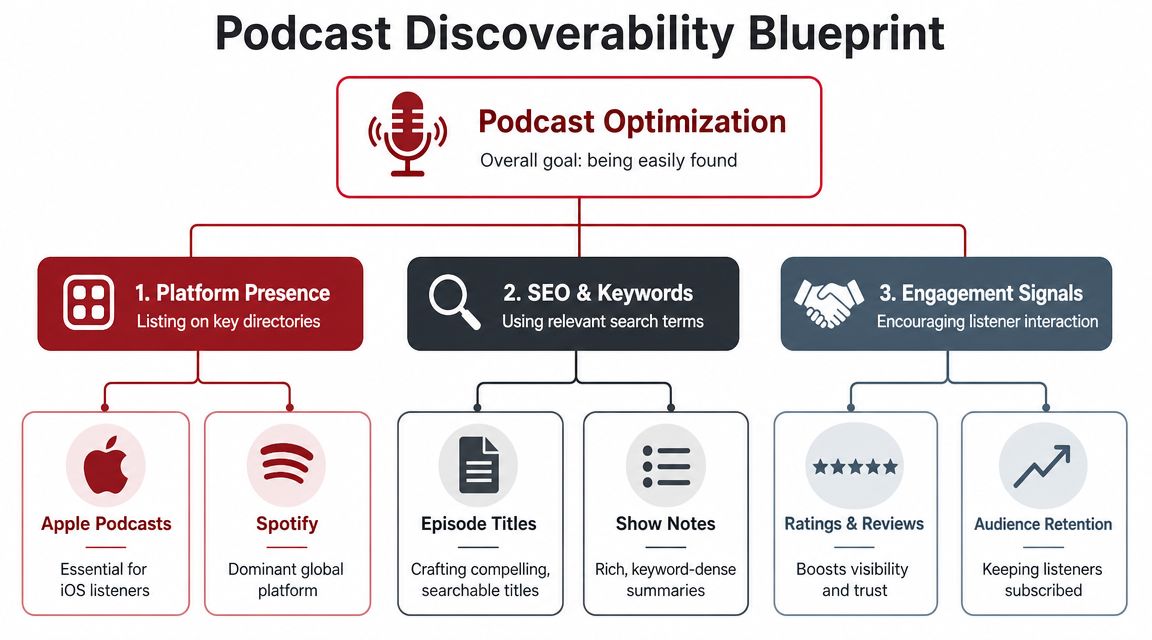
The biggest shift in discoverability is platform behavior. In 2025, an estimated 584.1 million people worldwide listened to podcasts, up about 6.8% from 546.7 million in 2024, and YouTube was the most-used podcast platform for about one in three listeners, around 33%, ahead of Spotify at about 25 to 27% and Apple Podcasts at about 14 to 15%, based on podcast platform summaries gathered by Teleprompter's podcast statistics roundup. That means an audio-only growth strategy is competing in a market where discovery increasingly happens through video-first behavior.
Treat packaging like part of the product
Episode titles, descriptions, thumbnails, and show notes aren't administrative tasks. They are the front door.
Three packaging rules matter most:
- Lead with the listener problem: "How founders can delegate without losing control" will outperform vague creativity.
- Use searchable language: Choose the terms the audience already uses in meetings, Slack channels, LinkedIn posts, and search bars.
- Make the payoff obvious: Curiosity helps, but clarity gets the click.
Weak titles are often clever and forgettable. Strong titles are plain and useful.
A better approach looks like this:
| Element | Weak version | Strong version |
|---|---|---|
| Episode title | Leading Through Change | How nonprofit leaders keep donor trust during change |
| Description | A great conversation with an expert | Practical guidance on donor communication, team alignment, and message clarity |
| Show notes | Short summary only | Summary, key takeaways, names, topics, resources, and timestamps |
Publish for YouTube on purpose
Uploading static audio with a generic title isn't a YouTube strategy. It is storage.
A discoverable YouTube podcast workflow usually includes:
- A searchable title that mirrors real audience language.
- A thumbnail with a clear promise, not crowded design.
- A description that explains the topic in plain terms.
- Timestamps so viewers can jump to relevant segments.
- A visible host and guest setup when possible, because video creates more usable assets later.
Shows that embrace YouTube often gain more than view counts. They gain better clip inventory, stronger guest sharing, and more opportunities to surface in recommended feeds.
Build owned search assets beyond the app
Directories matter, but they aren't enough. A podcast website or episode landing page helps a show show up in search results outside the listening apps and gives the brand a place to capture email signups, embed players, and organize topic clusters.
A common discoverability stack includes:
- Podcast directories such as Apple Podcasts and Spotify
- YouTube uploads for browse-based discovery
- Episode pages with transcript-based or summary-based copy
- Show notes written for humans first and search second
Search visibility usually improves when the show speaks the audience's language more clearly, not when the host tries to game an algorithm.
If the goal is learning how to grow podcast audience in the current environment, discoverability starts with metadata, but it compounds through consistency of packaging across every platform where people already spend attention.
Implement the Content Waterfall System
Many teams don't have a content problem. They have a workflow problem.
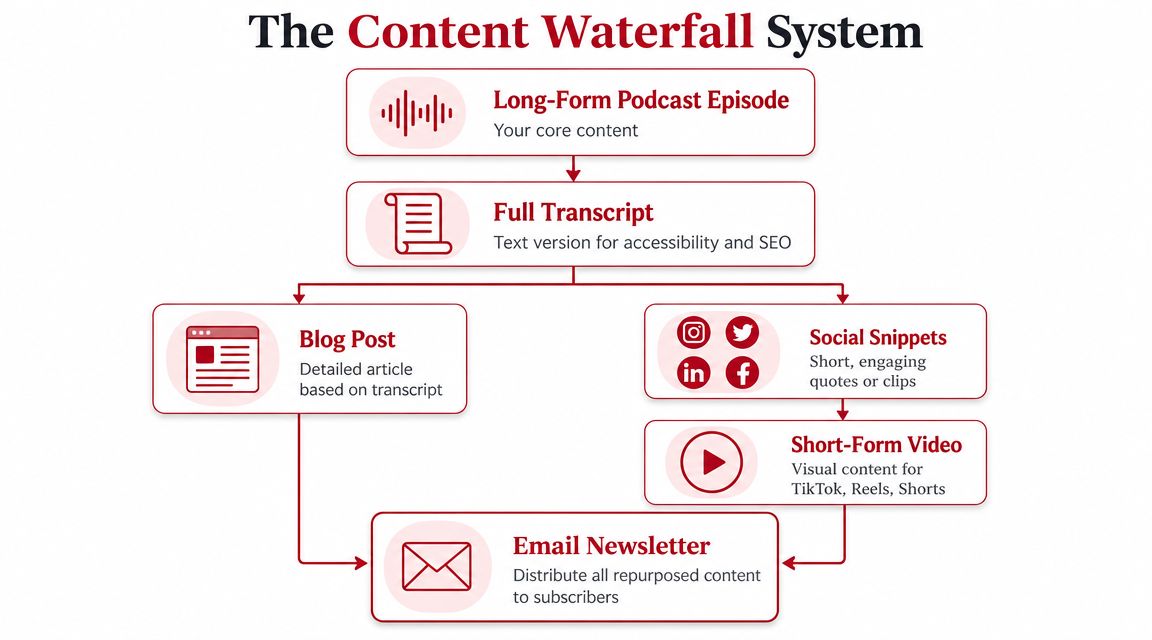
They record an episode, publish it once, post a link, and move on. That wastes the strongest asset they created all week. A smarter system turns one long-form conversation into multiple entry points that keep bringing people back to the full show.
Daily listening behavior has changed the stakes. As noted earlier in the introduction, podcast consumption became far more habitual over the past decade. That shift supports a retention-first model because repeat listening is what turns broad market adoption into real show growth.
Start with the master asset
The long-form episode is the source material. Everything else should flow from it.
A practical waterfall begins with these deliverables:
- The polished full episode: audio, video, or both
- A transcript: useful for editing, writing, search, and accessibility
- A key-moments review: mark the moments with tension, surprise, strong phrasing, practical steps, or emotional impact
- A publishing brief: define the episode promise, target audience, and CTA before creating clips
Many teams err initially by repurposing content randomly. A more effective approach involves identifying which moments suit which platform.
Match each asset to platform behavior
A quote that works on LinkedIn often won't work as a Reel. A fast visual clip for Shorts may need a different opening than a thought-leadership carousel.
The Content Waterfall works best when each asset has a job:
| Asset | Best use | What it should do |
|---|---|---|
| Short-form video clip | YouTube Shorts, Instagram Reels, TikTok | Stop the scroll and create curiosity |
| Audiogram | Instagram, email, light social distribution | Keep the show visible when no video is available |
| Quote graphic | LinkedIn, X, slides | Distill one clear idea worth sharing |
| Blog post | Website, search, sales enablement | Expand the episode into durable written content |
| Email newsletter | Subscriber list | Bring existing audience back to the episode |
For teams building this pipeline regularly, a documented content repurposing strategy from Get Up Productions shows what it looks like when one recording session feeds multiple channels instead of dying after publication.
Use clips to create repeat entry points
A single episode can generate weeks of top-of-funnel content if the clips are chosen well. Good clips usually begin with friction, not introductions. They open on a bold claim, a sharp question, a mistake, or a useful distinction.
For editors handling YouTube-based source material, this guide on how to clip YouTube videos is a helpful reference for building a cleaner extraction workflow before formatting clips for Shorts, Reels, or other channels.
A useful visual example of this system in action sits below.
The point of repurposing isn't to say the same thing everywhere. It's to create multiple ways for the right listener to enter the same ecosystem.
A disciplined waterfall also reduces creative fatigue. The host records once. The team extracts moments, rewrites hooks, formats natively, and distributes on schedule. That is how podcast promotion becomes a system instead of a scramble.
Amplify Your Reach with Smart Promotion
Promotion works differently depending on the stage of the show. Early on, the job is learning where the audience responds. Later, the job is scaling the channels that already produce qualified attention.
The cleanest way to think about promotion is through three buckets: organic, partnership, and paid. Each does a different job, and each can fail if used at the wrong time.
Organic promotion builds signal slowly
Organic distribution is the most accessible option, but it only works when it is targeted. Posting every episode link to every platform isn't a strategy. It is administrative activity.
Organic promotion tends to work when the team does a few things well:
- Native posting: Share clips, carousels, quote cards, or short insights that fit the platform instead of dumping links.
- Community participation: Contribute to niche conversations where the target listener already spends time.
- Consistency: Stay visible long enough for repeated exposure to matter.
This is often the right starting point for new shows because it teaches what language, hooks, and topics resonate. Teams that need a steady flow of vertical assets often use a short-form video content workflow to keep promotion active without inventing new ideas from scratch every week.
Partnership promotion transfers trust faster
Partnerships usually outperform cold promotion because they borrow credibility from an existing audience. This includes guest swaps, feed drops, newsletter mentions, strategic collaborations, community partnerships, and appearances on adjacent shows.
A quick comparison helps:
| Promotion type | Strength | Risk | Best use case |
|---|---|---|---|
| Organic | Low cost, strong learning loop | Slow without consistency | Early-stage testing |
| Partnership | Trust transfer, audience alignment | Weak if fit is poor | Niche authority building |
| Paid | Speed and control | Expensive if message is weak | Scaling proven offers |
The main mistake with partnership marketing is chasing audience size instead of audience fit. A smaller but tightly aligned show often sends better listeners than a larger but unrelated one.
Paid promotion should accelerate proof, not replace it
Paid ads can help. They can also magnify bad positioning.
Use paid promotion after the show already has:
- A clear listener segment
- Strong episode packaging
- A conversion path, such as an email signup or targeted landing page
- Creative assets that have already earned organic engagement
Paid social can put clips in front of a narrow audience. Sponsored placements can support launches. Retargeting can bring previous visitors back. But if the show itself isn't compelling, paid spend only buys more weak first impressions.
Promotion is most effective when each channel serves a role. Organic surfaces what resonates. Partnerships expand trust. Paid scales what already has evidence.
Convert Listeners into Leads and Donors
A growing audience only matters if the show moves people toward a real outcome.
For a B2B firm, that outcome might be qualified conversations. For a nonprofit, it might be donor trust or volunteer action. For a founder, it might be authority that leads to speaking, consulting, or client demand. The podcast should support that path without turning every episode into a pitch.
Place calls to action where intent is highest
Most hosts either ignore CTAs or overdo them. The stronger approach is simple and specific. One episode should usually push one next step.
Useful CTAs tend to fall into a few categories:
- Resource CTA: Mention a checklist, framework, template, or guide tied directly to the episode topic.
- Relationship CTA: Invite the listener to join an email list or community.
- Action CTA: Ask for a call, a donation, an application, or a share when the episode creates enough trust to justify it.
A dedicated podcast landing page gives those CTAs somewhere focused to send traffic. That matters because directories are good for listening, not for conversion.
Build owned audience, not rented attention
The email list is the bridge between audience growth and business value. Social platforms can help discovery, but email creates continuity and control.
A podcast earns attention. An email list keeps access to that attention.
The best lead magnets are tightly connected to the episode itself. If the conversation covered interview prep for B2B sales calls, offer the exact prep sheet. If it covered donor storytelling, offer the messaging template. When the CTA feels like the natural next step, conversion feels helpful instead of forced.
Measure What Matters and Optimize Your Growth
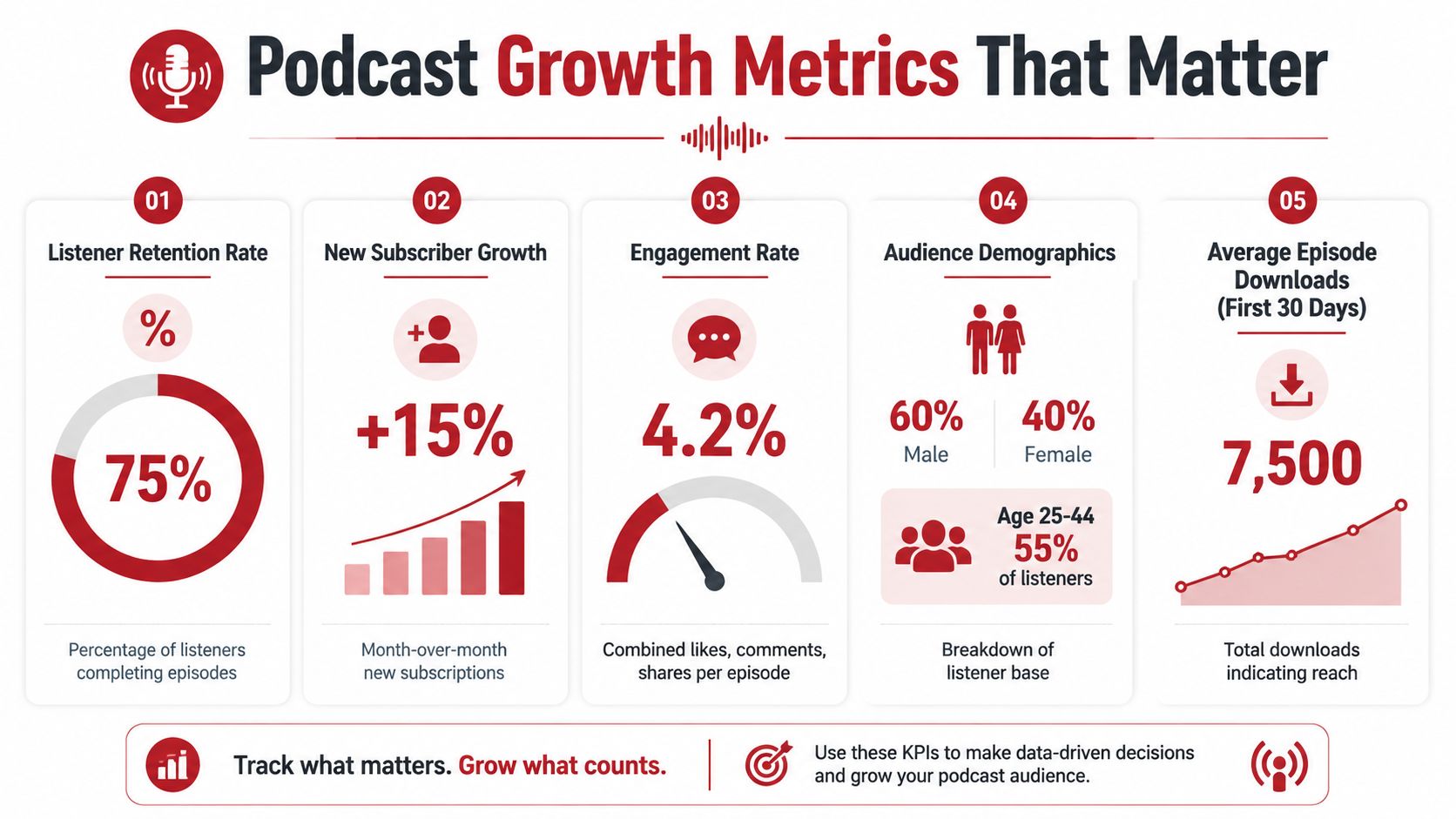
Downloads matter, but they don't tell the full story. A show can have decent download activity and still fail to build loyalty, momentum, or business results.
A better measurement approach combines scale, engagement, and behavior. Spotify recommends tracking engagement rates and follower growth as the core feedback loop, as noted earlier from its creator guidance. That advice is useful because it pushes teams beyond vanity metrics and toward what listeners do after they sample the show.
Track the signals that change decisions
A practical review cadence looks at questions such as:
- Are followers growing: That suggests the show is earning enough trust for repeat listening.
- Are people finishing episodes: Retention often reveals whether intros are too long, pacing is weak, or topics lose clarity.
- Are clips driving traffic back to full episodes: That shows whether repurposing is attracting the right audience.
- Are CTAs getting response: If not, the issue may be the offer, the placement, or the relevance.
Not every metric deserves equal attention every month. The right focus depends on the phase of the show.
Use the right strategy for the right stage
Podcast growth often follows a benchmark model of 0 to 100 downloads per episode for validation, 100 to 1,000 for traction, 1,000 to 10,000 for scaling, and 10,000+ for diversification, according to Podcast Marketing Academy's phase framework.
That model is useful because it discourages premature scaling. A show in validation needs audience-fit proof, strong listener language, and repeated feedback. A show in traction needs consistent packaging and community presence. A scaling show can justify stronger systems for cross-promotion, paid testing, and deeper repurposing. A diversified show can expand into products, events, memberships, or spin-off formats.
The teams that grow steadily don't chase every tactic. They review performance, identify where listeners drop off or engage, and adjust the system. That's how to grow podcast audience without turning the process into noise.
Get Up Productions helps brands, founders, nonprofits, and thought leaders build podcasts that function as growth systems, not one-off content projects. That includes production, YouTube-ready publishing, repurposing workflows, and the infrastructure needed to turn episodes into ongoing visibility and business value.