
Podcast advertising stopped being a side hustle channel a while ago. In the U.S., podcast ad revenues surpassed $2 billion in 2024, rising 26.4% year over year, and are forecast to exceed $3 billion by 2028, according to eMarketer's coverage of the IAB/PwC data and forecast. That changes the conversation.
For B2B founders, consultants, nonprofits, and thought leaders, the primary opportunity isn't just selling ad spots. It's building a show that attracts the right sponsors because the show already signals authority, trust, and category relevance. Revenue follows positioning. It rarely leads it.
That matters because many creators approach monetization backward. They ask what ad model pays the most before they've decided what role the podcast plays in the business. A serious B2B show can generate sponsorship revenue, yes. It can also sharpen market perception, open partnership doors, and create repeated brand association with the companies the host wants to stand beside.

A podcast with no strategic purpose becomes an expensive hobby. A podcast built as a content engine becomes a business asset. That's the difference between chasing ads and attracting aligned advertisers after the show has already earned attention. For brands still shaping the foundation, this business podcast launch guide is a practical starting point.
Table of Contents
- Introduction Why Podcast Advertising Is a Must-Know for Creators
- Understanding the Core Revenue Models
- How to Calculate and Forecast Your Ad Revenue
- Strategies to Actively Increase Your Ad Revenue
- Navigating Measurement and Legal Disclosures
- Podcast Advertising Success Stories in Action
- Conclusion Your Next Steps in Monetization
Introduction Why Podcast Advertising Is a Must-Know for Creators
Podcast advertising revenue matters because it sits at the intersection of media, trust, and buyer attention. Few formats let a host build a long-term relationship with an audience and then monetize that relationship without breaking the tone of the content. That's especially valuable in B2B, where buyers usually need repeated exposure before they act.
A strong show does more than create inventory. It creates context. If a leadership podcast consistently reaches operations executives, software buyers, healthcare administrators, donors, or founders, that context becomes part of the ad product. Advertisers aren't only buying impressions. They're buying adjacency to a trusted voice.
Practical rule: A B2B podcast shouldn't ask, “How can ads make money?” It should ask, “Which advertisers strengthen the brand this show is trying to build?”
That shift changes every monetization decision. A show designed for authority should reject sponsors that confuse the audience, even if they pay. Bad-fit advertisers weaken positioning. Good-fit advertisers act like social proof.
For entrepreneurs and thought leaders, podcast advertising revenue works best as a byproduct of a disciplined content system. The show earns trust. Trust attracts the right sponsors. Those sponsors reinforce market perception. Then the content gets repurposed across video, clips, posts, and sales conversations, creating more value than the ad slot alone.
Understanding the Core Revenue Models
Podcast ad revenue comes from three models. The right one depends on what your show is built to do.
If your goal is authority with a defined B2B audience, treat ad revenue as a byproduct of a strong content system, not the main event. A show that consistently attracts the right listeners creates better sponsor fit, stronger deal terms, and more useful repurposing opportunities across the rest of your Content Waterfall. If audience quality is still inconsistent, fix that first with a plan to grow a podcast audience in the right niche.
Host-read ads
Host-read ads are the highest-trust format. The host delivers the message in their own voice, usually inside the flow of the episode, so the endorsement carries more weight than a generic inserted spot.
For B2B creators, that trust has to be protected. A host-read ad should support the brand you are building. If you want to be known as a sharp operator, advisor, or category expert, your sponsors should reinforce that position. The wrong sponsor can dilute credibility faster than the revenue justifies.
Host-read ads work best for:
- Category-adjacent partners: Software, services, communities, or events that fit the listener's professional priorities
- Founder-led or expert-led shows: Programs where the host's judgment is part of the product
- Smaller, focused audiences: Shows with clear buyer relevance, even if download volume is modest
Programmatic ads
Programmatic ads prioritize efficiency. A platform places ads dynamically based on available inventory and buyer demand, which gives creators a simpler path to monetization without building a direct sales motion.
That convenience comes with weaker alignment. You usually control less of the message, the sponsor mix, and the listener experience. For a broad show, that trade can make sense. For a B2B authority show, it often creates noise.
Use programmatic if you want baseline revenue from unsold inventory or back-catalog episodes. Do not build your monetization strategy around it if your real goal is premium positioning.
Direct sponsorships
Direct sponsorships are the strongest model for serious B2B creators. You work directly with the sponsor on pricing, placements, messaging, and package structure. That control lets you sell more than a single ad slot.
It also lets you shape sponsorships around business goals instead of generic media inventory. A good deal can include multi-episode campaigns, newsletter placement, LinkedIn amplification, webinar tie-ins, event presence, or sales-enablement content pulled from the same core episode. That is where podcast monetization starts acting like a business development channel.
Direct sponsorships are the best fit when:
- Your audience is specific and commercially useful
- Your show supports a larger authority strategy
- You want sponsors to act as market signals, not just advertisers
- You can package the podcast inside a broader content system
A direct sponsorship should strengthen market position and generate revenue at the same time.
Podcast Ad Models at a Glance
| Model | Typical CPM | Creator Control | Scalability | Best For |
|---|---|---|---|---|
| Host-read ads | Varies by show and deal structure | High | Moderate | Trust-based shows with a strong host voice |
| Programmatic ads | Varies by platform and inventory | Low | High | Shows that want easier access to monetization |
| Direct sponsorships | Varies by package and relationship | High | Moderate | B2B creators focused on authority and aligned partners |
The practical recommendation is simple. Use programmatic to fill leftover inventory. Use host-read ads selectively. Put the most effort into direct sponsorships if your podcast is meant to build authority, attract serious buyers, and support the rest of your content engine.
How to Calculate and Forecast Your Ad Revenue
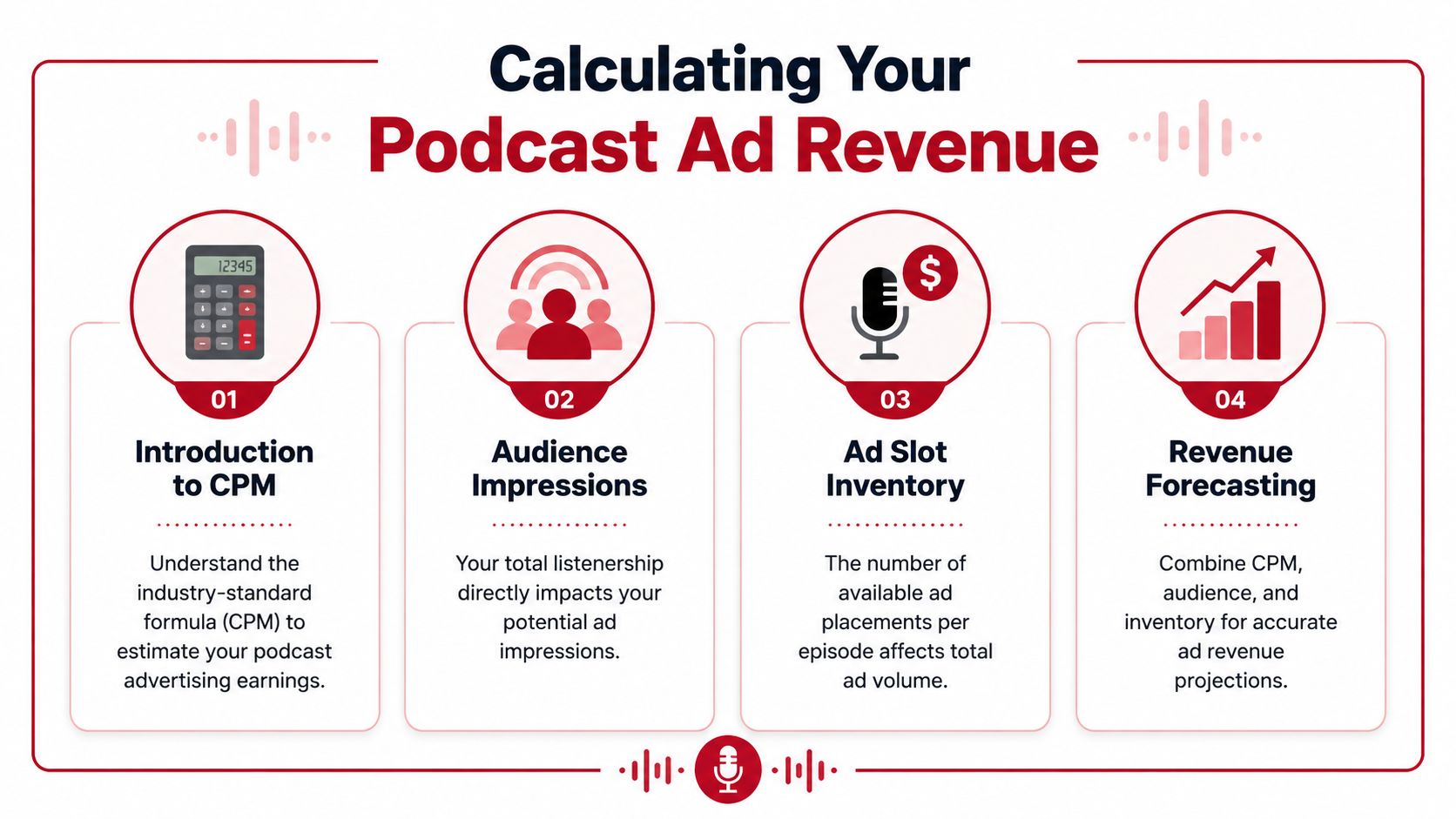
Forecasting podcast advertising revenue doesn't need complicated finance software. It needs a clean formula, a realistic view of inventory, and disciplined assumptions.
The broader market gives creators a useful backdrop. The U.S. podcast ad market grew from $1.9 billion in 2023 to over $2.0 billion in 2024, a 26.4% year-over-year increase, according to the IAB FY2023 podcast advertising revenue study. That doesn't tell any one show what it will earn, but it does confirm that buyers are taking the channel seriously.
The basic formula
The standard framework is CPM, which means cost per thousand impressions. The simple version looks like this:
Revenue = (downloads or impressions ÷ 1,000) × CPM × number of ad slots sold
That's the starting point, not the final answer. A B2B show should also separate inventory by slot type because a mid-roll host-read placement usually carries more strategic value than a quick pre-roll mention.
A simple spreadsheet should track:
- Average episode downloads: Use a consistent measurement window.
- Available ad slots: Pre-roll, mid-roll, post-roll, or sponsored segment.
- Sell-through: Which slots are sold, not just available.
- Campaign length: Single episode, monthly package, or seasonal sponsorship.
For audience growth planning, this podcast audience growth resource helps connect reach goals to future monetization.
What changes the forecast
Forecasts get distorted when creators assume every slot will be sold at the highest rate. That's fantasy. Better forecasting comes from conservative assumptions and clean packaging.
The most important variables are:
- Placement quality: Mid-roll inventory usually carries more weight than a closing mention.
- Audience relevance: A niche executive audience can be worth more to the right sponsor than a broad but vague audience.
- Ad format: Host-read, baked-in placements are often more valuable for authority-led shows.
- Operational consistency: Sponsors pay more confidently when episodes publish on time and assets arrive as promised.
Forecast revenue based on sold inventory and repeatability, not optimism.
The right mindset is to treat revenue projections as planning tools. If a show can't explain its audience, inventory, and sponsor fit on one page, the problem isn't pricing. The problem is packaging.
Strategies to Actively Increase Your Ad Revenue
A small group of top shows attracts a disproportionate share of podcast ad budgets. That reality matters because it forces B2B creators to sell a different offer. You will not outscale major entertainment networks. You can out-position them with a tighter audience, stronger sponsor fit, and a content system that keeps delivering value after the episode goes live.
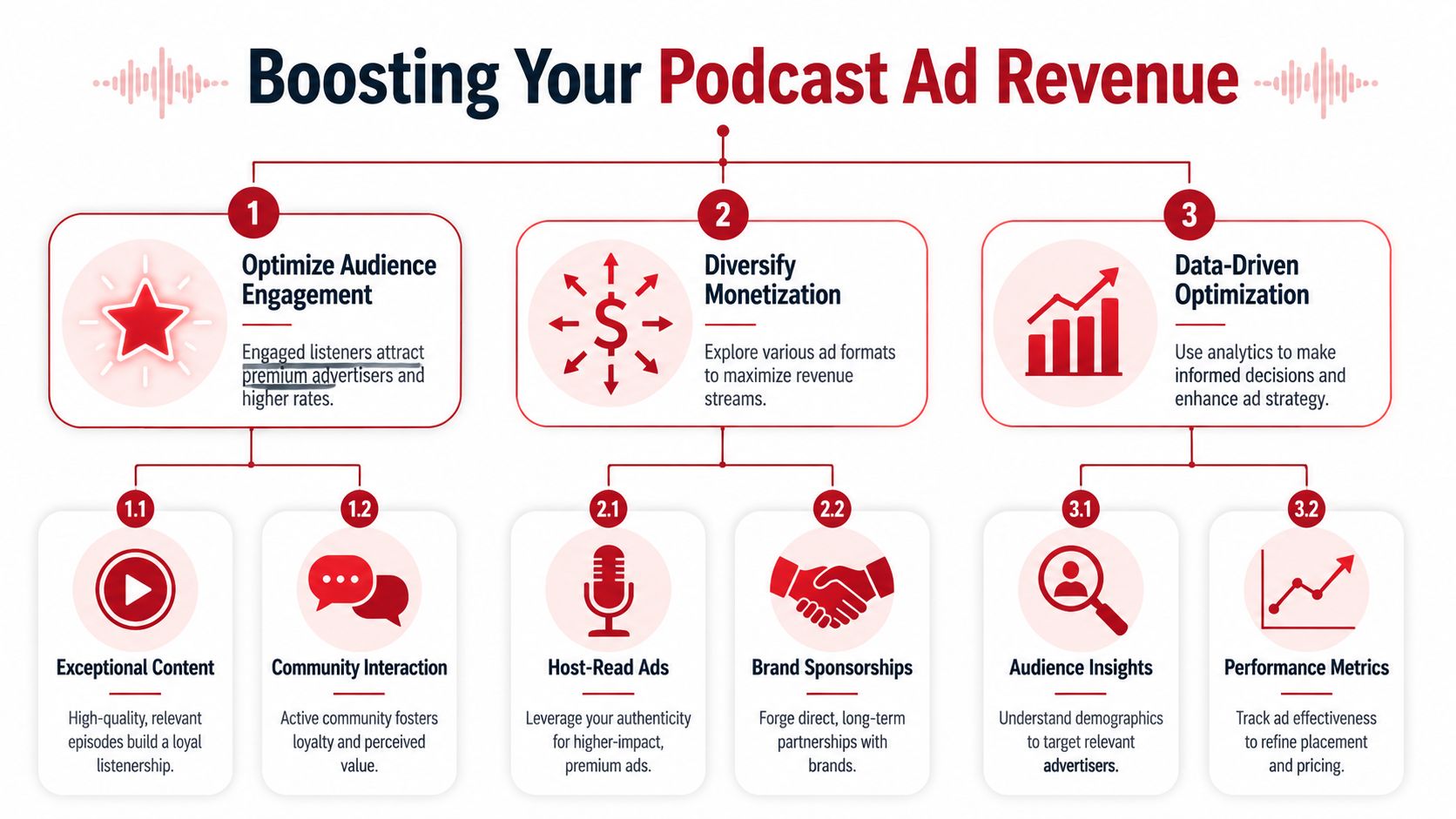
As noted earlier, ad spend is concentrated among a relatively small set of shows. Smaller podcasts still win. They win by being easier to buy, more credible to the right sponsor, and more useful inside a broader marketing plan.
Package business outcomes
Selling isolated ad slots is weak positioning. A B2B entrepreneur or thought leader should sell sponsor packages that support a clear business objective and strengthen the show's authority at the same time.
Build offers around what the sponsor is trying to accomplish:
- Awareness package: Host-read mention, episode description placement, and one social clip.
- Authority package: Sponsored segment, category exclusivity, and brand presence on repurposed assets.
- Launch package: Multi-episode support tied to an event, report, product release, or campaign theme.
This works because marketing teams buy coordinated exposure. They do not want scattered placements with no narrative. They want a program that helps them show up repeatedly in front of a defined audience.
A stronger packaging model also protects your brand. If a sponsor does not belong in the conversation, do not force the deal. Bad sponsor alignment weakens trust faster than it raises revenue.
If you want a clearer operating model, Get Up Productions' podcast marketing strategy approach shows how one episode can feed a repeatable multi-channel content system instead of a single ad impression.
Sell precision
Many B2B podcasters price themselves like general-interest media. That is a mistake.
A show that reaches procurement leaders, healthcare operators, nonprofit executives, pastors, or HR decision-makers has real commercial value if the sponsor needs that exact buyer. The pitch should center on relevance, context, and trust.
Use a simple sales standard:
- Name the audience clearly: Role, industry, buying influence, and core problem.
- Explain sponsor fit: Why this company belongs in your listeners' world.
- Protect the environment: Limit direct competitors and avoid cluttering the show with conflicting messages.
A narrow audience with purchase influence is often worth more than a larger audience with weak relevance.
A helpful comparison comes from video monetization. Strong operators package audience value across formats, channels, and buying moments instead of pricing every placement in isolation. This YouTube content earnings guide for organizations is useful because it frames monetization as a system, not a single metric.
Build a content waterfall sponsors can buy into
Ad revenue grows faster when the podcast is part of a larger publishing engine. That is where the Content Waterfall matters.
One recording should become short video, audiograms, quote graphics, newsletter copy, blog support, and sales-enablement material. Once you operate that way, the sponsor is no longer buying one audio mention. The sponsor is buying repeated association with your expertise across multiple touchpoints.
That changes the economics in your favor:
- More inventory: You can include video clips, newsletter mentions, and visual assets without creating a separate campaign from scratch.
- Longer visibility: The sponsor stays present after release week.
- Stronger authority transfer: Your credibility carries into every reused asset.
- Better renewals: Sponsors can see a fuller program, not a one-off placement.
This is the right strategy for authority-builders. Revenue is the byproduct. The true asset is a content system that attracts aligned sponsors, reinforces your market position, and gives buyers a clear reason to stay.
Navigating Measurement and Legal Disclosures
Podcast advertising has a measurement problem. That doesn't mean it lacks value. It means creators need to sell it transparently.

Measurement is improving, but it still has gaps
One of the clearest recent critiques is that podcast ad growth is often held back by weak conversion tracking and the absence of a reliable performance-marketing playbook, according to Right Side Up's analysis of the business intelligence gap in podcast advertising. That's especially important for B2B creators because sponsors often care more about lead quality and downstream influence than simple reach.
The practical fix isn't pretending attribution is cleaner than it is. The fix is setting expectations before the campaign starts.
A professional ad conversation should define:
- Primary objective: Awareness, trust, lead generation, event promotion, or category association.
- Evidence available: Downloads, listener geography if available, landing page traffic patterns, inbound mentions, or direct sponsor feedback.
- What won't be promised: Exact lower-funnel conversion proof when the setup can't support it.
Creators also need consistent reporting language. If the host says the campaign is for authority and upper-funnel attention, the recap should report against that logic instead of forcing a fake direct-response narrative.
Good sponsorship relationships survive imperfect attribution when expectations are clear from the start.
Disclose sponsorships like a professional
Legal disclosure isn't optional. If there's a material connection between the host and the sponsor, listeners should hear it clearly. Hidden sponsorships don't make the ad more effective. They make the host less credible.
A practical on-air disclosure can be simple:
- Sponsored episode: “This episode is sponsored by [brand].”
- Paid segment: “This segment is brought to you by [brand], a partner of the show.”
- Host endorsement with compensation: “This episode includes a paid partnership with [brand].”
The key is clarity. A disclosure buried at the end, mumbled quickly, or tucked into vague language doesn't help much. The same goes for show notes and video descriptions. If the content is sponsored, the written version should say so.
For B2B and nonprofit creators, disclosure also improves sponsor confidence. Serious partners want clean, compliant execution. They don't want ambiguity. A show that handles measurement carefully and disclosures clearly is easier to trust, easier to renew, and easier to recommend internally.
Podcast Advertising Success Stories in Action
Most discussions of podcast advertising revenue get stuck in abstract theory. The more useful lens is strategic application. The ad model should match the business objective.
Global market expansion makes that more relevant, not less. Global ad revenue for podcasts and vodcasts is projected to hit $5 billion in 2026, according to Podnews' report on Deloitte's projection. That means creators don't need to think like local hobbyists. They need to think like media operators with selective positioning.
A consultant building category authority
A B2B consultant with a narrow show about operational decision-making doesn't need a long list of advertisers. That host needs a few sponsors that reinforce credibility with the exact buyers the consulting firm wants.
The right model is a direct sponsorship package with host-read integration. A software platform, industry service provider, or association sponsor can fit naturally if the audience already sees that sponsor as relevant to the work. The ad isn't just revenue. It signals that credible companies want association with the host's platform.
A nonprofit funding a mission-aligned season
A nonprofit podcast works differently. It often carries donor, volunteer, and community trust that would be damaged by careless advertising. Programmatic ads can create awkward mismatches. A season sponsor aligned with the organization's mission is usually the cleaner choice.
That sponsor might support the entire season, underwrite production, and appear in a short acknowledgment that feels respectful instead of commercial. In that setup, the podcast remains mission-first while still generating sustainable support.
A company using global reach selectively
A company with international customers can use a video podcast to attract sponsors or partners that care about cross-border relevance, but only if the show's positioning is consistent. A broad “business talk” program is forgettable. A focused show around a clear industry problem can appeal to sponsors in more than one market.
The lesson isn't that every podcast should chase global advertisers. It's that the monetization ceiling is broader than many creators assume. The stronger move is to stay narrow in subject matter while staying open in sponsor geography.
Conclusion Your Next Steps in Monetization
Podcast advertising revenue doesn't come from stuffing ads into episodes. It comes from building a show that advertisers want to stand beside. That's a positioning decision before it's a sales decision.
The most effective B2B creators choose an ad model that fits the brand they're building. Host-read ads work when trust is the asset. Direct sponsorships work when alignment matters most. Programmatic can help monetize inventory, but it rarely creates authority on its own.
Forecasting also needs discipline. Clean inventory, realistic assumptions, and repeatable packaging matter more than inflated projections. So does professionalism. Sponsors want clarity on objectives, honest measurement, and proper disclosures.
The strongest move is simple. Audit the show against three questions:
- Audience fit: Who exactly is the show for?
- Sponsor fit: Which brands would strengthen that positioning?
- Content system: How does each episode keep creating value after release?
If those answers are weak, ad revenue will stay inconsistent. If those answers are sharp, monetization gets easier because the show becomes easier to understand, easier to sell, and easier to trust.
Get Up Productions helps brands and creators build podcasts as full content systems, not isolated episodes. For teams that want support with production, video podcast execution, and repurposing workflows that extend sponsor value, Get Up Productions is one practical option to evaluate.