
A lot of business podcasts start the same way. A founder buys a microphone, records a thoughtful first episode, publishes it, then realizes the hard part wasn't recording. The hard part was building a show that supports the business, fits the team's capacity, and keeps producing value after launch.
That's the question behind how to start a business podcast. Not “what mic should be used?” but “what job should this show do, and what system will keep it working?”
The strongest business podcasts behave like products. They have a clear audience, a repeatable format, a production workflow, and a conversion path. They also create more than one asset. One recording session can become a YouTube episode, short clips, sales enablement content, show notes, and social posts. That's where podcasting shifts from content hobby to business infrastructure.
Table of Contents
- Laying the Strategic Foundation for Your Show
- Designing Your Podcast Format and Episodes
- Your Tech Stack and Recording Workflow
- Mastering Post-Production and YouTube Optimization
- Launch Distribution and the Content Waterfall
- Growth KPIs and When to Hire a Partner
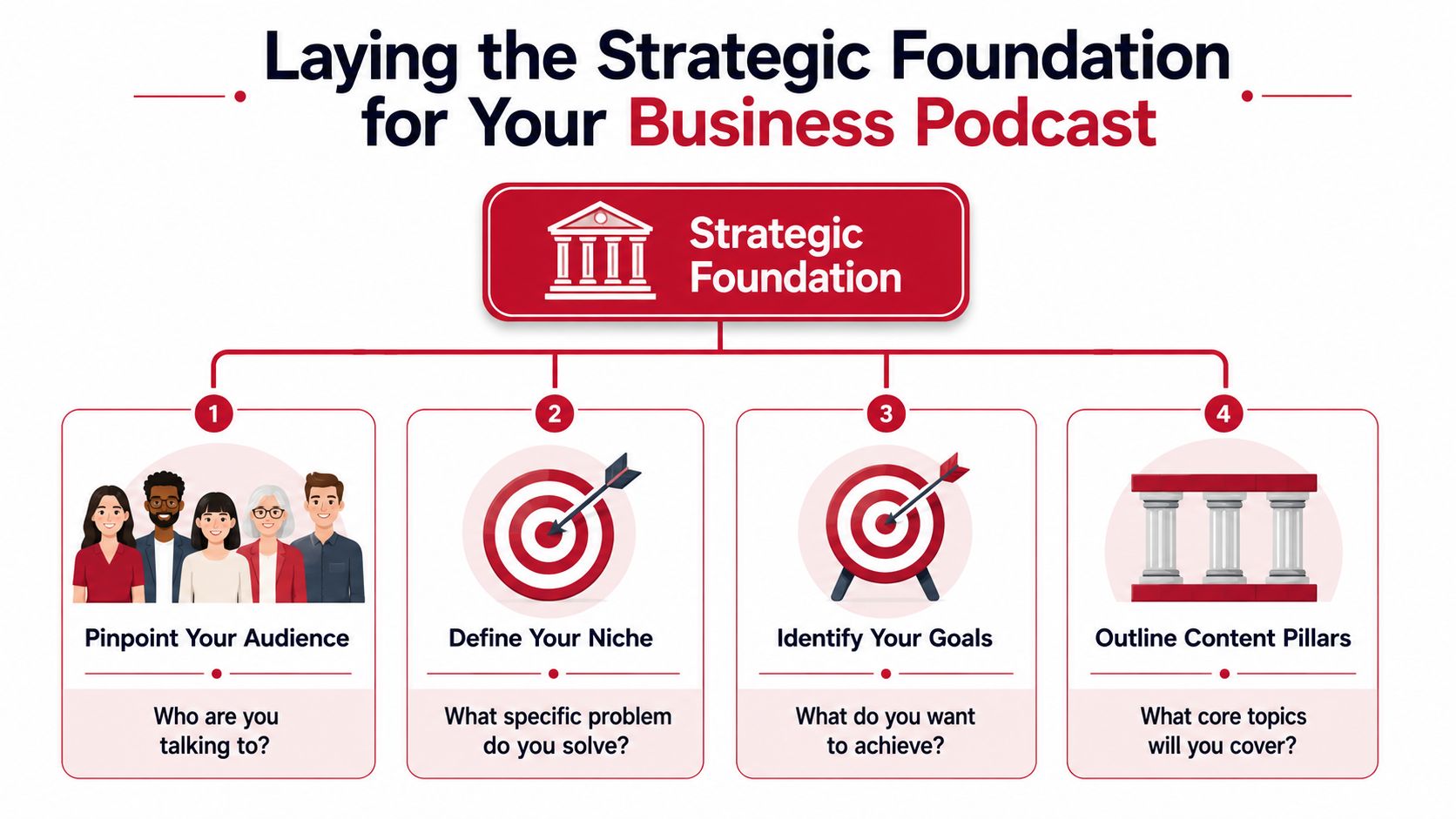
Laying the Strategic Foundation for Your Show
A common scenario looks like this. A consultant or founder wants to “build authority,” so a podcast seems like the next logical move. That instinct is often right, but authority is too vague to run a show on.
A business podcast needs a specific business job. It might support lead generation, shorten trust-building in the sales cycle, nurture an existing audience, strengthen recruiting, or create a consistent stream of repurposable content. If that job isn't clear, the show turns into a random set of conversations with no useful throughline.
Start with the business job
Before naming the show or choosing intro music, define what success would look like inside the business. Useful prompts include:
- Lead generation: Is the show meant to bring qualified prospects into discovery calls, demos, or applications?
- Authority building: Should listeners leave convinced that the host understands a category better than competitors?
- Relationship building: Will the show deepen trust with current clients, donors, or community members?
- Network expansion: Is the show partly a reason to start conversations with strategic guests?
- Content engine: Will each episode feed YouTube, LinkedIn, email, and short-form video?
More than one goal can exist, but one of them has to lead. If every outcome matters equally, episode decisions get muddy fast.
Practical rule: If the team can't explain why the show exists in one sentence, the audience won't understand it either.
Build an ideal listener profile that is specific enough to guide decisions
The audience for a business podcast is rarely “entrepreneurs” or “business owners.” That's too broad to shape format, guests, language, or calls to action. A better approach is to define one clear Ideal Listener Profile with role, stage, pain points, and buying context.
A sharp profile sounds more like this: “owner-led B2B service firms that already sell through referrals and want a stronger authority brand,” or “marketing leaders at midsized companies who need a thought leadership channel without adding more internal production work.”
The same discipline that improves positioning in marketing applies here too. Strong targeting makes every episode easier to plan. This is the same logic behind why target market clarity matters. A vague audience creates vague content. Specificity creates relevance.
Choose content pillars that can survive a long run
Business podcast advice often skips a hard truth. A show can't survive on a clever concept alone. It needs enough topic depth to keep publishing without panic. Kajabi's guide says a strong topic should support at least 50 episodes a year and recommends having at least three episodes ready before launch so new listeners have something to binge when they discover the show, as noted in Kajabi's business podcast guide.
That's a useful filter. If a show idea can't generate that kind of runway, it's too narrow or too dependent on inspiration.
A practical way to test depth is to build content pillars. These aren't episode titles. They're durable categories that keep generating angles.
For example:
Client problems
The recurring issues prospects ask about before they buy.Industry shifts
Changes in buyer behavior, platform changes, operational challenges, or strategic debates.Behind-the-scenes process
How work gets done, including mistakes, frameworks, and lessons.Proof of thinking
Opinions, point of view episodes, and responses to common assumptions in the market.
A strong podcast niche is narrow enough to be recognizable and broad enough to keep producing for the long haul.
Publishing cadence matters too, but not because one schedule is naturally superior. Consistency is what listeners trust. Avidly notes that publishers may choose anything from daily to a few times a month depending on audience and workload, and Nomono says many business podcasts can launch within a few weeks when the purpose, format, and workflow are already defined. The operational takeaway is simple. Choose the cadence the team can maintain, then build everything around protecting that rhythm.
Designing Your Podcast Format and Episodes
Format looks like a creative choice. In business podcasting, it's a strategic one.
The wrong format creates friction at every level. It slows scheduling, weakens authority, complicates editing, and makes distribution harder. The right format supports the show's main business goal.
Format drives outcomes
There's a reason the debate around interview, solo, or hybrid matters. Guidance for business podcasters increasingly recommends a hybrid approach because each format does a different job. Abbas Marketing notes that interviews are easier for early distribution because guests can share episodes, while solo episodes are often better for authority-building and tighter control of messaging, and current guidance often recommends a hybrid approach in this business podcast format discussion.
That trade-off should drive the decision.
A simple decision framework helps:
| Goal | Best starting format | Why it works |
|---|---|---|
| Broader reach and warm introductions | Interview-led | Guests extend distribution and add borrowed credibility |
| Strong category authority | Solo-led | The host owns the thinking and controls the narrative |
| Both visibility and expertise | Hybrid | Interviews widen the top of funnel, solo episodes sharpen the brand |
Interview-only shows often feel easier at first, but they can become dependent on guest availability and guest quality. They also risk building the guest's authority more than the host's if the host never contributes a distinct point of view.
Solo-only shows fix that problem but create another one. They demand stronger preparation, clearer delivery, and more confidence behind the mic. Without structure, solo episodes drift.
How to structure an episode so it holds attention
A business episode doesn't need theatrics. It needs shape.
A reliable structure looks like this:
- Open with the problem: Name the tension, mistake, or decision the listener is dealing with.
- State the angle: Tell listeners what they'll understand or be able to do by the end.
- Deliver the meat early: Don't bury the useful part under a long personal update or generic intro.
- Use signposts: Move through clear segments so the listener knows where the conversation is going.
- End with one action: Give a next step, not five.
The opening minute determines whether the episode feels useful or skippable.
For interviews, preparation matters more than charisma. Good hosts don't just collect interesting guests. They guide guests into stories, specifics, and tension. That means writing questions that uncover decisions, trade-offs, failures, and lessons, not just biography.
Batching beats scrambling
A lot of new hosts underestimate how exhausting reactive production becomes. Recording an episode because the calendar says “publish tomorrow” creates weak conversations and rushed promotion.
A better operating model is to batch planning and recording. Map themes in advance. Group similar episode types together. Reserve certain weeks for guest interviews and others for solo commentary. That gives the show tonal variety without forcing last-minute creativity.
A show also needs a publishing rhythm that matches capacity. Daily, weekly, or a few times a month can all work if the team can support the pace. What fails is overcommitting to a schedule the workflow can't sustain.
For most businesses, discipline beats ambition. A smaller, repeatable format will outperform a bigger concept that burns out the host after a short run.
Your Tech Stack and Recording Workflow
Poor audio signals amateurism fast. Poor video does the same on YouTube and LinkedIn. The fix isn't always expensive gear. It's a smart workflow, controlled environment, and consistent recording habits.
Two production models work for most business podcasts. One is remote and flexible. The other is studio-based and higher control.
Two recording models that work
Remote workflow works well when guests are distributed, the host travels often, or speed matters more than studio polish. Tools like Riverside, SquadCast, and Zoom each serve different needs, but the key is separate local recording when possible. That protects quality even if the live internet connection has issues. Teams building a distributed show can use this remote podcast recording guide to understand the setup choices.
Studio workflow makes more sense when the show is central to brand perception, the host records frequently, or video is part of the strategy from day one. A stable room, fixed camera positions, repeatable lighting, and monitored audio create consistency that remote setups struggle to match.
The choice comes down to trade-offs:
- Remote: faster scheduling, broader guest access, more variables
- Studio: higher production control, stronger visual brand, less flexibility
Good better best gear decisions
The smartest gear stack is the one the host can operate without friction. Complicated setups break momentum.
| Tier | Audio setup | Video setup | Best fit |
|---|---|---|---|
| Good | USB microphone with headphones | Webcam or smartphone on tripod | First-time host validating the concept |
| Better | XLR microphone with audio interface | Mirrorless or quality webcam with key light | Founder or team publishing consistently |
| Best | Broadcast microphone with treated room and engineered signal chain | Multi-camera setup with controlled lighting | Brand-led show where authority and repurposing matter |
For audio, microphone type matters less than using it correctly. A well-placed dynamic mic in a quiet room often sounds more professional than a pricey condenser in a reflective office.
For video, camera quality matters less than lighting and framing. A cheap camera with soft front lighting and a clean background beats an expensive camera pointed at a cluttered room with overhead shadows.
Technique matters more than gear
A few habits improve quality immediately:
- Mic distance: Keep the microphone close enough for presence, but not so close that plosives overwhelm the signal.
- Room control: Soft furnishings, curtains, rugs, and wall treatment reduce echo more than people expect.
- Headphone monitoring: Closed-back headphones catch clothing noise, clipping, and technical issues before the session ends.
- Eye line: For video, place the camera at eye level. Looking down into a laptop weakens authority on screen.
- Lighting direction: Use light from the front or slightly off-center. Overhead office lighting creates harsh shadows and tired-looking footage.
For creators using lean equipment, a well-built step-by-step iPhone podcasting guide can help tighten a mobile-first setup without overcomplicating production.
This walkthrough shows what a more intentional video setup looks like in practice:
One production option in this space is Get Up Productions, which provides recording support, remote and studio production workflows, editing, mastering, YouTube optimization, and repurposing. That kind of turnkey model fits teams that want a show to function as a marketing asset but don't want internal staff handling every technical layer.
A simple production checklist
A short pre-recording checklist prevents most avoidable mistakes:
Check the room
Silence notifications, HVAC noise, and anything that hums, buzzes, or rattles.Check the frame
Leave a little headroom, clear the background, and confirm the host is lit evenly.Check the signal Record a short test. Listen back before starting the main session.
Check the run of show
Guests perform better when they know the intended direction.
Most tech problems are workflow problems in disguise. Fix the environment and process first. Buy more gear second.
Mastering Post-Production and YouTube Optimization
Raw recordings rarely sound or look authoritative. They need shaping.
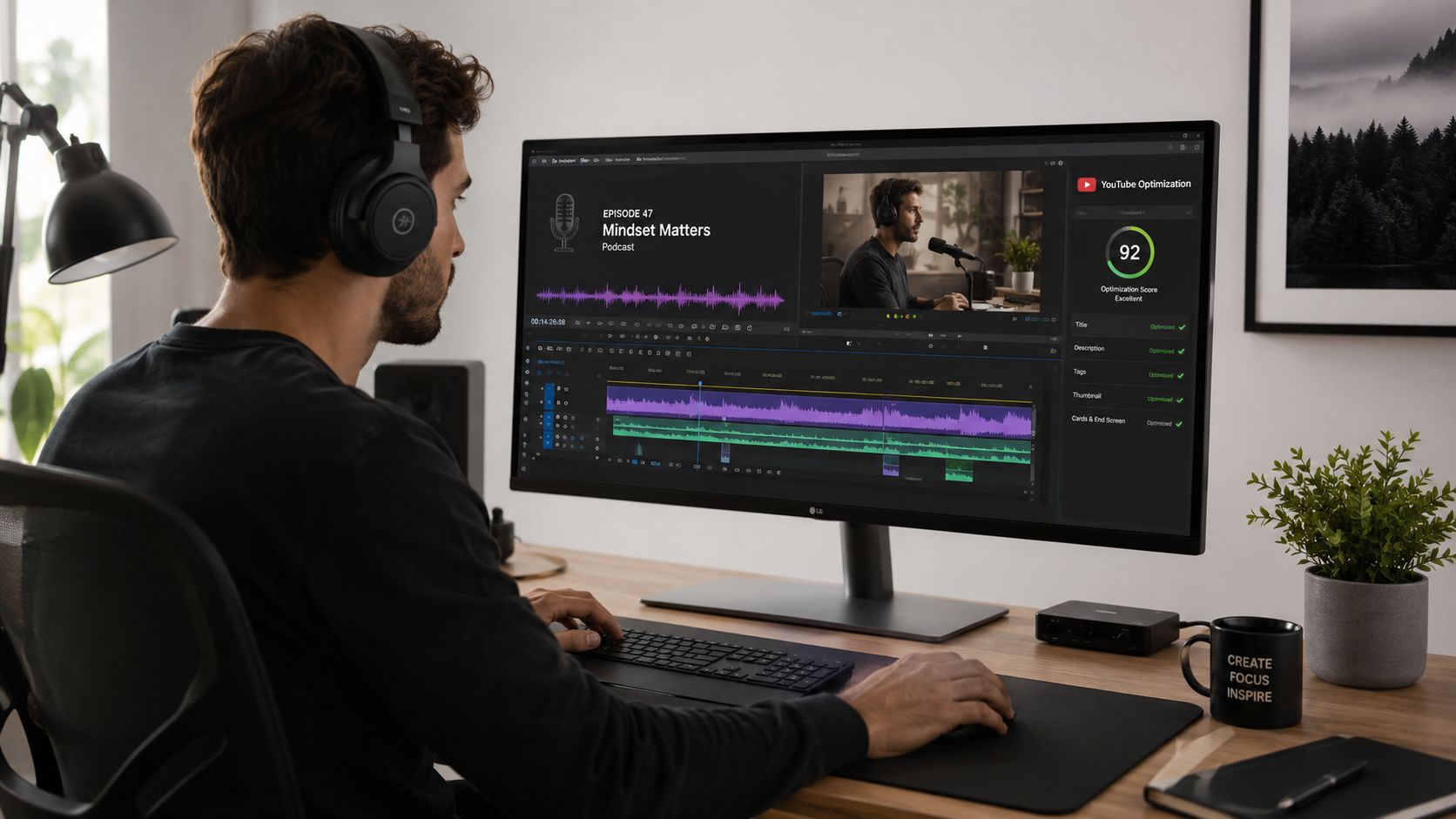
Post-production is where a business podcast starts sounding intentional instead of merely captured. That includes conversation editing, audio mastering, visual cleanup, graphics, transcript prep, and packaging for platforms where discovery matters.
Editing and mastering are not the same job
Editing removes friction from the conversation. It cuts long pauses, false starts, repeated points, awkward overlaps, and tangents that dilute the episode. Good editing keeps the host sounding natural while tightening the listener experience.
Mastering is different. It balances tone, evens out loudness, reduces distracting noise, and helps the final mix translate across headphones, car speakers, laptops, and phones. A show can be brilliantly edited and still sound weak if mastering is ignored.
Polished production doesn't make weak thinking strong. It does make strong thinking easier to trust.
A lot of business hosts underinvest here because mastering is less visible than a new camera. That's a mistake. Listeners forgive modest visuals sooner than they forgive harsh, inconsistent, tiring audio.
A YouTube podcast needs visual intent
Uploading audio with a static image isn't enough if YouTube is part of the strategy. A strong YouTube version functions like a visual show.
That usually means adding:
- Tighter cuts: Remove dead space faster than in the audio-only version.
- Camera changes: Alternate angles when available to keep energy moving.
- Text overlays: Highlight frameworks, quotes, names, and transitions.
- B-roll: Show relevant visuals during key moments rather than leaving a talking head on screen the entire time.
- Branded graphics: Lower thirds, intro cards, and thumbnail consistency help build recognition.
These choices do more than make the episode prettier. They improve retention and make the show look aligned with the authority the host is trying to project.
Transcripts chapters and discoverability
Transcripts are useful far beyond accessibility. They help with show notes, blog conversion, short-form clip selection, quote extraction, and chapter building. Clean transcripts also make it easier for teams to repurpose the best ideas without rewatching the entire episode.
For teams refining that part of the workflow, this guide on best practices for accurate interview transcripts is a useful reference because it focuses on accuracy and cleanup instead of treating transcription like an afterthought.
Chapters are another easy win. Timestamped segments help listeners jump to the parts most relevant to them, and they improve the usability of long-form YouTube episodes. A clear chapter structure also forces clearer editorial thinking during post-production.
A simple YouTube optimization checklist helps:
| Element | What good looks like |
|---|---|
| Thumbnail | One idea, readable text, strong face or clear visual cue |
| Title | Specific promise, not clever ambiguity |
| Description | Concise summary with call to action |
| Chapters | Clean timestamps with useful labels |
| On-screen design | Minimal but intentional branding |
A polished final product is the result of these layers working together. Editing creates flow. Mastering creates trust. Video optimization creates discoverability and watchability.
Launch Distribution and the Content Waterfall
Most podcast launches feel smaller than the team expected because they launch a single episode and hope platforms do the rest. That rarely creates momentum.
A better launch has enough substance to look legitimate, enough structure to reduce friction, and a plan for turning each episode into a stream of downstream assets.
Launch with enough substance to look real
A practical launch sequence starts before recording day. Rob Cressy recommends defining the topic, ideal listener, format, name, and cover art first, then keeping the production stack simple, publishing a trailer plus three episodes at launch, and moving into a consistent release schedule because that sequencing creates a credible back catalog and reduces early friction, as described in this podcast launch methodology.
That order matters. It keeps teams from obsessing over gear before they know what they're building.
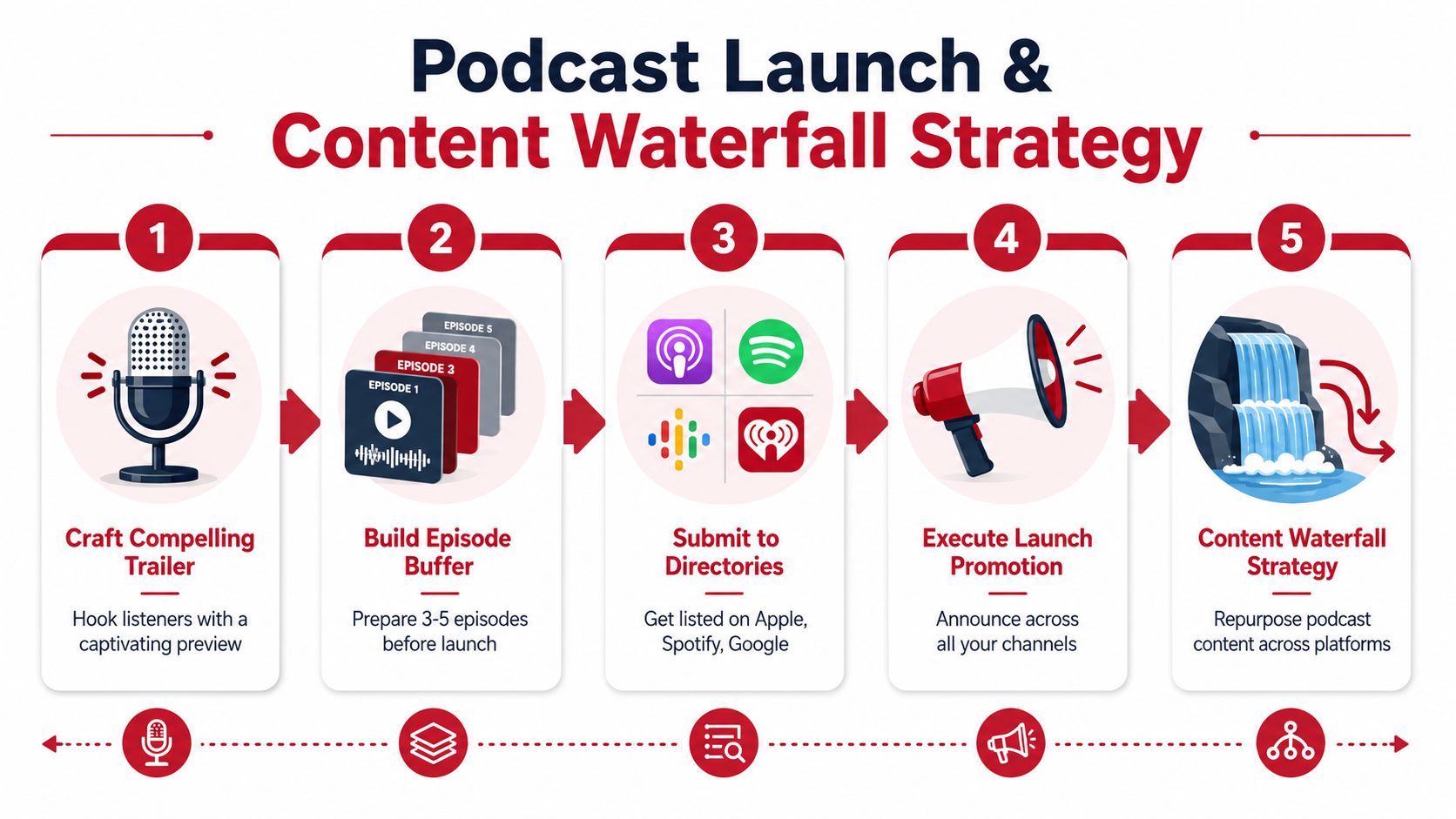
A clean launch checklist looks like this:
Create a trailer
Explain who the show is for, what it covers, and why it exists.Prepare launch episodes
Publish enough substance that new listeners can sample the range and tone of the show.Submit to directories
Ensure the feed is distributed to the major listening platforms before promotion begins.Write useful show notes
Include key takeaways, links, calls to action, and timestamps when relevant.Promote across owned channels
Email list, LinkedIn, Instagram, YouTube community, sales team, and internal advocates all matter.
Build the content waterfall from every episode
The most valuable business podcasts don't act like one weekly asset. They operate like a content waterfall.
That means one long-form episode becomes multiple short-form and mid-form assets adapted to where the audience already spends time. A single conversation can fuel YouTube clips, LinkedIn posts, vertical video, quote graphics, an email, and a blog article. That's where the production effort starts paying back across the whole marketing system.
For teams building that machine intentionally, this content repurposing strategy shows how a single recording can support multiple channels without creating everything from scratch each week.
Field note: The episode is the source asset. The distribution system is where most of the business value gets unlocked.
What to repurpose each week
Not every format belongs on every platform. Good repurposing adapts the same core idea to different consumption habits.
A practical weekly waterfall might look like this:
Short video clips
Pull the strongest opinion, tactical insight, or memorable exchange for Reels, Shorts, and TikTok.Audiograms or captioned clips
Useful for LinkedIn when the insight is stronger than the visual.Quote graphics
Best when the phrasing is sharp and tied to a strong point of view.Email summary
Turn the episode into a concise, useful newsletter with one core takeaway.SEO-focused show notes
Expand the episode into a searchable article. Teams using AI can streamline this process with guidance on using AI transcripts for podcast notes.
The mistake is trying to repurpose everything. Most episodes contain a few strong moments, not endless ones. Pull the ideas with the highest standalone value, then package them natively for each platform.
That's what makes the waterfall work. It isn't just more content. It's a disciplined way to multiply the reach of each recording session.
Growth KPIs and When to Hire a Partner
The biggest measurement mistake in business podcasting is treating downloads as the main success metric. Downloads matter, but they don't tell the whole business story.
A podcast can influence pipeline, trust, recruitment, partnerships, donor engagement, and close rates in ways that don't show up cleanly inside a listening dashboard. That's why serious teams track business signals, not just audience totals.
Track business signals not vanity metrics
Start with metrics tied to business movement.
Useful KPIs include:
Inbound attribution
Prospects who mention the podcast on discovery calls, forms, emails, or DMs.Show notes traffic
Whether episodes bring visitors to the website and keep them there long enough to explore offers.Consultation or demo requests
Calls booked from episode pages, YouTube descriptions, or podcast-specific calls to action.Sales conversation mentions
Reps hearing “been listening to the show” or “heard that episode” during active deals.Guest relationship outcomes
Partnerships, referrals, or warm opportunities created through host-guest conversations.Content reuse efficiency
How often the podcast reduces pressure on the rest of the marketing calendar.
These indicators answer the core question. Is the show helping the business earn trust and create opportunities?
A podcast aimed at authority may never produce dramatic public metrics, especially early on. It can still be highly effective if the right buyers keep encountering it at the right moments.
A business podcast earns its keep when it shortens trust, strengthens positioning, or feeds the rest of the content engine.
Growth usually comes from distribution discipline
Growth rarely comes from recording better opinions alone. It usually comes from getting more consistent about packaging and distribution.
That means:
| Growth lever | What it looks like in practice |
|---|---|
| Guest strategy | Invite people whose audiences overlap with the show's ideal listener |
| Call to action | Give listeners one relevant next step tied to the episode topic |
| Cross-channel publishing | Push each episode through email, LinkedIn, YouTube, and short-form clips |
| Sales enablement | Share relevant episodes during lead nurturing and objection handling |
| Community engagement | Turn episode themes into conversations, not one-way promotion |
A lot of podcast growth is really process growth. Teams that publish, repurpose, follow up, and reuse episode assets tend to see better business outcomes than teams that focus only on the recording itself.
When DIY still makes sense
DIY is a reasonable choice in several scenarios.
It makes sense when the team is still validating the concept, the host enjoys production work, publishing volume is low, or brand stakes are modest. It also works when a company has an internal marketer or content lead who can manage recording logistics, editing coordination, thumbnails, metadata, and clips without derailing higher-value work.
DIY tends to work best if these conditions are true:
- The host has time to learn the stack
- The workflow is simple
- Missed releases won't create major business cost
- The team can maintain quality control
- Repurposing demands are limited
The downside is opportunity cost. The host or team often ends up spending hours on editing rounds, guest scheduling, file wrangling, thumbnail feedback, transcript cleanup, and clip exports. Those hours don't disappear. They come from strategy, selling, client work, or rest.
When hiring a partner becomes the smarter call
Hiring a production partner starts making sense when the show becomes important enough that inconsistency or mediocre execution carries a cost.
That usually happens when the podcast sits close to revenue, public brand perception, executive visibility, donor trust, or a broader content strategy. It also becomes more attractive when YouTube production, visual packaging, repurposing, and show operations require more specialized skill than the internal team can spare.
A good decision filter is to ask:
Is the host the bottleneck?
If publishing depends on the host also acting as producer, editor, strategist, and promoter, the show will stall.Is quality affecting authority?
If the current output looks or sounds less credible than the expertise behind it, there's a mismatch.Is the podcast feeding other channels?
Once the show supports video, clips, email, and social, operations get much heavier.Is internal time more valuable elsewhere?
Founders, executives, and senior marketers usually create more value by speaking into a mic than by managing post-production.
Here's the trade-off in plain terms:
| Factor | DIY Approach | Hiring a Partner (e.g., Get Up Productions) |
|---|---|---|
| Cost structure | Lower cash outlay, higher time cost | Higher cash outlay, lower time burden on internal team |
| Creative control | Direct control over every detail | Shared process with approvals and collaboration |
| Speed to publish | Depends on internal bandwidth | More predictable if partner owns workflow |
| Technical quality | Varies with skills and consistency | Usually more stable across audio, video, and packaging |
| Repurposing output | Often limited by time | Easier to build a repeatable multi-platform system |
| Host focus | Split between content and operations | Concentrated on delivery, interviews, and expertise |
| Risk | Burnout, skipped releases, uneven quality | Less operational strain, but requires onboarding and alignment |
The right answer isn't ideological. It's economic. If the business benefits of a polished, consistent show outweigh the cost of external support, outsourcing becomes a rational move. If the show is still experimental, a lean DIY approach may be the smarter first phase.
The mistake is staying DIY long after the workflow has clearly outgrown the team's capacity.
A business podcast works best when it's treated like a long-term asset, not a side project. If the goal is to build a show that sounds polished, looks credible on YouTube, and feeds a full repurposing system without draining internal bandwidth, Get Up Productions is one option to evaluate for recording support, production, and content waterfall execution.