
Most advice about modern marketing is too absolute. “Niche down” gets repeated so often that people forget broad reach still works in specific markets. “Go viral” gets repeated just as often by people selling fantasy, not strategy.
Mass Marketing Inc. is useful because it cuts through both myths. It's an old-school company with a name that sounds outdated, yet the business still offers a concrete lesson for founders, consultants, and creators deciding whether to broadcast to everyone or build authority with a smaller group first. The point isn't to romanticize old-school advertising. The point is to understand when scale wins, when specificity wins, and when mixing both is smarter than arguing ideology.
A useful companion to that thinking is this piece on evolving marketing strategies, because the primary challenge isn't choosing between “old” and “new.” It's choosing the right distribution model for the product, the buyer, and the buying cycle. For brands thinking about message repetition and category association, the idea of an evoked set in marketing also matters. Buyers don't pick from the whole market. They pick from the few brands they remember.
Table of Contents
- Is Mass Marketing a Relic or a Resource
- A Profile of Mass Marketing Inc
- The Mass Marketing Model Explained
- Weighing the Strengths and Weaknesses
- Mass Marketing vs Authority Marketing for Modern Brands
- How to Choose Your Marketing Path
- Building Your Modern Marketing Mix
Is Mass Marketing a Relic or a Resource
Mass marketing isn't dead. Blind mass marketing is.
That distinction matters. A lot of marketers dismiss broad-reach promotion as lazy because digital channels made precision feel cheap and easy. But precision only helps when the audience is clearly defined, the message can be personalized, and the economics support the extra complexity. When those conditions aren't present, broad reach can still do its job.
Mass Marketing Inc. makes that tension easier to see. The company's very name sounds like a relic from another era, yet its existence forces a sharper question. Is broad distribution obsolete, or is it merely unfashionable among people who confuse trend with strategy?
The real issue isn't broad versus narrow
The practical question is fit. Some businesses sell standardized offers to a wide group with a shared need. Others sell expertise, trust, judgment, or transformation. Those shouldn't market the same way, and too many brands pay for that confusion.
Broad reach is a tool, not an identity. It works when the market shares the same problem and responds to the same promise.
Mass Marketing Inc. is a strong case study because it sits in a category where scale, repetition, and standardization still have logic. That doesn't mean every entrepreneur should copy the model. It means every entrepreneur should understand why the model can survive.
Why this matters to modern founders
Creators, consultants, nonprofit leaders, and B2B firms often hear advice built for consumer products. That's a mistake. A founder selling judgment and trust shouldn't market like a company selling broad commercial print placements. The reverse is also true. A business with a standardized offer and wide utility can waste time overcomplicating segmentation.
The useful lesson from Mass Marketing Inc. isn't “go mass.” It's simpler than that. Match message breadth to buyer similarity. If the audience thinks alike, broad campaigns can work. If the audience buys for nuanced reasons, authority and specificity usually beat reach.
A Profile of Mass Marketing Inc
Mass Marketing Inc. is not a vague internet brand. It appears to be a long-running, traceable operating business with a specific niche and a practical commercial model.

What the business appears to be
The Better Business Bureau profile for Mass Marketing Inc. says the company opened on April 1, 1977, and lists headquarters at 7209 Dixie Highway in Fairfield, Ohio, with a national service area. The same profile lists offerings such as chamber maps, commercial laminating, custom map design, custom printing, desktop publishing, and map advertising. It also identifies Donald J. Mueller as president and includes main office contact information.
That matters because it grounds the company in a real operating niche. This isn't a generic “marketing agency” selling jargon. It's a specialized print-and-map publisher serving practical institutional and commercial needs.
The longevity matters even more. Based on that BBB opening date, the company is at least 49 years old as of 2026 in a specialized publishing category. For a business tied to print, map products, and ad-supported local or institutional distribution, that kind of staying power suggests durable client relationships and the ability to adapt while media habits changed around it.
Why that matters strategically
Mass Marketing Inc. looks like the kind of business many digital-first operators underestimate. It's not flashy. It doesn't need to be. A company can survive for decades by serving recurring demand in a narrow commercial lane if the product remains useful and buyers keep renewing.
A business like this also shows what “mass marketing” often looks like in practice. It isn't always national TV or giant consumer ad buys. Sometimes it's standardized placement, repeatable local distribution, and commercial products that reach broad public audiences through institutional channels.
Practical rule: If a company lasts across multiple media eras, its model probably solves a recurring distribution problem, not just a temporary attention problem.
Mass Marketing Inc. should be read that way. Not as proof that broad marketing is universally superior, but as evidence that broad-reach formats still work when they align with buyer behavior, channel economics, and a standardized offer.
The Mass Marketing Model Explained
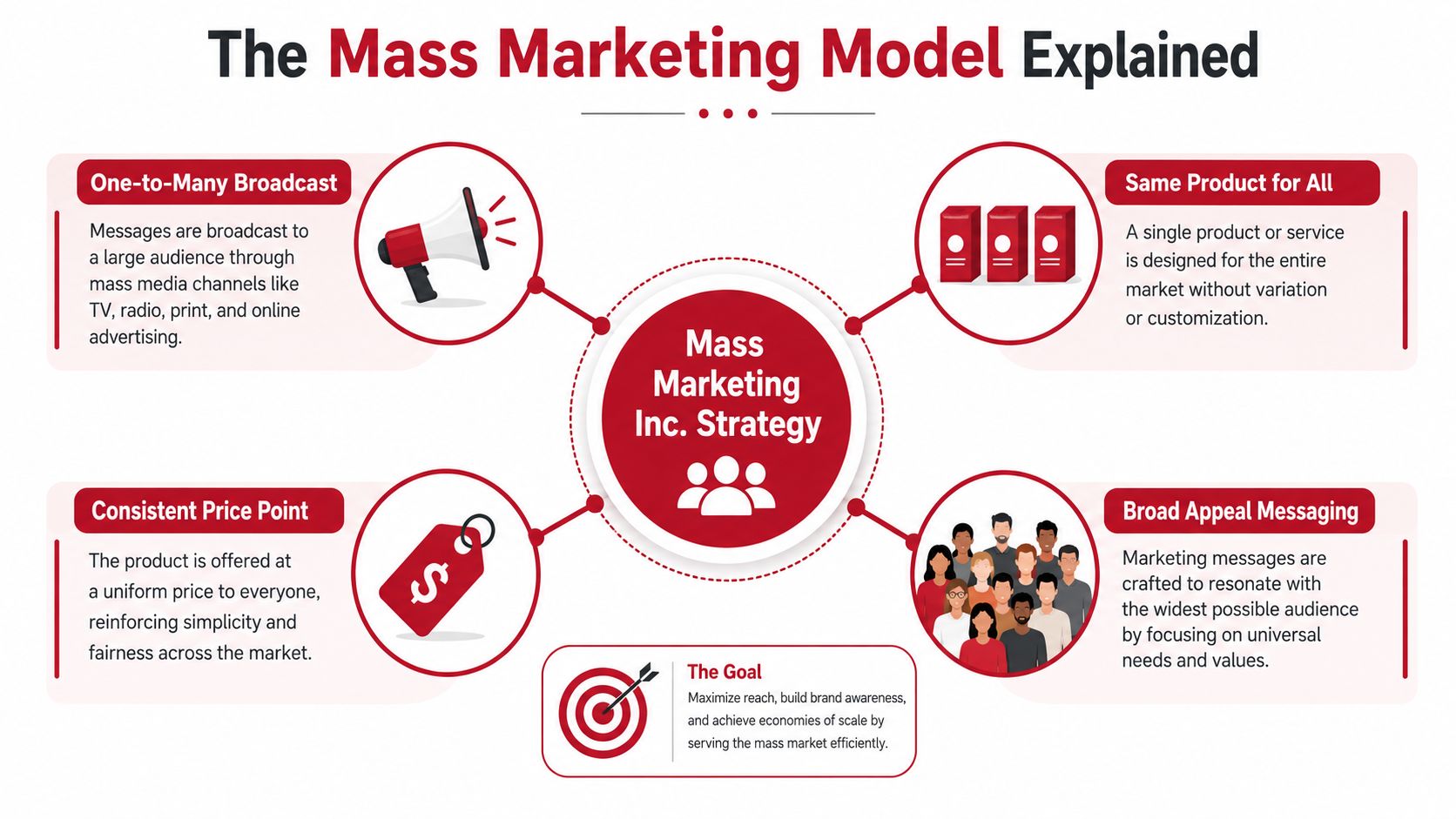
Mass marketing is a one-to-many approach. One message goes to a broad audience. The offer is largely standardized. The goal is reach first, precision second.
That's why the model often looks blunt from the outside. It trades relevance for scale. Instead of tailoring the message to micro-segments, it assumes a large enough group shares the same core need.
What mass marketing actually means
The cleanest way to think about it is this:
| Element | Mass marketing approach |
|---|---|
| Product | Standardized for a broad market |
| Pricing | Generally consistent across buyers |
| Message | Built for common needs, not edge cases |
| Distribution | Designed to maximize exposure |
Mass Marketing Inc. helps illustrate the logic. A company built around map publishing, custom printing, laminating, and advertising can package offerings that many chambers, institutions, tourism-related groups, or property-oriented organizations understand quickly. The closer a product gets to “widely understandable and repeatedly useful,” the more the broad model can make sense.
The common analogy is still the right one. Mass marketing fishes with a net. Niche marketing fishes with a hook. Neither tool is better in the abstract. The wrong one is expensive.
A related operational example shows up in outbound communication. Teams using broad campaigns still need discipline around list quality, deliverability, and volume control. Anyone running outreach through Gmail can learn from this guide to effective bulk email in Gmail, because scale without sending hygiene turns distribution into self-inflicted damage. The same logic applies to any broad-reach tactic. Good systems matter.
For marketers planning audience strategy, a solid marketing database foundation also changes the equation. Better customer records don't automatically mean hyper-personalization. They help teams decide when to segment and when a single message is enough.
When broad reach creates waste
The hardest question in mass marketing isn't the definition. It's efficiency. As Indeed's overview of mass marketing frames it, the critical issue for modern marketers is when broad-reach promotion creates waste versus scale.
That's the right question because broad campaigns waste money fast when any of these are true:
- The buyer is highly specific. If only a narrow slice of people can buy, broad distribution overpays for irrelevant attention.
- The offer needs education. Complex services rarely convert from generic messaging.
- Trust drives the sale. Expertise-based businesses need proof, not just awareness.
- The market has fragmented motivations. One headline won't resonate equally across all segments.
A broad message only works when the audience agrees on what problem matters most.
That's why mass marketing still fits some categories and fails badly in others. If the product is simple, standardized, and broadly relevant, one message can travel far. If the purchase is high-trust or nuanced, the same tactic becomes expensive noise.
Weighing the Strengths and Weaknesses
Mass marketing has real advantages. It also has obvious limitations that too many teams ignore until the budget is already gone.
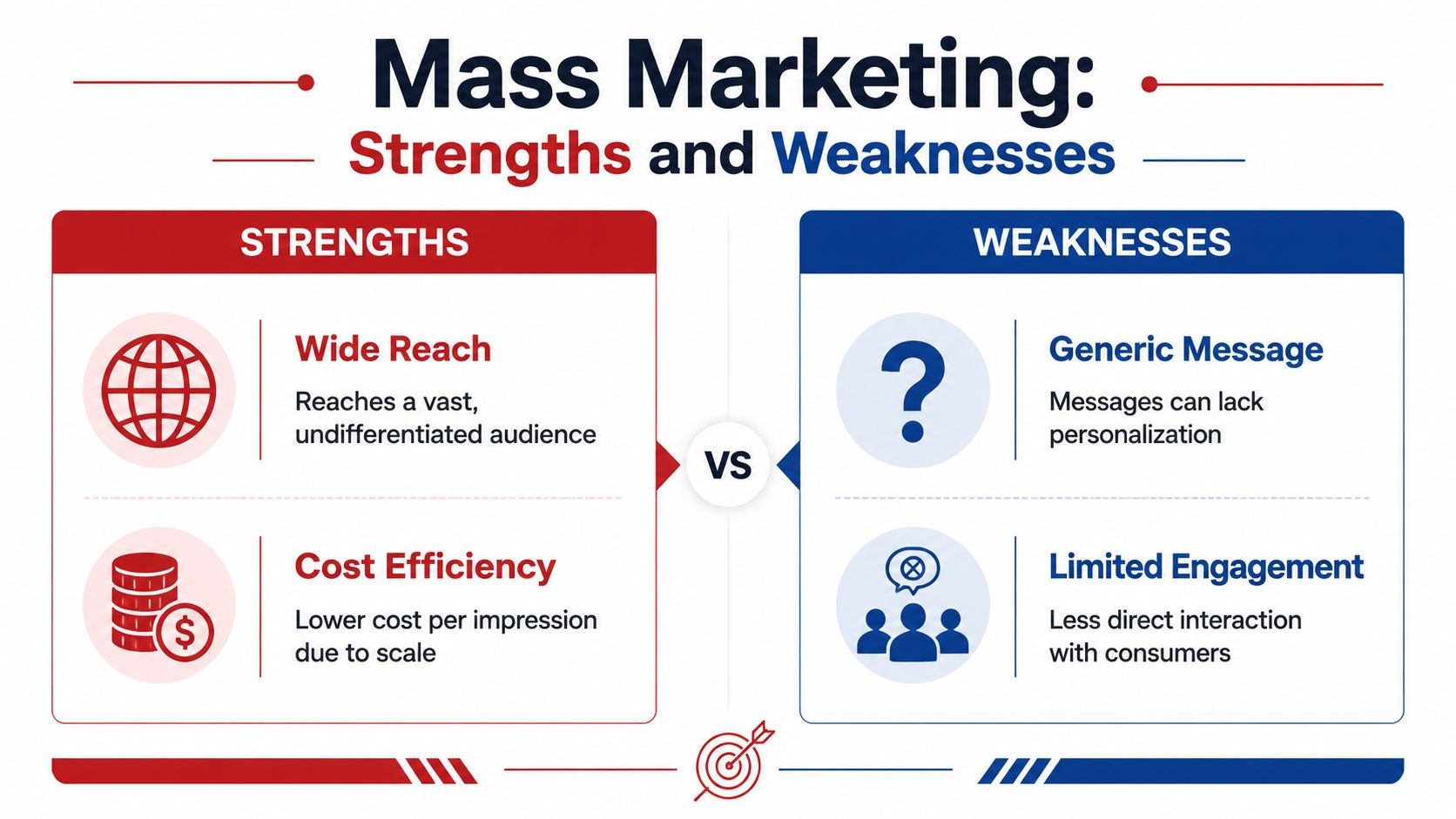
The model is strongest when repetition matters, the offer is easy to grasp, and the audience doesn't need much persuasion. It gets weaker as soon as buying becomes personal, consultative, or credibility-driven.
Where the model still works
Broad campaigns can be efficient in the right environment.
- Wide recognition matters most. If the goal is awareness, mass marketing can put the brand in front of many people quickly.
- The product is familiar. Offers that don't require long explanation benefit from simple, repeated exposure.
- Production can be standardized. One creative concept can serve many placements without endless customization.
- Distribution channels are naturally broad. Print placements, billboards, local sponsorships, and broad audio buys still make sense when the audience is mixed but the message is simple.
Mass Marketing Inc. fits this logic better than many modern founder-led brands do. A standardized commercial offering tied to public-facing maps, directories, print assets, or ad placements naturally leans toward repeatable, broad distribution.
Where the model breaks down
The weaknesses aren't subtle.
| Strength | Matching weakness |
|---|---|
| Reach | Reaches many people who will never buy |
| Simplicity | Can sound generic |
| Repetition | Can fatigue the audience |
| Standardization | Ignores buyer nuance |
That trade-off gets sharper under current measurement conditions. As this mass marketing explainer from U.S. Data Corporation notes, recent shifts toward privacy-safe measurement reduce visibility into individual-level targeting. That creates a serious strategic problem. Broader buying may become more attractive in some cases, but proving what worked gets harder.
Privacy changes don't automatically revive mass marketing. They mostly punish weak measurement discipline.
That means a company can be directionally right about broad reach and still misread performance. If the attribution model is loose, teams may over-credit awareness campaigns or kill them too early. Neither is smart.
The practical takeaway is simple. Mass marketing works best when demand is already broad, the message can stay simple, and the business can tolerate ambiguity in attribution. If any of those break, a narrower and more authority-driven strategy usually becomes the safer bet.
Mass Marketing vs Authority Marketing for Modern Brands
A lot of founders waste time. They compare tactics without comparing business models.
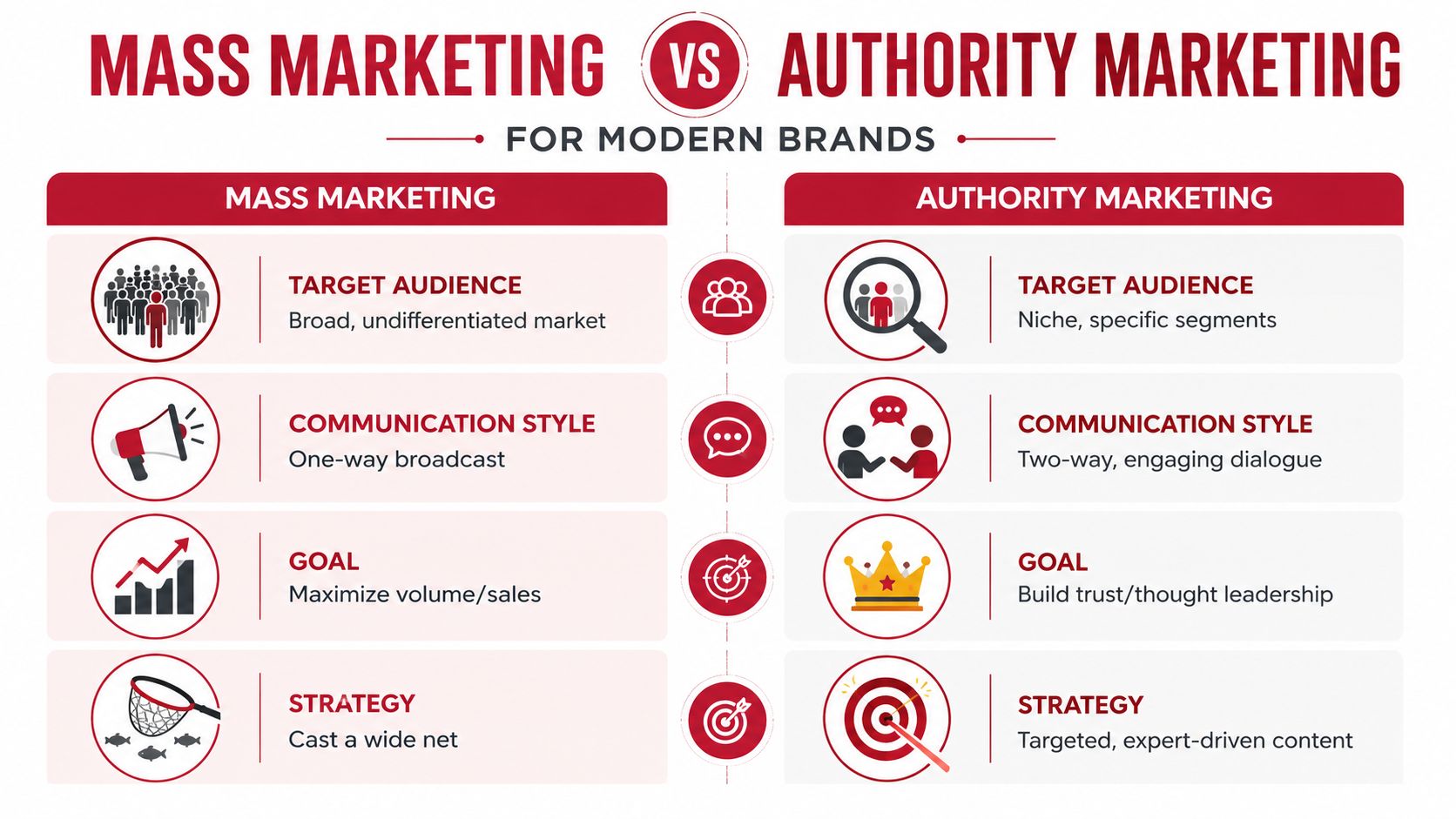
Mass marketing and authority marketing solve different problems. One is built for breadth. The other is built for trust. Confusing them leads to campaigns that look active but don't move the business.
Two different engines for growth
Mass marketing says, “Get the message in front of as many people as possible.”
Authority marketing says, “Earn trust from the right people until they see the brand as the obvious choice.”
Those are not small differences. They shape everything from channel choice to content format.
| Variable | Mass marketing | Authority marketing |
|---|---|---|
| Audience | Broad market | Specific audience or niche |
| Communication | One-way broadcast | Ongoing expertise-driven conversation |
| Best for | Standardized offers | High-trust or complex offers |
| Main asset | Reach | Credibility |
Mass Marketing Inc. proves that a focused, non-digital broad-reach model can still become a stable mid-market business. Data aggregators report about $7 million in revenue, with 11 to 50 employees according to RocketReach's Mass Marketing Inc. profile. That's important because it gives entrepreneurs a real benchmark for what success can look like in a specialized broad-distribution lane.
That benchmark should be interpreted carefully. It shows viability, not universality.
A founder selling consulting, advisory work, coaching, spiritual guidance, or donor engagement usually isn't selling a standardized item. That founder is selling confidence, worldview, judgment, and relationship. Those buyers need depth.
A short explainer can help frame the shift from generic exposure to reputation-building, especially for founders working on building a personal brand. The mechanism is different. Repetition alone doesn't create authority. Demonstrated thinking does.
Later in the process, the contrast becomes easier to see in media form:
Why authority wins for experts and mission-driven brands
For creators, consultants, nonprofits, and B2B firms, authority marketing is usually the better first move.
Here's why:
- Trust has to be earned. Buyers need to hear the thinking behind the offer, not just the slogan.
- The sale often takes time. Ongoing content compounds familiarity.
- Differentiation lives in perspective. Expertise is easier to show in long-form formats than in broad advertising.
- The audience is narrower than founders admit. Most expert-led businesses don't need everyone. They need the right subset.
That's why podcasts, educational video, interview-based content, and founder-led media outperform generic broad ads for many modern brands. They let a company demonstrate competence in public.
Get Up Productions is one example of a production partner in that authority-first lane. It handles podcast production, YouTube-optimized episodes, editing, branding, and multi-platform repurposing for brands that want long-form content to become an authority asset rather than another content chore.
If the product requires trust, the content should prove judgment before the sales process asks for commitment.
That's the dividing line. Broad marketing can create awareness. Authority marketing creates preference. When the business depends on expertise, preference is more valuable.
How to Choose Your Marketing Path
Most companies don't need more tactics. They need a decision filter.
The right path becomes obvious once the business answers a few uncomfortable questions. The mistake is pretending every business needs both scale and intimacy at the same time. Early on, that usually produces diluted execution.
Ask four hard questions
Who is the buyer, really?
If the truthful answer is “almost anyone,” broad reach may be justified. If the buyer is a specific kind of executive, donor, local institution, or values-driven listener, a niche strategy is usually smarter.What exactly is being sold?
A common product with clear utility can survive with simpler messaging. A high-consideration service, premium offer, or belief-driven mission needs more explanation and more trust.What does success look like right now?
Awareness and lead generation are not the same objective. Teams that say they want both often measure neither well.How much uncertainty can the business tolerate?
Broad campaigns can work, but they often require patience and comfort with fuzzier attribution. Narrow authority plays tend to align better with direct feedback, audience response, and visible content engagement.
A simple decision lens
This quick table keeps the choice practical:
| If this is true | Lean toward |
|---|---|
| The offer is standardized and broadly useful | Mass marketing |
| The offer depends on trust and expertise | Authority marketing |
| The audience shares the same pain point | Mass marketing |
| The audience has nuanced buying triggers | Authority marketing |
| The business needs category awareness | Mass marketing |
| The business needs qualified conversations | Authority marketing |
A founder doesn't need a perfect answer. A founder needs a committed direction.
Choose the model that matches how buyers decide, not the model that sounds more sophisticated in a strategy meeting.
That's the ultimate test. If buyers purchase because the brand is familiar, broad reach helps. If buyers purchase because they believe the brand understands their needs thoroughly, authority content should lead.
Building Your Modern Marketing Mix
The smartest takeaway from Mass Marketing Inc. isn't nostalgia. It's discipline.
The company represents a form of marketing that still works when the offer is standardized, the distribution model is repeatable, and the audience has enough shared need to justify a broad message. That's a legitimate strategy. It's just not the default strategy for expert-led brands.
For most modern companies, the better sequence is narrower first, broader later. Build authority in a defined market. Prove the message. Learn what language buyers repeat back. Then amplify what's already working. That sequence reduces waste and makes scaling less reckless.
For teams that do need outside help selecting channels, creative support, or broader distribution partners, lists like Cloud Present's agency recommendations can help with vendor research. The smart move is to choose partners based on strategic fit, not on whether they speak in the latest buzzwords.
Mass marketing still has a place. Authority marketing has become essential. The brands that win know which one should lead.
Get Up Productions helps brands and experts turn podcasting into an authority asset through production, editing, YouTube-ready episodes, and content repurposing. Teams that need a trust-first channel, not just more noise, can explore Get Up Productions to evaluate whether a podcast-led strategy fits their audience and goals.