
Most advice about personal branding fails because it starts with volume. Post daily. Be everywhere. Chase visibility. That approach creates noise, not authority. It also burns people out fast, especially experts, founders, and operators who already have a real job to do.
A stronger answer to how to build personal brand is simpler. Build a system that makes trust easier to earn. That means clear positioning, recognizable messaging, visible proof, and a content format that can carry nuance. For readers who want a wider primer before getting tactical, this guide from Zanfia can help discover how to build a personal brand.
The most durable approach is show-first. Instead of inventing random posts every week, create one recurring show, usually a podcast or video series, that demonstrates expertise in public. Then turn that flagship asset into the rest of the brand system. The result is more sustainable, more credible, and far easier to maintain than chasing short-form trends all day.
Table of Contents
- Beyond Authenticity The Real System for Building a Brand
- Define Your Foundation Before You Create Anything
- Design Your Show-First Content Engine
- Master Your Content Distribution and Platforms
- Implement Audience Growth and Engagement Playbooks
- Build Your Conversion and Monetization Funnel
- Your 12-Month Personal Brand Timeline
Beyond Authenticity The Real System for Building a Brand
“Just be authentic” sounds helpful, but it's incomplete. People don't trust a personal brand because it feels raw. They trust it because it feels clear, consistent, and backed by evidence.
That distinction matters. The U.S. Chamber of Commerce argues that strong personal brands are built through helpful education and proof points, not constant self-promotion, and that credibility comes from what a person gives, not just what that person says in the market's view of self-promoters (U.S. Chamber of Commerce on personal branding strategy).
Practical rule: A personal brand isn't a personality contest. It's a credibility system.
That changes what gets prioritized. Random posting drops down the list. A coherent message rises. So do testimonials, examples, strong profile assets, and a body of content that shows thinking over time.
The show-first model solves the biggest operational problem in branding. Individuals often don't need more ideas. They need a repeatable format that makes good ideas easier to produce. A show does that. It creates a fixed container, a publishing rhythm, a reason to keep researching, and a growing library of proof.
What doesn't work is treating personal branding like a stream of unrelated updates. One motivational post, one selfie, one opinion thread, one trend clip. Audiences can't tell what the person stands for, who that person helps, or why they should come back.
What works is building a recognizable body of work. A weekly interview series. A solo video breakdown. A topical podcast for a narrow audience. Over time, the format itself becomes part of the brand.
Define Your Foundation Before You Create Anything
A brand gets weak long before the first post goes live. It usually breaks at the strategy layer. The person doesn't know what lane to own, who to speak to, or how to describe the value clearly enough for others to repeat it.
Tom Peters popularized the business idea of personal branding in 1997, arguing that professionals should manage themselves like major brands. That logic still holds. Harvard Business School Online describes personal branding as making a narrative accurate, coherent, compelling, and differentiated (Harvard Business School Online on personal branding at work).
Brand clarity beats content volume
The fastest way to waste six months is to publish before the brand foundation is locked. That usually leads to bland messaging, scattered channels, and a feed full of content that doesn't stack into authority.
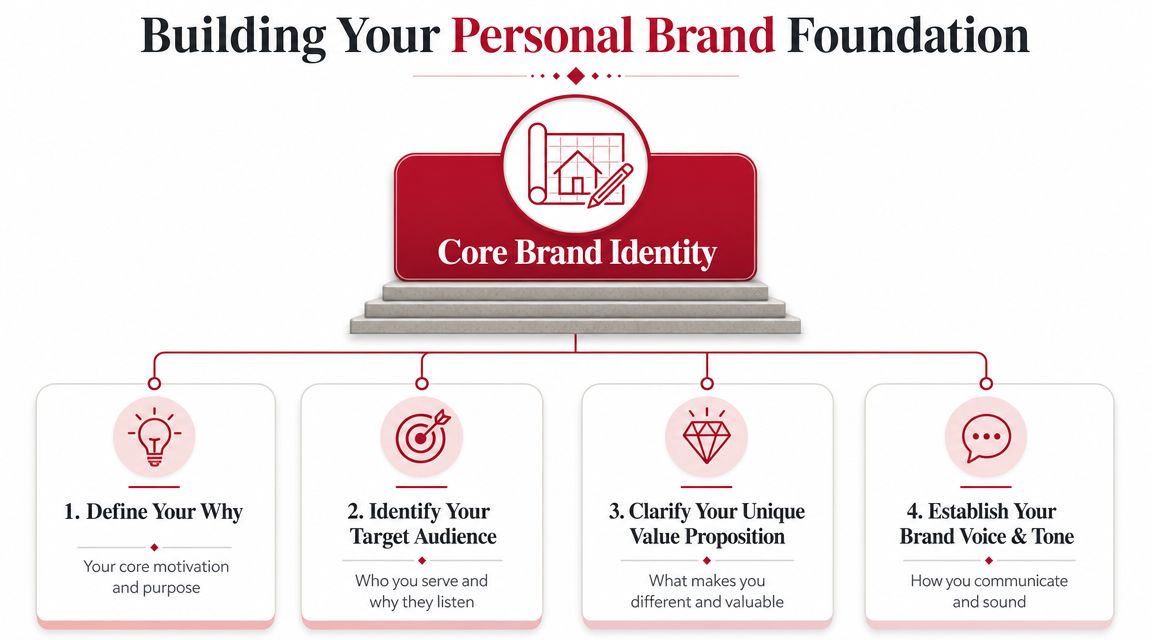
A useful way to simplify the work is to build a small brand pyramid:
Core identity
What the person stands for. This isn't a slogan. It's the underlying belief or mission that shapes every public message.Unique value proposition
What problem gets solved, for whom, and with what angle. The sharpest brands usually sit at a clear intersection of expertise and perspective.Audience definition
Not “everyone who needs this.” A smaller, specific group is easier to reach and easier to serve.Message pillars
Three to five repeatable themes that can support a show, social clips, articles, and live conversations.
A lot of content strategy advice skips this step. That's why many brands sound polished but indistinct. Resources like PressBeat on effective content strategy are useful because they push the work back toward narrative and positioning instead of pure output.
Build a simple brand pyramid
Individuals often overcomplicate positioning. They try to fit every skill, every audience, and every interest into one identity. The result is vague.
A stronger model looks like this:
| Layer | Key question | Output |
|---|---|---|
| Identity | What does this person want to be known for? | One brand statement |
| Audience | Who gets the most value from that expertise? | One minimum viable audience |
| Offer | What specific transformation or result is being helped? | One core promise |
| Themes | What topics will repeat publicly? | Three to five content pillars |
The audience layer deserves unusual discipline. Trying to speak to founders, job seekers, creators, consultants, and enterprise buyers at the same time usually collapses the message. A narrower target creates stronger language and better examples. That's also why why target market matters is such a practical business decision, not just a marketing exercise.
Narrow brands are easier to remember, easier to refer, and easier to trust.
Lock the audience before the channel
The channel decision comes after the audience decision. That order matters. Platform choice should follow how the audience thinks, not what feels trendy to publish.
A practical audit can answer most of the foundational questions quickly:
What proof already exists
Client outcomes, speaking clips, workshop material, community leadership, published writing, or internal expertise.What conversations keep repeating
The best message pillars usually come from questions already being asked in calls, meetings, comments, or DMs.What angle is defensible
Not a generic niche like marketing or leadership. A sharper intersection, such as founder storytelling for technical teams, local nonprofit communications, or spiritual leadership through long-form audio.What voice fits the operator
Educational, provocative, calm, analytical, pastoral, journalistic. Voice should be deliberate, not accidental.
When this foundation is solid, content gets easier. Titles become easier to write. Guest selection gets easier. Offers get easier to explain. Ultimately, the audience starts to recognize a pattern instead of seeing isolated content fragments.
Design Your Show-First Content Engine
Most personal brands stall because the content model is broken. The person relies on inspiration, tries to invent something new for every platform, and ends up publishing inconsistently. That's not a creativity problem. It's an architecture problem.
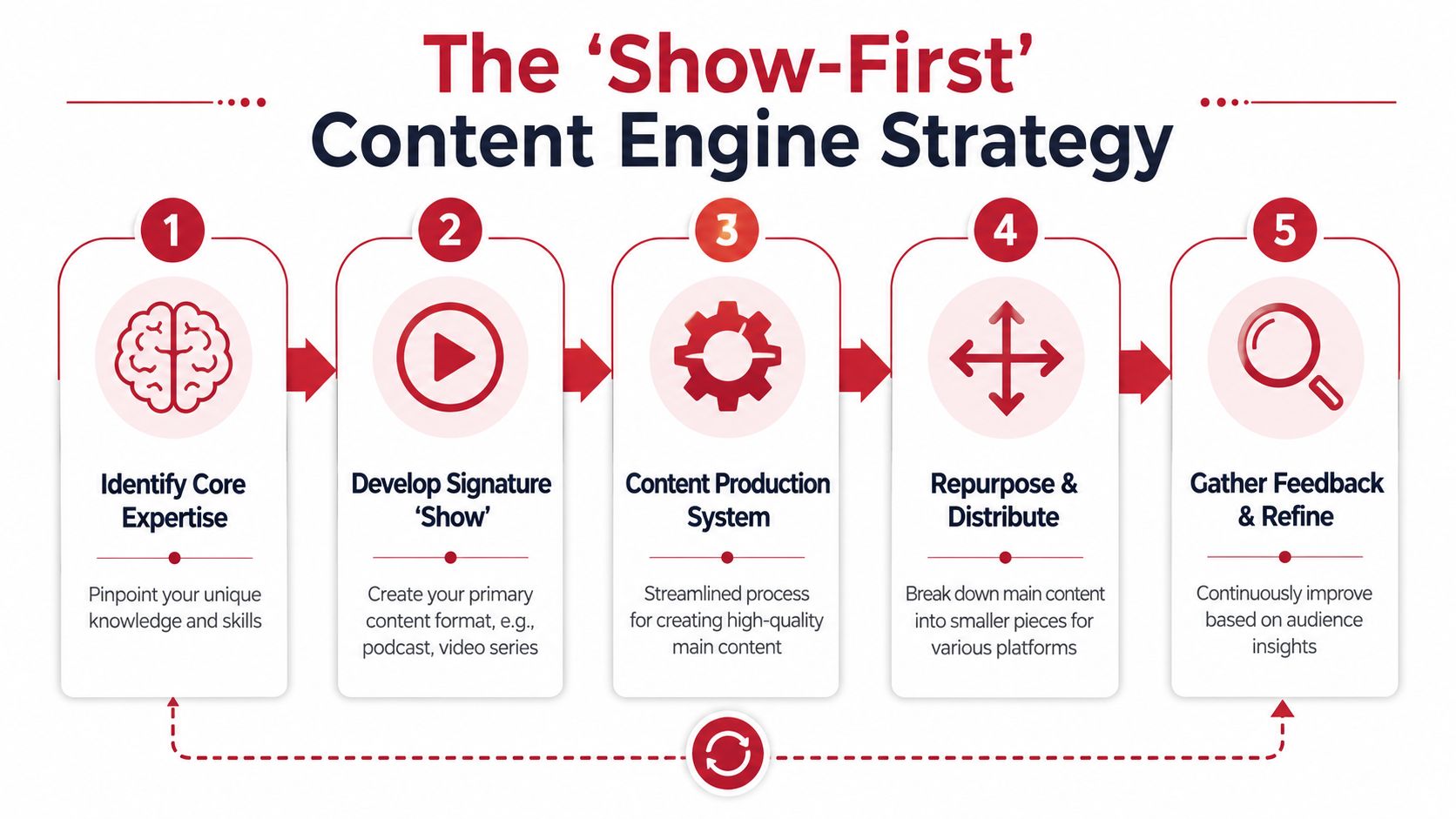
A show-first engine fixes the architecture. It puts one long-form flagship asset at the center and lets every other asset flow from it.
Why a show works better than disconnected posts
Personal branding has become format-sensitive. Depth-oriented brands need platforms where audiences go to think, not just scroll, and long-form formats such as podcasts support authority-building better than short-form content that can flatten expert positioning (The Art of Branding on building a personal brand).
That point is easy to see in practice. A podcast episode or video conversation gives enough space to demonstrate judgment. Short clips can attract attention, but they rarely carry enough nuance to establish real expertise on their own.
A recurring show also creates strategic advantages:
It proves consistency
Repetition matters. A show creates a visible cadence and a reason for people to return.It captures thought process
Not just conclusions. Buyers and audiences trust how a person thinks, not only what that person claims.It produces reusable raw material
One strong episode can feed many downstream assets without forcing the team to start from zero.It amplifies guest benefits
Inviting guests creates borrowed trust, fresh angles, and natural distribution through shared audiences.
For teams that want operational support, one option is a managed production partner. For example, brand content creation support can cover recording, editing, repurposing, and packaging so the subject matter expert stays focused on substance instead of production logistics.
The content waterfall in practice
The content waterfall is straightforward. Start with one substantial conversation or solo teaching session. Then break it down deliberately.
A single episode can become:
- A full YouTube or podcast release with title, thumbnail, show notes, and key takeaway framing
- Short vertical clips focused on one sharp claim, one story, or one teaching moment
- Quote graphics built from memorable language
- A LinkedIn post pulled from a key argument or lesson
- An email that reframes the episode around one business problem
- A blog article that expands the strongest segment into search-friendly form
- Sales support assets such as follow-up links, nurture content, or FAQ references
The mistake is treating repurposing like duplication. The goal isn't to cut one clip and spray it everywhere. The goal is to reshape the same underlying idea for each context.
A good show gives the brand one strong source of truth. Distribution then becomes adaptation, not reinvention.
Production rules that keep the engine alive
The show-first model only works if the production rules are realistic. The fastest way to kill the engine is to design a format that looks impressive and can't be sustained.
A durable setup usually has these traits:
| Decision area | Bad choice | Better choice |
|---|---|---|
| Format | Overproduced from day one | Clean, repeatable recording standard |
| Cadence | Ambitious but unstable | Publishing pace the team can maintain |
| Topic scope | Broad and generic | Narrow editorial lane |
| Repurposing | Random clipping | Planned asset list per episode |
Editorial discipline matters more than creative novelty. A show should have a recognizable promise. The audience should know what type of thinking to expect each time.
That's why the strongest hosts don't ask, “What should be posted today?” They ask, “What is this show designed to prove over the next year?” That question leads to better programming, better guests, better archives, and a much stronger answer to how to build personal brand with content that compounds.
Master Your Content Distribution and Platforms
Good content doesn't fix poor distribution. A strong episode can disappear if it lands in the wrong channel, in the wrong format, with weak packaging.
The answer isn't to publish everywhere. It's to build a platform stack with distinct jobs.

Choose a primary platform and support it properly
Start with one primary platform. That is the place where the flagship show lives best and where the audience is most likely to engage seriously. For many professionals, that's LinkedIn or YouTube. For some creators, it may be a podcast feed supported by email.
Then choose secondary platforms for discovery. Those channels should point people back to the core body of work instead of operating like separate brands.
A practical stack often looks like this:
Primary platform
Long-form home base, archives, authority, searchability, deeper engagementSecondary discovery channels
Clips, highlights, hooks, short teaching moments, guest snippetsOwned channel
Email list, subscriber base, or CRM segment where follow-up doesn't depend on algorithm shifts
Visual presentation matters more than many people admit. Northeastern reports that LinkedIn users with a professional headshot receive 14 times more profile views than those without, which shows how a basic brand asset affects discovery on an important professional platform (Northeastern on tips for building your personal brand).
That principle extends beyond the profile photo. A complete profile, clean banner, consistent bio, and visible proof all help the content work harder.
Adapt the asset instead of cross-posting it
Most repurposing underperforms because it isn't true repurposing. It's cross-posting. The same video, same caption, same framing, same call to action.
Channel-native adaptation works better:
- LinkedIn favors insight, professional context, and a clear lesson
- Instagram Reels often needs faster pacing and a stronger opening visual
- TikTok usually rewards a sharper hook and tighter emotional pattern
- X works better when the idea becomes a question, contrarian observation, or tight sequence
- Email should translate the lesson into one direct reason to care now
A clip about leadership can become five different assets without changing the underlying idea. The words around the clip, the framing, and the ask should shift.
A useful benchmark is this. If the audience can tell the asset was made for that platform, the adaptation is probably working. If it looks copied and pasted, it probably isn't.
A short lesson on workflow can help teams build that system. This guide on automating social media content is useful when the goal is to schedule intelligently without turning the brand into a bot.
Use light automation without sounding automated
Automation should handle repetitive steps, not the voice of the brand. Queueing clips, drafting descriptions, resizing assets, and moving files are good automation jobs. Final captions, platform framing, and audience replies still need judgment.
This video gives a useful visual reference for thinking about platform execution and content flow:
The trade-off is speed versus sharpness. Full manual publishing slows the team down. Full automation flattens the brand voice. The middle ground works better. Systemize the repeatable tasks, then keep human attention for hooks, context, and conversation.
Implement Audience Growth and Engagement Playbooks
Publishing creates surface area. Growth comes from deliberate moves that put the brand in front of the right people and give them a reason to respond. The strongest operators don't wait for the algorithm to discover them. They run repeatable playbooks.
Playbook one guest appearances that borrow trust
A guest appearance campaign works because it compresses trust-building. Instead of introducing the brand from scratch, the person enters a room where credibility already exists.
A smart version of this playbook looks like this:
- Build a target list of shows, channels, newsletters, or communities that already serve the same audience.
- Pitch a specific topic, not a generic “would love to chat.”
- Arrive with a clear framework, one strong story, and one memorable takeaway.
- Repurpose the appearance into clips, quotes, and follow-up posts on owned channels.
- Stay in contact with the host and audience after the appearance ends.
This works especially well for consultants, nonprofit leaders, spiritual voices, and B2B experts. Their market often trusts introductions more than cold discovery.
The borrowed trust from a respected host often matters more than another month of isolated posting.
Playbook two proof that compounds credibility
Many personal brands talk about value but hide the evidence. That's backwards. Proof should be visible enough that the audience doesn't have to guess whether the person can deliver.
A social proof flywheel usually includes a mix of:
- Testimonials that explain what changed after working together
- Before and after framing without invented metrics
- Screenshots or clips from talks, workshops, interviews, or audience feedback
- Process proof such as behind-the-scenes views of preparation and delivery
- Third-party validation like invitations, guest spots, or trusted collaborations
The key is specificity. “Great to work with” says almost nothing. “Helped clarify the message, tighten the offer, and launch a consistent show” says much more.
This playbook also helps skeptical audiences. People who dislike self-promotion usually respond better when the brand demonstrates usefulness indirectly through outcomes, artifacts, and other people's language.
Playbook three direct engagement that creates demand
A lot of creators underuse direct engagement because it feels small. In practice, it's one of the most impactful moves available.
A direct engagement loop can run like this:
| Trigger | Response | Outcome |
|---|---|---|
| New comment on a clip | Reply with substance, not just thanks | Starts conversation |
| Relevant DM or email | Send a useful resource or short answer | Builds goodwill |
| Repeated question from audience | Turn it into a future episode | Signals listening |
| Strong supporter interaction | Invite deeper connection | Creates community advocates |
The point isn't to “hack engagement.” It's to convert weak audience connection into stronger audience relationship.
This matters even more in narrow markets. If the brand serves a local business community, faith-based audience, founder niche, or technical buyer group, depth beats broadness. A handful of meaningful conversations can create referrals, speaking invitations, partnerships, and clients.
The practical trade-off is time. Endless back-and-forth doesn't scale. But consistent, selective engagement does. The goal is to build recognizable access without becoming permanently trapped in the inbox.
Build Your Conversion and Monetization Funnel
A personal brand that never connects to a business objective becomes a media hobby. That may be fine for some people, but most professionals want the brand to support clients, speaking, community growth, product sales, or donations. The conversion path needs to be designed, not assumed.
Turn attention into a path
Most monetization problems start with a missing middle. The audience sees content, likes the content, then has no obvious next step. There's attention, but no path.
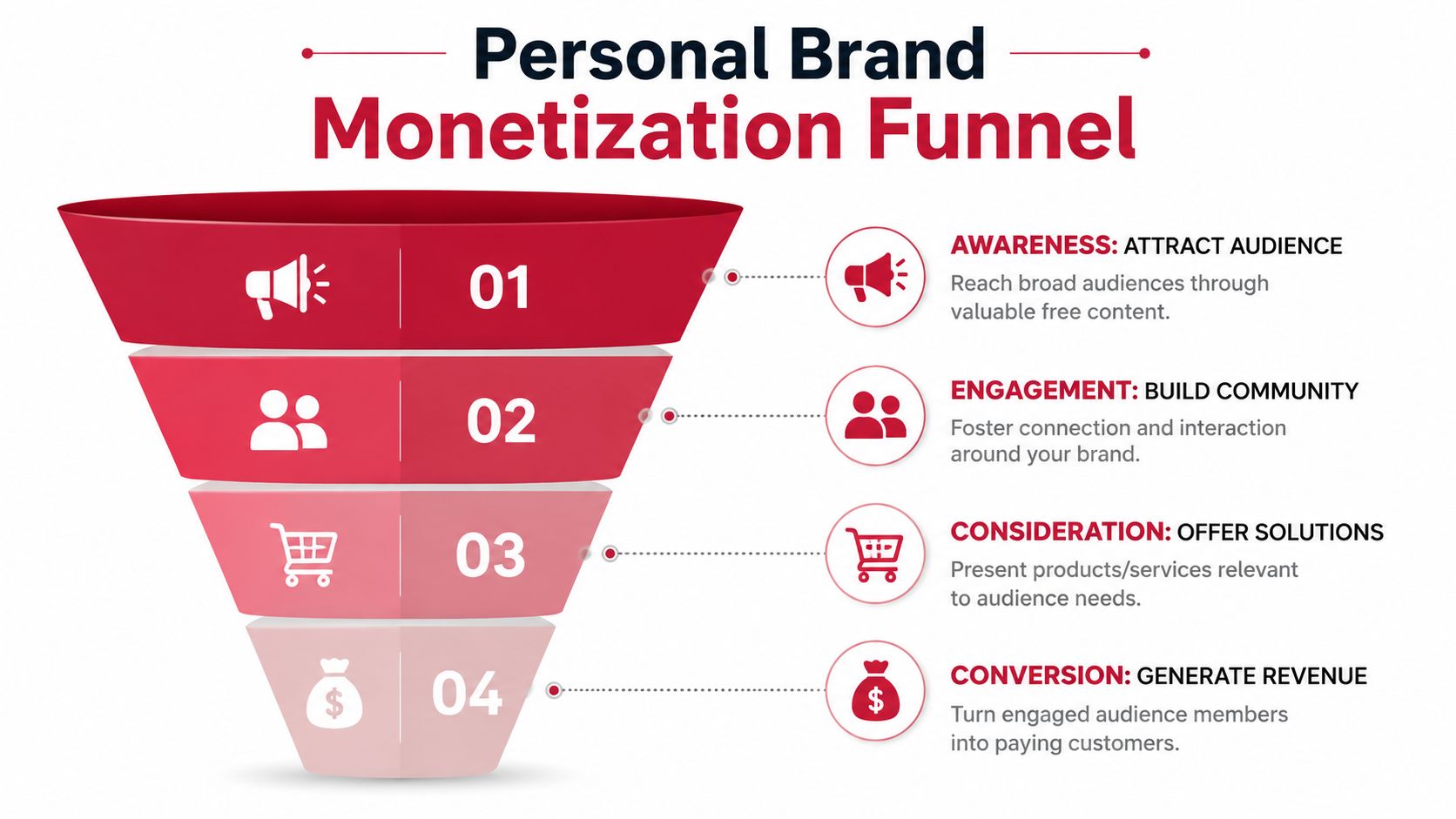
A functioning funnel usually includes four stages:
| Stage | What the audience sees | What the brand needs |
|---|---|---|
| Awareness | Free content, appearances, clips, articles | Reach and relevance |
| Engagement | Email signup, replies, community, repeat viewing | Relationship |
| Consideration | Clear offers, case examples, lead magnets, events | Fit and trust |
| Conversion | Consultation, purchase, booking, donation | Action |
That middle layer is where many brands leak value. They post useful material, then ask cold prospects for a sale. A better sequence gives people a lower-friction step first.
The infrastructure matters too. Capturing interest, segmenting contacts, and following up consistently gets easier when the brand has a clean system for managing audience data. A practical reference point is understanding what a marketing database does.
Two funnel models that fit personal brands
Different business models need different paths. Two reliable examples stand out.
Listener to lead
This model fits service providers, consultants, agencies, coaches, and advisors.
- Publish a strong episode around a specific business problem
- Add a call to action for a relevant resource, audit, or conversation
- Move the interested person to email or a form
- Follow with targeted nurture content
- Invite a consultation only after relevance is clear
Follower to customer
This model fits creators, educators, authors, and experts with offers that don't require a sales call.
- Use short-form content to attract attention around one recurring pain point
- Offer a workshop, guide, webinar, or email series
- Use that asset to deepen trust and frame the offer
- Present a product, membership, event, or course that matches the problem
A brand converts better when the offer feels like the next logical step, not an abrupt pitch.
What breaks conversion
The usual failure points aren't mysterious:
Weak offer clarity
People understand the content but can't tell what to buy or book.No audience segmentation
Every lead gets the same message, regardless of interest or stage.Poor CTA placement
The call to action appears once, vaguely, or only at the very end.Mismatch between content and offer
The show builds one kind of trust while the offer asks for something unrelated.
A good personal brand funnel feels coherent from first impression to paid action. The content should naturally pre-qualify the right people and subtly disqualify the wrong ones. That saves time, protects positioning, and improves conversion quality.
Your 12-Month Personal Brand Timeline
Strong brands usually don't appear suddenly. They compound through clear positioning, repeated proof, and a system that survives busy weeks. A year is enough time to build meaningful momentum if the work is staged properly.
Months one through three foundation and launch
The first quarter is for decisions, not volume. Define the positioning, narrow the audience, lock the message pillars, and build the show format. Record pilot episodes before making the public launch bigger than the system can support.
Use this phase to standardize visual identity too. The same headshot, bio logic, and tone should carry across major profiles. That consistency helps recognition later when clips begin circulating.
Months four through nine systemize and grow
The middle of the year is where discipline matters. Publish the show consistently. Build the content waterfall. Improve titles, thumbnails, descriptions, hooks, and clip selection. Start guest appearances and direct engagement loops.
This stretch is also where the team learns what the audience responds to. Not every pillar will pull equal interest. That's normal. The better move is to refine the editorial lane, not chase every surprising spike.
A weekly operating rhythm helps keep the engine practical.
Months ten through twelve convert and refine
The final quarter is for tightening the path from attention to action. Improve calls to action. Strengthen landing pages. Build one clear next step for the audience. Audit which episodes, clips, and guest appearances brought the right kind of interest.
This phase should also clean up what doesn't deserve to continue. Weak channels can be reduced. Vague offers can be rewritten. The brand should end the year more focused than it began.
Here's a simple operating template.
| Day | Platform | Content Asset |
|---|---|---|
| Monday | YouTube or podcast feed | Full show episode |
| Tuesday | Insight post drawn from one episode takeaway | |
| Wednesday | Instagram Reels or TikTok | Short video clip with a single hook |
| Thursday | Summary and call to action tied to the episode | |
| Friday | X or LinkedIn | Question post or quote card from the episode |
| Weekend | Community or DMs | Audience replies, follow-up, and relationship building |
The clearest answer to how to build personal brand is to stop thinking in isolated posts and start thinking in systems. Foundation first. Show second. Distribution with intent. Growth through trust. Conversion by design.
A personal brand gets stronger when the content engine is built to last. Get Up Productions helps individuals and organizations create turnkey podcast and video show systems, including recording support, editing, YouTube-ready episodes, and repurposed assets that can feed a broader brand strategy.