
A buyer needs exactly what a brand sells. They ask a colleague, open a few tabs, maybe search YouTube or LinkedIn, and make a shortlist within minutes. The painful part isn't losing the deal to a stronger competitor. It's losing before the brand was ever considered.
That gap sits at the center of the marketing evoked set. Most founders and service firms spend too much time trying to be visible in general and not enough time trying to be recalled at the right moment by the right buyer. Those are different jobs.
For high-consideration B2B services, creators, consultants, and personal brands, this matters even more. Buyers don't make these decisions from a blank slate. They lean on familiarity, perceived expertise, and whatever names feel safest and easiest to justify. That means a brand can be credible, competent, even well-known in some circles, and still miss the shortlist.
Table of Contents
- The Moment of Choice and Why Your Brand Isn't In It
- What Is the Evoked Set and Why It's Your Most Important Target
- The Psychology of Choice How Brands Enter the Evoked Set
- A Playbook for Entering Your Customer's Evoked Set
- Real-World Examples Brands That Mastered the Evoked Set
- Your Checklist for Becoming an Evoked Set Brand
The Moment of Choice and Why Your Brand Isn't In It
Most buying decisions don't begin with a full market review. They begin with urgency. A founder needs a podcast producer. A nonprofit leader needs help telling a story better. A marketing director needs a credible outside partner and needs one fast.
In that moment, buyers rarely scan every possible option. They reach for the few names already available in memory. If a brand isn't there, its website, testimonials, and service quality don't matter yet because the buyer never got far enough to evaluate them.
That's why many solid businesses feel invisible even when they're doing decent marketing. They publish occasionally, post inconsistently, and hope awareness alone will carry them into the next opportunity. It usually won't. Broad visibility without relevance creates recognition without consideration.
A sharper way to think about this starts with market focus. Brands that try to talk to everyone usually end up memorable to no one. The discipline of narrowing the audience, sharpening the problem, and repeating the same category cues matters far more than scattered reach. That's also why a clear target market strategy matters so much for brand recall.
Practical rule: If a buyer can't quickly answer "what are they known for?" the brand probably isn't entering the shortlist consistently.
Why awareness isn't the same as consideration
Awareness is a weak win on its own. A prospect may know a brand name, have seen its content, and still never think of it when a real purchase need appears.
That happens because memory retrieval is contextual. Buyers remember brands that were attached to a specific problem, point of view, or use case. Generic marketing creates weak associations. Specific marketing creates retrieval cues.
A B2B consultant who talks broadly about growth may be forgotten. One who repeatedly owns a narrow problem, such as sales enablement for mid-market SaaS or donor storytelling for nonprofits, becomes easier to recall.
What founders should take from this
The goal isn't to be the loudest voice in the category. The goal is to become one of the few names that surfaces naturally when a relevant problem appears.
That is the practical use of the marketing evoked set. It gives marketing a harder edge. Instead of asking, "How can the brand get more impressions?" the better question is, "What would make the right buyer remember this brand first, or at least include it on the list?"
What Is the Evoked Set and Why It's Your Most Important Target
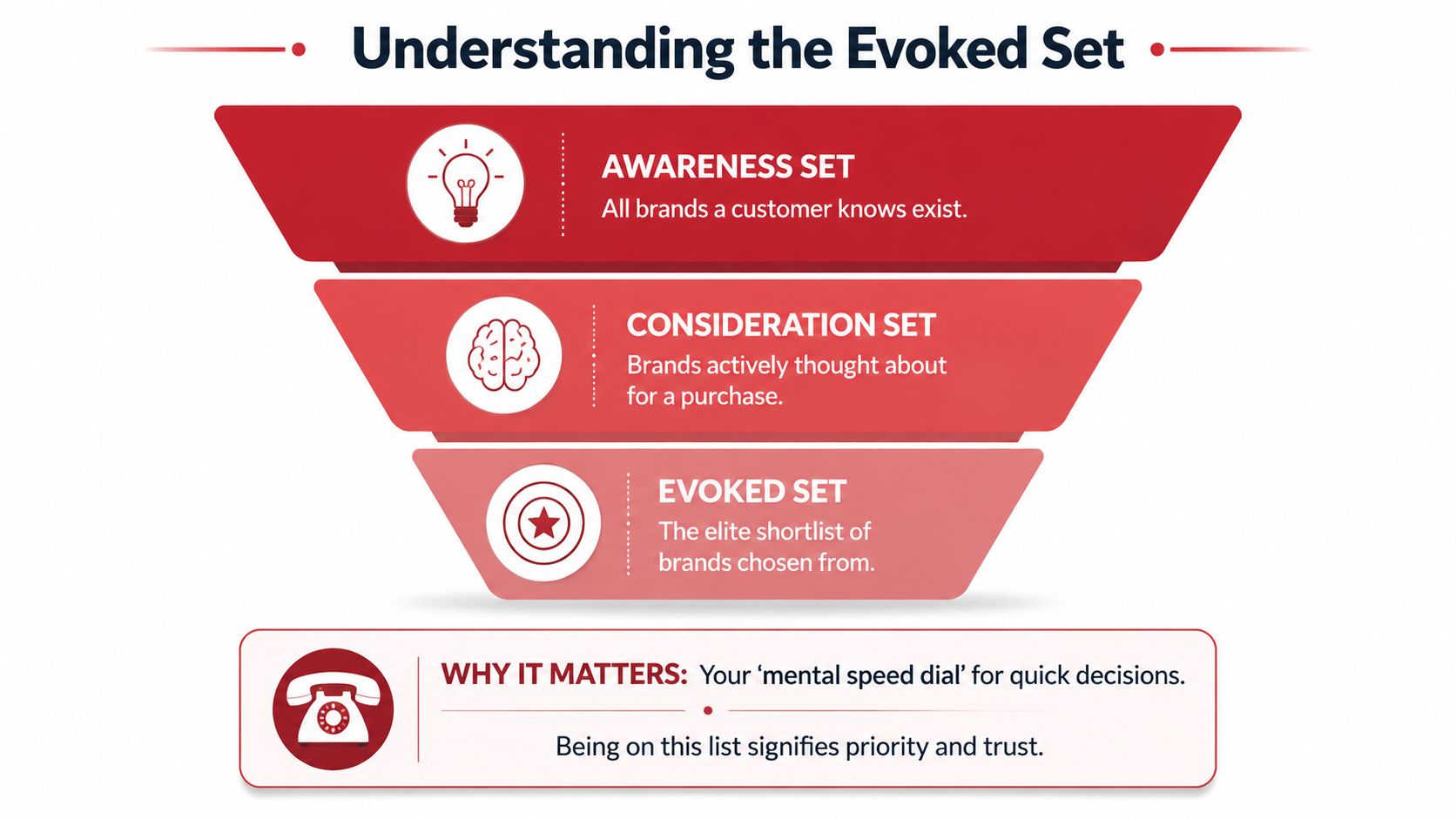
The simplest way to understand the marketing evoked set is to think of it as a buyer's mental speed dial. Not every contact makes that list. Only the names that feel familiar, relevant, and credible enough to call right now.
One widely used teaching model breaks the buyer's mental filter into three layers: total set for all brands in the category, awareness set for brands the buyer knows, and evoked set for brands the buyer would seriously consider buying, as described in this overview of evoked set stages.
The three mental buckets
A founder can picture the process like this:
| Stage | What it means | What usually gets brands stuck there |
|---|---|---|
| Total set | Every possible option in the market | The buyer doesn't know the brand exists |
| Awareness set | Brands the buyer recognizes | Recognition is shallow or vague |
| Evoked set | Brands the buyer would actually consider | The brand feels relevant, trusted, and easy to justify |
This reframes competition. A podcast production company isn't competing with every company that offers editing or video services. It's competing with the few names a buyer can recall when the need becomes active.
Why this target matters more than broad visibility
Many brands chase reach as if every impression has equal value. It doesn't. In high-consideration categories, the better use of time is often repeated exposure around a narrow expertise area.
That means the core job isn't "get seen by more people." It's "become easy to remember in a specific buying context." The market may be large, but the shortlist inside a buyer's head is small.
A brand can be known and still not be chosen. It only starts competing once it enters consideration.
The strategic shift
Many content programs break down at this stage. They publish material that is technically useful but not mentally sticky. The audience learns something, then remembers the lesson and forgets the source.
Strong evoked-set marketing does the opposite. It connects a clear problem, a consistent point of view, and recognizable brand assets often enough that the buyer starts associating that brand with a category decision.
For founders, creators, and service firms, that means the right target isn't mass awareness. It's shortlist inclusion. If the brand can earn that, sales conversations get easier because the buyer arrives with pre-loaded trust.
The Psychology of Choice How Brands Enter the Evoked Set
Buyers like to think they compare options rationally. In practice, they use shortcuts. They choose names that feel familiar, trusted, and socially validated. That's why entering the marketing evoked set is partly a messaging problem and partly a memory problem.
Technical guidance on evoked sets makes the sequence clear: first become a member of the evoked set, then win purchases within it. That same guidance also notes the set can change as people become aware of new brands, which means share of mind has to be maintained through exposure and positive experience, as explained in this evoked set marketing lesson.

Familiarity reduces friction
Repeated exposure works because buyers trust what feels known. Not blindly, but enough to lower the mental cost of taking the next step.
This is why inconsistent marketing underperforms. A founder posts heavily for a month, disappears for two, then returns with a different angle and different visuals. That pattern doesn't build familiarity. It resets it.
The stronger approach is boring in the best sense. Same themes. Same language. Same expertise lane. Same visual identity. The brand starts feeling dependable before the sales call ever happens.
Authority sharpens recall
Authority doesn't come from saying "industry leader." It comes from showing judgment in public. Strong content names trade-offs, explains mistakes, and teaches buyers how to think.
This is also where newer visibility models matter. Teams trying to increase discovery across search and AI-generated environments may find useful context in this Algomizer research paper on GEO, especially when thinking about how structured, topic-led content supports brand recall in emerging discovery channels.
A focused media mix matters too. Brands that distribute educational content across channels create more chances for prospects to connect expertise with a category need. This broader system is easier to build when the team understands how channels support each other, which is why a strong marketing media strategy can reinforce recall instead of fragmenting it.
Social proof makes the choice feel safer
Social proof is less about hype and more about risk reduction. Buyers look for signals that other credible people already trust the brand.
That can show up in several ways:
- Specific testimonials: Short praise is weak. Testimonials that mention the problem, the process, and the reason the client would recommend the brand are stronger.
- Visible associations: Guest appearances, speaking clips, and collaborations tell buyers the brand moves in the right rooms.
- Repeated endorsements: When the same themes come up across comments, reviews, and conversations, trust compounds.
Buyers don't only ask, "Is this good?" They also ask, "Will choosing this make sense to everyone else involved?"
A Playbook for Entering Your Customer's Evoked Set
The most reliable way to enter a buyer's evoked set isn't one viral post or one ad burst. It's a system. The system has to create repeated, relevant contact around the exact problem the buyer wants solved.
That matters even more in saturated categories. One practical gap in most advice is that it doesn't show how long-form content, repurposed clips, and founder-led storytelling shape recall and shortlist inclusion over time. A useful framing from this podcast-led authority content discussion is that podcast-driven content can create repeated, topic-specific associations that make a brand feel personally relevant to a niche audience.
Content and SEO that build recall
Content should answer the questions buyers ask right before they shortlist vendors. Not broad inspiration. Not fluffy leadership takes. Decision-shaping content.
A useful editorial filter is simple: if a buyer consumed this piece, would they know when to hire the brand, why to trust it, and what makes its approach distinct?
Start with these content types:
- High-intent comparison pages: "Agency vs freelancer for podcast production," "when a founder should launch a branded show," "how nonprofits use interviews to deepen donor trust."
- Problem diagnosis articles: Content that helps the buyer name the issue before they buy a solution.
- Point-of-view pieces: Content that draws a line. Example: polished production matters less than category clarity, or distribution matters more than episode count.
The structure matters almost as much as the topic. Strong pages use the exact language buyers use, include examples, and make the next step obvious. They don't sound like term papers.
Podcasting that creates mental availability
Podcasting has a special advantage in evoked-set marketing because it combines repetition, voice, and depth. Buyers hear the same host explain adjacent problems again and again. That creates familiarity with judgment, not just a logo.
For B2B firms and personal brands, the podcast shouldn't be treated like a side project. It should function like a relationship engine. Each episode should do at least one of three jobs: answer a high-stakes buyer question, demonstrate the host's way of thinking, or borrow trust from a strong guest.
A smart production workflow turns one recording into multiple memory cues across channels. That usually includes:
- Full-length episode for depth: Best for trust and long-form authority.
- Short clips for repetition: Best for social recall and light touchpoints.
- Quote graphics and carousels: Best for saving, sharing, and reinforcing key language.
- Email summaries: Best for reaching known contacts without asking them to consume a full episode.
Many brands miss the opportunity at this stage. They record a show, upload it, and stop. The stronger move is to build a distribution chain that keeps the same ideas circulating in different formats.
A useful companion resource for teams working on short-form distribution is AdCrafty's blueprint to make viral videos. Not because virality is the main goal here, but because the mechanics of hook, pacing, and edit selection matter when repurposing expert content into clips people watch.
A brand also needs a clean audience record to make this content useful beyond views. Teams that want to connect content activity with follow-up should think carefully about segmentation, contact capture, and source tracking inside a marketing database system.
A practical rhythm looks like this after one recording session:
- Publish the full episode with a title tied to a buyer problem.
- Clip two or three moments that communicate a clear stance, not just a generic tip.
- Turn one quote into a post that uses the brand's language consistently.
- Send the episode to a segmented list with a short note about why it matters.
- Reuse the same topic in sales conversations so marketing and selling reinforce each other.
A later-stage asset can deepen that strategy:
Paid media that stays narrow and strategic
Paid media helps the evoked set when it reinforces memory. It hurts when it chases cheap attention.
For service firms, smarter paid campaigns usually look narrow:
- Retarget recent site visitors with content tied to the service they viewed.
- Run account-based campaigns to a small list of target companies or donor-facing institutions.
- Promote thought-leadership clips instead of generic sales ads when the audience is still early.
The message should mirror the content strategy. If the organic program says the brand is known for one sharp expertise area, paid media shouldn't suddenly go broad and vague.
Field note: The ad doesn't need to close the sale. It needs to keep the brand mentally present until the buying window opens.
Measurement that reflects shortlist momentum
Many teams measure the wrong thing. Views and likes aren't useless, but they don't tell the full story of whether the brand is entering consideration.
Better signals include:
| Signal | What it suggests |
|---|---|
| Branded search queries | More people remember the brand by name |
| Direct traffic | Buyers return without needing a prompt |
| Inbound mentions of content | Prospects associate expertise with the brand |
| Shorter explanation needed in sales calls | Buyers already trust the category fit |
The pattern matters more than any single dashboard. If branded search rises, direct traffic improves, and prospects start referencing episodes or clips in conversations, the brand is likely becoming easier to recall when decisions happen.
Real-World Examples Brands That Mastered the Evoked Set
Some brands dominate the evoked set without looking like mass-market giants. They do it by owning a category conversation long before purchase intent appears. That's the strategic power of repeated exposure and positioning, which is also why researchers try to identify all plausible options in conjoint studies so they don't distort what buyers would consider, as noted in this discussion of evoked set significance and research design.
Ahrefs and the power of useful repetition
Ahrefs became hard to ignore in SEO circles not because it shouted the loudest, but because it kept publishing practical education tied tightly to the problems search professionals wanted solved. Its tutorials, YouTube presence, and product-led explanations repeatedly linked one brand to one domain of expertise.
That creates a classic evoked-set advantage. When a marketer needs an SEO platform, Ahrefs often arrives in memory early because the brand has already occupied the learning phase.
The niche consultant who owns one problem
The same pattern works at a smaller scale. A consultant who talks only about one buyer problem, publishes breakdowns regularly, appears on targeted podcasts, and shares strong opinions often becomes the default recommendation in a niche.
This doesn't require celebrity. It requires consistency. The market starts using that person's name as shorthand for a specific kind of solution.
Story-driven nonprofits stay top of mind
Nonprofits can use the same logic. The organizations that remain memorable to donors don't just post updates. They repeatedly connect the mission to human stories, recognizable voices, and consistent themes.
That matters because donor consideration is also selective. Supporters don't review every worthy cause from scratch each time they give. They return to the organizations whose stories they've heard often enough, and clearly enough, to recall them when generosity becomes active.
Repetition before demand often decides who gets remembered when demand finally shows up.
Your Checklist for Becoming an Evoked Set Brand
A brand enters the marketing evoked set when buyers can recall it quickly, connect it to a specific need, and trust it enough to include it on the shortlist. If the brand isn't recalled at decision time, it's effectively out of the funnel. In podcast-related services especially, repeated category cues, consistent brand assets, and thought-leadership content increase the chance of being mentally available when the need appears, according to this evoked set explanation for marketers.
A practical audit
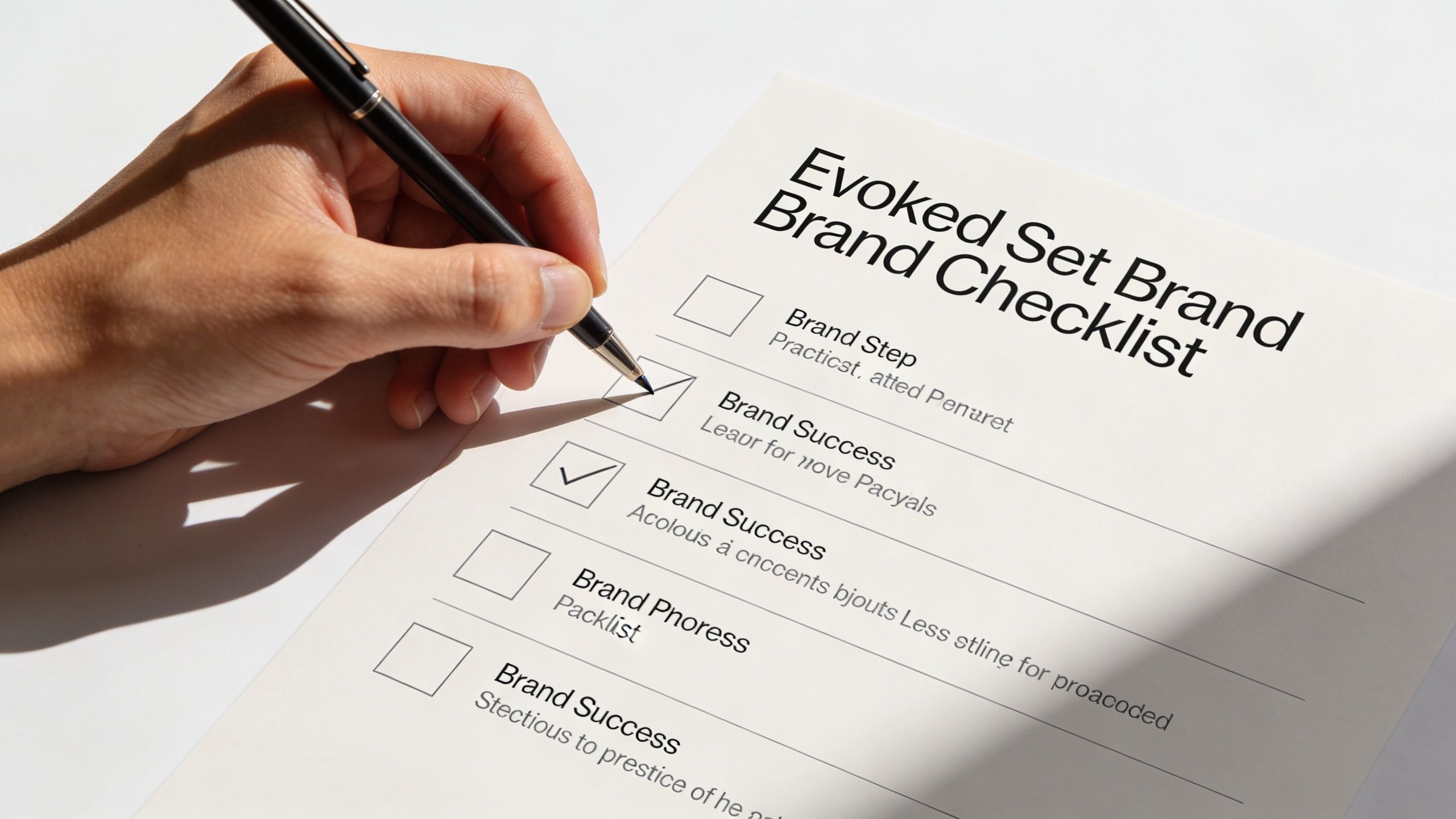
Use this checklist to evaluate whether the brand is becoming easier to remember and easier to choose.
- Clear category ownership: Can a prospect describe what the brand is known for in one sentence?
- Consistent content themes: Does the brand repeat a few core ideas across articles, video, audio, email, and social?
- Visible expertise: Does the content show judgment, trade-offs, and problem diagnosis, or only surface-level tips?
- Recognizable assets: Are the voice, visuals, titles, and framing consistent enough to become familiar?
- Repurposing discipline: Does one strong idea get distributed in multiple formats, or does each post start from zero?
- Proof in public: Can a buyer quickly find testimonials, guest appearances, or examples that reduce risk?
- Focused paid support: Are ads reinforcing a narrow expertise area instead of chasing broad awareness?
- Shortlist signals: Are prospects arriving warmer, mentioning the brand by name, or referencing content in conversations?
What usually fails
Many brands miss the evoked set because they confuse activity with memory-building. They post often but don't repeat. They teach useful ideas but don't tie those ideas back to a distinctive point of view. They look busy and still remain interchangeable.
The better path is tighter. Fewer topics. More repetition. More media built around the same expertise. More deliberate reinforcement of what the brand wants to be remembered for.
Bottom line: Awareness starts the process. Recall at the buying moment decides whether the brand gets a seat at the table.
Brands that want that kind of recall usually need more than raw recording help. They need a content engine that turns expertise into repeated, high-quality touchpoints across platforms. Get Up Productions helps founders, creators, nonprofits, and B2B teams build podcast-driven content systems that make their message easier to remember and easier to trust when the right buyer is ready.