
A lot of podcasters hit the same wall. The show is live, episodes are consistent, listeners respond, and yet revenue still feels out of reach.
That usually happens because creators chase the wrong monetization model for their stage. They pitch sponsors too early, drop random affiliate links into show notes, or copy what large entertainment shows do without the audience volume or infrastructure to support it. The result is frustration, weak offers, and a show that feels busier but not more profitable.
The better approach is to treat podcast revenue as a staged system. First, build a monetizable audience. Then earn direct support. Then add affiliate partnerships that fit the audience. Then pursue sponsorships with a package that makes sense. For authority-driven shows, the biggest upside often comes from using the podcast to sell higher-value services, speaking, consulting, or donor relationships.
Table of Contents
- Laying Your Monetization Foundation
- The Direct Support Playbook Your First Revenue
- Affiliate Marketing That Actually Converts
- Securing Your First Podcast Sponsorships
- Advanced Monetization and Scaling Your Brand
- Conclusion Your Monetization Engine
Laying Your Monetization Foundation
Most podcasts don't have a revenue problem first. They have an asset problem.
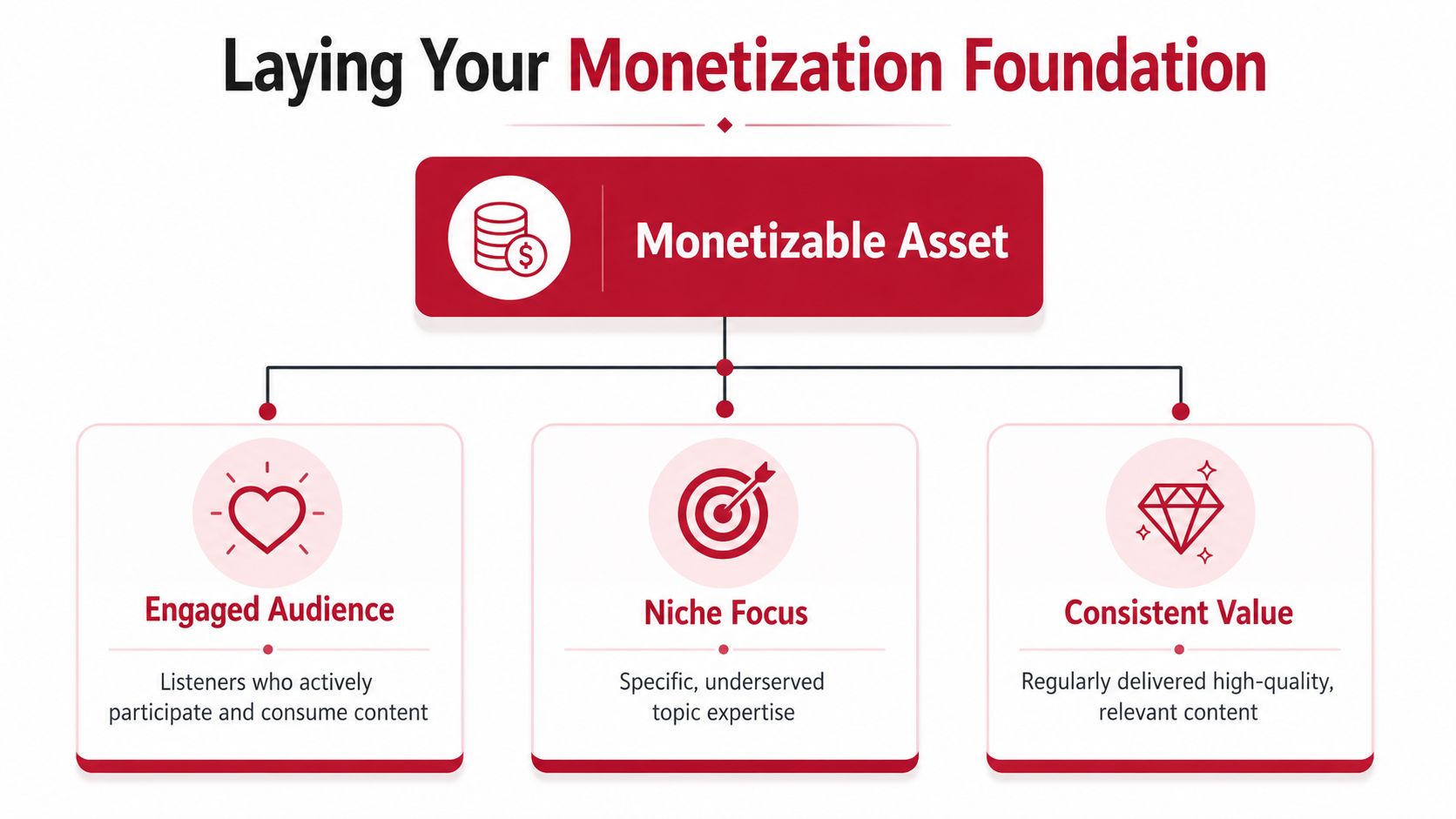
A monetizable podcast isn't just a feed with downloads. It's a show with a clear audience, a repeatable promise, and enough proof that listeners care. Until those pieces are in place, monetization efforts usually feel forced.
What a monetizable audience actually looks like
The first mistake is equating audience size with audience value. Brands, donors, buyers, and affiliates care about fit and behavior. They want to know whether the show attracts the right people and whether those people take action.
A spiritual leadership podcast with a tightly defined audience can be monetizable before a broad lifestyle show with more passive listeners. The same goes for a B2B consultant interviewing operators in one specific industry. Narrow beats vague because narrow creates purchase intent.
A practical audit should look at signals like these:
- Topic consistency: Can a listener describe the show's promise in one sentence?
- Audience response: Do listeners reply to emails, click links, leave reviews, or mention episodes in conversation?
- Content depth: Does the show solve a real problem or just fill time?
- Off-platform capture: Is the show pushing listeners toward an email list, community, or landing page?
For teams that want sharper revenue reporting later, it helps to start with a clean listener journey and a dedicated podcast landing page that centralizes episodes, offers, and conversion paths.
Practical rule: If a show can't explain who it's for, what problem it solves, and what action listeners should take next, it isn't ready to monetize aggressively.
The download thresholds that change your options
There is a real monetization gap in podcasting. Industry data from the Podcast Advertising Bureau (PAB) 2023 Report indicates that 92% of major brand sponsors require podcasts to achieve between 5,000 and 10,000 monthly downloads before initiating contracts, which shuts many strong niche shows out of traditional sponsorships early on (Podcast Advertising Bureau benchmark via IAB).
That doesn't mean a smaller show can't make money. It means the first revenue stream usually shouldn't be agency-style sponsorships.
A simple way to think about the stages:
| Growth stage | What usually works | What usually doesn't |
|---|---|---|
| Early niche show | Direct support, affiliate offers, email capture, lead generation | Cold pitching major brands |
| Established niche show | Grassroots sponsors, host-read partnerships, premium tiers | Relying only on passive ad marketplaces |
| Scaled show | Direct sponsorship packages, recurring memberships, higher-ticket offers | Treating the podcast as a standalone media product only |
For creators trying to build durable revenue, it helps to think in terms of understanding podcast ROI rather than chasing vanity outcomes. That means tracking what the show produces in donations, leads, affiliate sales, partnerships, and client conversations. A useful framing appears in this guide on understanding podcast ROI.
The setup serious buyers expect
Advertisers and partners don't just buy enthusiasm. They buy clarity.
That means a show needs consistent publishing, clean artwork, a believable host bio, accurate download reporting from the hosting platform, and a simple one-sheet or page that explains the audience and available opportunities. For nonprofit and spiritual shows, this may also include donor alignment and mission fit. For consultants, it should include role titles, industries served, and likely buying intent.
The strongest foundation usually includes:
- A clear niche statement that names the audience and outcome.
- A basic analytics habit with monthly download tracking and top episode topics.
- A conversion path such as newsletter signup, donor page, booking page, or resource library.
- An editorial rhythm that proves the show will still exist next quarter.
That groundwork isn't glamorous. It's what makes every later monetization move easier to close.
The Direct Support Playbook Your First Revenue
A show with 600 loyal listeners can produce revenue before a show with 6,000 passive ones.
That is the monetization gap many podcasters miss. They wait for ad-scale numbers, even though the first money usually comes from the people already getting value from the show. For podcasts under 10,000 downloads per episode, direct support is often the fastest path to proof of demand, cleaner cash flow, and stronger positioning for later sponsorship sales.

Why direct support works before sponsorships do
Early revenue works best when the offer matches the relationship you already have. Listeners know the host, trust the format, and understand the value of keeping the show going. That makes direct support easier to start than pitching brands that need audience scale, category fit, and reporting.
Patreon still leads this category, while Ko-fi and Buy Me a Coffee work well for simpler one-time or flexible support options. A useful overview appears in Transistor's guide to listener-supported podcast monetization.
The point is not the platform. The point is the offer.
Shows that introduce paid support early tend to build stronger perceived value and more stable revenue because the audience learns that the podcast is not just free content. It is a media product with a clear exchange. Even a small supporter base can cover hosting, editing, or promotion, and that changes how a creator operates.
A paid tier does not need scale first. It needs a specific promise.
Build an offer you can keep delivering
The common mistake is overbuilding. Hosts pile on bonus episodes, private chats, live calls, PDFs, and extra newsletters until the paid tier creates more stress than income.
A better model is to sell access to work already close to the existing production process.
Use this stage-based approach:
If the show is early and under 1,000 downloads per episode:
- Start with one paid tier
- Offer ad-free episodes, supporter shout-outs, or one short monthly bonus drop
- Add a one-time tip jar for listeners who do not want another subscription
If the show has a consistent niche audience and repeat listeners:
- Add a second tier with Q&A access, extended interviews, or practical templates
- Bundle direct support with your owned audience strategy using an email funnel. This guide on how to build an email list is useful if the show needs a stronger follow-up channel outside the podcast app
If the show serves a business or professional audience:
- Package paid support around utility, not fandom
- Offer research notes, office hours, private feeds, or curated tools
- If your workflow includes recommended tools, partner revenue can complement direct support. See details on AudioPen's partnership
Examples by show type keep this grounded:
- Spiritual leaders: private reflection audio, ad-free listening, monthly Q&A, community discussion access
- B2B consultants: extended interviews, templates, strategy notes, office-hours sessions
- Nonprofits: supporter updates, impact briefings, field stories, campaign previews
- Authors and speakers: early chapter readings, event debriefs, exclusive responses to audience questions
Annual plans can work well here. They reduce churn, bring cash in faster, and cut the monthly cancellation cycle.
The first ask needs a script
A weak ask sounds vague. A strong ask tells listeners what support funds and what they receive.
Use language like this:
If this show helps you do better work, you can support it directly. Members get ad-free episodes and a private monthly Q&A. Your support helps us keep publishing on schedule and keep the show independent.
For a one-time contribution, tie the ask to a clear moment:
If this episode saved you time or gave you a useful next step, you can buy us a coffee through the link in the notes. Those contributions help cover production and keep this series running.
The trade-off is simple. Ask too softly and listeners miss the opportunity. Ask too often and the show starts to feel transactional. The middle ground is a short, repeatable read placed after a strong value moment.
Three factors usually improve response:
- Specificity: state the perk or the mission the support funds
- Placement: ask after the audience has received something useful
- Consistency: repeat the same offer long enough for listeners to remember it
Direct support is not a vanity move for small shows. It is the first clean test of whether the audience values the work enough to pay for it. For podcasts still below ad-network scale, that proof matters more than waiting for permission from sponsors.
Affiliate Marketing That Actually Converts
Affiliate marketing gets treated like passive income. In practice, it's trust conversion.
Most podcasters make the same mistake. They paste links into the show notes, mention nothing in the episode, and wonder why revenue never appears. That approach asks listeners to notice, remember, and care about a random link with no context.
Why show note link dumps underperform
The better model is verbal recommendation plus useful context.
Podcasters who verbally recommend products during episodes can achieve conversion rates that are 3x higher than those who only list links in the description, because the endorsement connects the host's credibility to the product's value (Beehiiv on podcast affiliate strategy).
That changes how affiliate monetization should be structured. The product mention needs to live inside the content, not outside it.
A poor example:
- "Links are in the show notes."
A stronger example:
- "This episode was outlined using AudioPen to turn rough spoken thoughts into usable notes. The link in the notes is the same tool used in the weekly workflow."
The second version gives listeners a reason to care. It also tells them what the tool did.
The affiliate structure that respects trust
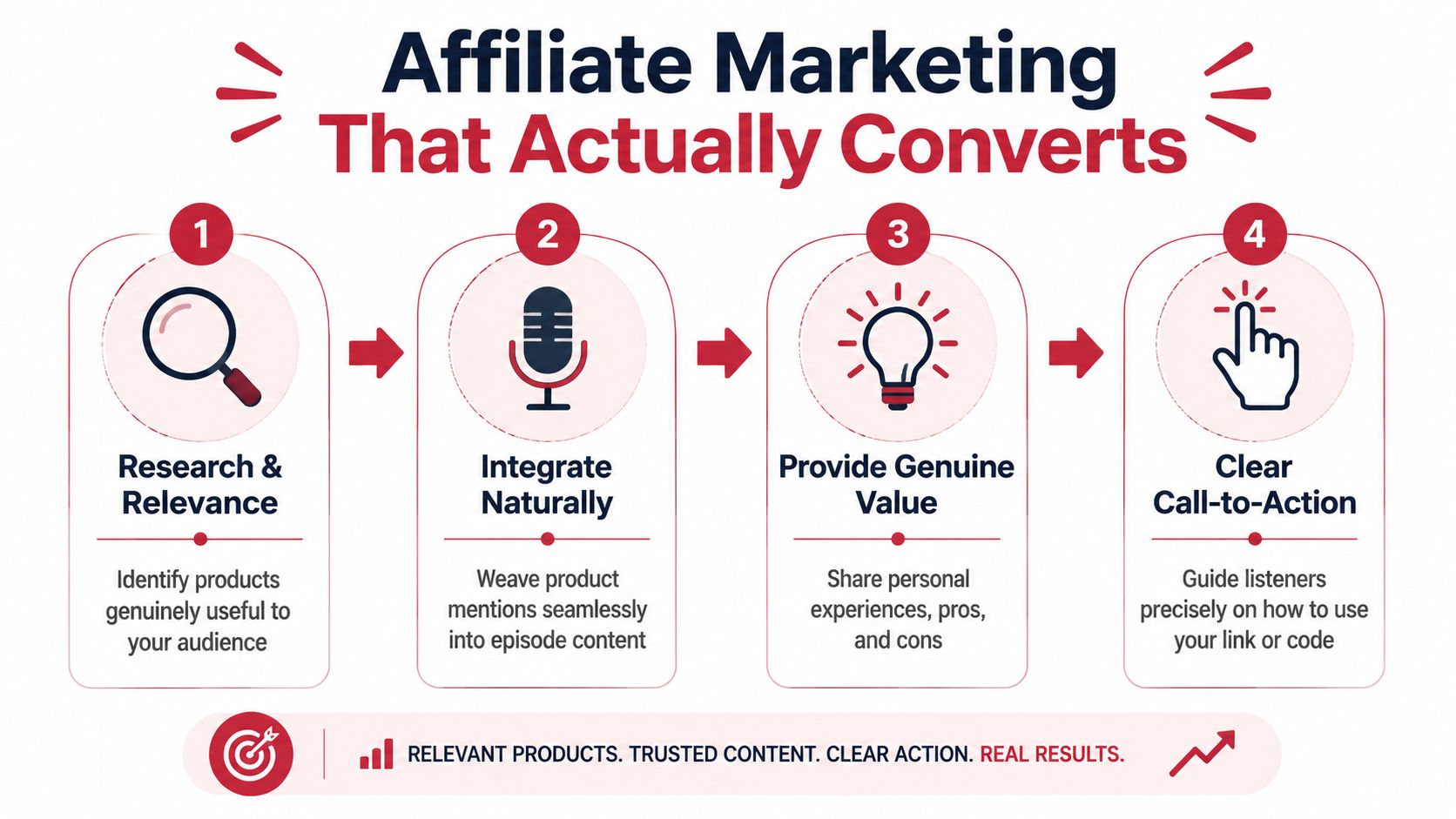
An effective affiliate segment usually has four parts:
- Context first. Tie the product to a real workflow problem.
- Personal utility. Explain how the host or team uses it.
- Specific benefit. Name the result without exaggerating.
- Clean CTA. Tell listeners exactly where to go.
This section's embedded video shows the kind of clear delivery that holds attention:
For creators who want a concrete partner example, AudioPen has a straightforward affiliate structure worth studying. The public details on AudioPen's partnership show how a creator-friendly offer can fit naturally into productivity, writing, consulting, and founder-focused content.
The best affiliate offer doesn't feel like an ad. It feels like a shortcut the audience is glad someone vetted.
What to put on a tools page
A curated tools page works when it's selective.
Don't build a bloated resource page full of every app ever tested. Build a short page with categories that match the show's real use cases. That might include recording tools, planning software, editing aids, scheduling apps, or audience engagement tools.
A useful structure looks like this:
| Section | What to include |
|---|---|
| Recording | The microphone, camera, or remote recording platform actually used |
| Workflow | Planning, note capture, transcription, or idea organization tools |
| Publishing | Hosting, repurposing, scheduling, and analytics tools |
| Business stack | CRM, email platform, forms, or booking tools tied to listener action |
Each item should include a brief explanation, who it's for, and any limitations. Pros and cons matter because they make the recommendation believable.
Two rules keep affiliate revenue healthy over time:
- Disclose the relationship clearly. Listeners should know a recommendation may earn a commission.
- Track by episode topic. Some topics naturally convert better than others. That pattern should shape future promotions.
Affiliate marketing works when the host curates instead of sprays links. That's the difference between occasional commission and a repeatable revenue stream.
Securing Your First Podcast Sponsorships
Most small shows approach sponsorships backwards. They wait for a media buyer, chase big-name brands, or apply to ad marketplaces that don't value their audience.
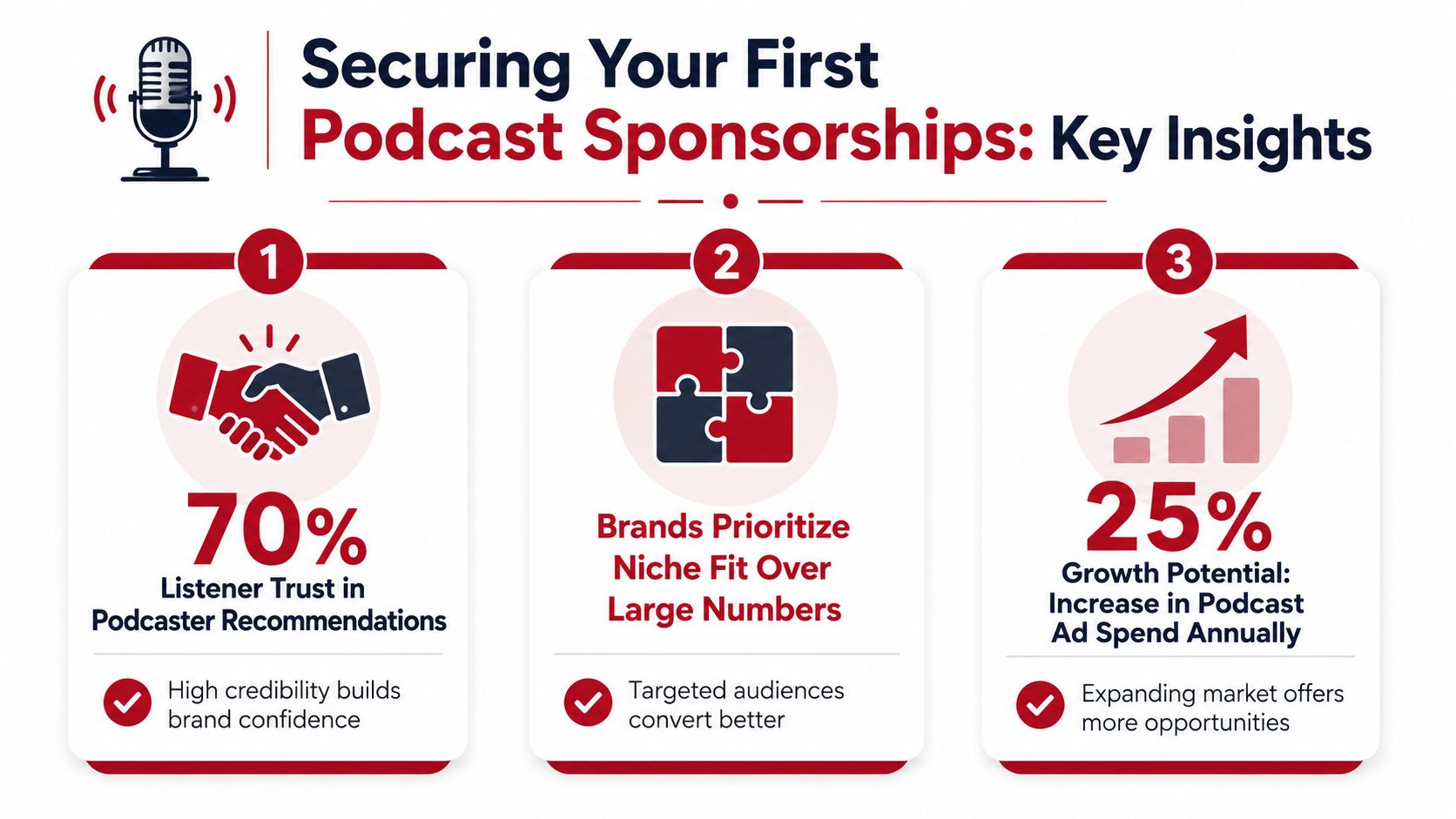
A better first move is direct outreach to niche-aligned companies that already want the exact listener the show reaches. That could be a wellness brand for a spiritual podcast, a SaaS product for operators, a local institution for a nonprofit show, or a professional service that wants authority by association.
Who to pitch before ad networks matter
The strongest early sponsors usually share three traits:
- They already sell to the audience
- They benefit from trust, not just reach
- They can use a founder-led or relationship-led marketing channel
That makes grassroots sponsorships especially viable for niche creators. A consultant's show can approach software companies, service firms, or training brands. A spiritual leader can approach retreat centers, wellness businesses, or values-aligned organizations. A nonprofit can approach local partners who want community credibility more than mass impressions.
The pitch should lead with fit, not vanity metrics. A brand doesn't need the biggest show. It needs the right room.
A simple pre-pitch checklist helps:
| Question | Why it matters |
|---|---|
| Does the brand already serve this audience? | It reduces the education burden |
| Can the host speak about the product credibly? | Host-read ads work best when the read feels natural |
| Is there a clear offer or CTA? | Sponsors need a measurable action |
| Can the show promote beyond audio? | Show notes, newsletter, clips, and landing pages increase value |
For a deeper look at the economics behind sponsor inventory and ad packaging, this breakdown of podcast advertising revenue is a useful companion.
A simple outreach script that gets replies
Cold outreach works better when it sounds like a partnership note, not a media kit blast.
A practical script:
Subject: Partnership idea for [Brand] and [Podcast Name]
Hi [Name],
[Podcast Name] serves [specific audience] with conversations focused on [clear topic or outcome]. Your work in [relevant category] aligns closely with what this audience already cares about.
A partnership could include a host-read mention in the episode, placement in the show notes, and support across owned channels tied to the episode.
If helpful, a short overview can be shared with audience fit, recent topics, and package options.
Would a quick conversation make sense?
This works because it gets to relevance fast. It doesn't over-explain. It doesn't pretend the show is a giant media property. It opens the door.
Offer design: Early sponsorship deals close faster when the host sells a package instead of a single ad slot.
A basic one-sheet should include:
- Audience summary
- What the show covers
- Publishing cadence
- Available placements
- Any supporting channels such as newsletter, blog, social clips, or community
- A simple contact method
How to package and deliver the ad
The most valuable real estate in a podcast episode is usually the mid-roll. Industry data from 2024 indicates that mid-roll ads can command 30% to 50% higher CPMs because listeners are more engaged once the episode is underway (Podglomerate on monetization expectations).
That means the first sponsorship package shouldn't treat all placements the same. A practical entry-level package can include:
- One mid-roll host-read as the anchor asset
- Show note placement with the sponsor's link and offer
- One supporting newsletter mention if the show has an email list
- One short-form clip mention if the show publishes video
Avoid overcomplicated pricing tables early on. Simple packages sell faster. The sponsor wants to know what they get, when it runs, and how the host will present it.
A starter packaging template might look like this:
| Package element | What the sponsor receives |
|---|---|
| Core placement | Mid-roll host-read inside one episode |
| Support placement | Show note mention with CTA |
| Extended value | Newsletter mention or social/video support |
| Reporting | Delivery confirmation and any available link performance notes |
Ad delivery matters as much as ad sales. The read should sound like editorially relevant guidance, not a jarring interruption. Hosts who weave the sponsor into the topic with honesty and restraint protect listener trust and give the brand a better outcome.
That's the key to sponsorship for smaller shows. Find fit. Package clearly. Sell the mid-roll first. Deliver like the audience relationship matters, because it does.
Advanced Monetization and Scaling Your Brand
At a certain point, the podcast itself stops being the main product. It becomes the engine that drives higher-value revenue elsewhere.
Many authority-driven creators underprice the show. They focus only on ad revenue and miss the bigger play. For consultants, founders, authors, speakers, nonprofits, and personal brands, the most profitable outcome often isn't the episode. It's the conversation, the lead, the donor, the discovery call, the speaking invitation, or the premium offer that follows.
Turn episodes into business development assets
A B2B podcast can qualify leads before a sales call ever happens. A listener who spends time with a host each week arrives warmer than a cold inbound lead. The same principle applies to authors building readership, nonprofit leaders cultivating donor trust, and speakers building demand.
The practical model is simple:
- Use the podcast to attract the right audience
- Move that audience to an owned channel
- Present the next logical offer
- Let episodes prove expertise over time
For a consultant, that next offer might be a workshop, advisory call, or retained service. For a spiritual leader, it might be a community program, retreat, or donor-supported initiative. For a nonprofit, it might be volunteer action, campaign support, or recurring giving. The podcast creates familiarity. The offer captures the value.
A useful discipline here is mapping each recurring episode category to a business outcome. If an interview series builds authority, connect it to speaking and partnership opportunities. If solo episodes solve tactical problems, connect them to consulting or training.
Why video can monetize earlier than audio
Audio-first creators often treat video as an afterthought. That leaves money on the table.
Emerging 2024 to 2025 data indicates that video clips and shorts drive stronger attention and engagement than audio alone, which opens monetization paths like YouTube revenue, affiliate links in video descriptions, and sponsored short-form content before a show is large enough for traditional podcast sponsorships. The important shift is strategic. Video doesn't just market the podcast. It can become its own monetization layer.
A simple video-first package can include:
- A short-form sponsor mention
- A full-episode show note mention
- A companion blog placement
- A CTA that points viewers to a lead magnet, booking page, or offer
For creators leaning into short-form, these YouTube Shorts monetization strategies offer a helpful framework for turning clips into revenue rather than treating them as disposable promotion.
A podcast clip should do one of three things. Build authority, drive a click, or start a sales conversation.
The highest leverage offer stack
Once a show has traction, the smartest revenue stack usually has both low-friction and high-margin offers.
A practical stack might look like this:
| Layer | Role in the business |
|---|---|
| Direct support or low-ticket product | Captures superfans and validates demand |
| Affiliate partnerships | Monetizes trusted recommendations |
| Sponsorships | Adds media revenue when fit and audience justify it |
| Core service or premium offer | Produces the largest revenue per qualified listener |
The most strategic move is often using the podcast to pre-sell expertise. Every episode becomes proof of thought process, communication skill, and category knowledge. That's why many serious creators don't ask only, "How do podcasts make money?" They ask, "How does this show make the rest of the business more valuable?"
That question leads to better monetization decisions than chasing ads alone.
Conclusion Your Monetization Engine
The right answer to how to monetize a podcast depends on the stage of the show.
Early on, direct support is often the clearest path because it monetizes trust before audience size catches up. Affiliate revenue works when the host recommends products with real context instead of hiding links in the notes. Sponsorships become more realistic when the show has a strong niche, a credible package, and a sponsor that values fit over scale. For authority-driven brands, the biggest payoff often comes from using the podcast to sell services, generate leads, deepen donor relationships, or create speaking opportunities.
That's why the strongest podcasts don't rely on one income stream. They build a revenue engine. Listener support stabilizes the show. Affiliate offers add flexible income. Sponsorships layer in predictable campaign revenue. Premium services or offers create the highest upside.
The main mistake is trying to monetize like a scaled media company before the show has earned that position. A smaller podcast with the right audience can outperform a larger but generic one when the offer matches the listener relationship.
A sustainable podcast business usually grows in this order:
- Build the niche
- Capture the audience
- Monetize trust
- Add partners
- Scale authority into bigger offers
That sequence works because it matches the economics of the medium. Podcasts are intimate. They reward consistency, clarity, and relevance. Creators who respect that usually build better businesses than creators who chase the fastest possible ad dollar.
If a show needs expert help turning episodes into a real revenue system, Get Up Productions helps brands, founders, nonprofits, and thought leaders build polished podcasts that convert attention into leads, clients, donors, and long-term authority.