
A founder usually reaches podcast marketing services at the same moment every serious content operator does. The team has already published episodes, maybe even invested in gear, cover art, and editing. But the show still feels disconnected from revenue. It exists, yet it doesn’t pull its weight.
That gap is where most podcast strategies fail. Production gets handled. Growth doesn’t. Attribution gets ignored. Content gets posted once, then buried. A business podcast becomes an expensive library instead of a system that builds authority, drives conversations, and supports sales.
That’s a problem in a market that’s no longer niche. The global podcast market is valued at nearly $40 billion and is projected to reach $131.13 billion by 2030, while 73% of Americans have consumed podcasts, according to podcast market data compiled by Sixth City Marketing. The opportunity is real. The mistake is treating a podcast like an isolated media project instead of a business asset.
Table of Contents
- Understanding Podcast Marketing Services
- The Four Pillars of Podcast Marketing Services
- How to Budget and Understand Pricing Models
- Measuring Your Podcast's True ROI
- A Practical Checklist for Choosing Your Agency
- Who Benefits Most and How to Apply These Services
Understanding Podcast Marketing Services
Hiring podcast marketing services is closer to hiring a full construction crew than buying lumber. Raw materials matter, but materials alone don’t produce a finished building. The value comes from planning, sequencing, execution, inspection, and making sure the final structure serves its purpose.
That’s the right way to think about this category. A real service partner doesn’t just edit audio. The partner helps shape the show concept, tighten messaging, manage recording, distribute episodes, optimize YouTube packaging, repurpose content, and connect the finished work to business goals like lead generation, donor engagement, or authority building.

Services are not the same as deliverables
A freelancer can clean up audio and export an MP3. That’s useful, but it isn’t a growth system. Podcast marketing services should coordinate the full lifecycle of an episode, from pre-production planning to post-publication distribution and follow-up.
That difference shows up fast in practice:
- Production-only support handles the asset.
- Strategic support handles the asset, the audience path, and the business outcome.
- Growth support makes one recording session fuel multiple channels for weeks.
A founder choosing between providers should ask a simple question. Is the team being hired to make a podcast, or to build an authority platform?
Practical rule: If a proposal ends at “we’ll deliver your episode files,” it’s a production package, not a podcast marketing service.
The business case is authority, not just audience
Podcasting works because it compresses trust. A buyer hears a founder explain a problem clearly, interview smart guests, and show up consistently. That does more than entertain. It establishes competence.
That’s why podcasts now sit inside broader marketing systems. Brands aren’t only chasing listens. They’re using episodes to support sales outreach, email nurturing, YouTube discovery, speaker positioning, and social content pipelines. Teams that need tactical ideas for audience-building can also borrow from practical podcast tips for content marketers, especially when they’re trying to tighten distribution habits after launch.
For teams leaning into video, the operating model changes again. A video-first show creates stronger packaging options across YouTube and short-form channels, and it gives every episode more repurposing value. This is why many founders start by studying examples of how to start a video podcast before they commit to a service partner.
The Four Pillars of Podcast Marketing Services
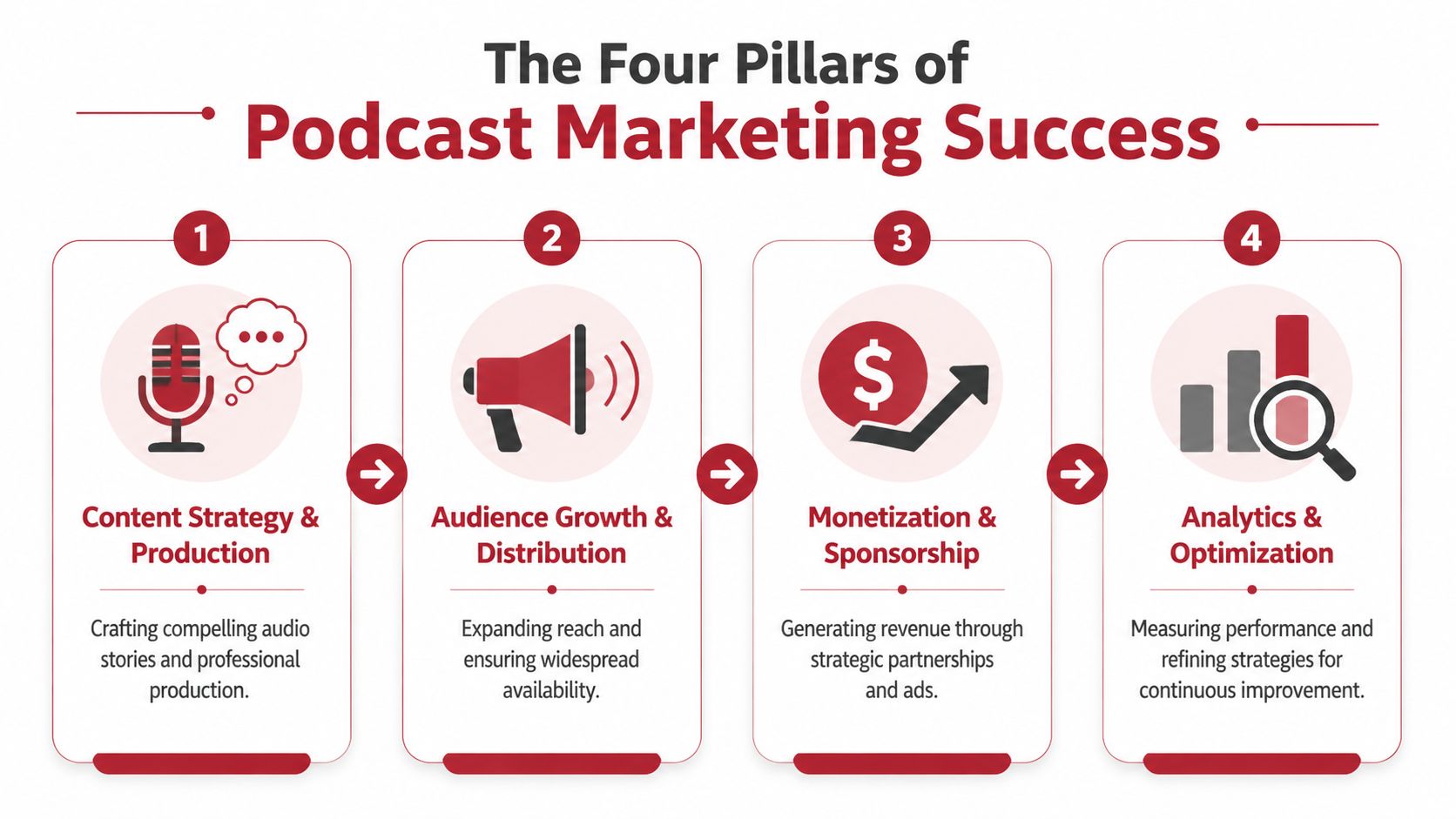
The strongest podcast marketing services are built on four connected pillars. If one pillar is weak, the whole system underperforms. Great production without distribution stalls. Great clips without strategy feel random. Great analytics without quality content can’t rescue the show.
Production that protects credibility
Founders often underestimate how quickly poor production erodes authority. Viewers notice bad lighting, harsh audio, weak pacing, and jumpy edits immediately. In B2B, that matters because the content reflects the business.
Strong production work includes show format planning, recording support, camera framing, sound treatment, audio editing, mastering, visual polish, and pacing decisions. For video podcasts, it also includes b-roll selection, branded graphics, and thumbnail direction.
This pillar isn’t about making the show look expensive. It’s about making the host look credible.
A reliable production workflow should answer these questions:
- How is the show recorded? Remote and in-studio setups need different controls.
- Who handles quality control? Somebody must catch technical issues before publishing.
- What gets standardized? Intros, outros, visual identity, and editorial tone should feel consistent.
- What gets customized? Guest framing, hooks, clips, and titles should fit each episode.
Distribution that matches listener behavior
Publishing everywhere isn’t a strategy. Publishing correctly is.
Podcast marketing services should manage syndication to major audio platforms, but that’s only the floor. The stronger play is aligning each episode with how people consume podcasts now. That includes platform-specific titles, descriptions, YouTube optimization, and episode packaging built for search and click-through.
A team that only uploads files is leaving reach on the table. A team that optimizes descriptions, chapters, thumbnails, metadata, and release cadence is treating distribution like performance work.
A podcast doesn’t grow because it was published. It grows because each platform gives the episode a reason to be discovered.
Repurposing that extends shelf life
Many agencies set themselves apart. One long-form recording should produce a stream of useful assets, not a single post.
Repurposing usually includes:
- Short-form video clips for YouTube Shorts, Instagram Reels, and TikTok
- Audiograms for audio-led promotion
- Quote graphics for LinkedIn and visual social posts
- Newsletter copy that turns an episode into an email touchpoint
- Blog or article adaptations for search and site retention
The most practical version of this is a content waterfall. One recording creates a long-form episode, then derivative assets optimized for different formats and attention spans. Teams comparing partners should pay close attention to how that workflow is handled. A useful benchmark is whether the agency has a clear system for content repurposing workflows, not just vague promises about posting clips.
Growth and monetization with intent
Audience growth and monetization are often treated like optional extras. They aren’t. They’re the reason the rest of the operation exists.
This pillar covers guest strategy, cross-promotion, platform testing, call-to-action design, sponsorship planning, and the structure behind lead capture. A show aimed at client acquisition needs a different CTA and follow-up path than a show aimed at donations or thought leadership.
The weak version of growth work sounds like “we’ll help promote the show.” The strong version answers harder questions. Which episodes should support direct response? Which clips belong on LinkedIn versus TikTok? Which guests can open business relationships? Which CTA belongs in the episode, the description, and the landing page?
How to Budget and Understand Pricing Models
Most buyers don’t struggle with the idea of investing in a podcast. They struggle with pricing because proposals often mix creative work, media operations, and strategy in one monthly number. That makes comparison hard.

The bigger issue is that many agencies still stop at production. They don’t build reporting around listener-to-client conversion, even though that’s the essential business question. As noted in Leverage with Media’s breakdown of podcast marketing services, many agencies lack frameworks for tracking listener-to-client conversion, which leaves founders with a polished show and weak visibility into outcomes.
Retainers versus project pricing
Podcast marketing services usually land in three pricing structures.
Monthly retainers work best when the show is ongoing and integrated into a broader marketing system. The agency can maintain release consistency, improve workflows, and optimize over time. This model also fits recurring deliverables like editing, publishing, repurposing, reporting, and platform management.
Per-project pricing works for launches, trailers, pilot episodes, rebrands, or one-time production sprints. It’s cleaner when the scope is fixed. It’s less effective when the business needs iteration, because there’s no built-in cadence for learning and adjustment.
Hybrid pricing combines a base retainer with one-off fees for bigger pushes, such as a launch campaign, a YouTube overhaul, a live event capture, or a deeper repurposing sprint.
A practical budgeting discussion also has to include software. If a team is comparing internal effort to external support, it helps to review categories like AI content repurposing pricing to understand where automation can lower labor on some post-production tasks while still leaving strategy, QA, and messaging decisions in human hands.
What a business case should include
A podcast budget shouldn’t start with “What does this cost?” It should start with “What role does this play in growth?”
A founder building a business case should define:
- Primary outcome such as qualified leads, donor conversations, thought leadership, or audience education
- Core distribution channels such as YouTube, Apple Podcasts, Spotify, LinkedIn, email, or short-form social
- Content reuse expectations including clips, articles, transcripts, and sales enablement assets
- Attribution plan covering promo codes, landing pages, pixel-based tools, and CRM visibility
- Internal lift required meaning who supplies guests, approvals, brand direction, and follow-up
This walkthrough helps frame the operational side of pricing:
A weak proposal focuses on outputs. Four episodes, eight clips, one thumbnail set. A strong proposal ties outputs to outcomes. It explains why the show exists, how the assets travel, what gets measured, and how the agency will adjust if results stall.
Buy based on process clarity, reporting discipline, and strategic fit. Cheap execution gets expensive when the show publishes for months without producing any useful movement.
Measuring Your Podcast's True ROI
Downloads have value, but they don’t answer the question a founder cares about. Did the show create action that mattered?
That’s why podcast ROI needs to be measured with the same seriousness as paid media or outbound campaigns. The tools exist. The challenge is that many teams still report the easiest metrics instead of the most useful ones.
Why downloads are not enough
A download count can tell a team that an episode was delivered. It can’t tell that team whether a listener visited a landing page, booked a call, redeemed an offer, or entered the sales pipeline.
That’s the trap. Vanity metrics make a show look active while the business stays blind. Better podcast marketing services move past surface reporting and build a chain of evidence from episode exposure to response.
The strongest strategies use dedicated landing pages, episode-specific calls to action, unique promo codes, and pixel-based attribution. Founders who want a more complete planning model should review a structured podcast marketing strategy before they lock in KPIs.
What to track instead
A practical measurement stack should focus on business movement, not just audience activity.
- Traffic by episode or campaign using dedicated URLs and landing pages
- Promo code redemptions tied to specific hosts, episodes, or offers
- Lead source data in the CRM so podcast influence doesn’t disappear after the click
- Conversion behavior after exposure using attribution tools that connect podcast impressions to downstream site visits and actions
One important benchmark here is that pixel-based attribution and custom promo codes are the core measurement tools for podcast ROI. The same source notes that Podscribe data showed 0.24% impressions-to-site-visits and 0.016% impression-to-conversion rates, which gives operators a starting point for evaluating direct response performance through proper tracking, according to Ad Results Media’s discussion of podcast attribution.
Why host-read conversions matter
Not all podcast ad formats perform the same. Host-read ads deliver direct-response ROAS of 3.4x to 5.1x, while programmatic ads deliver 1.8x to 2.4x, and the same dataset ties that advantage to tools like pixel-based attribution and the fact that 95% of listeners take action after hearing an ad, according to Digital Applied’s podcast advertising analysis.
That matters for service businesses because host-read ads feel like recommendations, not interruptions. They fit naturally into founder-led shows, expert interviews, and authority-driven content. A consultancy, nonprofit, or advisory firm doesn’t need mass-market ad inventory to benefit. It needs trusted messaging, a clean CTA, and a trackable follow-up path.
If an agency can’t explain how it will connect an episode, a CTA, and a business result, it isn’t measuring ROI. It’s reporting activity.
A Practical Checklist for Choosing Your Agency
Buying podcast marketing services without a checklist usually leads to a portfolio-driven decision. The show reels look polished, the thumbnails look sharp, and the sales call sounds smooth. That isn’t enough.
A better evaluation process tests whether the agency can operate as a business partner. The questions below help expose the difference between a vendor that ships files and a team that can support growth, reporting, and content optimization.
Podcast Agency Evaluation Checklist
| Evaluation Category | Key Questions to Ask |
|---|---|
| Strategy and onboarding | How does the agency define the show’s role in the business? What does onboarding require from the client? How are audience, positioning, and CTAs decided? |
| Production workflow | Who manages recording logistics, editing, revisions, and QA? What happens if an episode has technical issues? How is consistency maintained across episodes? |
| Repurposing and distribution strategy | How does one episode get transformed for YouTube, LinkedIn, email, and short-form platforms? Are titles, descriptions, thumbnails, and clips tailored by channel or reused without changes? |
| Reporting and KPIs | How does the agency measure ROI beyond downloads? What attribution methods are used? How often are results reviewed, and what gets changed when performance is weak? |
| Communication and responsiveness | Who is the day-to-day contact? What are turnaround expectations? How are approvals, deadlines, and feedback handled? |
| Fit with business model | Has the agency worked with founders, B2B teams, nonprofits, or thought leaders before? Do they understand the difference between authority building and entertainment content? |
A few answers matter more than the rest. If an agency can’t describe its repurposing workflow in plain language, that work probably isn’t mature. If it can’t talk confidently about attribution, the client will likely be left guessing about ROI.
Shortlists should also be judged by decision quality, not just capability.
- Choose strategic clarity over service sprawl. A smaller set of well-run services beats a bloated menu.
- Choose operational discipline over creative hype. Deadlines, review loops, and QC matter.
- Choose channel fluency over generic marketing language. Podcasting, YouTube, and short-form platforms don’t behave the same way.
Who Benefits Most and How to Apply These Services
Not every business needs the same kind of podcast. The format, CTA, guest strategy, and distribution model should match the operator behind it. That’s why podcast marketing services work best when they’re applied differently for different goals.
Entrepreneurs
For entrepreneurs, the podcast often functions as a personal brand engine. The host uses episodes to clarify ideas, build familiarity, and create repeated trust with future clients or collaborators.
A practical version looks like this. The founder records one strong interview or solo episode, then turns that conversation into clips for social, a newsletter insight, and a clean follow-up asset for sales conversations. The podcast isn’t the end product. It’s the source material for relationship-building content.
B2B firms
B2B teams benefit when the show is aligned with pipeline goals. Guest selection becomes strategic. Episode topics map to buyer pain points. Clips support account-based outreach, newsletters, and LinkedIn distribution.
This is also where ad and sponsorship strategy can become useful. Host-read ads hold a 62% market share, and 60% of listeners have purchased from a podcast ad, according to Grand View Research’s podcast advertising market report. For B2B firms, that matters because trusted host delivery turns authority into a more direct lead mechanism than generic display-style messaging.
Thought leaders
Authors, speakers, educators, and public-facing experts can use podcast marketing services to expand reach without constantly starting from zero. One recording session can support book promotion, event visibility, media outreach, and audience education at the same time.
The strongest setup usually combines a signature point of view with disciplined repurposing. A keynote idea becomes an episode. That episode becomes clips. Those clips support social proof, speaker booking pages, and ongoing audience touchpoints. Anyone comparing service partners in this space can borrow selection logic from adjacent creator industries, including this guide for choosing influencer agencies, because the same partner-evaluation issues show up: alignment, messaging fit, reporting, and relationship management.
The businesses that win with podcasting don’t ask, “How do we publish more?” They ask, “How do we make every episode support trust, distribution, and conversion?”
A founder who wants a show that does more than fill a content calendar can explore Get Up Productions for turnkey video podcast production, YouTube optimization, and repurposing systems built to turn episodes into authority-building assets.