
Organizations often don't have a video problem. They have a system problem.
A founder records a few clips when launch season gets hectic. A marketing manager posts a Reel because the team feels pressure to stay visible. Someone suggests YouTube, then someone else says the brand needs a podcast, then the calendar fills with disconnected video ideas that all need scripting, shooting, editing, captions, thumbnails, and approvals. A month later, the team has published a lot and learned very little.
That approach breaks because video is no longer optional background activity. By 2025, Wyzowl reported that 89% of businesses use video marketing, while 95% say video is important to their strategy. Global digital video advertising spending exceeded $191.4 billion in 2024, according to data cited by Wix in its roundup of video marketing statistics. The pressure to publish is real, but chasing volume without a structure usually produces burnout, not momentum.
A stronger video marketing strategy starts with one durable asset. A show. For many brands, that means a long-form video podcast or recurring expert-led episode that can be turned into clips, quotes, shorts, and supporting written content. Instead of inventing content from scratch every week, the team builds once and distributes many times. Teams exploring that repurposing model often look at resources like BlitzReels for video creators to map out how one recording can feed multiple channels. For brands that want a broader framework around this kind of system, Get Up Productions' media and marketing approach outlines how show-led production connects recording, editing, and distribution.
Table of Contents
- Escaping the Content Treadmill with a Real Strategy
- Define Your Strategy Foundation and Goals
- Design Your Pillar Content Show
- Create Your Content Waterfall Production System
- Implement Your Multi-Platform Distribution Plan
- Measure What Matters and Scale Your Impact
Escaping the Content Treadmill with a Real Strategy
The content treadmill usually starts with good intentions. A team wants more reach, more authority, and more consistency, so it tries to publish everywhere. The result is familiar. One-off clips pile up, each one requiring a fresh idea, a separate production effort, and a new round of approvals. Nothing connects. Nothing compounds.
A show-based video marketing strategy fixes that by changing the unit of work. Instead of treating every post as an isolated task, the team treats one long-form recording as the source material for the entire content cycle. That pillar episode carries the core substance: the teaching, the story, the guest insight, the positioning, the proof. Everything else comes from that core.
Practical rule: If a team has to reinvent its message every time it opens a camera app, it doesn't have a strategy. It has a posting habit.
This model works especially well for founders, consultants, nonprofits, educators, and brands with expertise that can't be explained in ten seconds. A long-form show gives space for depth. It also creates an archive. Each episode becomes a reusable business asset that sales teams can share, marketing teams can clip, and audiences can discover later.
The biggest trade-off is commitment. A show demands editorial discipline. Topics need to fit a clear mission. Guests need preparation. Recording days need consistency. But that trade-off is better than the chaos of producing dozens of unrelated videos that never build toward anything larger.
Define Your Strategy Foundation and Goals
A workable video marketing strategy doesn't begin with cameras, lighting, or clip templates. It begins with a business decision. What should the video system do?
Start with the business outcome
Many teams say they want "more visibility." That isn't specific enough to guide production. A stronger starting point sounds like this:
- Lead generation: Attract the right prospects and move them toward a call, form, or consultation.
- Customer education: Reduce confusion and answer recurring questions before support or sales needs to.
- Authority building: Establish a recognizable point of view in a niche where trust matters.
- Community growth: Give existing followers a reason to return, respond, and share.
Each outcome creates different creative choices. A lead-generation show needs strong topic relevance and clear calls to action. An authority-building show needs sharper editorial positioning. A customer education series may work better with tutorials and demonstrations than interviews.
A lot of teams still default to views as the primary scorecard, but the market is moving away from that. According to Wistia's 2026 State of Video Report, social engagement is the fastest-rising video success metric and became the top KPI for nearly a quarter of marketers, which Wistia highlights in its video marketing statistics report. That shift matters because it rewards resonance, not just distribution.
Build around a real audience problem
Audience definition gets weak when it stays demographic. "Small business owners" is too broad. "Marketing directors at midsized B2B firms who need to prove content ROI to leadership" is useful. Good strategy gets closer to the problem than to the profile.
A practical audience outline should answer these questions:
- What triggers their search for content? A stalled pipeline, an upcoming launch, a need to explain a complex offer.
- What are they trying to understand? Process, risk, timelines, expectations, mistakes, terminology.
- What would make them trust the host? Experience, clarity, consistency, calm decision-making, strong interviews.
- What format can they realistically consume? A full episode during focused work, short clips on mobile, or both.
Teams that need help clarifying this layer often benefit from grounding their planning in target-market work before production starts. Why target market definition matters is a useful reference for tightening the connection between message and audience.
A broad audience creates broad content. Broad content usually gets polite attention and weak results.
Choose KPIs that show movement
Once the business objective and audience are clear, the KPI stack gets easier. One useful method is to assign one primary business KPI and a few supporting video metrics.
| Business objective | Primary KPI | Supporting video signals |
|---|---|---|
| Lead generation | Qualified inquiries or demo requests | Click-through rate, watch time on key episodes, form completion after video exposure |
| Education | Viewer retention on instructional segments | Repeat views, completion of tutorial sections, follow-up questions |
| Authority | Engagement quality | Comments, shares, saves, direct replies, invitations sparked by content |
| Community | Returning viewers and conversation | Social engagement, episode discussion, subscriber behavior |
Many teams overcomplicate things. They build giant dashboards before they know what decisions those dashboards should support. A simpler rule works better: track only the metrics that can change the next editorial or distribution decision.
Design Your Pillar Content Show
A pillar show isn't just a content format. It's a positioning device. It tells the audience what kind of expertise the brand offers, how it thinks, and why it's worth returning for more.
Why a show beats scattered one-off videos
One-off videos can work for campaigns, announcements, and specific launches. They usually fail as the foundation of an ongoing video marketing strategy because they don't create expectation. The audience never knows what is coming next, why it belongs with the last post, or what the brand stands for over time.
A show solves that. It creates recurring structure and recurring meaning. Nielsen guidance referenced by Infinity Marketing notes that marketers should use a full-funnel measurement approach because video influences multiple stages of the buyer journey, as discussed in this piece on video marketing strategy tips. That supports the pillar-show model because a recurring series can be measured across awareness, consideration, and conversion more clearly than random clips can.
Long-form also gives teams more strategic flexibility. A single episode can serve search, nurture, social clipping, internal enablement, and website embedding. A short standalone clip usually gets one chance on one platform.
Pick a format you can sustain
Most brands don't need a flashy format. They need one they can repeat without friction.
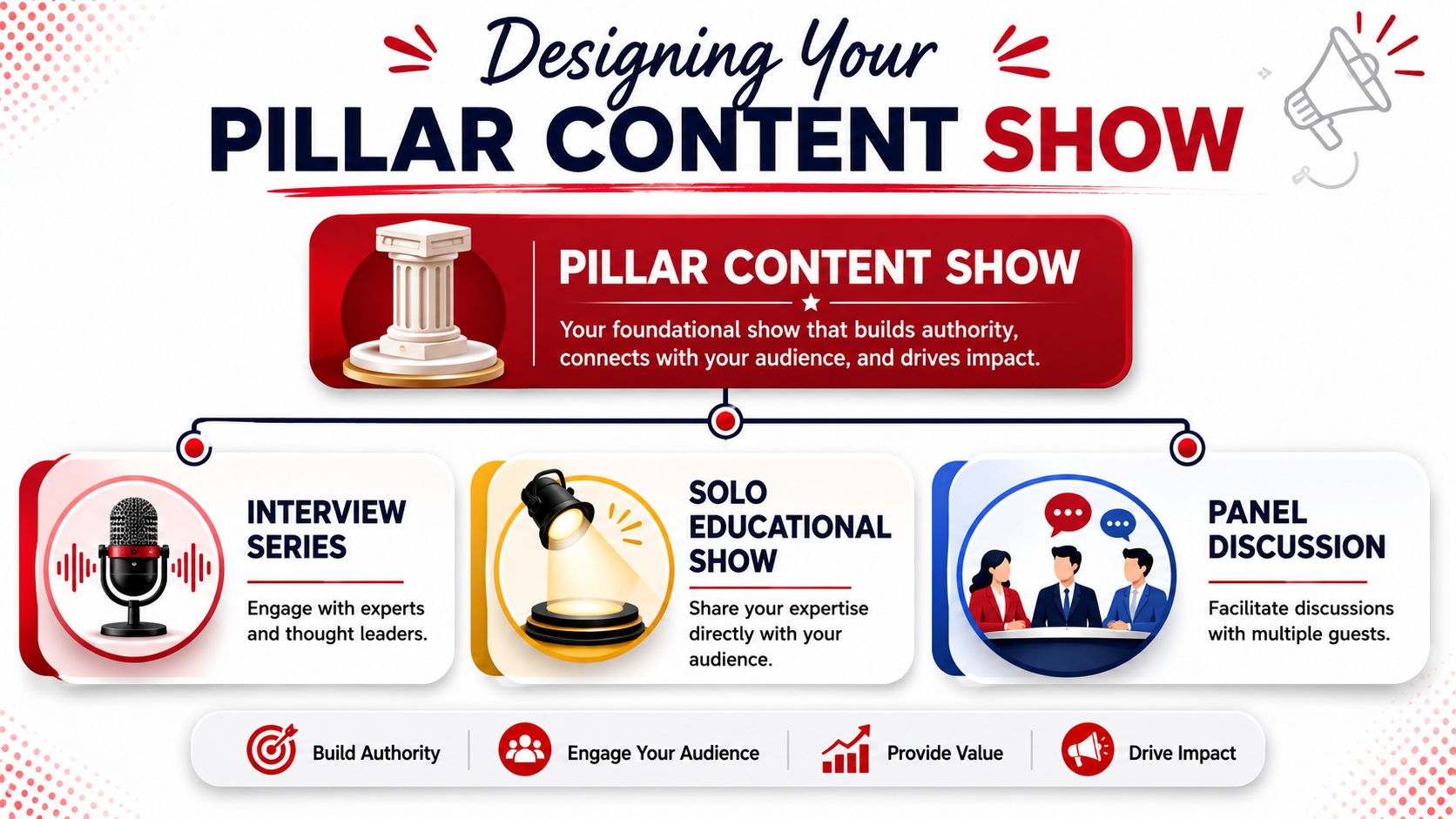
Three common options work well:
- Interview series works when the host can draw out insight, challenge assumptions, and attract credible guests.
- Solo educational show works when the brand has a clear teaching voice and a repeatable method to explain.
- Panel discussion works when multiple perspectives are part of the value, especially in industries with nuanced decisions.
The wrong choice is the format that looks impressive but collapses under production load. A heavily scripted show with multiple cameras, custom sets, and frequent travel may look appealing on paper. If the team can't maintain it, consistency disappears fast.
Document the concept before recording
A documented show concept prevents drift. It doesn't need to be fancy. It needs to be clear.
A solid show brief includes:
- Mission: What recurring problem does the show solve?
- Ideal viewer: Who should feel that each episode was made for them?
- Promise: What kind of value will every episode deliver?
- Structure: Opening hook, main discussion beats, closing CTA.
- Voice: Conversational, analytical, pastoral, direct, technical, or story-led.
- Clip potential: Which recurring segments are likely to produce strong repurposed moments?
The strongest shows don't try to cover everything. They become known for covering one category unusually well.
That focus is what turns a recording schedule into an asset library instead of a folder full of disconnected footage.
Create Your Content Waterfall Production System
The show gives the strategy a center. The waterfall gives it output.
Record with repurposing already planned
Most repurposing problems start before editing. They start in the recording itself.
If the host rambles through long intros, buries the main insight halfway through the conversation, or never lands a clear statement, the editor has very little to clip. A better production system records with extraction in mind. That means cleaner segment transitions, stronger hooks, tighter questions, and deliberate moments that can stand alone on social.
Audio quality matters more than teams often admit. Viewers forgive simple visuals faster than they forgive unclear sound. The same goes for lighting. It doesn't need to look cinematic, but it does need to look intentional. Stable framing, controlled room echo, and a clean background make the final content easier to trust and easier to reuse.
Teams using AI inside this workflow should use it selectively. HubSpot's 2025 video marketing reporting, as cited by SundaySky, shows short-form video remains a top investment while differentiation gets harder as AI reduces the cost of creating more clips. That is why a human-led pillar show matters. The SundaySky article on video marketing strategy frames AI as an accelerator for repurposing, not a substitute for a distinctive voice.
For teams designing that workflow, Get Up Productions' content repurposing strategy is one example of how a single episode can be turned into platform-specific assets without rebuilding the message from scratch.
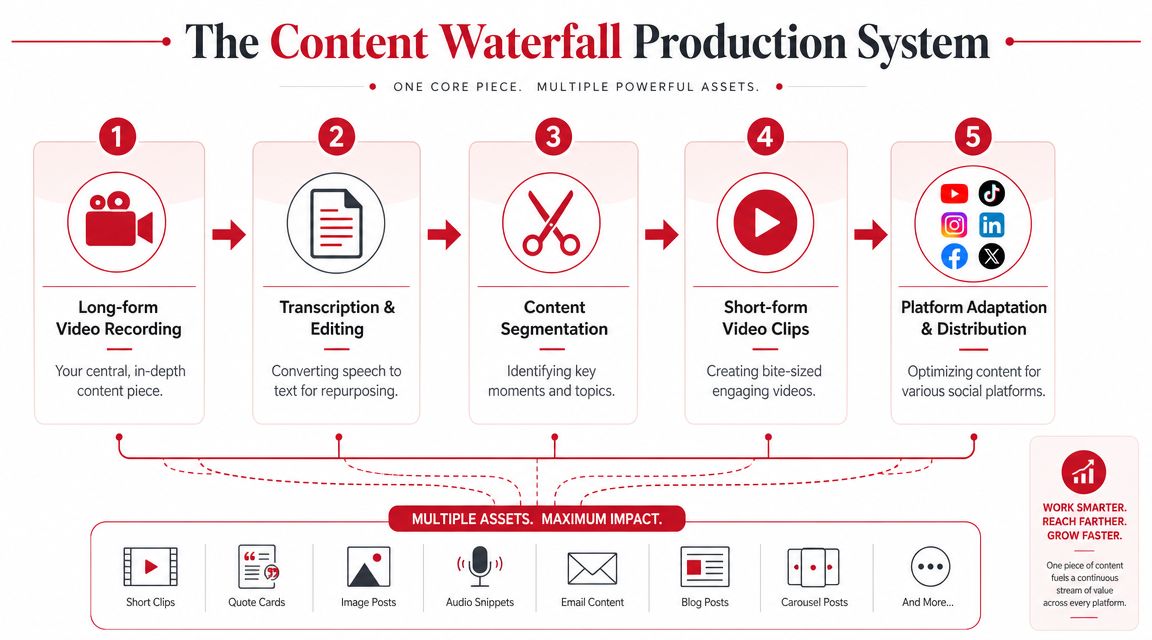
Build the waterfall in stages
A reliable waterfall has clear production phases. It shouldn't depend on someone feeling inspired after the full episode goes live.
Capture the pillar episode
Record the long-form conversation or teaching session with a clear run of show. Plan opening hooks, recurring questions, and segment breaks.Create the master edit
Produce the full version for YouTube, the website, or the primary archive channel. This is the flagship asset, not an afterthought.
A useful production walkthrough appears below.
Transcribe and mark moments
Pull the transcript and identify passages that work as standalone ideas. Look for tension, clarity, surprise, specificity, and quotable phrasing.Cut short-form clips by purpose
Some clips should spark attention. Others should teach one practical point. Others should drive viewers back to the full episode or a landing page.Adapt for each platform
Change framing, captions, opening text, and CTA based on where the clip will run.Package support assets
Pull quote graphics, episode summaries, title options, email copy, and thumbnail variations from the same source material.
Lightweight AI tools can save time if they stay inside a real editorial process. Teams testing idea generation or app-assisted production may look at tools like LunaBloom AI generator for workflow experimentation, but the judgment about what deserves publishing still needs a human editor or strategist.
Editorial filter: Repurposing isn't slicing a video into equal parts. It's selecting the moments that can carry meaning without the rest of the conversation.
Sample Weekly Production Timeline for one episode
| Day | Task | Owner |
|---|---|---|
| Monday | Finalize topic, outline, guest prep, recording notes | Strategist or producer |
| Tuesday | Record pillar episode | Host and production team |
| Wednesday | Edit full episode, clean audio, add branding elements | Editor |
| Thursday | Review full episode, pull transcript highlights, identify clip candidates | Producer and strategist |
| Friday | Edit short-form clips, write captions, prepare thumbnails and scheduling assets | Social editor or content team |
This kind of schedule works because each task has a handoff. Without ownership, a waterfall turns into a pileup. With ownership, one recording can support an entire week or longer of distribution.
Implement Your Multi-Platform Distribution Plan
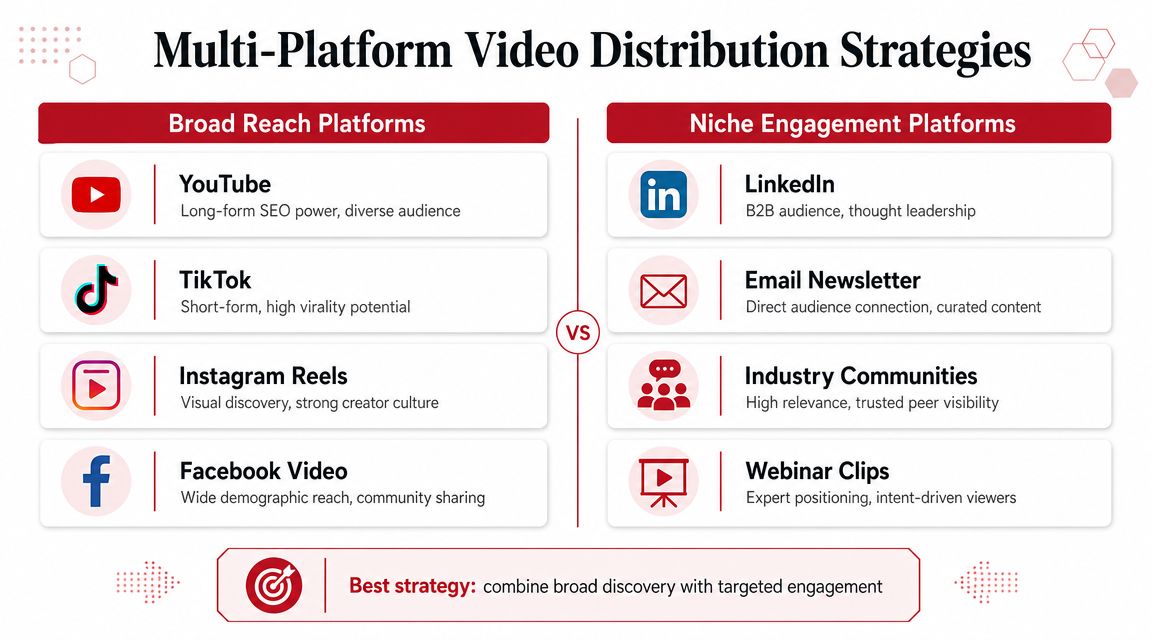
Distribution isn't cross-posting by default. It is matching the same core idea to different viewer expectations.
How the same clip should change by platform
A strong clip on YouTube Shorts may need only minor adaptation for Instagram Reels, but "minor" still matters. The hook text, pacing, caption density, and call to action should reflect platform behavior.
| Platform | What viewers usually want | Best use of the clip | What to change |
|---|---|---|---|
| YouTube Shorts | Quick insight tied to a searchable topic | Discovery and pathway to the full episode | Use a title and on-screen language that matches a clear problem |
| Instagram Reels | Fast relevance and strong visual pacing | Reach, shares, saves, and brand familiarity | Tighten the opening and make captions easy to scan without sound |
| TikTok | Native-feeling commentary or sharp opinion | Attention and topical conversation | Lead with the strongest line first and avoid over-produced packaging |
| LinkedIn video | Professional relevance and practical takeaways | Thought leadership and relationship building | Add context in the post copy and frame the clip around a business issue |
The mistake is uploading the exact same asset everywhere and expecting each platform to do the same job. They won't. One clip can have the same message and still need different packaging.
Build a lightweight distribution matrix
Organizations need fewer channels and better adaptation, not more channels and more chaos. A simple matrix helps.
- Primary home: Publish the full episode where long-form discovery and archive value matter most.
- Short-form reach channels: Use clips to attract new viewers and test which hooks create attention.
- Relationship channels: Use email, community posts, and professional networks to deepen context around the same episode.
- Conversion destinations: Drive qualified viewers toward a landing page, booking page, or key resource.
A Facebook distribution plan can also fit inside this system when a team wants to extend YouTube-led content into another owned social environment. For teams working through that workflow, Narrareach's Facebook video strategy offers practical considerations around sharing and adapting video across platforms.
Good distribution doesn't ask, "Where else can this be posted?" It asks, "Where will this specific version make sense to the person seeing it?"
That question keeps the strategy audience-first instead of calendar-first.
Measure What Matters and Scale Your Impact
Video becomes a growth system when the team can explain what happened, why it happened, and what should change next.
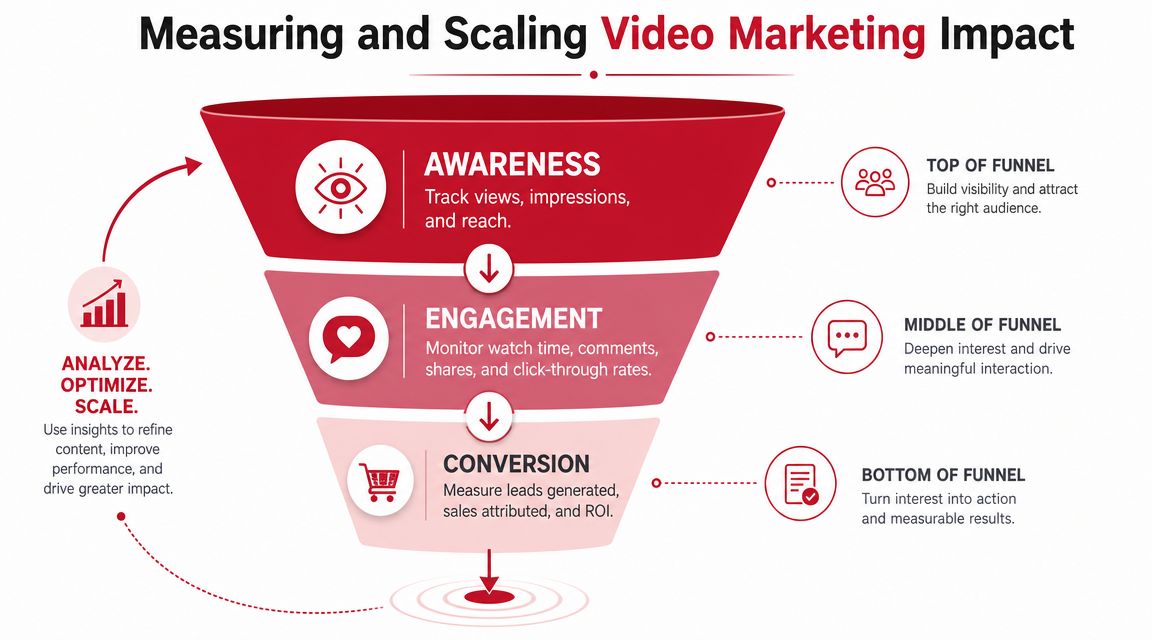
Use a three-stage measurement funnel
Adobe's guidance recommends building a measurement stack as a funnel, using impressions for awareness, watch time for consideration, and CTR for conversion. Adobe also warns that views alone tell you almost nothing about business impact. That is the right frame for a serious video marketing strategy.
A practical funnel looks like this:
Awareness
Track impressions, reach, and play rate. This shows whether the packaging and topic are earning initial attention.Consideration
Track watch time, average view duration, retention curves, comments, and meaningful engagement. This shows whether the content is holding attention and building interest.Conversion
Track click-through behavior from the player or post, then tie that traffic to form fills, demo requests, purchases, or other business actions in analytics.
This is also where attribution discipline matters. Platform dashboards tell part of the story. They rarely tell the whole revenue story. Teams need event-based analytics that connect video exposure to downstream actions.
Read the data like a strategist
The useful question isn't whether a clip "performed." The useful question is what the pattern suggests.
If awareness is strong but watch time falls fast, the hook is working and the delivery isn't. If watch time is healthy but clicks are weak, the content may be valuable but the CTA is vague or mistimed. If full episodes hold attention better than expected while short clips get surface engagement, that often signals a brand with deeper trust potential than its social strategy assumes.
A few diagnostic habits help:
- Compare hook types: Which openings keep attention longer?
- Track recurring topics: Which themes repeatedly create replies, saves, or follow-up questions?
- Separate format from subject: Was the result caused by the clip style, the guest, the topic, or the CTA?
- Look for downstream behavior: Which episodes get shared by sales, referenced in calls, or used in nurture flows?
The scale decision should come after those patterns become clear. More production only helps when the system already knows what deserves repeating.
Brands that want a show-led video marketing strategy often need more than editing. They need recording support, a repeatable content waterfall, and a team that can turn one episode into assets built for YouTube, Shorts, Reels, and conversion-focused distribution. Get Up Productions provides that kind of podcast and video production support for organizations that want a sustainable content engine instead of a constant scramble for the next post.