
A lot of Augusta businesses are doing the work and still getting weak results. The posts go out. A Reel gets a few likes. A Facebook update reaches existing followers. Then nothing happens that matters to the business. No qualified inquiry. No booked call. No donor conversation. No clear sign that the time spent creating content is turning into revenue or momentum.
That usually isn't a posting problem. It's a systems problem.
Strong social media marketing in Augusta starts when a business stops treating social as a stream of isolated posts and starts treating it like a publishing operation tied to a funnel. That matters because social isn't a side channel anymore. There are more than 5.22 billion global social media users in 2024, social ads account for 28.8% of digital advertising spend, and spending is projected to exceed $345 billion by 2029, according to DSMN8's social media marketing statistics. For local brands, that means audience attention is already there, and the competition is more professional than many owners assume.
Podcasting is one of the cleanest starting points for that system. One good conversation can produce video clips, quote posts, audiograms, show notes, email copy, and website content. That's a better use of time than chasing daily ideas from scratch.
Table of Contents
- Why Your Social Media Efforts Are Falling Flat in Augusta
- Choosing the Right Platforms for Your Augusta Audience
- The Content Waterfall A System for Endless Social Media
- Setting Goals That Move the Needle for Your Business
- Your 30-Day Social Media Starter Plan
- Hiring Help What to Expect from Augusta Agencies
- Conclusion Build Your System Not Just Your Social Feed
Why Your Social Media Efforts Are Falling Flat in Augusta
A common Augusta scenario looks like this. A business posts three or four times a week, stays active around local events, gets a handful of likes, and still sees no clear lift in calls, form fills, bookings, or donations. The problem usually is not effort. The problem is that the content never forms a usable path from attention to inquiry.
That gap shows up everywhere. Service businesses post polished graphics with no offer. Nonprofits share event photos without a follow-up ask. Founders record useful videos, but never turn that attention into email signups, discovery calls, or sales conversations. The feed stays busy. Revenue stays unchanged.
The issue is often fragmented execution
A business can have a solid offer, a recognizable brand, and decent posting habits and still get weak results. Social breaks down when each post stands alone and nothing points people toward a next step. Augusta teams run into this constantly because social often gets treated as a visibility task instead of a lead generation system.
In practice, that means good content sends people into a dead end. They click through to an outdated site, a vague bio link, or a homepage that does not match the post they just saw. If the destination is weak, social traffic loses value fast. That is why I usually review the website and conversion path before I recommend posting more often. For businesses that need that foundation fixed, Augusta web design support for lead-focused local sites can help connect social activity to a real business outcome.
A simple rule helps here.
Practical rule: If a post gets attention but gives people no clear next action, it is publishing activity, not marketing.
Feed pressure is also higher now because video is standard on every major platform. Local brands are not only competing with other Augusta businesses. They are competing with creators, franchises, and national companies that publish constantly. Passive posting rarely holds up in that environment. A stronger starting point is a recorded conversation, usually a podcast or interview-style episode, that can be cut into clips, quotes, short posts, email content, and landing-page assets tied to one offer.
Generic tips help, but they do not fix the core problem
Day-to-day advice still has value. These social media marketing tips for small businesses are useful for improving consistency, captions, and posting workflow.
But local results usually come from structure, not from isolated tips. Augusta businesses that get measurable return from social tend to have three things in place:
- A defined buyer path: They know what action they want from each audience segment.
- A repeatable content source: They record one strong piece of core content instead of inventing every post from scratch.
- A tracking habit: They measure inquiries, booked calls, registrations, and sales, not just reach and reactions.
That is why random posting underperforms. Social media marketing Augusta businesses can count on usually starts when content is built around a system. Podcasting works well for that because one recording session can produce weeks of platform-native content while also building trust with local audiences who want substance before they contact you.
Choosing the Right Platforms for Your Augusta Audience
Most platform decisions get made backward. A business owner prefers Instagram, so the whole strategy becomes Instagram. A consultant sees other people on LinkedIn, so everything shifts there. That approach feels efficient, but it usually ignores where the actual audience pays attention.
Local strategy gets sharper when the audience is defined by community, role, and intent. Augusta content often misses this niche layer. Existing local coverage tends to stay broad, even though Seoteric's Augusta social media marketing page points to the need to identify content gaps and focus on strategic fit for specific audiences rather than relying on volume alone.
Start with audience behavior, not platform features
A church, a healthcare consultant, and a founder building a personal brand shouldn't run the same social plan.
Fort Eisenhower and military-connected families often respond to practical, community-centered content. Local events, family resources, schooling information, service updates, and trusted recommendations tend to perform better than abstract branding. For that audience, Facebook often stays useful, while Instagram can support short-form visibility and community storytelling.
B2B firms in Augusta usually need a different mix. Buyers in that category often want proof of expertise before they book anything. LinkedIn is usually the primary channel because it lets the business publish insights, clips from expert interviews, short commentary, and thought leadership tied to real business problems. A secondary platform like YouTube Shorts or Instagram Reels can support reach, but it shouldn't replace a trust-building hub.
For nonprofits and spiritual leaders, the mistake is often copying creator trends that don't match the mission. Those organizations usually need a blend of testimony, education, event promotion, and clear calls to action. Social should support relationship depth, not just attention.
A platform is only “right” if it fits how the audience already discovers, evaluates, and responds to information.
Social Platform Focus for Augusta Niches
| Audience Niche | Primary Platform | Secondary Platform | Content Focus |
|---|---|---|---|
| Churches and spiritual leaders | Sermon clips, event reminders, testimonies, short teaching moments | ||
| Nonprofits and community organizations | Mission stories, volunteer spotlights, donor education, local impact updates | ||
| B2B consultants and service firms | YouTube Shorts | Expert commentary, FAQ clips, trust-building insights, client problem breakdowns | |
| Founders and personal brands | Point-of-view content, podcast clips, behind-the-scenes thinking, authority posts | ||
| Local lifestyle and consumer brands | Product demos, staff personality, customer stories, local culture content | ||
| Healthcare-adjacent professionals | Educational content, credibility signals, community information, myth-busting |
This table isn't a rigid rulebook. It's a filter. Most Augusta businesses don't need to be everywhere. They need one platform where trust is built and one platform where reach can expand.
A useful test is simple:
- Choose primary based on trust: Where would a serious buyer or supporter look before taking action?
- Choose secondary based on discoverability: Where can short-form content introduce the brand to new people?
- Ignore platform pressure: If a network doesn't fit the audience or the team can't produce native content for it, skip it.
That restraint matters. A narrow strategy executed well will outperform broad, inconsistent posting almost every time.
The Content Waterfall A System for Endless Social Media
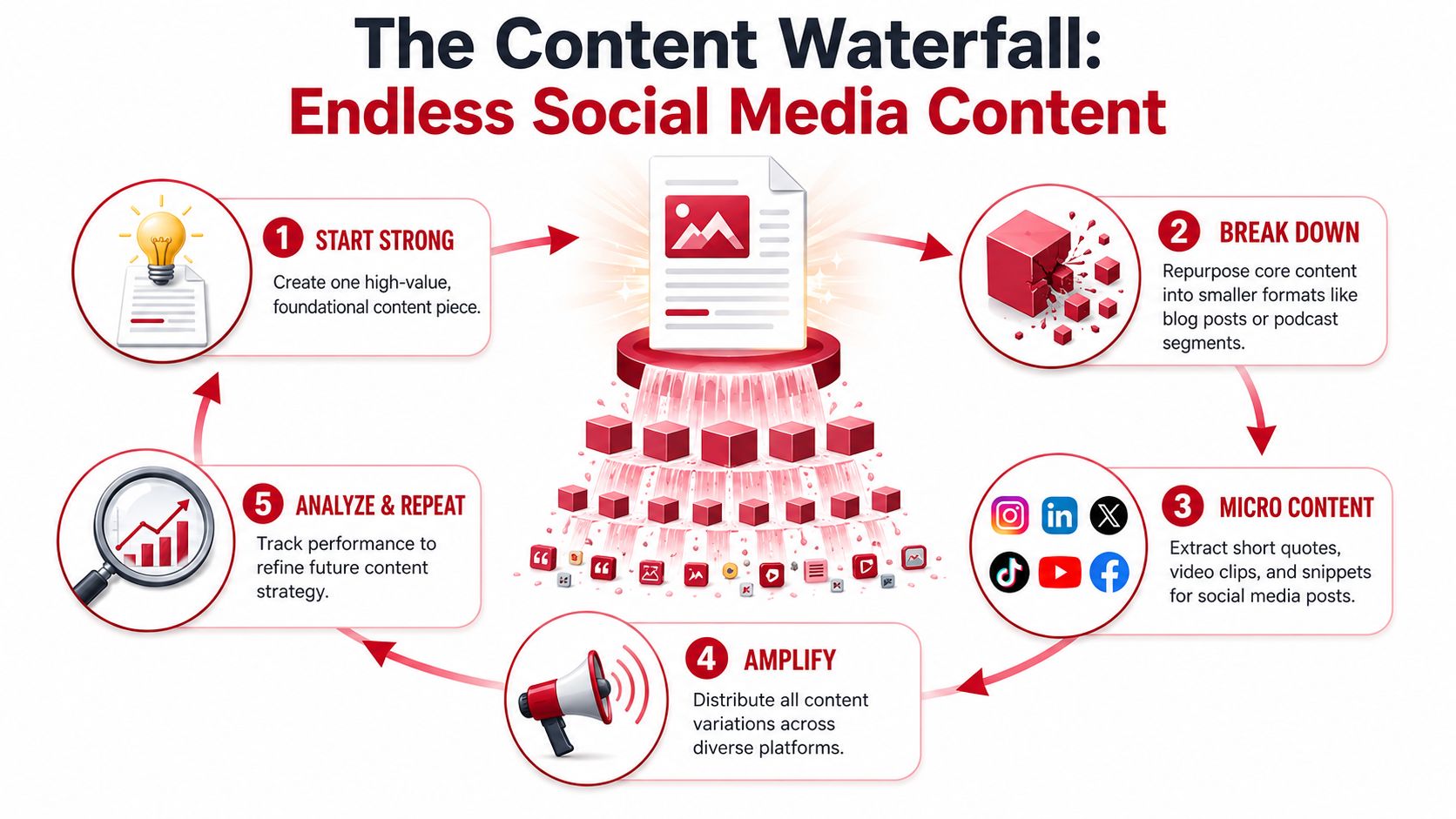
The easiest way to burn out a marketing team is to ask for original content every day. That creates pressure, lowers quality, and leads to repetitive posts that sound thin. A better model starts with one strong source asset and turns it into many smaller pieces.
Augusta Technical College's digital marketing training emphasizes integrating social, content, SEO, and funnel strategy, which supports repurposing one long-form asset into clips, quotes, audiograms, and related pieces across channels, as described in its digital marketing strategist program.
A visual model helps make that process easier to operationalize.
One recording session should feed the whole week
A podcast works well as the top of the waterfall because it naturally produces depth. A single episode can answer real buyer questions, surface the host's expertise, and create enough raw material for multiple formats without sounding forced.
That's why podcast-led social media marketing Augusta brands use can be more efficient than trying to invent separate content for every network.
A practical waterfall often looks like this:
Record one pillar conversation
Use a podcast episode, founder interview, panel discussion, or teaching session as the source material.Pull short clips from strong moments
Look for tension, clarity, disagreement, a sharp opinion, or a useful answer. Those moments usually make the best vertical video.Turn insights into static content
A sharp sentence becomes a quote graphic. A recurring question becomes a carousel. A clean argument becomes a text post.Publish a search-friendly home base
Show notes, a blog post, or a landing page gives the content a place to live outside the feed.Distribute with intent
Each asset should send people toward one next step, not just fill the calendar.
For teams trying to streamline the production side, this guide to optimizing creator workflow is useful because it focuses on workflow discipline instead of just platform hacks.
How the waterfall works in practice
The repurposing process needs structure. Otherwise, teams create assets that feel disconnected from one another. A cleaner setup is to tag every asset by topic, audience, format, and funnel stage. That's how a clip becomes part of a system instead of a one-off post.
A service page on content repurposing strategy gives a concrete example of this model. One recorded episode can be cut into short-form social video, audiograms, quote assets, and supporting content built for different channels.
This is what that looks like in execution:
- Discovery layer: Short clips for Instagram Reels, YouTube Shorts, or LinkedIn video
- Consideration layer: Carousel posts, quote graphics, email follow-up, short commentary posts
- Conversion layer: Show-note page, booking page, lead magnet, donor page, or event registration
A lot of teams skip the middle layer. They publish top-of-funnel clips, then ask for the sale too early. The audience may notice the brand, but it hasn't built enough trust yet.
This embedded example shows the broader idea of turning expertise into a media engine:
When one asset is planned as a source, not a finished product, social stops feeling endless and starts feeling manageable.
The waterfall works because it reduces creative waste. Instead of asking for ten unrelated posts, the team asks one better question: what single piece of content is worth breaking apart this week?
Setting Goals That Move the Needle for Your Business
Most social reporting is too shallow to guide decisions. The dashboard says reach is up, views are holding, and engagement looks fine. Then leadership asks the core question. Did any of this create business value?
That question should shape the whole plan.
Augusta Technical College's curriculum includes dashboards and analytics as core social media marketing practice, which reinforces that social should be managed as a measurable discipline rather than casual posting, according to the Augusta Technical College catalog.
Build goals from the bottom up
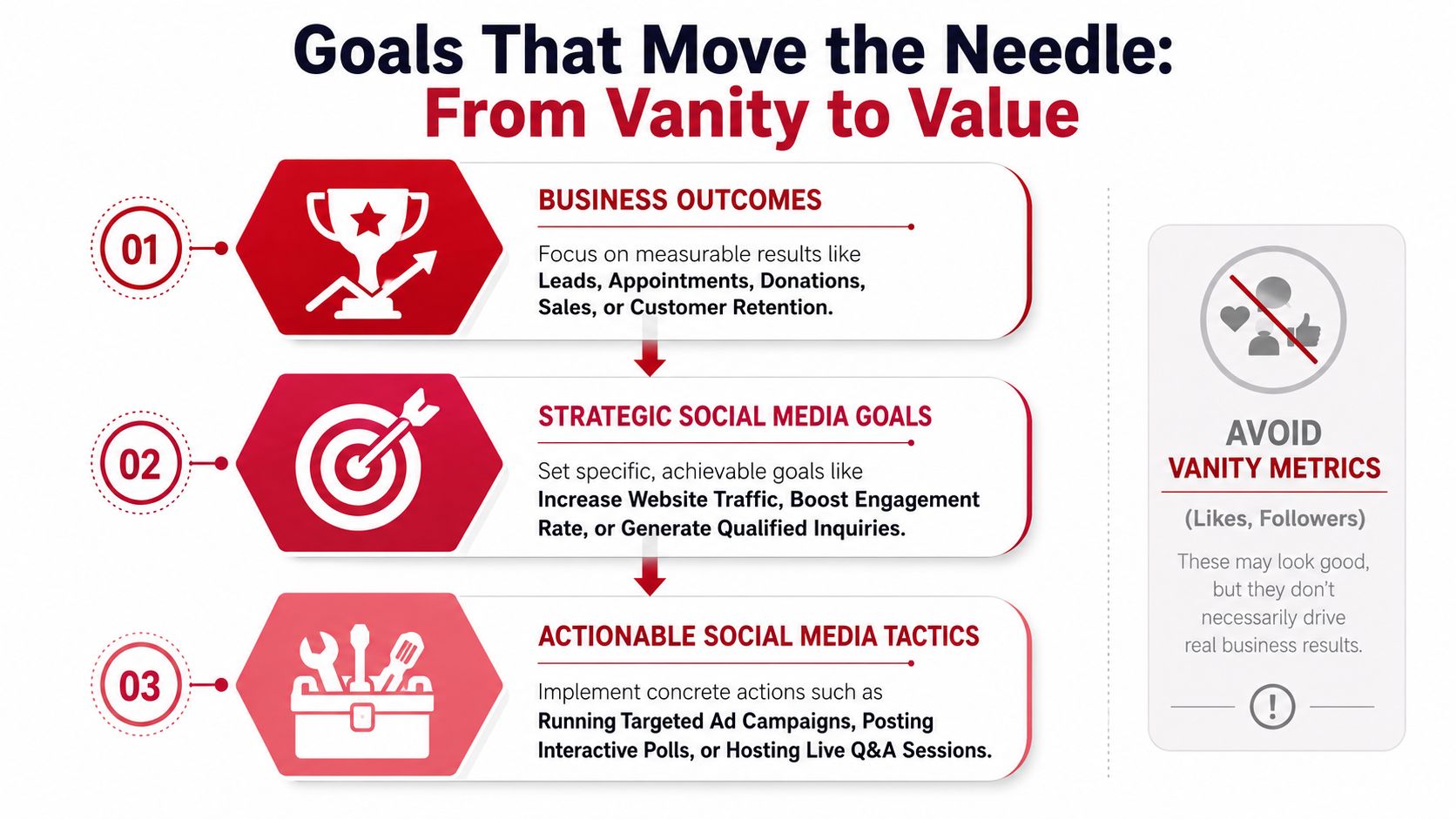
A business should start with the outcome it cares about most. For some Augusta companies, that's booked consultations. For a nonprofit, it may be volunteer interest or donor conversations. For a founder-led brand, it may be speaking inquiries or email subscribers.
Once that outcome is clear, social goals become easier to set.
A simple chain looks like this:
- Business outcome: booked calls, applications, donations, registrations, purchases
- Strategic goal: more qualified site visits, stronger inquiry volume, better repeat engagement
- Content action: publish clips, answer objections, highlight expertise, drive visits to a landing page
That order matters. This is often done backward. They start with content ideas, then hope those ideas produce business value later.
A simple measurement stack
An ROI-focused setup doesn't need to be complicated, but it does need to be consistent.
- Use native analytics: Review watch time, saves, shares, click activity, and profile actions inside each platform.
- Tag links with UTM parameters: That makes it easier to separate traffic from Instagram, LinkedIn, Facebook, email, and specific campaigns.
- Define conversion points clearly: A booked call, donation form completion, contact form submit, and event registration should each have a distinct destination.
- Match content to funnel stage: A clip designed for awareness shouldn't be judged by the same standard as a landing-page post built to drive action.
Working standard: If the team can't tell which post or clip contributed to a qualified inquiry, the reporting setup is incomplete.
Some teams need help translating broad ambitions into actual targets. This piece on EvergreenFeed for social media success is useful because it frames goal-setting around outcomes instead of vanity metrics.
One caution matters here. Likes and follower growth aren't useless, but they're supporting indicators. They only matter if they contribute to a larger path. If they don't, they can distract a business from what social was supposed to do in the first place.
Your 30-Day Social Media Starter Plan
A workable plan needs to be small enough to execute and structured enough to learn from. Many Augusta businesses already hear advice about consistency and posting cadence, but local guidance often stops there. That's part of the gap identified on Be U Social Media Marketing's Augusta page, where broad frequency advice appears more often than ROI mapping.
The first month should build a system, not a huge content library.
Week one and two
Week 1 focuses on audience and channel selection.
Choose one primary audience. Not “everyone in Augusta.” A tighter group. Military families, local contractors, nonprofit donors, B2B decision-makers, or faith-based community members. Then choose one primary platform and one secondary platform based on how that audience evaluates trust.
Week 2 is topic planning.
Build four pillar topics that connect directly to the business outcome. A consultant might cover common buyer mistakes, implementation myths, hidden costs, and case-based lessons. A nonprofit might focus on mission stories, volunteer questions, community needs, and supporter education.
Use this filter for every topic:
- Problem relevance: Does this address a real question the audience already has?
- Authority potential: Can the team speak on this with clarity and firsthand expertise?
- Repurposing value: Will this topic produce clips, quotes, carousels, and written content?
Week three and four
Week 3 is production.
Record the first pillar asset. A podcast episode works well because it creates long-form depth and natural soundbites. Keep the conversation focused on one problem, one audience, and one outcome. Don't try to cram every service or idea into the same recording.
Week 4 is distribution and tracking.
Cut the episode into native assets and publish them with purpose. One clip may drive profile visits. Another may answer objections. A quote post may support trust. A show-note page or landing page should capture the traffic.
A strong starter month usually includes:
- One pillar asset: Podcast episode, interview, or expert conversation
- Several short clips: Each focused on one clear takeaway
- A written conversion asset: Landing page, article, or show notes
- A reporting habit: Check link traffic, inquiries, and platform response weekly
This plan works because it proves whether the business can sustain the process. If the team can produce one strong pillar asset and repurpose it well, scale becomes realistic. If it can't, posting more won't solve the problem.
Hiring Help What to Expect from Augusta Agencies
A common Augusta scenario looks like this. The owner records a few videos, someone in the office tries to turn them into posts, then the whole effort stalls once client work gets busy. Social does not fail because the business lacks ideas. It fails because nobody owns strategy, production, distribution, and reporting at the same time.
That is usually the point where outside help makes sense.
Augusta University's Certified Social Media Manager program points to labor-market demand for this role, and it cites salary data showing the average Digital Marketing Manager in Augusta, GA earns $106,677 per year as of May 1, 2026, according to Augusta University's program page. That number does not set agency pricing, but it does reinforce a useful point. Good social execution is skilled work. Businesses are paying for judgment, systems, creative decisions, and follow-through, not just someone to post three times a week.

What different types of help do
Freelancers fit best when the business already knows its message, offer, and publishing plan. In that setup, a freelancer can edit reels, write captions, build graphics, schedule content, and keep the calendar moving.
Agencies make more sense when the business needs broader support. That can include campaign planning, paid distribution, reporting, creative direction, and coordination across multiple channels. The trade-off is cost and complexity. Some agencies are strong at brand visibility but weak at lead tracking, so ask how they connect content to inquiries, booked calls, donor intent, or sales opportunities.
There is also a third option that many Augusta businesses overlook. A production partner focused on content systems. For a podcast-led approach, a social media content creation agency can handle recording, editing, repurposing, and delivery of platform-ready assets while the internal team stays focused on expertise, customer questions, and closing work. That model is often more efficient than hiring a full-service agency if the primary bottleneck is content creation, not media buying.
The key question is simple. Are you missing strategy, production capacity, distribution discipline, or all three?
What to ask before signing anything
Good agency conversations get specific fast. Vague answers usually mean vague results.
Use these questions to pressure-test the fit:
- What business outcome are you tracking? Ask what counts as success beyond reach and engagement. Local service businesses usually care about calls, form fills, consult requests, foot traffic, or qualified leads.
- What deliverables are included each month? Clarify whether the scope covers filming, editing, copy, graphics, approvals, publishing, community management, and reporting.
- Who owns the strategy? Ask how they choose topics, offers, audience segments, and calls to action. If the answer is just "we'll keep your feed active," keep looking.
- What does the client still need to do? Some firms expect the client to script content, appear on camera, review every edit, and publish manually. That may be fine, but it needs to be clear before the contract starts.
- How will this system create reusable assets? In Augusta, one recorded conversation should not end as one post. It should turn into clips, quotes, written content, and a conversion asset that supports lead generation.
The wrong hire creates more motion for the team and more noise in the feed. The right hire builds a workflow the business can repeat, measure, and improve over time.
Conclusion Build Your System Not Just Your Social Feed
Social media marketing Augusta businesses can rely on isn't built from random bursts of activity. It comes from audience clarity, platform discipline, a repeatable content engine, and clean measurement.
That's why podcasting is such a practical starting point. It creates depth first. From there, a business can break that depth into short-form clips, quote assets, written content, and conversion paths that fit each platform instead of posting disconnected ideas all week.
The local opportunity is still strong, but the standard is higher now. Audiences expect native content. Platforms reward relevance and format fit. Teams need to know what content contributes to trust and what content contributes to action. Without that structure, social stays busy but unproductive.
A smaller, better-built system will outperform a larger, chaotic one. One strong audience. One pillar asset. One repurposing workflow. One measurement habit. That's enough to create traction.
The businesses that grow from social in Augusta usually stop acting like occasional posters and start acting like publishers. They think in episodes, campaigns, funnels, and assets. They know what each post is supposed to do. They build around what can be repeated, improved, and measured.
Get Up Productions helps Augusta brands build that kind of system through podcast production and repurposing workflows that turn one recorded conversation into platform-native content across social, web, and video. Businesses that want a cleaner way to create authority-driven content can learn more at Get Up Productions.