
Most advice about the podcast business model is wrong in one important way. It starts with monetization tactics. Get sponsors. Launch a membership. Sell merch. Ask for donations.
That approach fails because a podcast doesn't become profitable by stacking random revenue ideas on top of a show. It becomes profitable when the show is built to serve one commercial purpose from the start. A B2B consultant doesn't need the same model as a nonprofit. A spiritual leader shouldn't copy a tech interview show. A founder building authority shouldn't chase ad revenue too early.
The right question isn't "How can this podcast make money?" It's "What job should this podcast do for the business, brand, or mission behind it?" Once that answer is clear, content gets sharper, production choices get easier, and the metrics start to mean something.
Table of Contents
- The Three Foundational Podcast Business Models
- The Advertising Model Sponsorships and Ad Revenue
- The Audience-Supported Model Subscriptions and Direct Value
- The Business-Integrated Model Leads and Authority
- How to Choose Your Podcast Business Model
- Implementing Your Model with the Content Waterfall
- Conclusion Your Model Is Your Strategy
The Three Foundational Podcast Business Models
A podcast business model isn't just a way to collect revenue. It's the operating logic behind the show. It determines what gets published, who gets invited, how episodes are packaged, and what success looks like.
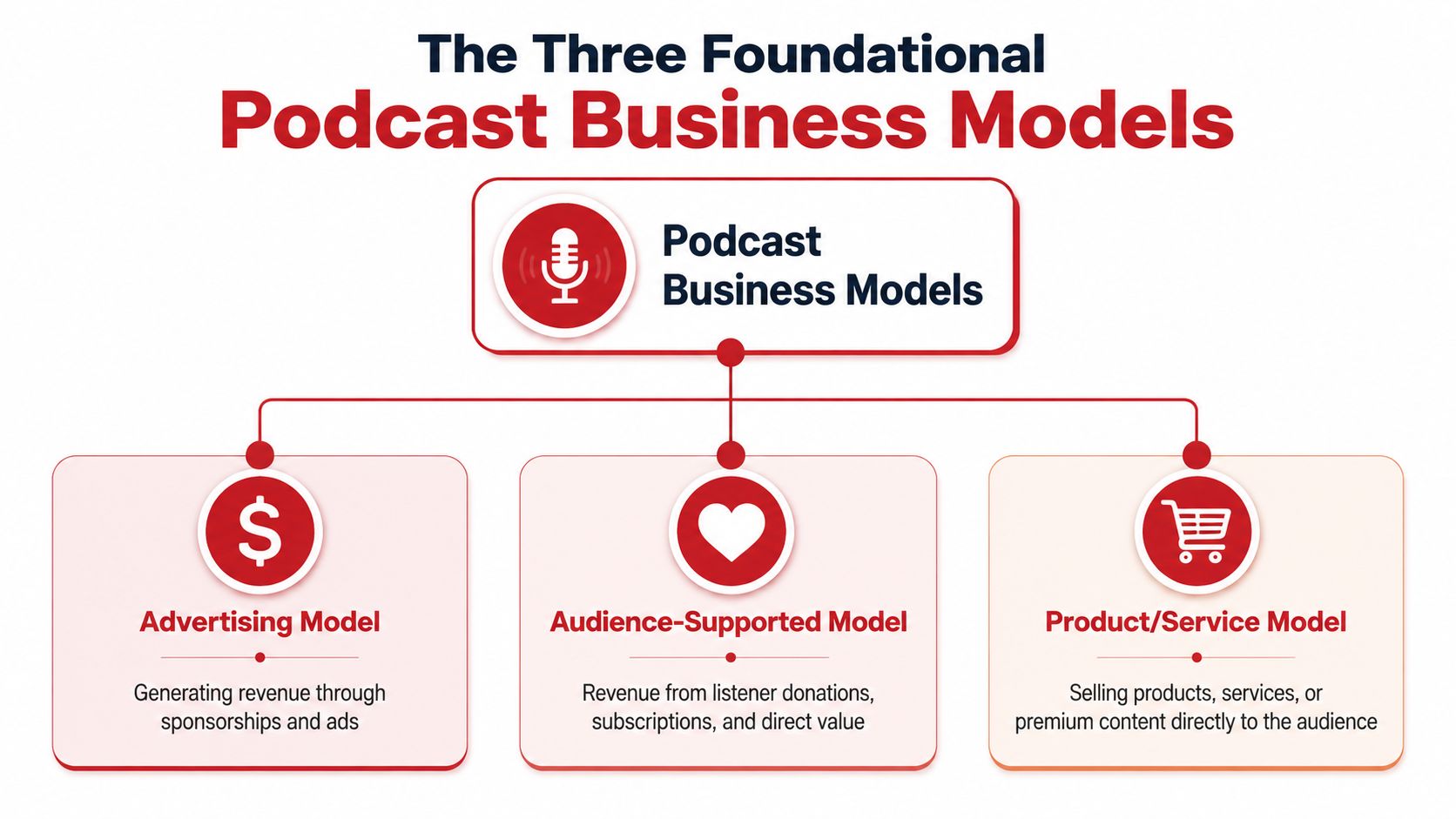
Most shows fall into three buckets. Some are built around ad inventory. Some are built around listener trust and direct support. Others use the show as a growth engine for an existing business, cause, or personal brand.
Advertising rewards scale
The advertising model works when a show can consistently deliver verified audience attention at enough volume to matter to sponsors. In that setup, the podcast itself is the product. The episodes create inventory, and that inventory gets sold through sponsorships, host-read ads, or dynamic placements.
This model pushes decisions toward reach, repeatable publishing, and broad listener appeal. It usually works better for shows with category fit for advertisers and enough consistency to support media buying conversations.
Audience support rewards trust
The audience-supported model works differently. Here, the relationship is the asset. Listeners don't pay because a show has the biggest audience. They pay because the show has become useful, meaningful, or identity-shaping in their weekly routine.
That makes this model a strong fit for spiritual leaders, educators, niche experts, and creators with a clear worldview. The podcast builds trust, and that trust supports subscriptions, premium content, donations, or direct value exchanges.
Practical rule: If listeners describe the show as something they "rely on," direct support usually has more upside than chasing generic sponsors.
Business integration rewards outcomes
The third model is often the most profitable, but it's the one many hosts miss. The podcast doesn't need to earn money directly if it helps close higher-value business elsewhere.
For consultants, agencies, founders, authors, and B2B teams, the show can create authority, open conversations with ideal clients, strengthen sales cycles, and keep the brand top of mind. In this setup, the podcast is closer to a business development asset than a media property.
A simple way to think about the three models:
| Model | Core Asset | Best Fit | Main Success Signal |
|---|---|---|---|
| Advertising | Attention at scale | Media-style shows, broad categories | Sponsor demand |
| Audience-Supported | Listener trust | Spiritual leaders, educators, niche creators | Paid community support |
| Business-Integrated | Authority and relationships | B2B firms, consultants, founders | Qualified pipeline and client influence |
Many shows eventually become hybrids. That can work well. But early on, clarity beats complexity. A show built for everyone usually monetizes for no one.
The Advertising Model Sponsorships and Ad Revenue
The advertising model gets the most attention because it's easy to understand. Build an audience. Insert ads. Get paid.
That summary hides the hard part. Sponsors don't buy enthusiasm. They buy credible audience delivery.
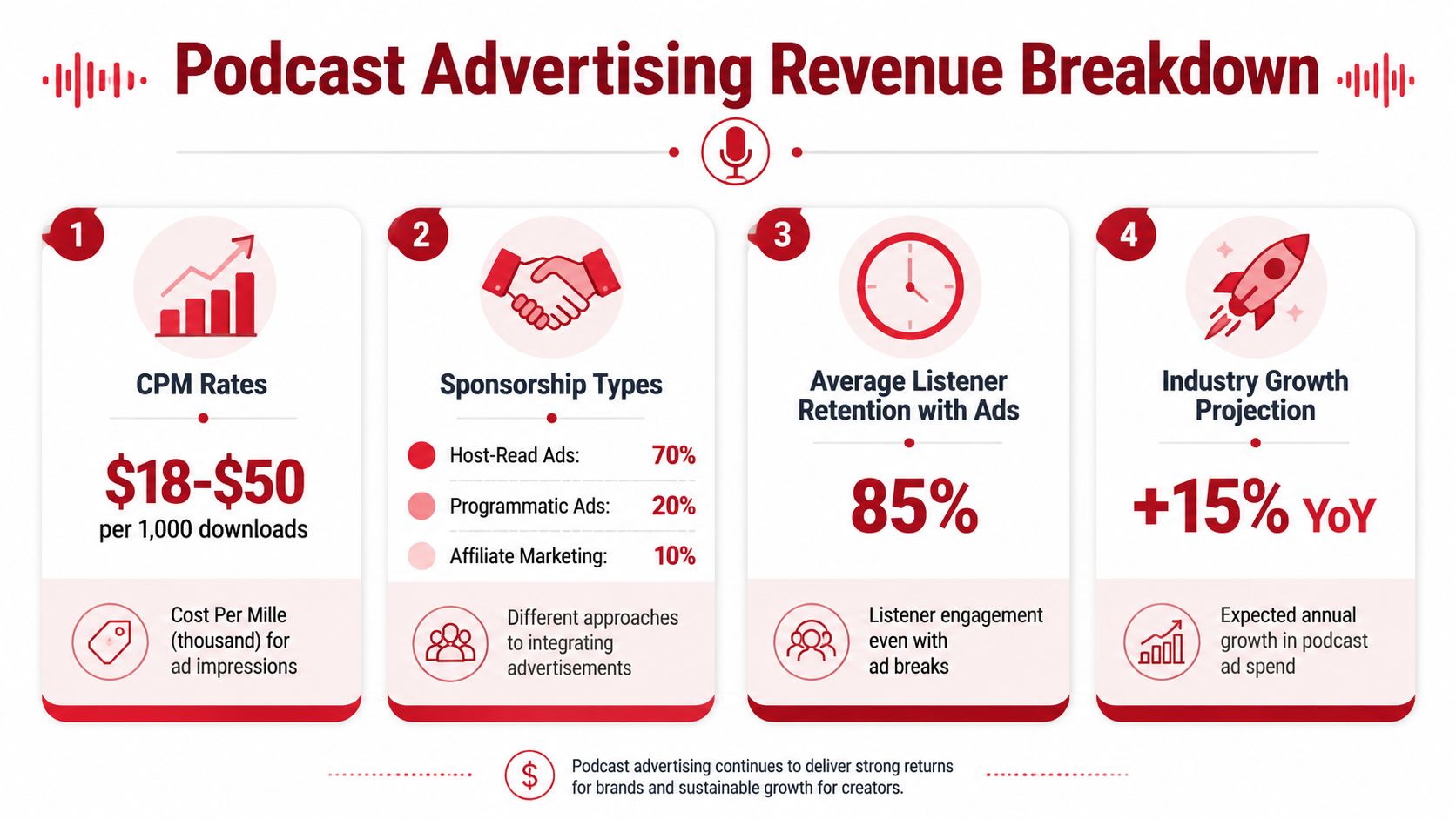
Global podcast ad spending is projected to reach $4.46 billion in 2025, podcast ads deliver nearly 5x better ROI than other digital formats, and they hold a 70% retention rate. Sponsors still expect credible measurement, which is why $18 to $50 CPM is tied to IAB-certified download volumes that filter bot traffic and verify human impressions, as outlined in podcast advertising market data and standards details.
What CPM actually means
CPM means cost per thousand impressions. In podcasting, that benchmark only matters when the underlying downloads are trustworthy. If a host tries to sell sponsorships using inflated hosting stats or screenshots from a platform that doesn't meet accepted measurement standards, negotiations get shaky fast.
The practical issue isn't theoretical. Without IAB Tech Lab-certified reporting, download counts can be overstated by 20% to 30%. That can kill a deal or trigger clawbacks after a campaign if a brand decides the audience numbers don't hold up.
Credibility is part of the product in an ad-supported podcast business model.
For that reason, ad-driven shows need a measurement stack before they need a sponsor deck.
Where ad revenue works and where it breaks
This model is strong when a show has:
- Consistent publishing: Brands want predictable inventory.
- Clear audience positioning: Niche can work if buyers understand the value.
- Verified analytics: Human impressions matter more than vanity download claims.
- Host trust: In the U.S., 55% of podcast ad revenue comes from host-read ads, while dynamically inserted ads account for over 90% of total ad revenue, based on the industry figures summarized by Backlinko's 2026 podcast statistics roundup.
A short explainer can help clarify the mechanics before outreach starts.
This model breaks when hosts chase sponsors too early, price based on hope instead of data, or build a show around narrow business goals that advertisers don't care about. A consultant's podcast for chief revenue officers might be commercially valuable, for example, but not because it sells generic ad spots. Its real value may sit elsewhere.
The advertising model works. It just doesn't forgive weak positioning or sloppy analytics.
The Audience-Supported Model Subscriptions and Direct Value
Some shows don't need sponsors because the audience already trusts the host enough to buy directly. That's a different game. The creator isn't renting access to listeners. The creator is deepening a relationship and asking the audience to support what they already value.
That shift matters most in categories where trust is the product. Spiritual leaders, nonprofit voices, educators, coaches, and niche experts often have more to gain from listener support than from ad inventory.

What listeners actually pay for
People rarely pay just to hear more talking. They pay for access, relevance, convenience, and belonging. The strongest audience-supported offers usually package one or more of these:
- Premium depth: Extended episodes, private feeds, bonus Q and A sessions, or ad-free listening.
- Useful transformation: Courses, guided series, frameworks, templates, or practical implementation help.
- Closer access: Community calls, member-only newsletters, small group teaching, or direct interaction.
- Aligned recommendations: Affiliate offers that fit the audience's values and the host's actual use.
A useful support model feels like a continuation of the show's promise, not a bolt-on upsell.
Why Value-for-Value works for certain creators
The Value-for-Value model fits hosts whose audience sees the show as meaningful enough to support voluntarily or through light subscription structures. It's gaining traction in B2B and entrepreneurial circles too. A 2025 GetElements report found that podcasts using subscription fees based on perceived value can generate 2.5% of total client income directly from the show, yet only 12% of creators know how to implement V4V pricing without alienating their audience, according to the GetElements report summary source cited in the verified data.
That gap explains why many creators either undercharge, overcomplicate the offer, or ask for support in a way that feels awkward.
A good Value-for-Value offer doesn't interrupt the show's trust. It formalizes it.
For audience growth around this model, creators also need strong distribution habits. At this point, practical execution matters more than theory. A concise list of Practical podcast promotion tips can help hosts turn a loyal core audience into a paying one without relying on aggressive sales language.
The audience-supported model doesn't work when the host is vague about the value exchange. "Support the show" is weak. "Get the private weekly breakdown, bonus training, and direct access to the teaching archive" is concrete. The first sounds like a favor. The second sounds like a decision.
The Business-Integrated Model Leads and Authority
For many professional hosts, the podcast shouldn't be judged like a media property at all. It should be judged like a pipeline asset.
Many founders, consultants, professional firms, and marketing teams often make expensive mistakes. They launch a show, watch download numbers, then decide it isn't working because sponsorship interest never appears. That misses the point. If the show helps create trust with buyers, shortens sales conversations, and opens doors to qualified relationships, it may already be doing its job.
The show isn't the product
A consultant interviewing ideal clients and referral partners isn't just making content. That host is building context before the sales call ever happens. An author is proving expertise at length. A B2B firm is creating category authority episode by episode.
This model works because a podcast lets buyers spend time with expertise. That kind of familiarity is hard to replicate with static blog posts or one-off social content.
A practical lead generation setup usually includes:
- One landing page per episode: Every episode needs a clear destination tied to the specific topic, guest, or offer.
- UTM-tagged links: Traffic has to be traceable back to the episode source.
- CRM integration: Contact records should include podcast engagement fields.
- Attribution questions on forms: "How did you hear about us?" needs a controlled "Podcast" option.
- Episode-level logging: Teams should record the specific episode or guest when a podcast touchpoint influenced a deal.
Proof beats vanity metrics
This model becomes credible when the show is connected to sales operations. According to episode-level podcast attribution guidance for B2B teams, proving ROI requires a dedicated landing page for each episode, UTM-tagged links, CRM integration, and a specific intake form field asking "How did you hear about us?" That setup allows teams to measure monthly influenced pipeline and closed-won deals tied to podcast touchpoints.
That approach changes internal conversations. The team stops asking, "How many downloads did this get?" and starts asking, "Which episodes moved real opportunities?"
Field note: In a business-integrated podcast business model, the most important listener may be the one who books a call, refers a client, or enters the CRM with strong intent.
For firms building around authority and demand generation, a podcast can support a broader system for B2B lead generation through content and conversations. That's where the show earns its keep.
How to Choose Your Podcast Business Model
The wrong model creates friction everywhere. Content feels forced. Calls to action feel random. Metrics don't line up with the actual reason the show exists.
The right model usually becomes obvious when the host answers one question truthfully: what matters more right now, audience scale, audience trust, or downstream business outcomes?
Match the model to the mission
A nonprofit trying to increase donor engagement shouldn't copy a broad entertainment show built for ad inventory. A founder using a podcast to meet buyers shouldn't judge success by listener donations. A spiritual leader serving a committed community often finds greater strength in trust than in audience volume.
That isn't theory. For spiritual leaders and nonprofits, audience monetization often outperforms ad-heavy models. A Lumos Business study found that 72% of podcasts combining direct selling and affiliate marketing achieve 3.5x higher net revenue than shows relying only on ads, according to Lumos Business research on podcast monetization for trust-based brands.
Podcast Business Model Decision Matrix
| Creator Type | Primary Goal | Recommended Model | Key Metric to Track |
|---|---|---|---|
| B2B consultant or service firm | Qualified leads and sales influence | Business-Integrated | Influenced pipeline |
| Nonprofit or community organization | Donor engagement and recurring support | Audience-Supported | Donor conversions tied to episodes |
| Spiritual leader or faith-based creator | Trust, teaching reach, direct support | Audience-Supported | Member or supporter growth |
| Founder building a personal brand | Authority and relationship access | Business-Integrated | Strategic conversations created |
| Broad lifestyle or general interest host | Sponsor revenue | Advertising | Verified sponsor-ready audience delivery |
| Author, speaker, or thought leader | Long-term authority and offer demand | Business-Integrated with audience support layer | Inbound inquiries and premium offer uptake |
Hybrid models work later, not earlier
A hybrid setup can be smart. It just shouldn't be the opening move.
Early-stage shows usually need one primary scoreboard. If a host tries to chase sponsors, donations, consulting leads, YouTube revenue, and premium memberships all at once, the audience gets mixed signals. The show starts sounding like a collection of monetization experiments.
A better progression looks like this:
- Start with one economic driver: Pick the model that aligns with the core business goal.
- Build the content around that driver: Guests, episode formats, and calls to action should support it.
- Add a second layer only after the first is working: For example, a consultant may later add premium resources. A nonprofit may later add aligned sponsorships.
This is also where guest strategy matters. For business and mission-driven shows, the right guest can create partnerships, referrals, collaborations, and direct revenue opportunities that don't show up neatly in download charts. That is one reason a podcast business model should always be chosen in context, not copied from whatever model is popular.
Implementing Your Model with the Content Waterfall
Choosing a model is strategy. Repetition is execution. Most podcasts don't fail because the host picked the wrong idea. They fail because one episode stays one episode.
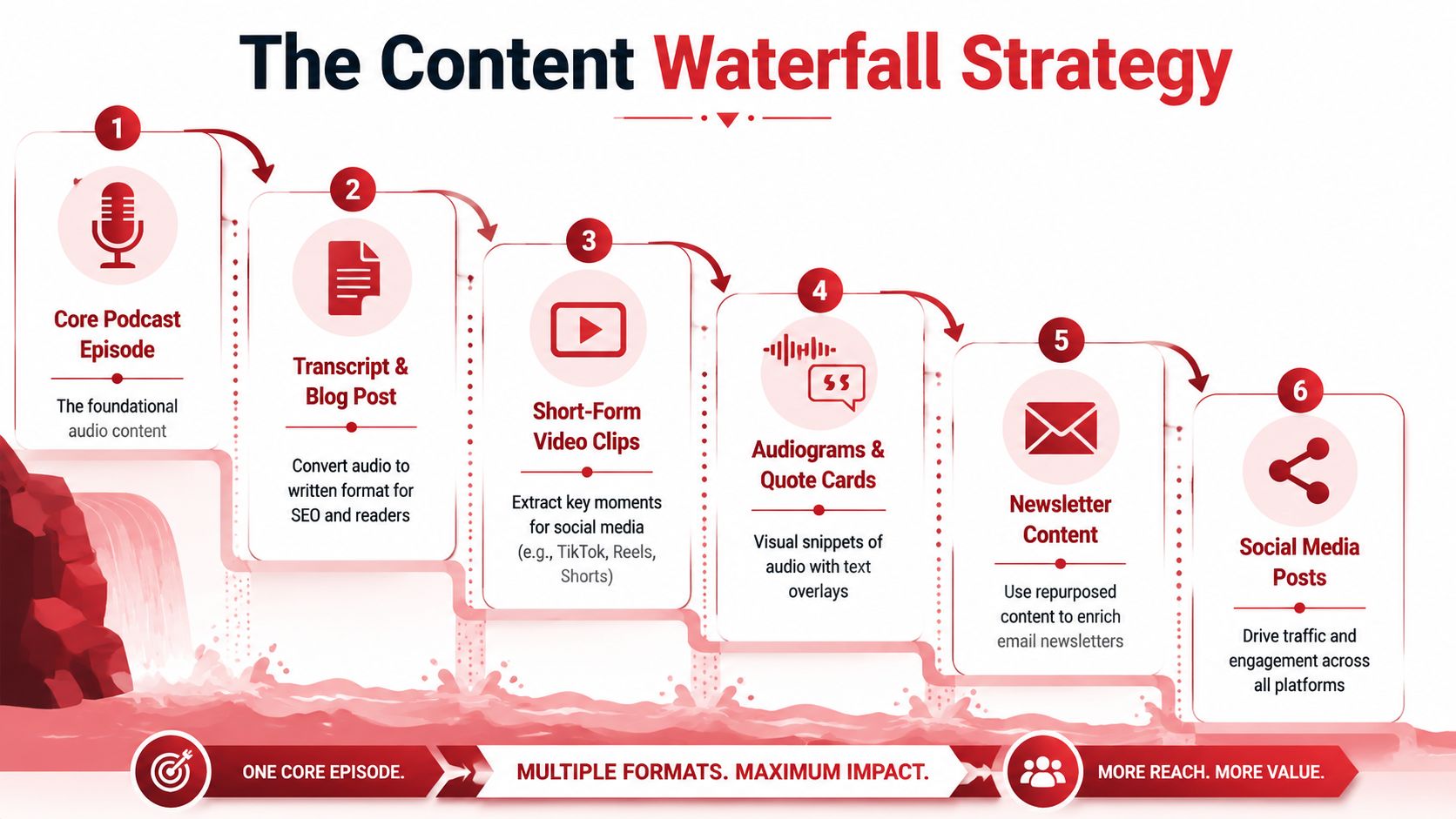
A show needs a distribution system that multiplies the value of every recording session. That's what the Content Waterfall does. One core episode becomes a blog post, short-form clips, audiograms, quote graphics, newsletter material, and social assets that keep working after the full episode drops.
Why multi-platform execution matters
The modern podcast business model is increasingly multi-platform. 53% of U.S. podcast listeners now prefer watchable podcasts, and the market is projected to reach $131.13 billion by 2030, which supports a Content Waterfall approach where one episode turns into multiple short-form assets across channels, as summarized in Grand View Research coverage of podcast market growth and watchable podcast behavior.
That has practical consequences for every model:
- Advertising model: More distribution creates more discoverability and a stronger case for sponsor value.
- Audience-supported model: Repeated exposure deepens trust before the ask.
- Business-integrated model: Extra touchpoints keep the host visible during long consideration cycles.
A workable repurposing flow
The process doesn't need to be complicated. It needs to be consistent.
- Record one strong flagship episode: Good planning beats trying to manufacture clips later.
- Extract the core argument: Pull out the most teachable, quotable, and emotionally clear moments.
- Convert it into format-specific assets: Full video for YouTube, short vertical clips for social, transcript-based blog content for search, and email takeaways for owned channels.
- Connect each asset to one action: Subscribe, book a call, join the list, support the show, or watch the full episode.
- Track which formats support the chosen business model: Not every clip needs the same goal.
Teams that want a deeper operating reference on how to repurpose content effectively can use that framework to tighten workflow and avoid creating low-value fragments.
One episode should create a chain of touchpoints, not a single release-day spike.
For creators who want this handled as a production workflow rather than an internal burden, Get Up Productions' content repurposing process is one example of a service model built around turning recorded episodes into multi-platform assets. The point isn't the vendor. The point is the system. Without a system, the show asks for too much effort per episode and returns too little reach.
Conclusion Your Model Is Your Strategy
A profitable podcast isn't built by adding revenue ideas after launch. It's built by choosing a business model early and letting that decision shape the show.
The three foundational options stay consistent. The advertising model sells verified attention. The audience-supported model converts trust into direct support. The business-integrated model turns episodes into authority, relationships, and measurable commercial outcomes.
Each one can work. Each one can also fail when it doesn't match the creator's real objective.
The strongest shows usually keep the business logic simple. They know who the podcast is for, what action it should drive, and how each episode fits that purpose. They also treat production as a multiplier, not a finishing step. Even simple tools that help convert MP3 to video can support broader distribution when a team wants to expand an audio-first show into more watchable formats.
A podcast stops being a hobby when the host stops asking whether content is getting made and starts asking whether the content is doing a job.
Get Up Productions helps brands, consultants, nonprofits, founders, and thought leaders build podcasts that support real business goals instead of just filling a content calendar. For teams that need recording support, editing, video production, and a repeatable repurposing system, Get Up Productions provides a turnkey path from episode creation to multi-platform distribution.