
Most podcast advice starts in the wrong place. It tells creators to watch downloads, celebrate spikes, and assume bigger reach means better results. That's how teams end up with a nice-looking chart and no clear answer about whether the show is building authority, creating demand, or driving any meaningful action.
A stronger way to think about how to measure podcast success is to separate attention, engagement, and business impact. A podcast can attract listeners and still fail. It can also serve a narrow audience, perform modestly on raw volume, and become one of the strongest trust-building assets in a brand's content mix. The difference comes down to what gets measured, when it gets measured, and what decisions follow.
For creators comparing channels, the same lesson shows up elsewhere. Social teams that only chase top-line numbers run into the same problem, which is why resources on how to boost your TikTok views in 2026 are most useful when they add context, not just volume targets. Podcasting works the same way. Raw reach matters, but it doesn't explain quality on its own.
Table of Contents
- Why Your Download Count Is a Vanity Metric
- Define Your Podcast's Version of Success
- Choose KPIs That Actually Matter to Your Goals
- Build Your Podcast Measurement Stack
- Analyze Your Data to Find Actionable Insights
- Turn Measurement Into Content and Growth
Why Your Download Count Is a Vanity Metric
Downloads aren't useless. They're incomplete.
A download tells a creator that an app delivered an episode file. It doesn't show whether the listener stayed, whether the topic resonated, or whether the episode moved anyone closer to a donation, a discovery call, or a stronger perception of the host's expertise. Teams that treat downloads as the headline metric usually make bad editorial decisions. They chase titles that inflate clicks, ignore weak retention, and misread temporary spikes as durable traction.
The bigger problem is timing. Many podcasters try to prove business ROI before they've built the operating discipline and audience signals needed to support it. That pattern is common enough that 78% of new podcasters skip Horizon 3 metrics, meaning business outcomes, because they lack Horizon 1 consistency and Horizon 2 brand growth data according to Ed Barker's three-horizon podcast measurement framework.
Think in horizons, not one scoreboard
The cleanest measurement system uses three horizons:
- Operational horizon checks whether the show is being produced reliably. Are episodes shipping on time? Are formats repeatable? Is the team improving production flow?
- Marketing horizon looks at audience development. Are episodes earning attention? Are listeners coming back? Are followers growing across platforms?
- Business horizon tracks downstream outcomes. Are listeners turning into leads, donors, subscribers, or meetings?
Practical rule: A show shouldn't be judged by business ROI alone if it still lacks consistent publishing habits and reliable audience behavior data.
This structure prevents the most common overreaction in podcasting. A team launches, publishes a few episodes, sees modest download volume, and concludes the channel failed. In reality, the show may be too early for a business verdict.
What vanity looks like in practice
A vanity metric becomes dangerous when it changes nothing. If download counts rise but no one studies episode completion, no one reviews listener comments, and no one tracks what content gets reused or acted on, the metric creates the illusion of progress.
Useful metrics force a decision. They answer questions like:
- Which episode topics deserve another angle?
- Which guest interviews lost attention too early?
- Which calls to action sparked site visits or replies?
- Which episodes helped the right audience take the next step?
That shift matters. The goal isn't to count listeners. It's to understand whether the show earns attention, holds it, and converts it into something valuable.
Define Your Podcast's Version of Success
A podcast fails on paper long before it fails in reality. The problem usually starts with a vague goal, then a dashboard full of numbers that cannot tell a team what to do next.
Podcast success has to be defined before reporting starts. Otherwise, every metric gets treated like a priority, and the show gets judged too early or by the wrong standard.
I have seen this happen with very different teams. A spiritual leader wants stronger response to a message. A B2B consultant wants sales conversations with the right buyers. A nonprofit wants supporters to stay engaged between campaigns. All three can produce a strong show, and all three need different evidence that the show is working.
Start by defining who the show is for and what action or shift you want from that audience. Teams that skip this usually publish broad episodes for a vague listener profile, then struggle to explain uneven performance. It is the same problem brands create when they never clarify their niche, which is why understanding why a clear target market matters should happen before anyone builds a reporting dashboard.
Start with the outcome, not the format
A weekly interview show is not a goal. Neither is a solo thought leadership show.
Formats are delivery choices. Success comes from the result those choices produce.
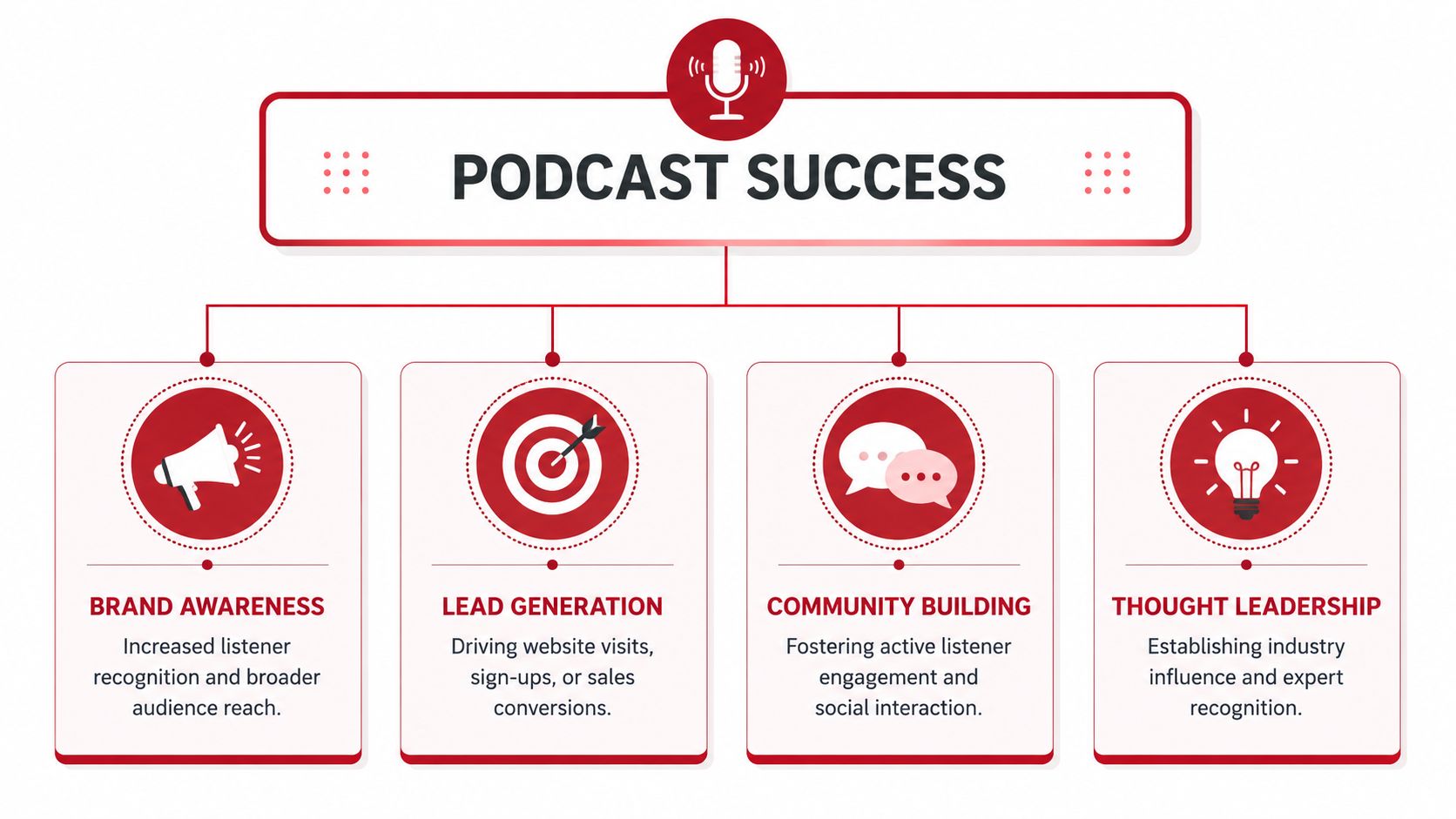
In practice, podcast goals usually fall into one primary lane:
- Brand awareness for companies or hosts that need stronger recognition in a defined market
- Lead generation for firms that want the show to support pipeline and qualified conversations
- Community building for creators, memberships, and mission-driven brands that grow through loyalty and participation
- Thought leadership for experts who want to build authority, trust, and recall with a specific audience
A show with a small audience can still perform well if it reaches the right people and gives them a reason to respond, return, or take the next step.
That trade-off matters. A niche B2B show may never post big audience numbers, yet still justify its budget if it consistently reaches decision-makers. A nonprofit may care less about scale and more about whether listeners become donors, volunteers, or event attendees. A faith-based or values-led show may judge success by direct feedback, sharing behavior, and signs that the message is resonating with the intended community.
Use the three horizons to set the right expectations
Once the core outcome is clear, define success across the three horizons introduced earlier: operational, marketing, and business.
Operational success answers whether the show is being produced well enough to earn a fair evaluation at all. Is the release cadence consistent? Is the format repeatable? Is the team collecting transcripts, clips, and episode assets every time? If the answer is no, weak results may reflect execution problems, not content-market fit.
Marketing success looks at whether the show is gaining attention and building audience behavior you can trust. That includes signs like improving episode starts, repeat listening, follower growth, stronger retention, and better response to episode themes. At this stage, the job is not to chase a universal benchmark. The job is to see whether the right audience is finding the show and sticking with it.
Business success measures what happens after attention is earned. That could mean qualified leads, booked meetings, donations, applications, memberships, sponsor interest, or customer retention. This horizon matters most to brands, but it becomes useful only after the first two horizons are stable enough to interpret.
This sequencing prevents a common mistake. Teams ask for ROI from a show that has only published a handful of episodes, has no consistent repurposing process, and has not yet shown repeat audience behavior. That is not a business verdict. It is an early-stage show.
Set goals your team can actually use
Good podcast goals change editorial decisions. Weak goals sit in a slide deck.
A practical filter is simple:
- Specific enough to guide topic and format decisions
- Measurable enough to review without guesswork
- Realistic for the stage of the show and the size of the audience
- Time-bound enough to force a real review cycle
I also recommend one more test. Ask whether the goal can shape your repurposing plan. If an episode performs well with the right audience, the team should know what to do with that signal. Cut clips. Turn the insight into LinkedIn posts. Pull quotes for email. Build a short-form sequence around the strongest point. At Get Up Productions, that is where measurement becomes useful. It feeds a content waterfall instead of ending as a report no one uses.
Success is not one number. It is a clear definition of what the show needs to achieve now, at this stage, for this audience, and how the team will use what it learns.
Choose KPIs That Actually Matter to Your Goals
More metrics do not create better reporting. Clear metrics create better decisions.
The practical way to choose podcast KPIs is to sort them by horizon. Operational KPIs show whether the show is being published, distributed, and consumed consistently enough to trust the trend line. Marketing KPIs show whether the audience is growing and responding. Business KPIs show whether the show is influencing revenue, retention, recruiting, or partnerships. Mixing those horizons into one scorecard is how teams end up judging an early-stage show by late-stage standards.
Match KPIs to the job they need to do
Use audience growth metrics to compare distribution strength, not to prove ROI on their own. A common benchmark in podcasting is the first 7 days after release because it gives a clean comparison across episodes before back-catalog listening muddies the picture. As noted earlier, benchmark numbers can help frame performance, but they should not become copied targets.
A niche B2B podcast can stay relatively small and still outperform a larger show on sales impact, account influence, or sponsor value. I have seen shows with modest reach produce strong results because the right buyers kept listening and acting.
Growth KPIs worth tracking include:
- First-week downloads to compare launch strength across episodes
- 30-day downloads or listens to evaluate performance on a more stable window
- Platform followers or subscribers to measure repeat audience formation
- Unique listeners across major platforms to understand actual audience size, not just episode volume
Engagement KPIs show whether the content deserves more promotion
Downloads answer one question. Did someone start the episode?
Engagement answers the harder one. Did the episode hold attention long enough to matter?
Apple and Spotify both provide listener retention and completion data inside their creator dashboards. Apple Podcasts Connect's analytics documentation explains how average consumption and retention charts show where listeners drop. Spotify for Creators analytics guidance covers starts, streams, and consumption patterns that help isolate weak openings, confusing structures, or segments that lose momentum.
Use those signals to make editorial decisions:
- Completion rate to judge whether the episode kept attention
- Retention drop-off points to spot weak intros, slow setups, or misplaced ads
- Average consumption by episode type to compare solo episodes, interviews, roundtables, or narrative edits
- Shares, replies, and reviews to gauge audience response quality
If listeners leave in the first few minutes, promotion is not the first fix. The intro probably runs too long, the value proposition is unclear, or the episode starts too far away from the main point.
Use a simple KPI map
A useful KPI system is small enough to review every month and specific enough to change production choices. One or two primary KPIs per goal is usually enough. Secondary KPIs should explain movement, not create clutter. Teams setting this up often benefit from a shortlist of podcast analytics tools for tracking hosting, platform, and conversion data.
| Podcast Goal | Primary KPIs | Secondary KPIs |
|---|---|---|
| Brand awareness | First-week downloads, unique listeners, follower growth | Social shares, guest amplification, branded search lift |
| Lead generation | Podcast landing page conversions, CTA clicks, influenced meetings | Episode traffic, email signups, time on page |
| Community building | Completion rate, repeat listeners, direct replies | Reviews, survey responses, shares |
| Thought leadership | Retention by episode, audience feedback, content reuse performance | Guest invitations, website engagement, newsletter clicks |
The strongest KPI setups also connect measurement to repurposing. If an episode holds attention, pull clips from the strongest segment. If a topic drives conversions, build follow-up posts, emails, and short-form video around that angle. At Get Up Productions, that is the point of measurement. It should shape the next round of content in the waterfall, not sit in a dashboard no one uses.
Build Your Podcast Measurement Stack
A podcast measurement stack should match the way value is created over time. If you judge a show with one dashboard and one monthly screenshot, you miss the difference between an operational problem, a marketing signal, and a business result.
That is why I build podcast reporting in three horizons. Operational metrics show whether the show is being produced and consumed properly. Marketing metrics show whether episodes create attention and response. Business metrics show whether the podcast influences pipeline, revenue, retention, or brand lift. This structure keeps teams from declaring success too early or killing a show before it has had time to work.
For teams setting this up from scratch, this shortlist of podcast analytics tools for tracking hosting, platform, and conversion data helps assign the right tool to each layer.
Horizon 1. Operational measurement
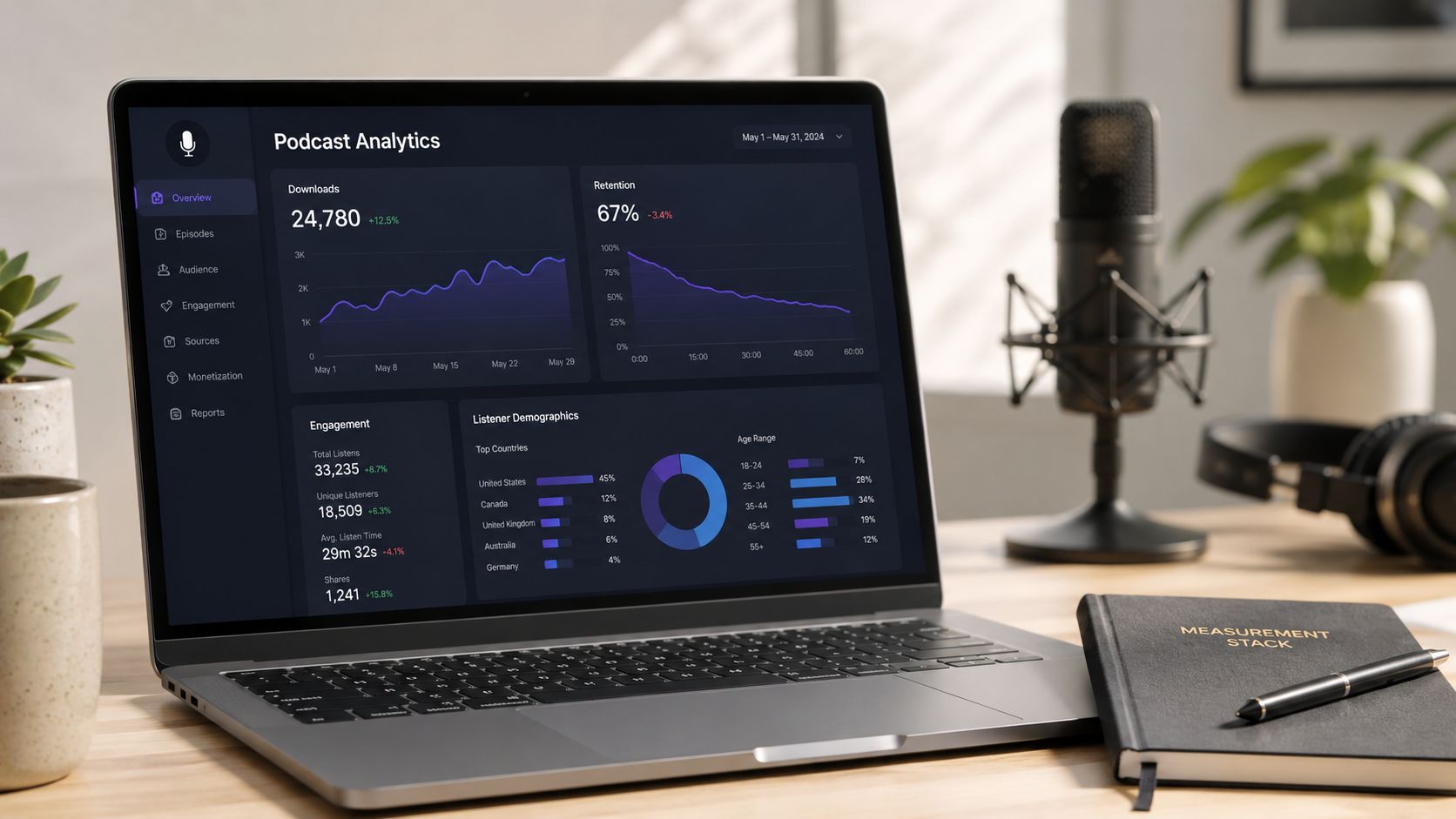
Start with trusted listening data from your hosting provider and platform dashboards. The host gives the baseline for delivery, downloads, and episode-level trends. Apple and Spotify add listener behavior, including consumption and retention patterns that a hosting dashboard cannot fully show.
Use an IAB-certified hosting platform if accurate reporting matters to sponsors, clients, or internal stakeholders. The IAB Podcast Measurement Technical Guidelines exist to reduce invalid traffic and create more consistent counting standards across the industry. Without that filter, teams can overstate audience size and make weak decisions from inflated numbers.
This layer should answer practical production questions fast. Did the episode publish correctly? Did it reach a normal baseline? Where did listeners drop? Did a format change improve completion?
Completion rate belongs here because it is an editorial diagnostic before it is a growth metric. If listeners leave in the first few minutes, the issue is often the hook, pacing, or intro structure. If they stay through the setup and exit later, the problem may be relevance, guest quality, or segment length.
Horizon 2. Marketing measurement
The next layer connects episodes to audience response on channels you control.
GA4 works well when it is paired with UTM-tagged links, episode-specific landing pages, and short vanity URLs read in the episode. That setup lets a team separate podcast-driven traffic from other sources and compare which topics, guests, and CTAs effectively generate action.
Keep the setup simple:
- Create episode-specific links for core offers, lead magnets, or campaign pages.
- Build landing pages that match the episode promise so the transition feels consistent.
- Tag show notes links with UTMs so traffic remains attributable in GA4.
- Review conversions by episode and campaign instead of looking at total site traffic.
A short walkthrough helps if the team needs to see the stack in motion.
Horizon 3. Business measurement
This is the layer many shows skip. It is also the layer that proves the show deserves budget.
Business measurement ties podcast activity to outcomes that matter beyond the content team. That can include lead quality, influenced opportunities, sales conversations, customer education, recruitment, partner interest, or brand search lift. The exact metric depends on the role the show plays in the business.
This layer often requires some manual work. CRM fields, sales notes, self-reported attribution, post-purchase surveys, and campaign tracking all help. Imperfect attribution is still useful if the method is consistent. A clean directional signal beats a polished dashboard that stops at downloads.
For teams comparing episode performance over time, interpreting data variance for optimizing campaigns can also help separate a real performance shift from normal fluctuation.
Use one reporting rhythm
The stack only works if the review process is repeatable. I usually recommend a weekly operational review and a monthly strategy review. Weekly review catches publishing problems, retention drops, and CTA issues while they are still fixable. Monthly review is where trends become decisions about format, promotion, guest selection, and repurposing.
A useful report answers four questions every cycle:
- Operational: Did people receive and listen to the episode as expected?
- Marketing: Did the episode generate traffic, clicks, replies, or shares?
- Business: Did the episode influence leads, meetings, revenue, or another defined outcome?
- Content: Which segment deserves to be reused in the next round of the Content Waterfall?
That last question matters. Measurement should not end in reporting. If one episode keeps attention through a specific story, pull that moment into shorts, email copy, LinkedIn posts, and sales enablement. If a topic drives visits but no conversions, adjust the CTA or landing page before promoting it again. A good measurement stack does more than prove value. It helps the next piece of content perform better.
Analyze Your Data to Find Actionable Insights
Collecting data isn't the hard part anymore. Interpreting it is.
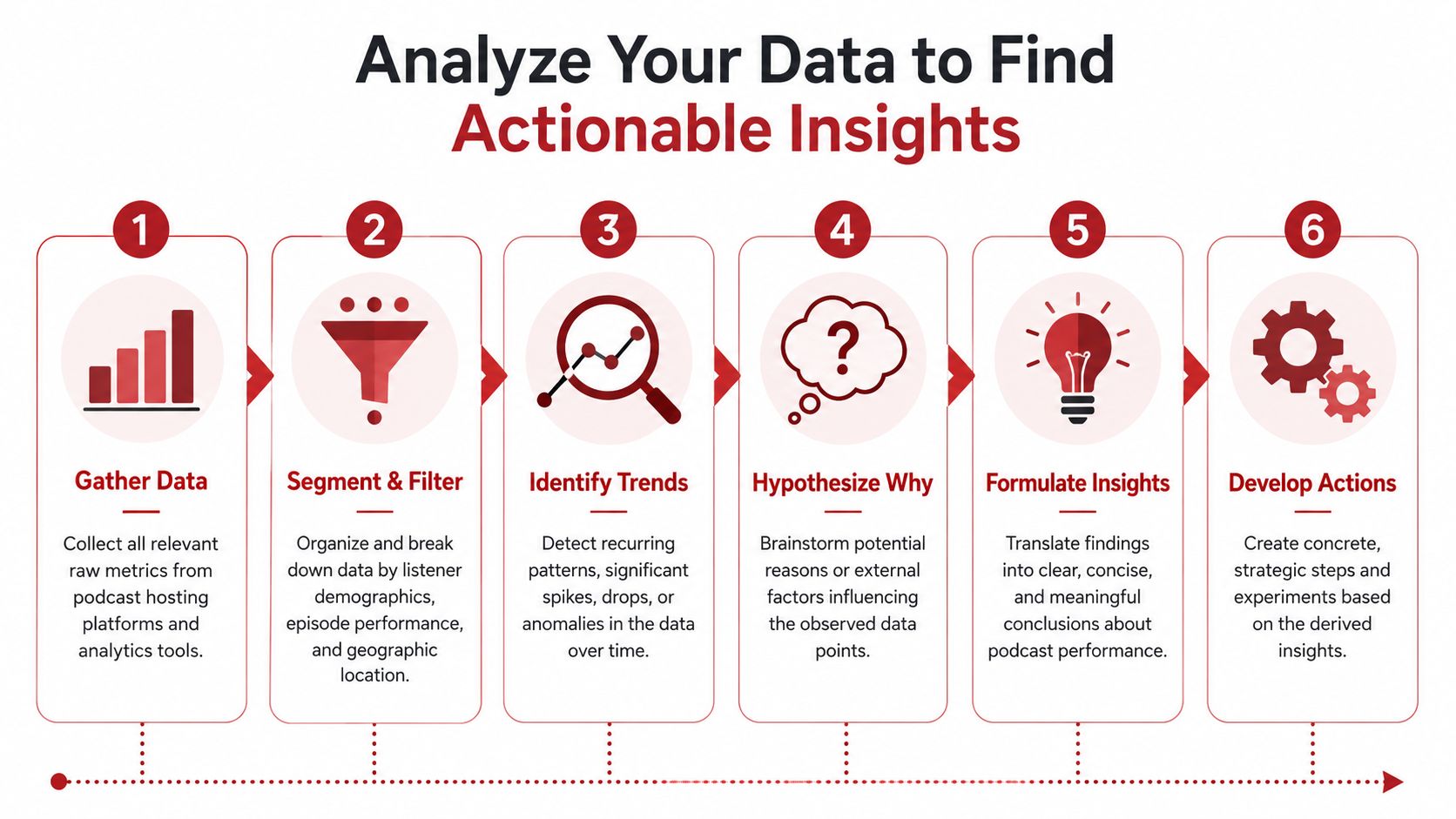
The useful question isn't whether an episode performed well. It's why it performed that way. That requires combining platform data, traffic patterns, listener feedback, and editorial judgment. A download spike can come from a guest promotion, a timely topic, a stronger title, or a better opening minute. Without analysis, the team guesses and often repeats the wrong thing.
Read the story behind the drop-off
Retention charts are often the fastest way to spot content problems.
If listeners leave during the opening, the intro is probably too slow or too self-focused. If they stay through the setup but drop during a guest answer, the issue may be pacing, clarity, or relevance. If the audience disappears around a recurring ad break, the transition likely feels abrupt or misplaced.
The point isn't to hunt for blame. It's to identify edit and structure choices that can be tested in the next episode.
A practical review looks like this:
- Opening segment checks whether the first minute earns attention fast enough
- Middle section shows whether the conversation develops
- CTA moment reveals whether asks are placed where trust is strongest
- Closing segment indicates whether listeners value the final takeaway or leave once the core discussion ends
Add qualitative signals to quantitative patterns
Quantitative data shows what happened. Qualitative feedback often explains why.
Success should also be measured through self-reported attribution and conversion tracking, and downloads alone aren't enough because audio engagement needs to be correlated with audience intent and feedback from surveys, as outlined in Acast's guidance on measuring podcast advertising success.
That means asking direct questions. How did the listener find the show? Which episode changed their perception of the host? What topic should be explored next? For authority-driven podcasts, those answers can be more useful than another week of top-line download reporting.
Some of the best measurement work happens outside the dashboard. Replies, survey answers, and sales-call mentions often explain more than the chart itself.
When reviewing trend lines, teams also need to separate signal from normal fluctuation. Anyone managing recurring content can benefit from learning more about interpreting data variance for optimizing campaigns, especially when episode performance naturally moves around from week to week.
Turn patterns into experiments
Insight should lead to a test, not a slide deck.
If episodes with shorter intros hold attention longer, shorten the next three openings. If practical solo episodes generate stronger site visits than broad interviews, schedule more of them. If one guest segment gets unusually strong retention, repurpose that segment first and build related supporting content around it.
A clean analysis loop looks like this:
- Observe the pattern
- Form a reasonable explanation
- Change one variable
- Measure the next result
That loop is how to measure podcast success in a way that improves the show. The analytics only matter if they change what gets made next.
Turn Measurement Into Content and Growth
Podcast measurement shouldn't end in a report. It should feed the next round of content, promotion, and conversion activity.
The strongest teams use performance data as editorial direction. They don't just ask which episode got attention. They ask which moments held attention, which topics moved people to click, and which themes showed up again in responses, shares, and sales conversations. That's where the show starts acting less like a weekly content obligation and more like a growth system.
Repurpose what audiences already proved they want
A smart repurposing workflow starts with evidence.
If a short segment inside a longer episode earned unusually strong retention, that's a candidate for short-form video, audiograms, or quote graphics. If a niche topic drove meaningful website traffic, that topic probably deserves a blog post, a follow-up episode, an email feature, or a webinar. Good repurposing doesn't mean chopping every episode into random clips. It means extracting the pieces the audience already validated.
That approach also improves promotion. Instead of guessing which angle to post on LinkedIn, YouTube Shorts, Instagram, or TikTok, the team uses retention and response signals to choose the strongest hook.
A simple waterfall often looks like this:
- Best retained segment becomes short-form video
- Most clicked episode topic becomes a supporting article
- Most replied-to takeaway becomes an email angle
- Most referenced guest quote becomes social creative
Measure the episodes that influence decisions
Business impact becomes much easier to prove when the team tracks downstream actions tied to specific podcast content.
A practical standard is to measure the number of leads generated through podcast-driven content, track conversions on podcast pages, and identify which specific episodes listeners in the buying cycle consumed, as described in Casted's guide to measuring podcast success. That last point matters because it closes the gap between content performance and pipeline influence.
This is also where broader audience growth work supports business outcomes. More reach helps, but only if the right people enter the ecosystem and take the next step through pages, offers, and follow-up content designed for them. Teams trying to improve that flow usually benefit from stronger distribution and audience-building systems, which is why learning how to grow a podcast audience matters alongside measurement.
The podcast itself is only one asset. The real value often comes from the ecosystem it powers around clips, pages, emails, and conversations.
The shift is simple but important. Measurement isn't a passive activity for monthly reporting. It's an input for better editing, better repurposing, better targeting, and stronger conversion paths. That's what turns a podcast from a vanity project into a working business asset.
Get Up Productions helps creators, brands, and organizations build podcasts that do more than publish on schedule. The team handles production, editing, and repurposing so each episode can support authority, audience growth, and real business goals. For teams that want a show backed by a stronger content system, Get Up Productions is a practical place to start.