
A lot of podcasters are sitting on strong episodes that almost nobody discovers.
The episode is polished. The guest is sharp. The conversation has real substance. Then it goes live as a full YouTube video or audio episode and stalls, not because the content is weak, but because discovery now happens in shorter bursts. Viewers rarely commit to a long conversation from a cold start. They need a reason first.
That's where Shorts fit. For podcast producers, the main opportunity isn't making random short videos. It's building a repeatable system that turns one recorded episode into a stream of standalone clips that pull new people into the larger show. At Get Up Productions, that workflow is treated like a content waterfall. One recording session feeds multiple assets, and YouTube Shorts sits near the top because it can introduce the show to people who'd never search for a full episode on their own.
For creators trying to learn how to create YouTube Shorts, the technical side is the easy part. The hard part is choosing the right moments, shaping them for vertical viewing, and publishing them with enough consistency to matter. That's the gap this guide addresses.
Table of Contents
- Why YouTube Shorts Are Your Podcast's Secret Weapon
- The Art of the Short Form Hook and Vertical Story
- Uploading and Publishing Your Shorts for Discoverability
- The Content Waterfall Turn Podcasts into a Shorts Machine
- Optimizing for Growth and Driving Action After Publishing
- Frequently Asked Questions about YouTube Shorts
Why YouTube Shorts Are Your Podcast's Secret Weapon
A podcast episode can be excellent and still be hard to discover.
That's the reality for founders, nonprofits, consultants, and thought leaders who publish long-form conversations. Most new viewers won't start with a full interview or a forty-minute teaching session. They start with a single sharp idea. If that idea lands, they'll give the longer content a chance.
YouTube Shorts solves that discovery problem better than most podcasters realize. YouTube reported that Shorts averages more than 200 billion daily views, a milestone publicly cited by CEO Neal Mohan in June 2025, which shows how large the discovery surface has become for creators who publish short vertical video (YouTube Shorts daily views milestone).
Discovery happens before commitment
For a podcast, a Short works like a first handshake. It doesn't need to summarize the whole episode. It needs to deliver one complete payoff that makes the viewer think, “This person is worth following.”
That changes the role of the clip. A weak Short acts like a trailer with no clear takeaway. A strong Short acts like a compact piece of content that also happens to lead into a deeper library.
Practical rule: A podcast Short should earn attention on its own before it asks for a longer watch.
That distinction matters because short-form viewers are impatient. They aren't browsing for context. They're deciding within seconds whether this person is useful, interesting, credible, or forgettable.
Shorts gives podcasters a testing ground
Shorts also changes how a show develops creatively. Long-form episodes are slower to test. A host might spend serious time booking, recording, editing, and packaging a single episode. Shorts creates a faster feedback loop. One episode can generate multiple angles, and each angle can test a different hook, framing choice, or audience pain point.
That's especially useful for podcasts with broad themes. A business show can spin out clips about hiring, leadership, pricing, or mistakes. A ministry podcast can pull moments on faith, doubt, discipline, or relationships. A nonprofit interview can surface one story, one lesson, or one challenge rather than asking a new viewer to commit to the entire conversation.
The result is simple. Shorts broadens the top of the funnel, while the podcast deepens the relationship.
The hidden value for podcasters
Many creators still treat Shorts like extra work tacked onto the end of production. That mindset usually leads to rushed clips and weak results. The better approach is to treat Shorts as part of the show's distribution plan from the start.
A strong episode contains multiple entry points. The job is to identify them, shape them, and release them in a way that keeps the show visible between full episodes. That's why YouTube Shorts has become a secret weapon for podcast growth. It gives long-form creators a way to meet audiences where attention already lives.
The Art of the Short Form Hook and Vertical Story
Most podcast clips fail in the first seconds.
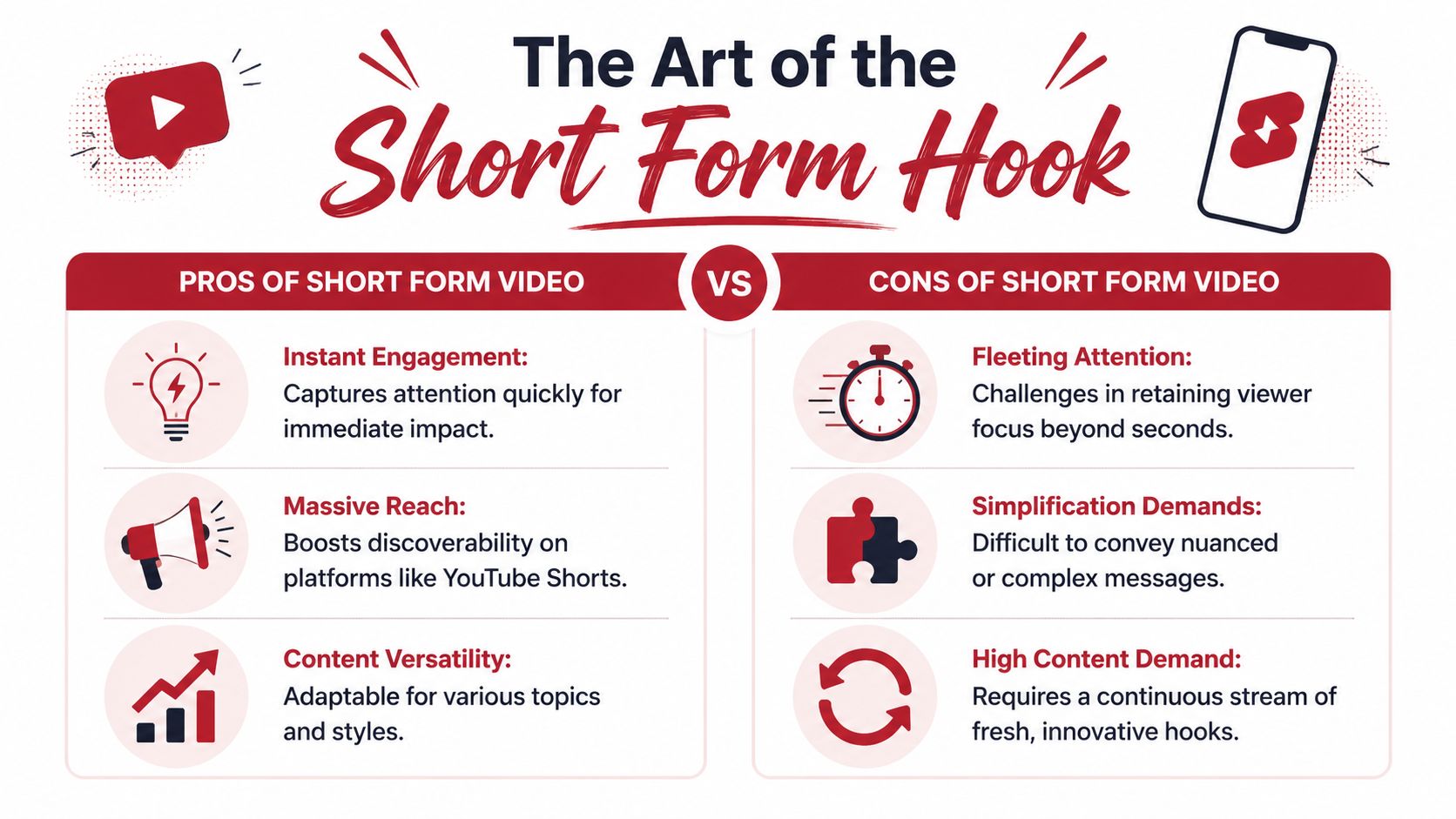
Not because the underlying idea is bad, but because the edit still behaves like long-form content. It includes throat-clearing, setup, filler, and context the viewer hasn't earned yet. Learning how to create YouTube Shorts starts with a different instinct. Lead with the moment that carries tension, surprise, disagreement, clarity, or emotion.
Start with the moment, not the setup
The strongest podcast Shorts usually begin in one of four places:
- A sharp question: “Why do smart founders wait too long to hire?”
- A surprising answer: “The biggest mistake wasn't bad marketing. It was saying yes too early.”
- A moment of tension: a guest disagreeing, correcting a common belief, or naming a costly mistake.
- A concrete promise: one idea the viewer can use immediately.
What doesn't work is the original podcast rhythm. Lines like “That's a great question,” “To give some background,” or “Earlier in my career” waste prime attention. The clip has to begin where the energy already exists.
A useful editing test is this. If the first line could survive without the rest of the episode, it's probably strong enough for a Short. If it needs two more sentences of explanation before it makes sense, it's not ready.
Cut until the clip feels slightly abrupt. That's often the right starting point for Shorts.
Build for vertical attention
Vertical framing isn't just a technical requirement. It changes how the viewer experiences the speaker.
A wide podcast frame that looks polished on desktop often feels distant on a phone. Shorts works better when the face is readable, the eyes are clear, and the composition gives room for captions without covering the mouth. For remote interviews, that may mean reframing each speaker separately instead of dropping the full conversation layout into a vertical crop.
If the original footage wasn't captured with Shorts in mind, creators can still salvage a lot by tightening the crop and prioritizing the active speaker. When the framing is awkward, the clip feels recycled. When the framing feels intentional, the same footage plays like native short-form content.
For teams that need to quickly optimize video for short-form content, resizing tools can speed up the reframing step before the clip moves into final editing. The same production logic sits behind structured short-form video content services that build vertical deliverables from long-form source footage.
Give the clip a complete arc
A good Short isn't just short. It feels complete.
That usually means the clip contains three beats:
- Hook: the line that stops the scroll.
- Development: the explanation, example, or story beat.
- Payoff: the conclusion, twist, lesson, or invitation to think differently.
Many podcast clips have a hook and no ending. They stop as soon as the soundbite ends. That creates a preview, not a piece of content. The viewer should leave with a finished idea, even if the full episode goes deeper.
A few practical choices help:
- Use captions intentionally: They should reinforce meaning, not flood the screen.
- Keep one visual focus: rapid cuts can help, but too many make spoken insight harder to follow.
- Write on-screen text for scanners: some viewers decide whether to keep watching based on text before audio.
- Trim every repeated phrase: spoken conversation often includes natural repetition that weakens short-form pacing.
The mental shift is simple. Don't ask, “What section of the episode can be clipped?” Ask, “What standalone story can be built from this moment?”
Uploading and Publishing Your Shorts for Discoverability
Editing the clip is only half the job. Publishing decisions affect whether YouTube treats the upload like a true Short and whether viewers understand why they should watch.
For podcast teams moving quickly, avoidable mistakes often occur. A strong edit gets exported in the wrong shape, runs too long, or gets uploaded with a vague title that doesn't communicate the payoff.
Meet the format rules first
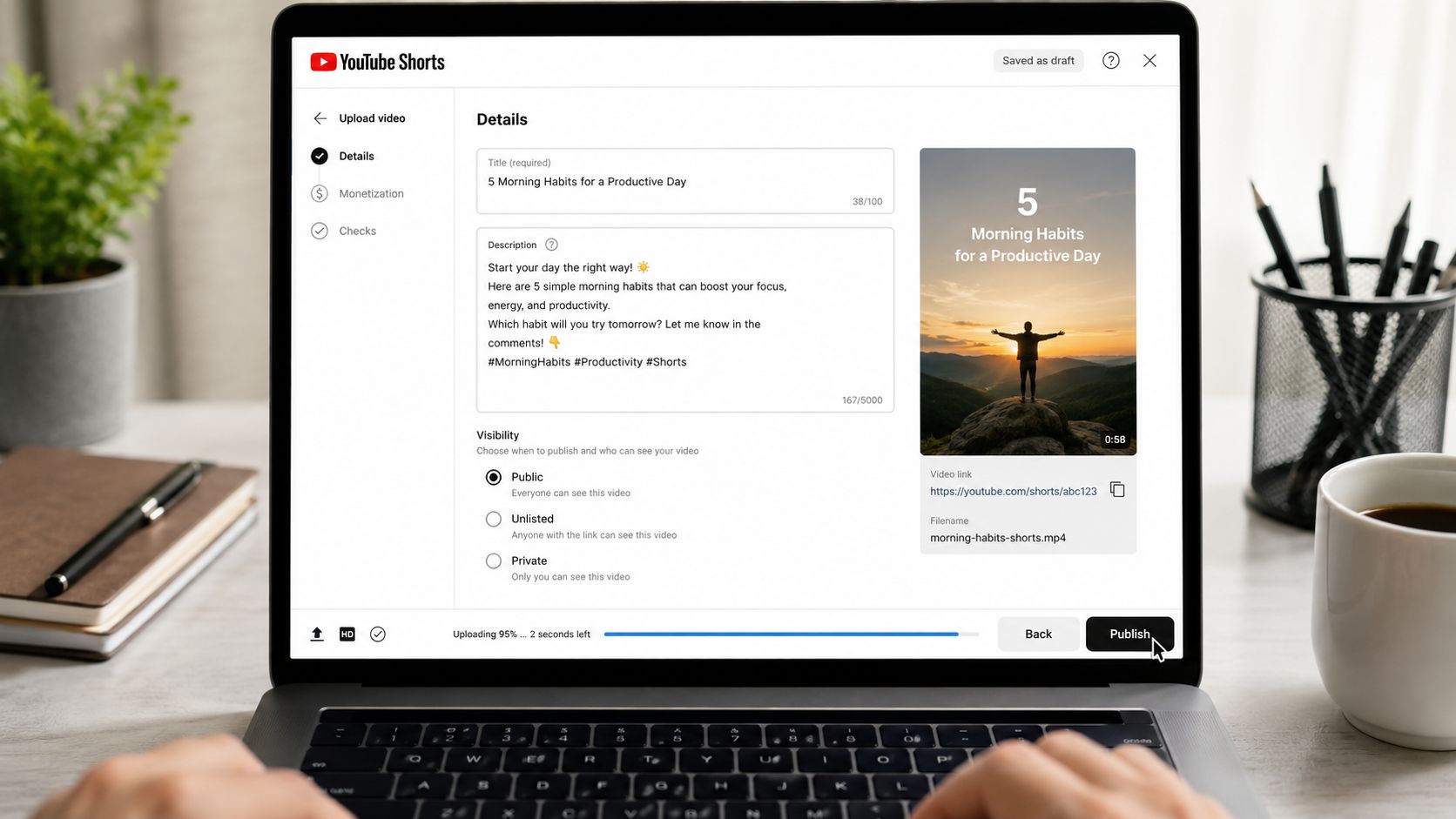
For Shorts uploaded from desktop or mobile, the key classification rule is a vertical video with a maximum duration of 60 seconds. If the video isn't vertical or goes past that limit, it may not be treated as a Short, which affects discoverability in the Shorts feed (YouTube Shorts classification rule).
That rule should shape the workflow before publishing day. Don't finish the edit and hope it qualifies. Build the clip to fit the format from the start.
A simple pre-export check helps:
| Check | What to confirm | Why it matters |
|---|---|---|
| Orientation | Vertical frame | Helps the upload classify correctly |
| Duration | 60 seconds or less | Avoids missing Shorts treatment |
| Safe zones | Captions and text stay readable | Prevents clutter on mobile |
| Ending | Final beat lands cleanly | Avoids abrupt drop-off |
Use a publishing checklist
A good publishing routine saves time because it reduces decisions. The same sequence can be repeated for every Short.
- Write the title around the payoff: YouTube's creation flow supports a title of up to 100 characters, so the title should surface the core idea quickly, not restate the episode name.
- Choose the audience setting carefully: Handle this before publishing so nothing gets delayed or miscategorized in the workflow.
- Save drafts when batching: Drafts are useful when a team wants to edit multiple clips in one sitting and release them over time.
- Keep hashtags limited: A few relevant tags are enough. Stuffing the title or description usually adds noise.
Captions are also a publishing issue, not just an editing issue. A lot of viewers watch without relying fully on audio, so subtitle quality affects clarity and retention. If a team needs a fast way to create video subtitles easily, that can remove one of the most common bottlenecks in Shorts production.
What actually hurts discoverability
Some mistakes are more costly than creators expect.
The first is treating the Short title like archive metadata. Titles such as “Episode 42 Clip 3” give no reason to stop. The second is publishing clips that look like leftovers from a horizontal episode. The third is forgetting that Shorts viewers are cold traffic. They don't know the guest, the host, or the larger conversation.
A Short has to explain its value before the viewer decides to care who said it.
That's why clean packaging matters. The clip should be obvious at a glance. The title should signal an outcome, tension point, or useful idea. The visual frame should feel native to mobile. The upload should qualify as a Short without ambiguity.
Publishing isn't the glamorous part of the workflow, but it's where strong edits often lose momentum. A repeatable checklist protects the work.
The Content Waterfall Turn Podcasts into a Shorts Machine
The most efficient Shorts strategy doesn't start with Shorts.
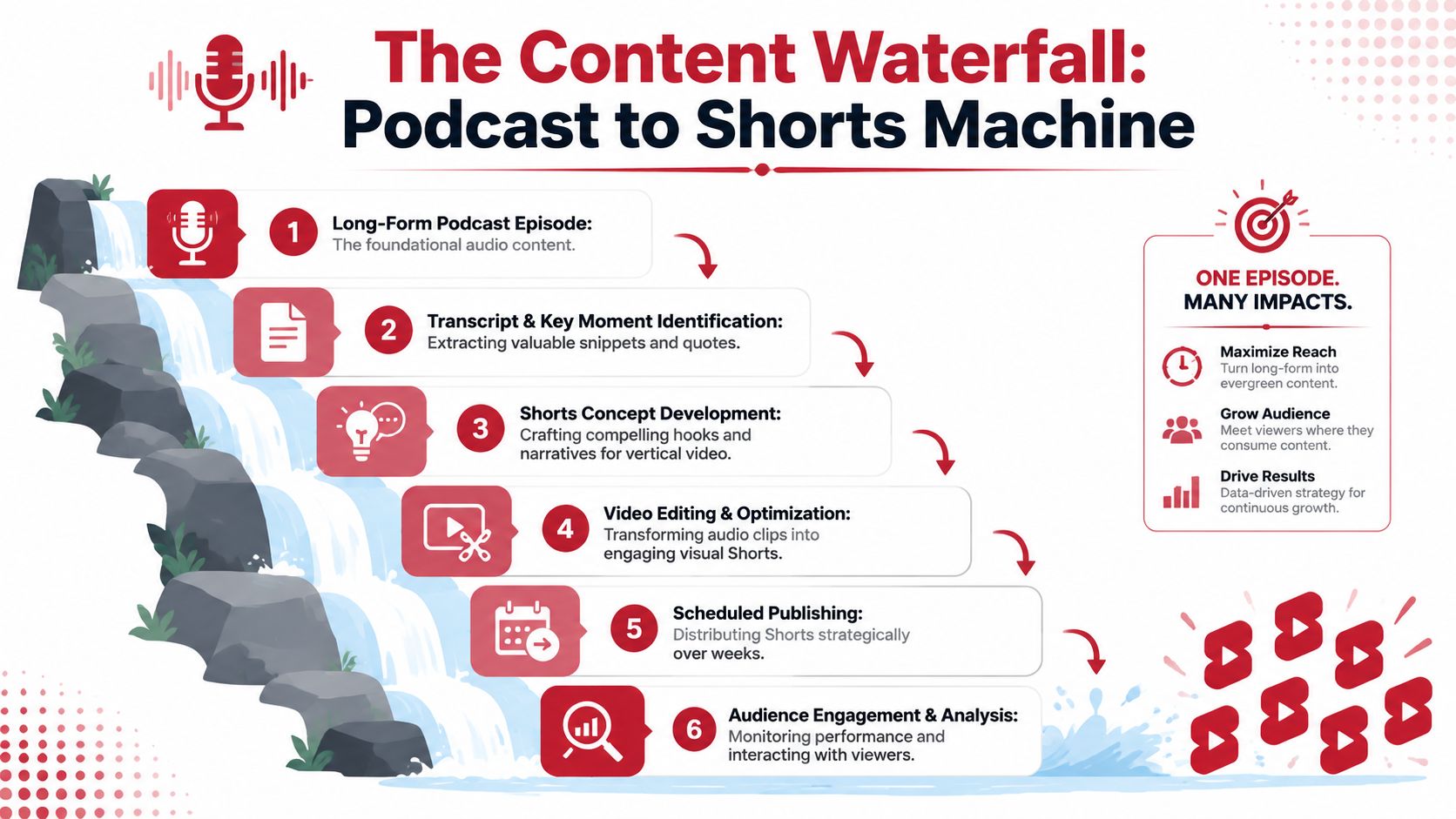
It starts with a long-form episode that's planned, recorded, and edited with repurposing in mind. That's the core of the Content Waterfall approach. One podcast becomes the source asset. From there, the team identifies the moments with standalone value, shapes them into vertical clips, and releases them across a schedule instead of dumping everything at once.
YouTube's own guidance says Shorts should be standalone content, not just previews, which is a key challenge for podcasters pulling clips from longer conversations (YouTube guidance on turning long-form into Shorts).
Find clips worth isolating
A long episode usually contains more usable Shorts than the host thinks. The problem is that teams often search for clips casually instead of systematically.
The first pass should be a miner's pass. Review the transcript or timeline and mark moments in these categories:
- Opinion moments: strong takes, contrarian views, or clean disagreements.
- Teaching moments: one tactic, one framework, one correction.
- Story moments: a mistake, turning point, lesson, or surprising result.
- Emotion moments: conviction, humor, tension, or vulnerability.
Not every good podcast moment makes a good Short. Some sections are excellent in context but weak in isolation. The test is whether the clip can stand without a long runway.
A practical way to judge clips is to ask three questions:
- Does the first line create immediate curiosity?
- Can the viewer understand the point without hearing the whole episode?
- Does the clip end with a clear payoff?
If the answer is no to any of those, it's probably better left inside the full episode.
For creators trying to repurpose your content effectively, this sorting step matters more than any editing trick. Selection drives performance. Editing only sharpens what was selected.
Batch the work so the system holds
Most creators fail with Shorts because the process is too manual. They clip one video at a time, write one title at a time, and publish only when there's leftover time. That approach breaks under normal business pressure.
The Content Waterfall works better as a batch system:
| Stage | What happens | Output |
|---|---|---|
| Episode review | Transcript scan and timestamp marking | Clip shortlist |
| Clip shaping | Hook trimming and ending cleanup | Rough cuts |
| Vertical edit | Reframe, captions, text, branding | Final Shorts |
| Packaging | Titles, descriptions, publish order | Scheduled batch |
A structured content repurposing strategy shifts from aspirational to operational. The episode isn't just published once. It becomes the source for multiple touchpoints with different audiences and attention spans.
A lot of teams also benefit from seeing the workflow in action before building their own version. This breakdown helps illustrate the logic behind clip selection and packaging:
What a usable weekly rhythm looks like
A realistic rhythm is more valuable than an ambitious one that collapses.
One episode gets recorded. The editor or producer reviews the transcript and marks clip candidates. The strongest moments move into a rough-cut folder. Then those clips get finished in one focused batch, not scattered across the week. Titles and captions are prepared in the same session, and the uploads are scheduled so the channel stays active between full episodes.
That rhythm helps in two ways. First, it lowers decision fatigue. Second, it keeps every Short connected to a broader content asset that already exists.
Strong repurposing is ruthless. If a clip only works because the audience already watched the full episode, it isn't ready.
One mention belongs here because it fits the workflow discussion directly. Get Up Productions offers podcast production and repurposing support that includes turning full episodes into YouTube Shorts and related short-form assets. That kind of setup is useful for teams that want the system without handling the editing and packaging internally.
The larger lesson is simple. Don't create Shorts as isolated tasks. Build them as downstream outputs from a well-produced episode. That's how a podcast becomes a Shorts machine instead of a content treadmill.
Optimizing for Growth and Driving Action After Publishing
Monday morning, a Short from last week's episode is still climbing. Views look healthy. Then the bigger question shows up. Did it send anyone to the full episode, earn subscribers, or pull the right audience into your content ecosystem?
That is the test.
A Short can perform inside the feed and still do very little for the podcast. In our workflow at Get Up Productions, we judge Shorts in two layers. First, can the clip stop the scroll and hold attention on its own? Second, does it push viewers into the next logical asset in the Content Waterfall, whether that is a full episode, another Short, a playlist, or an offer?
Read the signals that actually change your next edit
Post-publish review should lead to a production decision. If it does not, it is just dashboard watching.
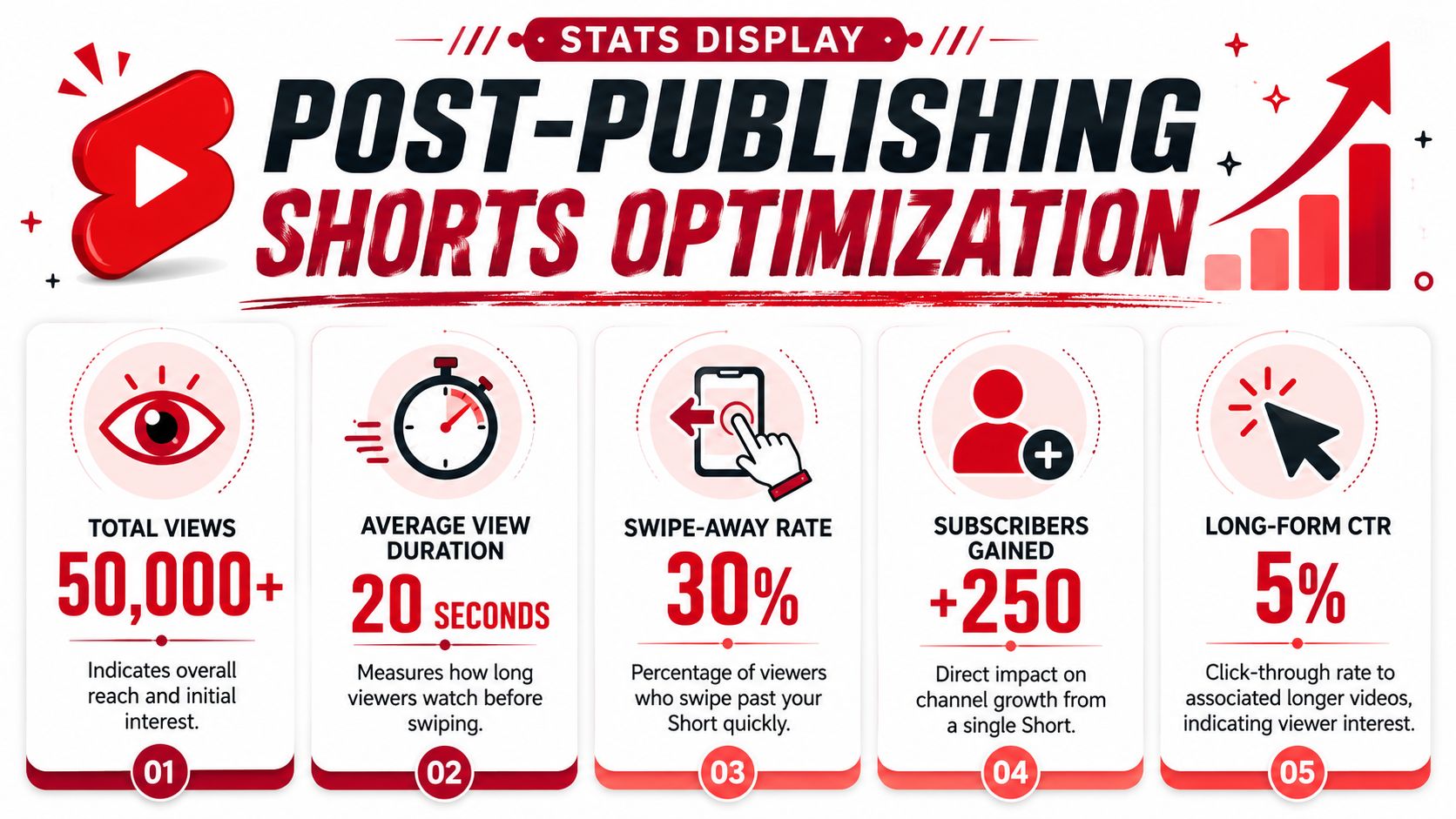
Start with the metrics that help you improve the next batch of clips:
- Viewed versus swiped away: this shows whether the first second earned attention.
- Audience retention shape: sharp drop-offs usually mean the hook promised one thing and the clip delivered too slowly.
- Subscriber growth and follow-on views: this shows whether the Short attracted the right viewer for your show, not random traffic.
These signals matter because Shorts often reach people who have never seen your podcast before. That makes opening clarity and pacing more important than raw view count alone.
In practice, the fixes are usually straightforward. If viewers leave early, cut the setup and open closer to the strongest line. If retention holds but full-episode clicks stay weak, the clip probably worked as entertainment but not as a bridge. If the right viewers subscribe but do not keep watching, the problem is often packaging on the destination asset, not the Short itself.
That is one reason the Content Waterfall works so well. Every Short already has a logical next stop.
Add a CTA that fits the clip
A weak call to action hurts in two directions. It can lower retention, and it can waste a strong clip by sending viewers nowhere useful.
The fix is restraint. One CTA is enough.
For podcast Shorts, the best-performing prompts are usually simple and specific:
- Watch the full episode if the clip opens a loop the longer conversation closes
- Subscribe for more clips like this if the show has a clear recurring theme
- Use the pinned comment when you want to direct viewers to a playlist, resource, or episode link
- Put short on-screen text at the end so the next step is visible even with sound off
Match the CTA to the job of the clip. A provocative opinion clip can send viewers to the full discussion. A tactical clip can point to a resource or service page. A guest soundbite often works best when it routes people into the full interview, where trust has more room to build.
For brands using a podcast to create demand, that handoff matters. Attention only becomes business value when there is a clear next step, which is the same logic behind using video content for lead generation as part of a broader conversion path.
The Short gets attention. The next asset has to earn more time.
Reviewing performance this way keeps the system honest. Instead of asking whether a clip “did well,” ask what role it played in the waterfall and whether it moved viewers to the next stage. That is how long-form episodes keep producing results after the publish date, instead of disappearing into a one-and-done content cycle.
Frequently Asked Questions about YouTube Shorts
How long can a YouTube Short be
A practical rule keeps this simple. Keep the video vertical and keep it short enough that the point lands fast.
For podcast clips, shorter usually performs better because the viewer decides within seconds whether to stay. In our workflow, we cut the moment as soon as the payoff hits. If the best line needs too much setup, it usually belongs in the full episode or in a different clip from the same recording.
How does Shorts monetization work
YouTube offers monetization paths for creators who meet its program requirements, but podcast teams should treat that as a later-stage benefit, not the main reason to publish Shorts.
Shorts does its best work earlier in the Content Waterfall. A strong clip gets a new viewer to sample the show, recognize the host, and decide whether the full episode is worth their time. Revenue can follow. Discovery has to come first.
Can podcasters use music in Shorts
Yes, but rights matter.
Music added through YouTube's approved tools is different from dropping in a track pulled from somewhere else. Use audio YouTube allows in its own system, or use music you have clear rights to publish. If there is any doubt, leave it out.
Podcast Shorts also do not need much music. Spoken audio carries the clip. A light bed can help pacing, but if the music competes with the voice, the clip gets weaker.
How often should a podcast publish Shorts
Publish at a pace your team can sustain every week.
For most shows, consistency beats short bursts of volume. One episode can produce several usable clips if the source conversation is strong, which is why the Content Waterfall works so well. Batch the review, select the best moments, cut them in one session, and schedule the releases across the week. That approach saves time and keeps quality steady.
Should every podcast episode become Shorts
No.
Some episodes produce five strong clips. Some produce none. The decision should come from the material, not from a quota. I look for moments that stand on their own, make sense without a long preamble, and give the viewer a clear payoff before the clip ends.
Forcing every episode into Shorts usually creates filler. That hurts the channel faster than posting less often.
Do Shorts need to feel connected to the full episode
They should connect to the full episode by topic and tone, but each clip still has to work on its own.
The best podcast Shorts are self-contained insights pulled from a bigger conversation. The viewer gets something useful in the clip itself, then has a clear reason to watch more. That is the foundation of a working Content Waterfall. The long-form episode generates the raw material, the Shorts broaden reach, and the strongest clips send qualified attention back to the deeper content.
Get Up Productions helps brands, founders, nonprofits, and thought leaders turn podcast episodes into finished content systems, including YouTube-ready clips, repurposed assets, and full production support. Creators who want help building that workflow can learn more at Get Up Productions.