
Most marketing teams aren't short on ideas. They're short on a system.
A campaign goes live, social needs fresh clips, sales asks for a follow-up asset, leadership wants more visibility, and the content calendar starts to feel like a machine that only stays running if someone keeps feeding it. That's the treadmill. The team publishes constantly, but each asset behaves like a one-off job instead of part of a connected engine.
For content creation for brands, that approach breaks down fast. The pressure isn't just to publish. It's to stay consistent, look credible on camera, turn expertise into discoverable media, and keep every episode, post, and clip tied to revenue. The answer isn't more random output. It's a format that naturally creates depth, authority, and reusable source material.
A video podcast does that better than almost any other single format. It gives the brand a recurring editorial container, a repeatable production rhythm, and raw material for weeks of downstream assets.
Table of Contents
- Moving Beyond the Content Treadmill
- Laying the Foundation with Show Design
- Building Your Production Checklist
- Implementing the Content Waterfall Model
- Establishing Your Distribution Cadence
- Measuring Success and Scaling Your Team
Moving Beyond the Content Treadmill
The old model treated content like a list of deliverables. Write a blog post. Cut a reel. Send an email. Repeat next week. That keeps channels active, but it rarely creates momentum because every asset starts from zero.
That's a problem in a market where content is already standard practice. By 2026, 97% of marketers say they have a content strategy, 61% report that it significantly or moderately improved results and ROI, and 58% say content marketing generates sales and revenue, according to Taboola's content marketing statistics roundup. The takeaway isn't that brands need to start creating content. It's that they need to run content like an operating system.
A video podcast works because it solves several problems at once. It captures subject-matter expertise in a format that feels human. It creates a flagship asset with audio, video, transcript, and narrative structure built in. It also gives the team a recurring editorial event that can feed every other channel.
Practical rule: If a content program can't produce one strong long-form asset that turns into many useful short-form assets, the team will keep paying the setup cost over and over.
Many teams confuse activity with impact. Publishing five unrelated posts may fill a calendar. Recording one well-designed episode can support YouTube, LinkedIn, email, website content, short-form video, sales follow-up, and internal enablement. The asset is doing more work because the system around it is doing more work.
The shift is operational. Teams that need a clear scalable content creation workflow usually don't need another brainstorming session. They need a central source asset, a repeatable production cadence, and a defined repurposing path.
Three signs a brand is still stuck on the treadmill:
- The team creates channel-first content: Social posts, blog drafts, and email copy are all planned separately, so each one requires a fresh brief.
- Experts are underused: Leaders have valuable perspective, but it stays trapped in meetings, calls, or internal documents instead of becoming public-facing media.
- Distribution is disconnected: Assets go live without a coordinated sequence, so the audience sees fragments instead of a coherent conversation.
The video podcast flywheel fixes that because one recording session creates the source material, the authority signal, and the editorial spine for the rest of the month.
Laying the Foundation with Show Design
A brand show succeeds or fails before the first recording starts. Most weak shows don't have a production problem. They have a design problem. The team picked a topic category, booked a few guests, and hoped consistency would create traction.
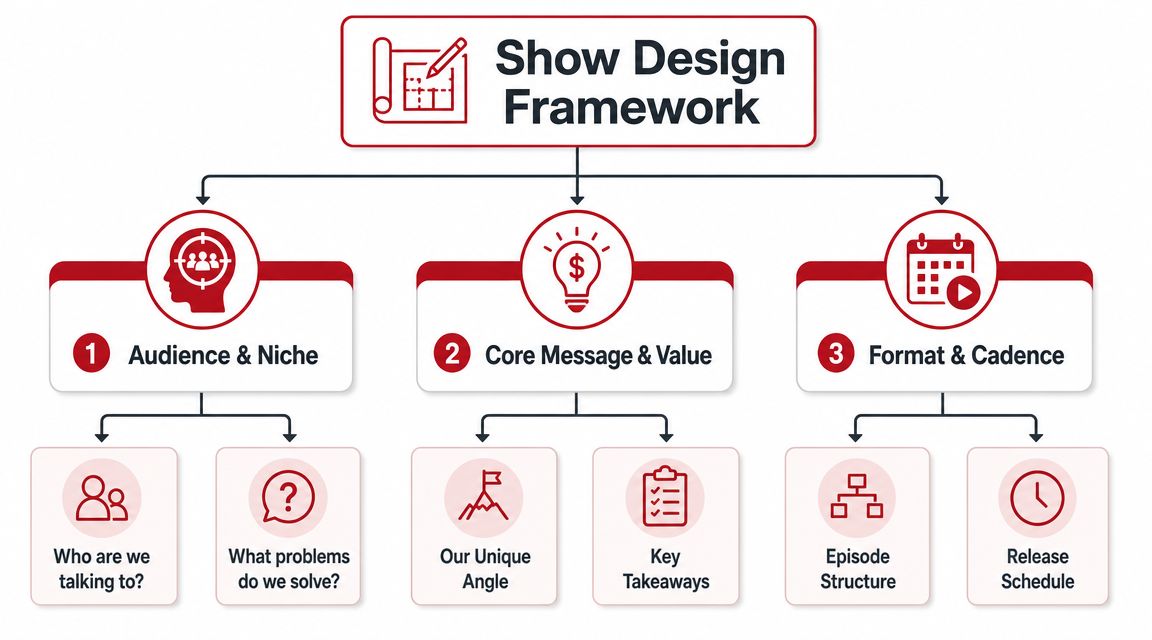
It usually doesn't. The stronger route is to define the show the same way a team would define any strategic product. It needs a business job, a specific audience, a perspective the brand can credibly own, and a format that the team can sustain.
Start with the business job
The first question isn't what the show should talk about. It's what the show should do.
Some brand shows are built to support lead generation. Others exist to shorten trust-building in a complex sales cycle. Some help a founder become the recognizable face of a category. A nonprofit may use the format to deepen donor connection. A professional services firm may use it to turn partner expertise into search-friendly and shareable media.
Useful prompts at this stage:
- Desired action: What should a qualified viewer do after engaging with an episode?
- Commercial role: Does the show support awareness, consideration, conversion, or retention?
- Internal owner: Which team is accountable for turning audience attention into pipeline or relationship depth?
A video podcast shouldn't sit off to the side as a branding experiment. It should have a direct relationship to a business objective. Teams that want examples of how video supports broader business outcomes can look at video marketing for business as a category, then decide where the show fits in that larger system.
Define the audience and point of view
A lot of branded content fails because it's made for "anyone in the industry." That audience isn't real enough to program for. The brand needs to know who the show is for, what that audience already knows, and where confusion or friction still exists.
The sharper lever is point of view. Recent guidance highlighted by Valchanova's piece on remarkable content angles argues that the biggest performance lever often isn't volume but a clear perspective and niche positioning. The right question is, what perspective can only this brand credibly own, and what problem does that perspective help solve?
That changes the show from generic commentary into ownable media.
Brands don't stand out because they cover a topic. They stand out because they interpret that topic in a way competitors can't easily copy.
A strong point of view usually comes from one of these sources:
Operational experience
The brand sees patterns across clients, customers, patients, donors, or partners that outsiders don't.Mission and belief
The organization has a clear philosophy about how work should be done, who should benefit, or what the industry gets wrong.Proximity to the problem
The host or team has firsthand exposure to buyer questions, objections, and implementation failures.
Choose a format that fits the team
Format is where strategy meets reality. A polished interview show sounds attractive until the team realizes guest booking, prep, approvals, and scheduling are eating the calendar. A solo format may be easier to produce, but it can expose weak hosting or thin episode planning.
The practical options tend to be:
- Interview-led: Strong for borrowed authority and relationship building.
- Host-led teaching: Strong for category ownership and direct education.
- Roundtable: Useful when multiple internal experts can create informed disagreement.
- Hybrid: Often the most practical choice because it mixes guest episodes with focused solo or team commentary.
Cadence matters too, but consistency only helps when the format is sustainable. A monthly show with strong planning usually beats a weekly show that rushes every stage and delivers flat conversations.
Building Your Production Checklist
A good show doesn't come from talent alone. It comes from removing avoidable failure points before recording day. When a team has a defined checklist, production becomes repeatable, editors get cleaner source material, and the downstream repurposing process moves faster.
That discipline matters because execution problems usually show up later as marketing problems. In a 2026 B2B benchmark, the top challenge was creating content that prompts a desired action or conversion at 40%, followed by resource constraints at 39% and measuring content effectiveness at 33%, according to MarketMuse's summary of common content strategy mistakes. A checklist doesn't just protect quality. It protects conversion intent and team time.
Pre-production that prevents waste
The strongest production days are boring in the best way. Everyone knows the plan, the guest knows the angle, and the host isn't inventing the episode halfway through the interview.
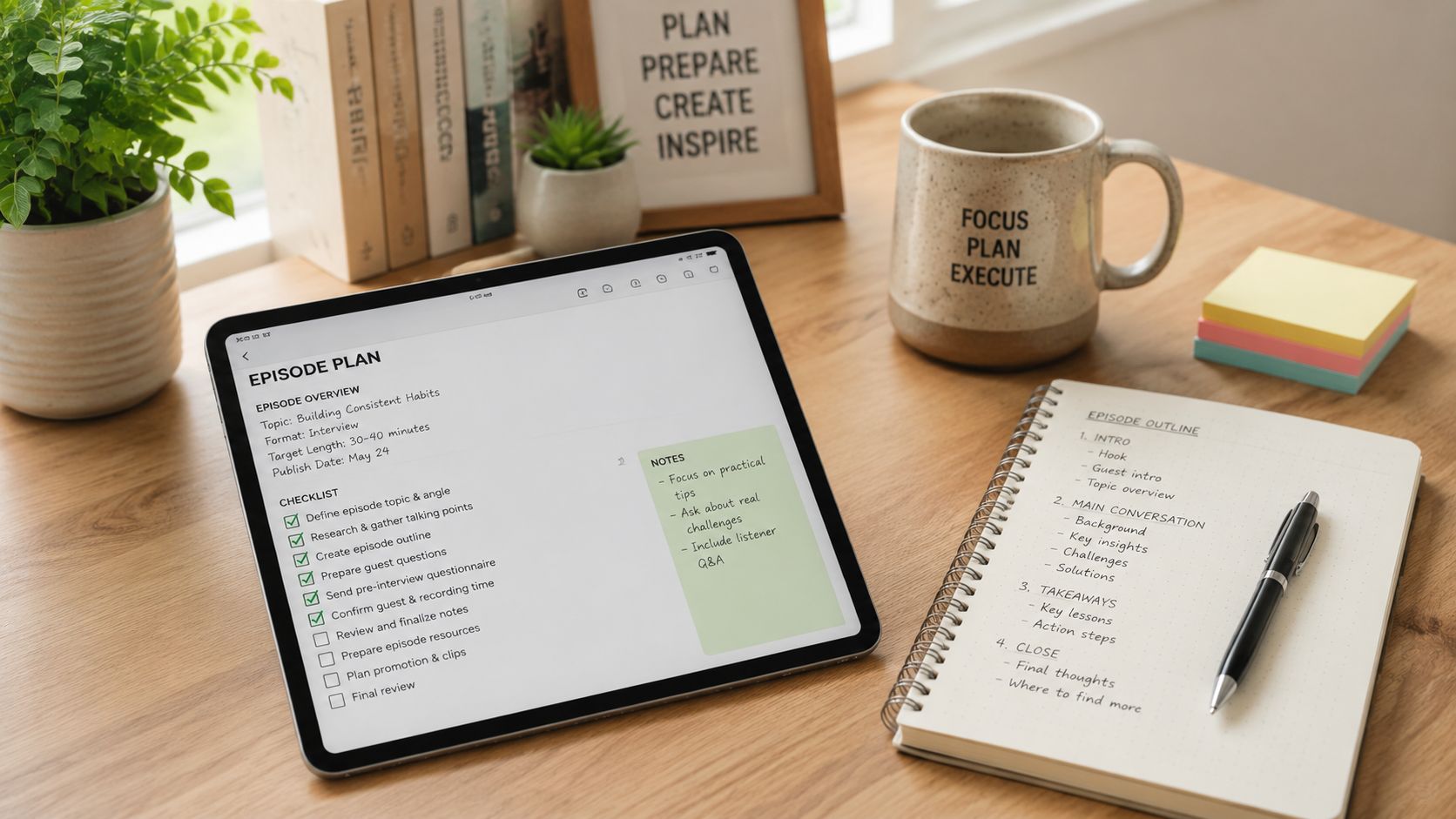
A practical pre-production checklist includes:
- Episode brief: Define the working title, audience problem, desired takeaway, and call to action.
- Run of show: Map the opening, core discussion beats, transition moments, and close.
- Guest prep document: Send topic framing, timing expectations, wardrobe guidance, recording setup notes, and any do-not-cross subjects.
- Question architecture: Write questions in sequence. Start broad, move into specifics, and include prompts that surface stories, examples, and strong quotable lines.
- Tech confirmation: Test camera framing, audio capture, internet stability for remote sessions, local backup recording, and file naming conventions.
One missing pre-production step creates expensive cleanup later. The guest rambles. The host overexplains. The editor has to manufacture structure from a shapeless conversation.
Recording standards that protect the episode
During production, the team's job is to create clean, intentional raw material. That means directing the room, not just pressing record.
The basics matter more than gear shopping lists:
- Audio first: Viewers forgive minor visual imperfections faster than they forgive muddy or inconsistent sound.
- Framing with purpose: Keep eyelines, posture, and shot composition consistent so clips look deliberate on every platform.
- Host control: The host should redirect long answers, clarify vague claims, and ask for examples when a guest gets abstract.
- Segment awareness: Record with future clips in mind. That means pausing between major topics and inviting concise restatements when a strong point deserves a clean pull quote.
A producer's quiet job during recording is to hear the edit before the edit exists.
Brands that want a managed option for this stage often split responsibilities between internal marketing and a production partner. One example is Get Up Productions, which handles branded podcast recording support, editing, YouTube-optimized episodes, and downstream repurposing for teams that don't want production logistics sitting on the marketing director's desk.
Post-production that sets up repurposing
Post-production isn't where the team fixes everything. It's where the team packages good source material for discoverability and reuse.
The post checklist should include:
Edit for clarity, not vanity
Remove repetition, dead air, weak tangents, and phrasing that slows comprehension.Add brand assets carefully
Intro sequences, lower thirds, music, and motion graphics should reinforce recognition without making the episode feel overproduced.Create platform-ready metadata
Write YouTube titles, descriptions, chapter markers, and show notes that reflect the audience's search intent and likely questions.Mark repurposing moments
Identify timestamps for clips, quotable moments, teachable excerpts, and story-driven segments while the edit is still fresh.
A production checklist works when it reduces decision fatigue. If the team has to reinvent the process every episode, the show will eventually stall.
Implementing the Content Waterfall Model
Repurposing gets talked about loosely. A team publishes a full episode, cuts a clip or two, and calls it a day. That isn't a system. It's leftovers.
The Content Waterfall is different because it starts by assuming the primary asset will be intentionally broken into multiple downstream formats, each with its own job. The full video podcast isn't the finish line. It's the source file for an entire release cycle.
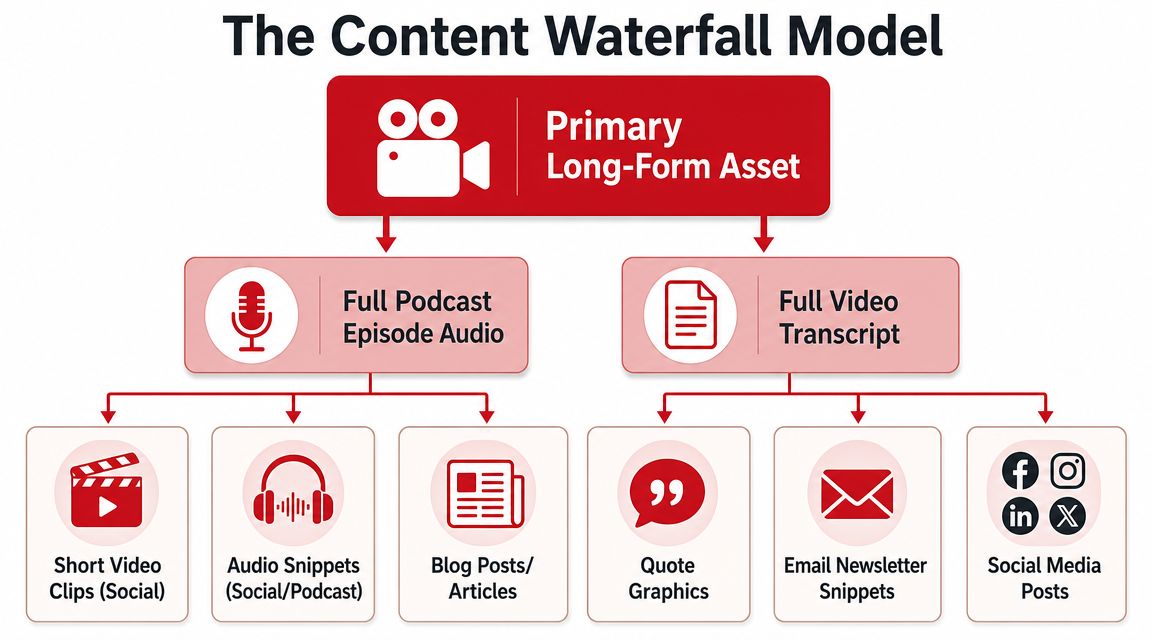
A helpful way to think about the model is this. The team records once, then extracts value at descending levels of depth. Full episode for committed viewers. Clips for discovery. Quotes for fast engagement. Transcript-derived writing for search and email. Every layer carries the same core idea into a different consumption environment.
That aligns with a practical view of branded media. For brands, a podcast or video channel shouldn't be treated as a standalone asset. It should be designed as a content engine that can be repurposed into clips, quotes, audiograms, and interactive pieces suited for the audience's preferred channels, as discussed in this YouTube conversation on content repurposing for brands.
What the waterfall actually looks like
Take a single episode featuring a consulting firm's operations lead discussing why client onboarding breaks after the sale. That one conversation can produce very different assets without changing the underlying message.
The full YouTube episode serves the viewer who wants nuance. A short clip isolates the strongest thirty to sixty seconds. An audiogram gives the audio team something native to podcast-adjacent channels. The transcript becomes a blog post focused on one searchable subtopic. A carousel turns the episode's framework into a sequence of skimmable slides. A quote card highlights one sharp sentence for LinkedIn.
Later in the cycle, the same raw material can support sales enablement. A business development rep can send a clip to a prospect who raised that exact onboarding objection. That's where repurposing becomes operational, not cosmetic.
For teams that want to sharpen this stage, a useful practical read on how to repurpose content for social media can help frame channel adaptation without treating every platform the same.
A visual example helps clarify the flow from one source asset into many outputs:
Content Waterfall Asset Breakdown
| Source Content | Micro-Asset | Primary Platform | Strategic Goal |
|---|---|---|---|
| Full video podcast episode | Full-length upload | YouTube | Authority and long-form consideration |
| Full video podcast episode | Short vertical clip | Instagram Reels, YouTube Shorts, TikTok | Awareness and reach |
| Full episode audio | Audiogram | LinkedIn, Instagram, podcast social feeds | Attention and recall |
| Episode transcript | Blog post or article | Website blog | Search visibility and education |
| Key guest statement | Quote graphic | LinkedIn, Instagram | Engagement and brand perspective |
| Episode framework | Carousel post | LinkedIn, Instagram | Teachability and saves |
| Episode takeaway | Email snippet | Newsletter | Re-engagement and traffic return |
| Q&A section from episode | Sales follow-up asset | Email or direct outreach | Consideration and trust building |
Teams that need a more formal playbook for this process usually benefit from a documented content repurposing strategy so editors, social managers, and marketers aren't making inconsistent decisions episode to episode.
Why this beats isolated repurposing
Generic repurposing asks, "What else can be made from this?" The waterfall asks, "What should be extracted, for whom, and in what order?"
That shift matters because not every derivative asset should say the same thing in the same way. A clip should create curiosity. A blog post should expand understanding. A carousel should simplify a framework. An email should reconnect the audience to one useful takeaway and direct them to the next action.
The strongest waterfall systems don't duplicate content. They translate it.
This is also where underserved audiences and emerging formats matter. A team may learn that one audience segment responds better to direct teaching clips, while another prefers story-led conversations or audio-first summaries. The waterfall allows those preferences to shape packaging without forcing the brand to invent entirely new source material each time.
Establishing Your Distribution Cadence
Production creates assets. Cadence turns them into presence.
Many teams lose value after editing because they release everything at once or let assets sit in folders with no schedule. The result is familiar. A full episode gets one launch post, a few clips appear when someone remembers, and the conversation disappears before the next recording is ready.
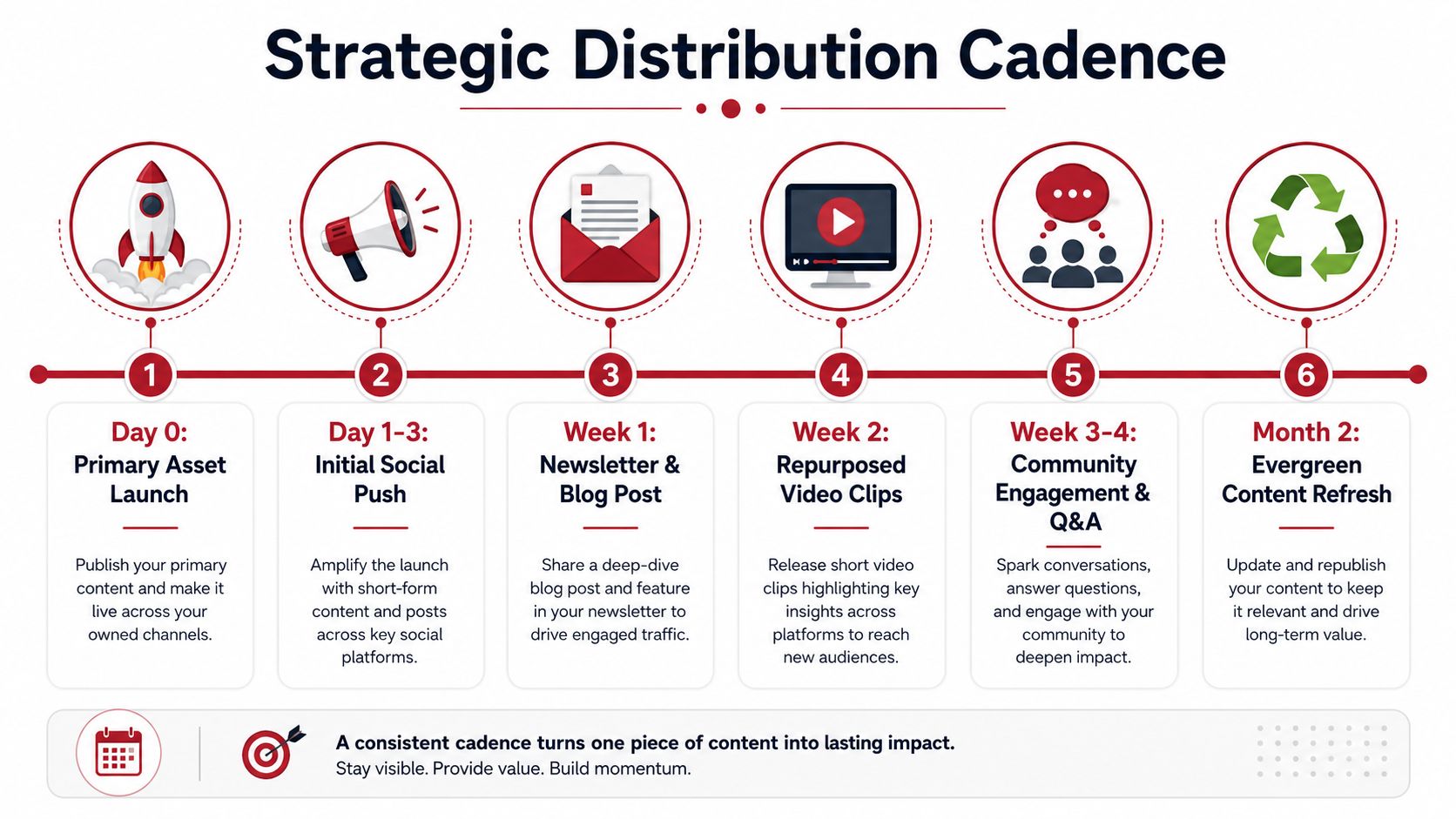
A better system staggers the release. The goal isn't to dump content into every channel. It's to keep the same core topic alive long enough for different audience segments to encounter it in the format they prefer.
A weekly rhythm that stays visible
A simple cadence around one episode might look like this:
- Day 1: Publish the full video episode on YouTube and the full audio version on podcast platforms. Send the main launch post to the brand's highest-priority social channel.
- Day 2: Publish a blog article built from one focused section of the transcript rather than a vague recap.
- Day 3: Release the first short-form clip. Pick the moment with the strongest hook, not necessarily the moment that feels most polished.
- Day 4: Publish a carousel or quote graphic that translates the episode's central framework into a skimmable format.
- Day 5: Send an email snippet that connects one audience pain point to the full episode or article.
- Week 2 and beyond: Drop additional clips, repost a sharpened angle, answer comments, and reuse the most useful excerpt in sales or community conversations.
This cadence works because each asset has a role. The audience doesn't need to consume everything. Different people enter through different doors.
One operational note matters here. Scheduling should support judgment, not replace it. Teams that want to automate your social media content can use scheduling tools to maintain consistency, but someone still needs to decide which asset belongs on which channel and whether the hook fits that audience.
How teams keep cadence without chaos
Distribution breaks when ownership is fuzzy. If everyone touches the content but nobody owns the release sequence, the schedule slips.
A workable approach assigns three layers of responsibility:
| Responsibility | Owner | What they control |
|---|---|---|
| Editorial timing | Marketing lead or content strategist | What goes live, when, and why |
| Asset preparation | Editor or repurposing specialist | Export formats, captions, thumbnails, clip variants |
| Channel execution | Social or community manager | Publishing, comment response, repost timing, audience interaction |
The other trap is publishing every derivative asset with the same caption logic. Audiences don't behave the same way on YouTube, LinkedIn, Instagram, or email. The same source idea should be packaged differently depending on intent. A direct educational angle may work on LinkedIn. A stronger curiosity gap may work better in short-form video. Email usually performs better when the copy promises one concrete takeaway instead of summarizing the whole episode.
A real cadence feels calm. The team knows what asset comes next, what action it's supposed to support, and how long the episode stays active in distribution.
Measuring Success and Scaling Your Team
If the only scoreboard is views, branded content gets distorted fast. Teams start chasing clip styles that attract attention without building the right audience, and hosts begin optimizing for reaction instead of relevance.
Measurement gets more useful when each asset is tied to a business outcome. A video podcast may support awareness at the top, but the program should still connect to practical signals such as qualified inquiries, newsletter growth, repeat engagement from the right buyer profile, lead capture through show notes, or sales conversations influenced by episode content. For teams focused on pipeline, video for lead generation is the right lens because it forces the discussion away from vanity metrics and toward action.
Measure business movement, not applause
A sensible scorecard usually combines channel indicators and commercial indicators.
Channel-level indicators might include:
- Retention signals: Are viewers staying long enough to get the core message?
- Audience quality: Are comments, shares, and replies coming from the right people?
- Content pull-through: Do clips and articles drive traffic back to the full episode, site, or email list?
Business-level indicators go deeper:
- Lead intent: Are prospects referencing the show in forms, calls, or replies?
- Sales enablement use: Are internal teams sending episodes or clips in follow-up?
- Topic validation: Which conversations produce the strongest downstream questions, demo requests, or consultation interest?
A brand show is healthy when audience attention turns into identifiable next steps, not just public applause.
That also changes editorial planning. Topics that create useful sales conversations may deserve follow-up episodes even if they don't generate the most visible social response. Topics that travel well on social but attract the wrong audience should be treated carefully.
The lean team behind the flywheel
The video podcast flywheel doesn't need a huge department, but it does need clear functions. When those functions are blurred, bottlenecks show up quickly.
A lean structure often includes:
Strategist or show lead
This person owns audience fit, episode themes, business alignment, and call-to-action logic.Host or subject-matter expert
They carry the conversation, draw out specifics, and make the brand's point of view audible and memorable.Producer
The producer manages run-of-show, guest coordination, recording logistics, and quality control during sessions.Editor
This role shapes the full episode, polishes audio and video, and marks moments worth extracting.Repurposing specialist
They cut clips, create quote assets, adapt messaging by platform, and maintain consistency across derivative pieces.Distribution owner
This person schedules releases, monitors responses, coordinates with email or sales teams, and keeps the cadence moving.
Some brands assign several of these roles internally. Others split them between a marketing lead and an external production partner. The key isn't where the roles sit. It's whether the work is clearly owned.
When the system is working, content creation for brands stops feeling like endless demand generation theater. One recorded conversation becomes a useful asset library. The team spends less time reinventing and more time refining. Authority compounds because the brand keeps showing up with a recognizable perspective, in formats people already use, on a cadence the team can sustain.
Get Up Productions helps brands build that kind of system around podcast-led content. The company handles branded show production, YouTube-optimized episode editing, and multi-platform repurposing so marketing teams can turn one recording session into a repeatable video podcast flywheel. Teams exploring a podcast-centered content engine can learn more at Get Up Productions.