

Marketing teams are under pressure to publish everywhere at once. A founder needs LinkedIn posts. Sales wants a deck. Someone on the team says the company should start a podcast. Then the month disappears into chasing clips, captions, blog drafts, approvals, and revisions that never seem to add up to a real system.
That's usually the point where companies start looking for a content creation marketing agency. Not because they need “more content,” but because the current way of working is exhausting. The team is producing, but not compounding. Every asset feels like a fresh lift. Every platform feels like another obligation.
The mistake is hiring for outputs instead of hiring for process. A weak agency sells a menu. A useful agency builds a machine.
Table of Contents
- Beyond the Content Treadmill An Introduction
- What a Modern Content Agency Actually Sells
- Calculating the Real ROI of Agency Partnership
- Choosing Your Model Turnkey vs Fragmented Agencies
- The Content Waterfall in Action A Case Study
- Red Flags to Spot Before You Sign a Contract
- Your Agency Evaluation and Hiring Checklist
Beyond the Content Treadmill An Introduction
Most companies don't hit a content ceiling because they run out of ideas. They hit it because their operating model breaks.
A team records a webinar. Nobody clips it. A founder writes a strong LinkedIn post. It never becomes email copy, a short video, or a blog. The company launches a podcast, but every episode dies after publish day because no one owns the post-production chain. The work happens, but it doesn't multiply.
That's why the conversation around content has changed. The global content marketing industry was valued at $413.3 billion in 2022 and is projected to reach about $1.95 trillion by 2032, according to Reboot Online's content marketing statistics. The useful takeaway isn't just market size. It's that companies increasingly treat content like core infrastructure.
A serious content creation marketing agency helps fix the operational problem behind the burnout. It puts structure around ideation, recording, editing, packaging, publishing, and distribution so the internal team stops rebuilding the wheel every week. That's the difference between random activity and a repeatable content engine.
For teams trying to understand what that scale looks like in practice, this guide on scaling video content is a helpful companion because it frames automation as workflow design, not just speed.
Most burnout in content marketing comes from asset-by-asset decision making. Good process removes those decisions before production starts.
That's also why companies exploring podcast-led or video-led growth often end up looking beyond freelancers and toward more integrated marketing and media support. The decision usually isn't about whether one blog post or one reel is needed. It's about whether the business can sustain a publishing system without draining the founder, the CMO, or the internal content lead.
What a Modern Content Agency Actually Sells
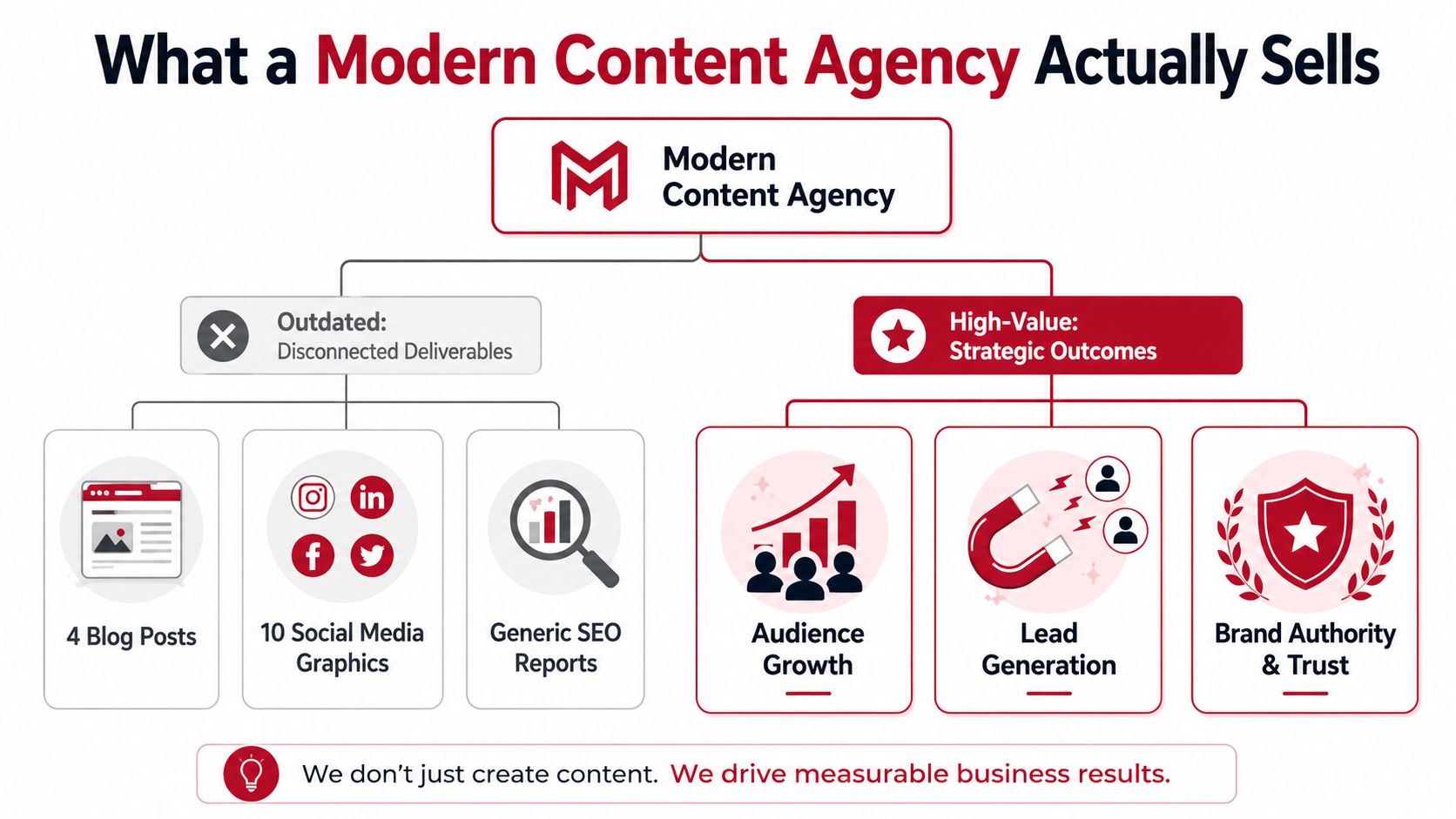
A modern content creation marketing agency doesn't really sell blog posts, reels, or show notes. Those are outputs. The actual product is a repeatable operating system that turns expertise into distributed media.
Deliverables are the surface layer
The outdated pitch sounds familiar. Four blog posts a month. Ten social graphics. A monthly SEO report. Maybe a few email drafts if the package is larger.
That model looks organized on paper, but it often creates disconnected work. The blog team writes one thing. Social posts summarize something else. Video gets handled separately. Sales can't use any of it because the messaging wasn't built around objections, trust, or decision-stage content.
A better agency starts with a source asset and a narrative plan. In many companies, that source asset is a podcast episode, founder interview, webinar, customer conversation, or strategy session. From there, the agency structures what can be extracted, adapted, and distributed.
The real asset is the workflow
The content waterfall is a crucial element. Industry guidance summarized by Column Five notes that 61% of marketers now use AI-assisted workflows to repurpose long-form content into channel-specific assets, as described in their piece on content marketing for data platforms. That matters because the benefit doesn't come from producing one excellent thing. It comes from producing one excellent source and rebuilding it intelligently for every channel that matters.
A strong workflow usually includes:
- Source capture: A podcast, webinar, expert interview, roundtable, or recorded solo episode.
- Editorial extraction: Key claims, usable quotes, objections, stories, and proof points get tagged before editing finishes.
- Format adaptation: Clips for YouTube Shorts, Reels, LinkedIn video, audiograms, email snippets, and article drafts are shaped for the platform instead of copied blindly.
- Distribution logic: The agency knows what publishes first, what follows, and how one asset supports another.
Some teams use internal stacks built around Notion, Descript, Riverside, Adobe Premiere Pro, Canva, and Airtable. Others rely on specialist partners. For buyers comparing tooling approaches, this roundup of AI tools for content repurposing is useful because it shows how many of these workflows now depend on orchestration, not just editing.
Practical rule: If an agency can list deliverables but can't diagram the path from one recording to two weeks of distribution, it's selling labor, not a system.
That's why the highest-value agencies feel less like vendors and more like outsourced content operations. They own the handoffs. They reduce decision fatigue. They make authority scalable.
Calculating the Real ROI of Agency Partnership
The cleanest way to evaluate a content creation marketing agency is to ask what happens after publishing. If the answer stops at impressions, reach, or “brand awareness,” the conversation is incomplete.
The business case has to include demand generation, trust building, and operating efficiency. Content does all three when the agency's process is tight and the measurement is usable.
Lead generation is only one part of the return
One industry summary reports that content marketing can generate 3x as many leads as paid advertising while costing 62% less, and that budgets grow an average of 3.1x faster for businesses that can prove their content ROI, according to Wellows' content marketing statistics roundup. Those figures explain why buyers have become less patient with agencies that only promise activity.
But lead volume alone can mislead teams. Not every content asset is built to close a form fill. Some assets shorten sales cycles because prospects arrive educated. Some give the sales team better follow-up material. Some build enough trust that inbound conversations start warmer than they used to.
That's especially true in podcast-first systems. A buyer may not convert because of a single episode. They may convert because they watched three clips, saw one strong LinkedIn post, read a summary article, then used a podcast page to validate the company's thinking.
Measurement changes the value of every asset
A strong agency measures content in layers, not just in dashboards.
For many organizations, that means tracking:
- Top-of-funnel signals: Which episode topics, article themes, or clips pull in attention from the right audience.
- Mid-funnel movement: Which content pieces get used in email follow-up, sales conversations, retargeting, or nurture flows.
- Bottom-funnel evidence: Which assets show up repeatedly before meetings, inquiries, donor conversations, or demo requests.
An agency that can't discuss attribution models usually defaults to vanity reporting. That's where many engagements go wrong. The content may be polished, but the client still can't tell what's helping pipeline.
One practical benchmark is whether the agency can explain how it will tag campaigns, compare formats, and report on downstream behavior. If the answer is fuzzy, the work will stay fuzzy. Buyers looking specifically at repurposed, multi-channel content can see what a more structured service looks like through a content repurposing agency model that centers distribution rather than isolated production.
The most expensive content program isn't the one with the highest monthly fee. It's the one that produces assets nobody can connect to outcomes.
Operational efficiency matters too. When a founder records once and the agency turns that into a usable content stack, the company buys back internal energy. That doesn't always show up cleanly in a spreadsheet, but it shows up in consistency, lower team drag, and fewer stalled campaigns.
Choosing Your Model Turnkey vs Fragmented Agencies
This is the decision that shapes everything after kickoff. Not budget alone. Not style. The operating model.
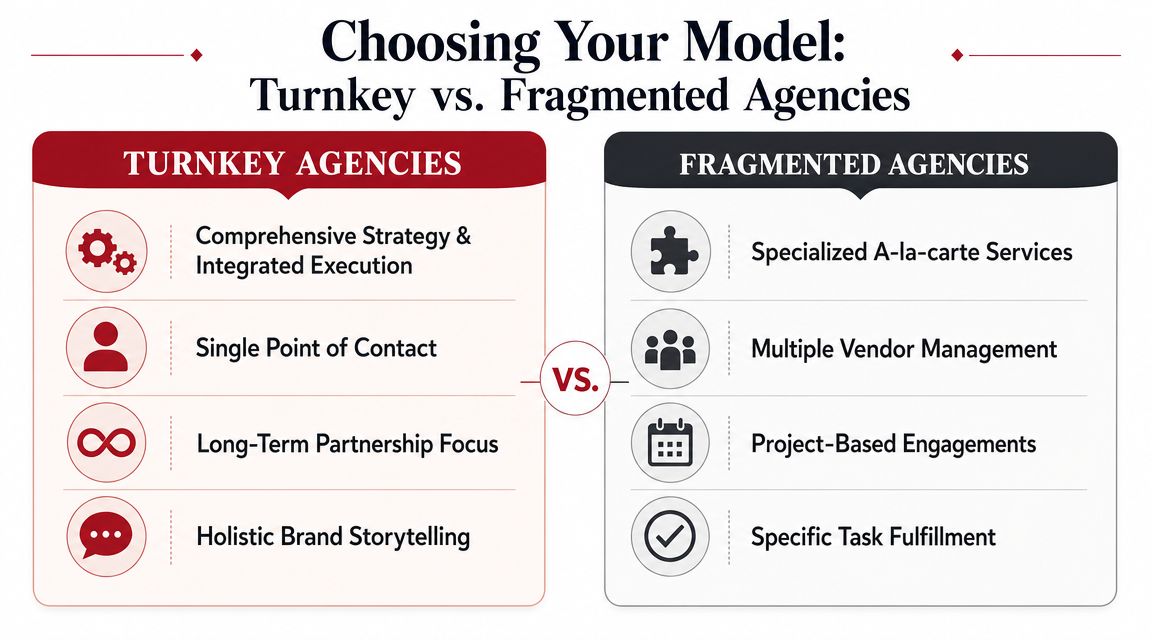
Some companies hire separate specialists. One freelancer edits the podcast. Another writes blogs. A social manager schedules clips. A designer handles graphics when available. That arrangement can work, but only when someone internal is strong enough to run the system.
Where fragmented models work
Fragmented setups usually fit companies that already have a sharp internal marketing lead. That person can write briefs, enforce voice, chase deadlines, and catch strategic drift before it spreads.
They're often a fit when:
- The company already has process: There's a content calendar, approval chain, and a clear owner for every handoff.
- Specialist depth matters more than speed: A niche SEO writer or a highly technical video editor may be needed for a narrow job.
- The brand can tolerate more management overhead: Someone on the team has time to coordinate contributors.
The downside is friction. Every vendor has a different turnaround, creative standard, and interpretation of the brief. Small disconnects multiply fast.
A side-by-side view helps:
| Attribute | Turnkey Agency (All-in-One) | Fragmented Approach (Multiple Freelancers/Agencies) |
|---|---|---|
| Strategy ownership | Centralized | Usually internal |
| Communication | One main contact | Multiple contacts |
| Workflow speed | Higher when process is mature | Slower at handoffs |
| Brand consistency | Easier to maintain | Depends on internal oversight |
| Flexibility | Structured packages and process | High specialist flexibility |
| Management load on client | Lower | Higher |
A short walkthrough of the model comparison is worth watching before deciding:
Where turnkey models pull ahead
Turnkey agencies work best when the company wants one system, not five contributors. They handle strategy, recording support, editing, packaging, repurposing, and distribution under one roof.
That model is usually stronger when:
- Executives are time-poor: The founder or subject matter expert can record, approve, and move on.
- The business wants podcast-led growth: Long-form content needs coordinated extraction to become useful across channels.
- Consistency matters more than endless customization: The team wants a reliable publishing rhythm.
A provider like Get Up Productions offers an example of a turnkey model. It handles podcast recording support, editing, YouTube-ready episodes, and multi-platform repurposing under one process rather than splitting those tasks across separate vendors.
The trade-off is simple. Fragmented models can look cheaper at the start, but the client often pays in coordination. Turnkey models can feel more opinionated, but that structure is usually what prevents burnout.
The Content Waterfall in Action A Case Study
A content waterfall works because it respects reality. Most subject matter experts don't have time to create from scratch for every platform. They do have time to show up for one solid conversation.
One recording session becomes a campaign
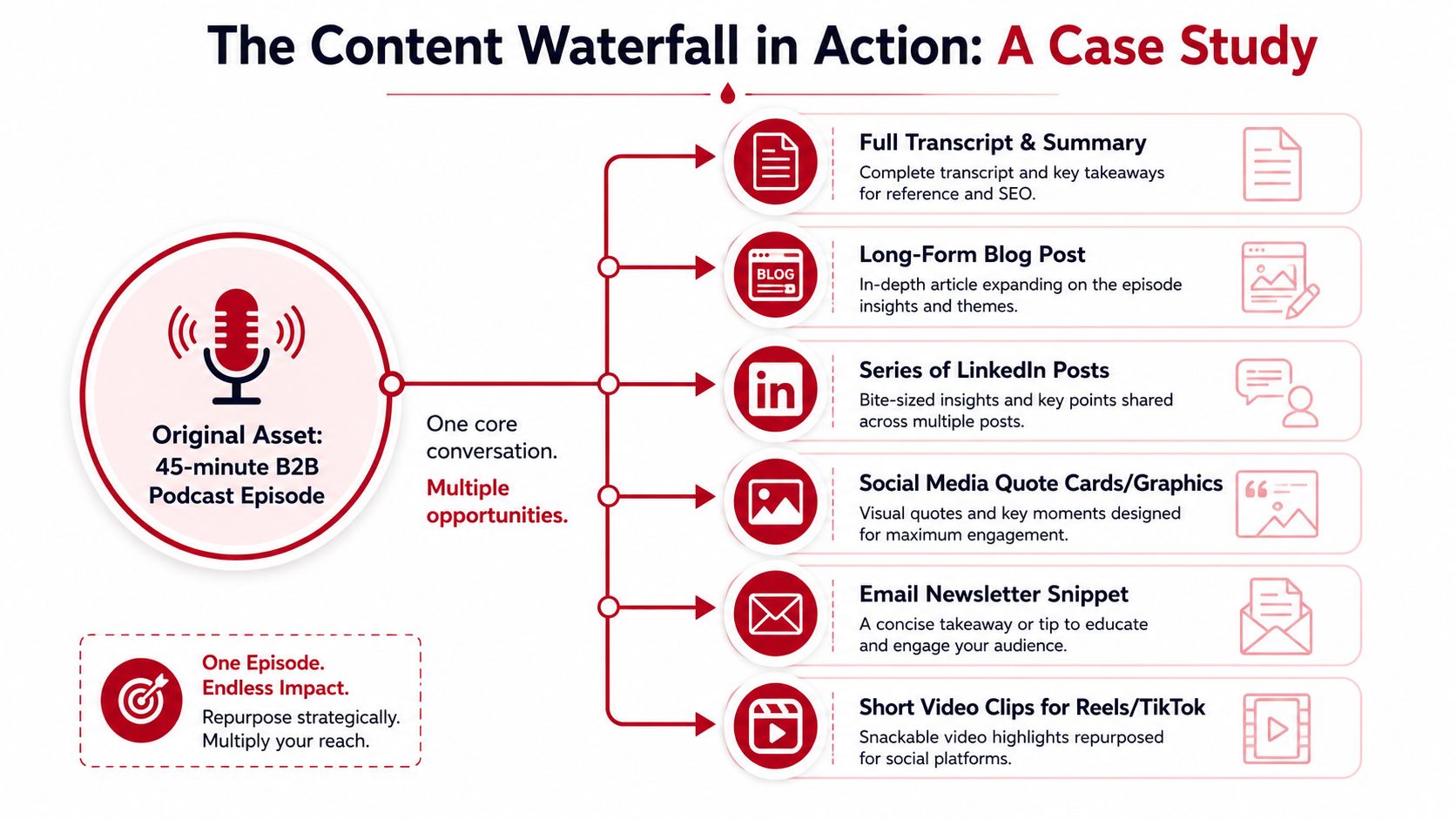
Take a B2B consultant who records a 45-minute podcast episode about why most companies mis-hire agencies by focusing on deliverables instead of process. That single session can feed an entire publication cycle.
The waterfall might look like this:
- Full-length episode on YouTube: Clean edit, branded intro, chaptering, and show notes.
- Audio podcast version: Distributed to podcast platforms for subscribers who prefer listening.
- Short-form clips: Several vertical videos cut around one opinion each, such as hiring mistakes, ROI misconceptions, or why founders burn out on content.
- LinkedIn-native assets: Audiograms or captioned clips paired with a text post written for professional context.
- Quote graphics: Strong one-liners extracted from the transcript and matched to a visual system.
- Article version: A summary or expanded blog post that embeds the episode and gives search and sales teams a readable asset.
That's the mechanical side. The strategic side is deciding which idea belongs where. A sharp clip for Instagram may need a stronger hook and tighter pacing. A LinkedIn post may need more framing and less flash. A blog version should add structure, subheads, and buying context.
One long-form asset doesn't create leverage by itself. Leverage comes from adaptation, sequencing, and distribution discipline.
How this performs in the real world
Podcast-first content often gets judged by the wrong metric. Teams look at downloads and stop there. That misses the actual role the format often plays.
As discussed in Zerys' agency commentary on content marketing agencies, podcast-led content is often strongest as a trust-building and sales-enablement system, not a direct-response channel. That framing helps companies evaluate the waterfall correctly.
A practical review might ask:
- Did prospects reference the episode in a sales call?
- Did the clips outperform generic talking-head content?
- Did the article rank for a relevant buying topic over time?
- Did the sales team start using the episode or clips in follow-up?
For B2B teams trying to connect this kind of content to actual demand, it helps to study how B2B leads can be generated through content systems rather than treating each episode like a standalone campaign.
The best waterfall programs don't ask one asset to do every job. They give each derivative a role, then let the system carry the message further than any single post could.
Red Flags to Spot Before You Sign a Contract
Most agency problems don't start with bad intentions. They start with vague process, inflated promises, and a sales call that stays at the level of deliverables.
A content creation marketing agency should be able to explain how it thinks. If it can only explain what it ships, that's a problem.
Bad agencies talk volume before strategy
The first red flag is speed without structure. If the agency immediately promises more posts, more clips, more platforms, or more output without asking about sales motion, audience, subject matter access, or approval workflow, it's probably selling production capacity alone.
Another warning sign is platform sameness. Some agencies repurpose by copying the same asset everywhere with minor trimming. That usually creates bland content that feels misfit for every channel at once.
According to Mavrk's guidance on content creation agencies, a hidden failure mode is scaling repurposing so aggressively that it dilutes brand voice, especially when agencies mechanically cross-post instead of adapting to platform norms. That issue shows up fast when clips feel generic, captions flatten expertise, or social posts sound like they came from a template library.
Weak process shows up fast
A strong buyer can usually spot weak process by asking a few direct questions.
- Ask how raw material gets selected: If the answer is “we'll make content from whatever you send,” expect inconsistency.
- Ask who owns narrative extraction: Great agencies identify themes, hooks, objections, and quote moments before content gets chopped into pieces.
- Ask how revisions work: If there's no clarity on rounds, ownership, or approval timing, delays will stack up.
- Ask how they preserve voice: A serious team should mention brand references, transcript review, editorial guidance, or platform-specific rewriting.
If every client gets the same workflow, the agency isn't efficient. It's inflexible.
There are softer red flags too. A scattered portfolio. Reporting that stays high-level. Strategy decks that never become operating documents. Fancy language around “virality” with no discussion of editorial discipline.
The sharpest agencies are usually plainspoken. They know where content breaks. They know what the client must provide. They know that repurposing fails when the source conversation is weak, the messaging is muddy, or nobody edits for context.
Your Agency Evaluation and Hiring Checklist
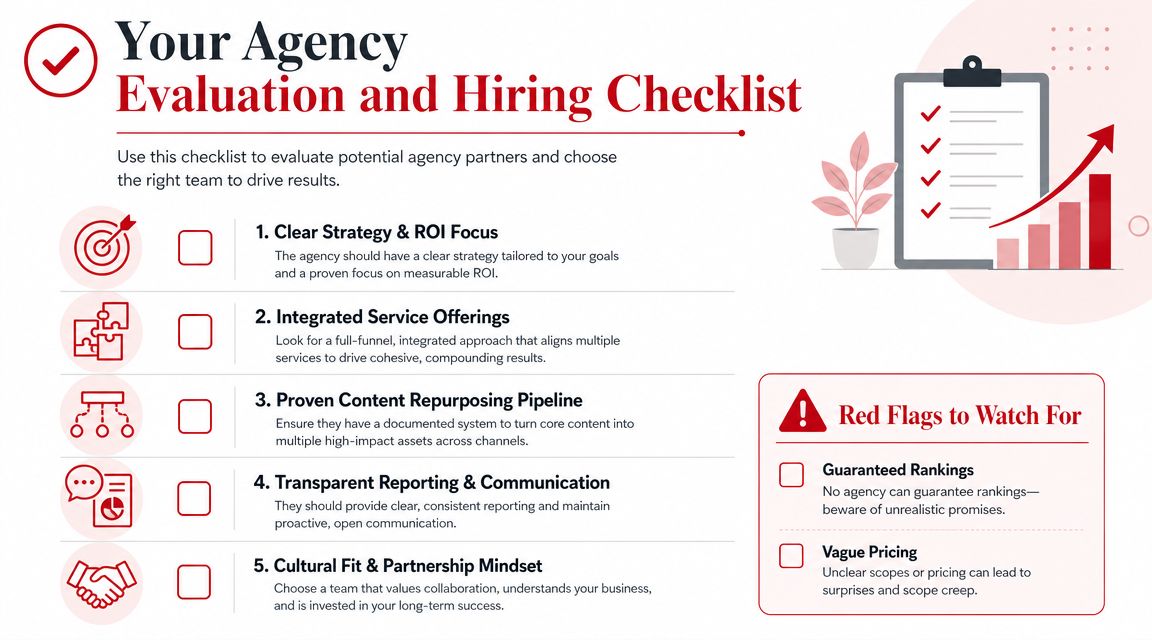
A good hiring process doesn't need to be complicated. It needs to be disciplined. The goal is to compare agencies on how they work, not how polished the proposal looks.
Questions worth asking in the sales call
Bring these into every conversation and write the answers down.
- What is the source-content model? Ask whether the agency builds around podcasts, interviews, webinars, customer calls, or original writing. Strong agencies have a clear view of where raw material comes from.
- How does the content waterfall work? They should be able to map the path from one recording to clips, posts, articles, and distribution.
- Who owns strategy after kickoff? Some firms sell strategy, then disappear into production. That gap causes drift.
- How is success measured? Look for specifics around tracking, reporting cadence, and format comparison.
- How are communication and approvals handled? Good operating rhythm matters as much as creativity. Teams that want a standard to compare against can borrow from these client communication best practices when evaluating responsiveness and accountability.
What to save and compare before deciding
Don't rely on memory after multiple calls. Build a simple comparison sheet.
Include:
- Sample deliverables: One full episode, one clip, one article, one social post.
- Process notes: Turnaround times, revision model, meeting cadence, and required client involvement.
- Voice fit: Whether the work sounds like the brand or sounds agency-made.
- Risk factors: Vague pricing, vague ownership, or no clear measurement plan.
A final shortlist should favor agencies that reduce client burden while preserving strategic control. The right content creation marketing agency won't just ship more. It will make the company easier to market.
Get Up Productions helps brands and experts build podcast-led content systems that cover recording, editing, YouTube-ready production, and repurposing from one workflow. Teams that want a turnkey option for consistent long-form and short-form output can review Get Up Productions as part of their agency shortlist.