
A lot of people land in the same place first. They open LinkedIn, Indeed, or a creative jobs board, type in “content creator,” and get hit with a mess of titles that don’t line up. One company wants a social media manager who can edit video. Another wants a writer who can also run analytics. A third wants someone to host a podcast, cut clips, design thumbnails, and track performance.
That confusion isn’t a sign that the field is broken. It’s a sign that content creation jobs have matured faster than the naming has. The companies hiring often know they need content, but they don’t always know how to describe the work clearly. Job seekers have the opposite problem. They may have real skills, but they struggle to translate them into the language employers use.
This market is worth taking seriously. The global creator economy is valued at US$191.55 billion in 2025 and is projected to reach US$528.39 billion by 2030, with a 22.5% CAGR, according to Tribe Group’s creator marketing statistics. That scale changes the conversation. Content work isn’t side-project territory anymore. It’s a real career track and a real hiring function.
Table of Contents
- The Exploding World of Content Creation Jobs
- Decoding the Four Main Types of Content Roles
- Building the Skills and Portfolio to Get Hired
- What to Expect for Salary and Freelance Rates
- Where to Find Openings and How to Win the Interview
- Choosing Your Path Contract vs Full-Time Work
- A Guide for Employers Hiring Content Talent
The Exploding World of Content Creation Jobs
The demand for content used to feel concentrated in a few obvious roles. A writer handled blog posts. A designer handled graphics. A video editor worked in media or entertainment. That’s not how it works now.
Almost every business publishes. Law firms publish. Consultants publish. Software companies publish. Nonprofits publish. Founders publish under their own names, and then ask a team to turn one idea into a newsletter, a podcast, short clips, social posts, and a landing page. That shift has expanded content creation jobs far beyond traditional marketing departments.
Why this job market feels chaotic
Part of the chaos comes from convergence. Roles that used to sit apart now overlap in daily work. A social media manager may need basic CapCut skills. A writer may need to understand search intent. A podcast producer may need enough YouTube literacy to package an episode well. Employers combine tasks because content moves across platforms, not because they’re always trying to create impossible jobs.
That’s also why job seekers need to think in systems instead of titles. “Content creator” can mean very different things depending on who’s hiring. In one company it means on-camera brand personality. In another it means production operator. In another it means hybrid marketer with strong editorial instincts.
Practical rule: Don’t apply based on title alone. Read for outputs. The useful question isn’t “What do they call this role?” It’s “What do they need this person to ship every week?”
What smart candidates and employers do differently
Strong candidates stop trying to look universally creative and start looking specifically useful. They show they can plan, produce, refine, and distribute content in a business context. Employers who hire well do the same from the other side. They define what success looks like before posting the role.
A useful way to think about this market is simple:
- Job seekers need role clarity. They should know whether they’re better at strategy, execution, distribution, or analysis.
- Employers need hiring clarity. They should know whether they need one versatile operator, a specialist, or outside support.
- Both sides need realistic expectations. One person rarely does every part of content equally well.
That’s the practical map. Without it, people either undersell themselves or hire the wrong person and call the role a failure.
Decoding the Four Main Types of Content Roles
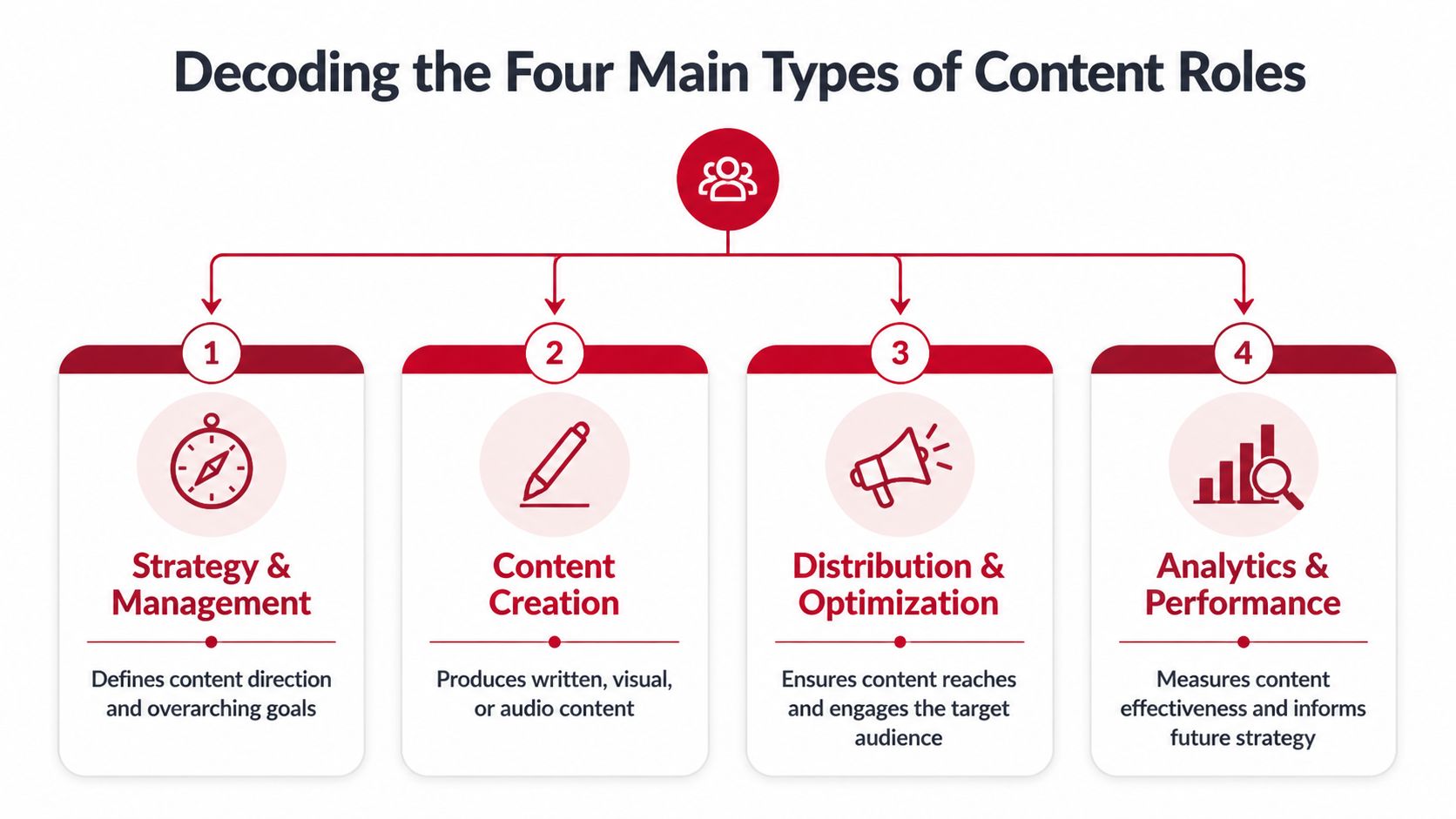
Most content teams look messy from the outside and surprisingly predictable from the inside. The titles vary, but the work usually falls into four buckets. The work can be compared to that of a film crew: someone sets direction, someone creates the material, someone gets it in front of the audience, and someone reads the performance data so the next round improves.
The market behind that work keeps growing. The global digital content creation market was valued at USD 32.28 billion in 2024 and is projected to reach USD 69.80 billion by 2030, driven by a 13.9% CAGR, according to BeOnAir’s digital content creation market summary.
Why titles create so much confusion
One company might call someone a content strategist when they mostly manage a calendar. Another might call someone a producer when they’re mainly a video editor. That mismatch causes bad applications and weak hiring decisions.
The fix is to sort roles by function.
The four pillars that actually matter
1. Strategy and management
These are the directors. Content strategists, editorial leads, brand content managers, and social media managers often sit here. They decide what gets made, why it matters, who it serves, and how it fits business goals.
This work suits people who like pattern recognition, messaging, prioritization, and coordination. They often own briefs, publishing calendars, campaign themes, and approvals. They don’t always make the final asset, but they protect the quality of the system.
2. Content creation
These are the writers, designers, editors, producers, videographers, and podcast specialists. They turn raw ideas into assets people can watch, read, or hear.
This category includes:
- Writing and editorial roles such as copywriters, content writers, and editors
- Visual roles such as graphic designers, motion designers, and thumbnail designers
- Audio and video roles such as podcast producers, camera operators, and video editors
For teams leaning hard into long-form video, short-form clips, and platform-specific packaging, this is often where the most immediate production pressure shows up. A good podcast marketing strategy usually depends on this pillar working closely with strategy and distribution, not operating alone.
3. Distribution and optimization
These people act like the release team. They schedule, publish, adapt, repurpose, and package content so it fits the rules and culture of each platform. Social media specialists, channel managers, and content marketers often live here.
They care about timing, formatting, thumbnails, titles, descriptions, metadata, and audience behavior. A strong creator can produce a great piece of content, but if distribution is weak, the work stalls.
Good content that’s packaged badly often loses to decent content that’s packaged well.
4. Analytics and performance
This group reads the scoreboard. SEO specialists, content analysts, growth marketers, and performance-focused strategists turn results into decisions. They identify what to keep, what to cut, and what to test next.
A lot of teams underhire here. They assume analytics is just reporting. It isn’t. The best performance operators shape future content before it gets made.
Building the Skills and Portfolio to Get Hired
Hiring managers don’t just look for talent anymore. They look for evidence that someone can work inside a repeatable process, use current tools, and make sound decisions when a brief is incomplete.

The tools matter, but judgment is the differentiator. Plenty of applicants can open Adobe Premiere Pro, CapCut, Descript, Canva, Figma, Notion, or a scheduling platform. Fewer can explain why they cut a clip a certain way, why they chose one hook over another, or why a content series should continue at all.
What hiring managers actually want to see
The strongest portfolios show more than polished outputs. They show thinking. Employers want to see whether the candidate can move from idea to execution without drifting off-brief or creating content that looks nice but doesn’t serve a purpose.
Useful proof usually includes:
- A clear role in the project such as scripting, editing, publishing, research, or creative direction
- Platform awareness shown through channel-specific formats like a YouTube description, a LinkedIn post variation, or a short-form cutdown
- Process notes that explain the brief, audience, constraints, and decisions
- Consistency across several pieces, not one lucky hit
A portfolio should answer three questions fast. Can this person make strong work? Can they work with direction? Can they keep doing it under deadlines?
How to build proof before someone hires you
No client history isn’t a dead end. It just means the candidate has to manufacture useful proof.
A practical path looks like this:
- Pick a lane first. Start with one core capability such as editing, writing, social content, or podcast production.
- Create spec work with constraints. Rewrite a weak landing page. Edit a mock interview into clips. Build a sample content calendar for a local business.
- Publish a small recurring series. A niche newsletter, interview format, or short educational video sequence works better than random one-off pieces.
- Work with a nonprofit, local founder, or community group. Real stakes sharpen quality.
- Document the workflow. Show brief, draft, revisions, final asset, and what changed.
Candidates who need help structuring those samples can use a guide on how to create an impressive portfolio so the work reads as professional proof instead of a loose collection of files.
AI changes the skill mix, but it doesn’t remove the need for strategy. Job security concerns are rising with AI integration and the growth of faceless niches. Salaries can range from $22-$68/hour, and job postings increasingly list AI tools for efficiency, according to this YouTube discussion on creative careers and AI. That pushes creators toward higher-value skills like concept development, interviewing, narrative structure, editing judgment, and audience positioning.
A strong example of that shift shows up in video. This walkthrough on how to start a video podcast is useful because it reflects the actual production layers candidates now need to understand, from recording setup to packaging and reuse.
A practical look at the workflow helps more than abstract advice:
Hiring signal: A candidate who can explain their process calmly will usually beat one who only shows finished work.
What to Expect for Salary and Freelance Rates
Money conversations go wrong when candidates anchor on title instead of scope. “Content creator” can describe a junior generalist, a senior video editor, a technical writer, or a hybrid producer who runs half a brand’s publishing engine. Those jobs shouldn’t be priced the same.

What the benchmark salaries actually tell you
The cleanest salary anchor in this field comes from role-specific benchmarks, not broad creator labels. According to the U.S. Bureau of Labor Statistics media and communication data, Film and Video Editors earn around $70,570 annually and Technical Writers reach $91,670.
That tells job seekers two useful things.
First, specialized skills carry weight. A business may like “versatile creators,” but it still pays premiums for people who can solve expensive problems well. Technical writing, strong editing, and domain expertise are harder to replace than generic posting.
Second, salary negotiation should focus on business relevance. A video editor who understands pacing for audience retention, repurposing, and platform packaging is more valuable than someone who only assembles footage. A writer who can extract expertise from subject matter experts and turn it into clear sales or educational content often has a stronger negotiating position than someone who only writes clean sentences.
How freelancers should think about pricing
Freelancers often make one of two mistakes. They charge by the hour for everything, or they quote project fees without defining revision limits and deliverables. Both create friction.
A better pricing approach usually comes down to matching the model to the work:
| Pricing model | Best use | Common risk |
|---|---|---|
| Hourly | Undefined scopes, consulting, overflow support | Rewards time instead of outcomes |
| Per project | Clear deliverables such as one article, one edit, one batch of clips | Scope creep if revisions aren't capped |
| Retainer | Ongoing content systems and repeatable publishing | Bad fit if the client has no cadence |
Freelancers who build recurring work around repurposing, editorial support, or channel management often move toward monthly retainers because the value comes from continuity, not isolated files. Teams exploring that structure can learn from content system examples around content repurposing workflows.
Candidates and freelancers both win more often when they talk about outputs, decision-making, and reliability. They lose when they sell “passion” and leave the business case vague.
Where to Find Openings and How to Win the Interview
A lot of content hires still start on mainstream job boards, and those boards are useful for reading the market. A recent search on Indeed showed 3,501 “content creator” jobs available, with many requiring a mix of social media management and video production skills, according to Indeed job listings for content creator roles.
That number matters less as a promise of easy hiring and more as a signal of what employers expect. They want hybrid capability. Even specialist roles often ask for enough adjacent skill to keep a workflow moving.
Where strong candidates look beyond job boards
Job boards are the visible market. The hidden market lives in referrals, collaborators, founder networks, agency relationships, and people already publishing consistently.
Useful search channels include:
- LinkedIn searches with narrow filters for role, platform, and industry
- Creative communities where editors, designers, and producers share openings informally
- Founder-led brands that may not post widely before asking around
- Agencies and production shops that need overflow talent before full hires
- Cold outreach with customized samples when a business has weak content but clear potential
The strongest outreach doesn’t say, “Available for work.” It says, “This brand has a packaging problem, a consistency problem, or a distribution problem, and here’s how that could be fixed.”
How to interview like a strategist not just a maker
Content interviews often split into two tests. Can the candidate do the craft, and can they think through the business problem behind the craft?
Strong candidates prepare stories around:
- A messy brief they clarified
- A piece of content they improved through revision
- A channel-specific choice they made and why
- A time they handled feedback without getting defensive
- A workflow they used to stay organized under deadline
A weak interview sounds like a portfolio tour. A strong one sounds like a problem solver talking through trade-offs.
“This clip was too slow for the first thirty seconds, so the opening got rebuilt around the strongest line” is stronger than “This is one of my favorite edits.”
Employers should also listen for signs of operational maturity. Good candidates talk about file naming, approvals, deadlines, stakeholder communication, and revision management. That’s the difference between someone who can make content and someone who can hold a role.
Choosing Your Path Contract vs Full-Time Work
A lot of people treat this choice like a personality test. It’s better treated as an operating model decision. Both paths can work. The wrong one usually becomes painful when it doesn’t match the person’s tolerance for uncertainty, structure, and self-management.
The freelance side of the market is large. The US freelance workforce includes 53.7 million people, with over one-third of all US workers now freelancing, and 77% of freelancers are optimistic about the future of contract work, according to nDash content creation and freelance statistics.
Freelance vs Full-Time Which is Right for You
| Factor | Freelance / Contractor | Full-Time Employee |
|---|---|---|
| Income stability | Less predictable month to month | More predictable paycheck |
| Earning potential | Can grow with positioning, pricing, and client mix | Usually tied to salary band and promotion cycle |
| Flexibility | Higher control over schedule and clients | More structure and fixed expectations |
| Benefits | Self-managed | Often provided through employer |
| Career path | Self-directed and nonlinear | Clearer progression inside one organization |
| Administrative burden | High, includes sales, invoicing, and operations | Lower, more focus on assigned work |
The best freelance content creators usually like autonomy, outreach, and the business side of creative work. They can manage dry spells, set boundaries, and keep their own pipeline alive.
The best full-time hires often want deeper immersion. They like learning one brand, working with a team, and improving a system over time instead of constantly selling themselves.
Neither option is automatically more serious. The better question is this. Does the person want to build a client base or build within a company?
A Guide for Employers Hiring Content Talent
Employers usually make the same expensive mistake at the start. They post one oversized role and hope one person can cover strategy, scripting, production, design, posting, analytics, and reporting without bottlenecks. Sometimes that works for a while. Usually it burns out the hire or lowers the quality ceiling.
The real trade-offs in hiring models
There are three common ways to build content capacity.
In-house hire
This works best when the company has steady content demand, fast access to subject matter experts, and enough management structure to support the role. The upside is proximity. The downside is narrow bandwidth. One person can become a bottleneck fast.
Freelancer network
This model gives flexibility and specialist access. A business can hire a writer, editor, designer, and strategist separately as needed. The problem is coordination. Someone still has to own briefs, timelines, brand consistency, and quality control.
Specialized agency partner
This works well when the company needs a full workflow without building a department. It’s especially useful for high-output formats like video, podcasting, and repurposed multi-platform content where strategy, production, editing, and packaging all need to connect. Teams trying to discover ways to boost your content output often end up here because adding headcount isn’t always the cleanest fix.
What businesses should stop doing
A few hiring habits create trouble quickly:
- Writing vague job descriptions that mix senior strategy with junior execution
- Judging candidates on aesthetics alone instead of process and reliability
- Hiring for volume before clarity when there’s no content strategy underneath
- Expecting one creator to solve distribution problems caused by weak messaging or weak internal approvals
The smartest hiring decision starts with one sentence. “What exactly needs to happen every month that isn’t happening now?” If the answer is one stream of work, hire in-house. If the answer is specialist gaps, use freelancers. If the answer is a whole production system, a managed partner is usually cleaner.
Businesses that want authority-building video podcasts and a team that can handle the production, editing, packaging, and repurposing can explore Get Up Productions. It’s a practical fit for brands that want to publish consistently without building the entire engine in-house.