
A lot of businesses reach the same breaking point in marketing. The website lives with one vendor. Social posts come from a freelancer. Video editing sits with someone else. Paid campaigns run through a specialist who rarely speaks to the web team. Nobody owns the system, so the business owner or marketing lead becomes the default project manager.
That setup can work for a while. Then the gaps show up. A campaign drives traffic to a landing page that doesn't match the ad. A strong podcast episode gets posted once and disappears instead of feeding email, short-form video, search content, and sales follow-up. The brand sounds polished in one channel and generic in the next.
That's where agency full service becomes more than a convenience. At its best, it functions like an operating system for marketing. Instead of buying isolated tasks, a company buys coordination, accountability, and a shared plan for turning ideas into repeatable growth.
Table of Contents
- The Hidden Cost of Disconnected Marketing
- What Is a Full Service Agency Really
- Core Services of a Modern Agency
- Full Service vs Specialist Agencies
- Your Checklist for Evaluating Agencies
- Understanding Engagement Models and Pricing
- Conclusion Is a Full Service Agency Right for You
The Hidden Cost of Disconnected Marketing
A common pattern looks efficient on paper. Hire a writer for blogs. Add a freelance designer. Bring in a web developer when something breaks. Contract a video editor for launches. Use an ad buyer for lead generation. Each person is capable. The problem is that capability doesn't equal coordination.
The writer doesn't know what sales keeps hearing on calls. The editor cuts clips without knowing which offers matter most. The ad buyer sends traffic into a site structure built for a different campaign. The business starts paying for motion without getting momentum.
Where the waste actually happens
The hidden cost isn't only vendor overlap. It's decision fatigue. Internal teams spend hours answering the same questions, relaying feedback between people who never speak directly, and fixing mismatches after assets are already produced.
That creates three expensive problems:
- Brand drift: Messaging changes from channel to channel because nobody is protecting one positioning strategy.
- Slow execution: Work stalls while one contractor waits on another contractor's output.
- Lost reuse: Good ideas get published once instead of being adapted across formats.
Practical rule: If the client has to stitch together strategy, creative direction, timelines, and reporting, they don't have a marketing partner. They have a vendor stack.
A full-service agency is supposed to solve that. Not by offering every service under the sun, but by taking responsibility for how the moving parts fit together. That includes planning, production, revision flow, channel coordination, and measurement.
Why this model exists
Modern agencies aren't side projects run on instinct. They're operating businesses with financial discipline and delivery systems. One agency metrics guide notes that U.S. agencies grew revenue by 9.9% in 2022, and it describes 25% net margin as a benchmark target for stronger performance in well-managed firms, according to Resource Guru's agency metrics overview.
That matters because it changes how a client should evaluate agency full service. The question isn't just, “Can they make good work?” It's also, “Can they manage process, staffing, and accountability well enough to keep producing good work over time?”
For businesses trying to simplify disconnected execution, that's the core appeal of an integrated partner. Teams looking at video, podcasting, and campaign support in one connected workflow can see that model in practice through marketing and media production services.
What Is a Full Service Agency Really
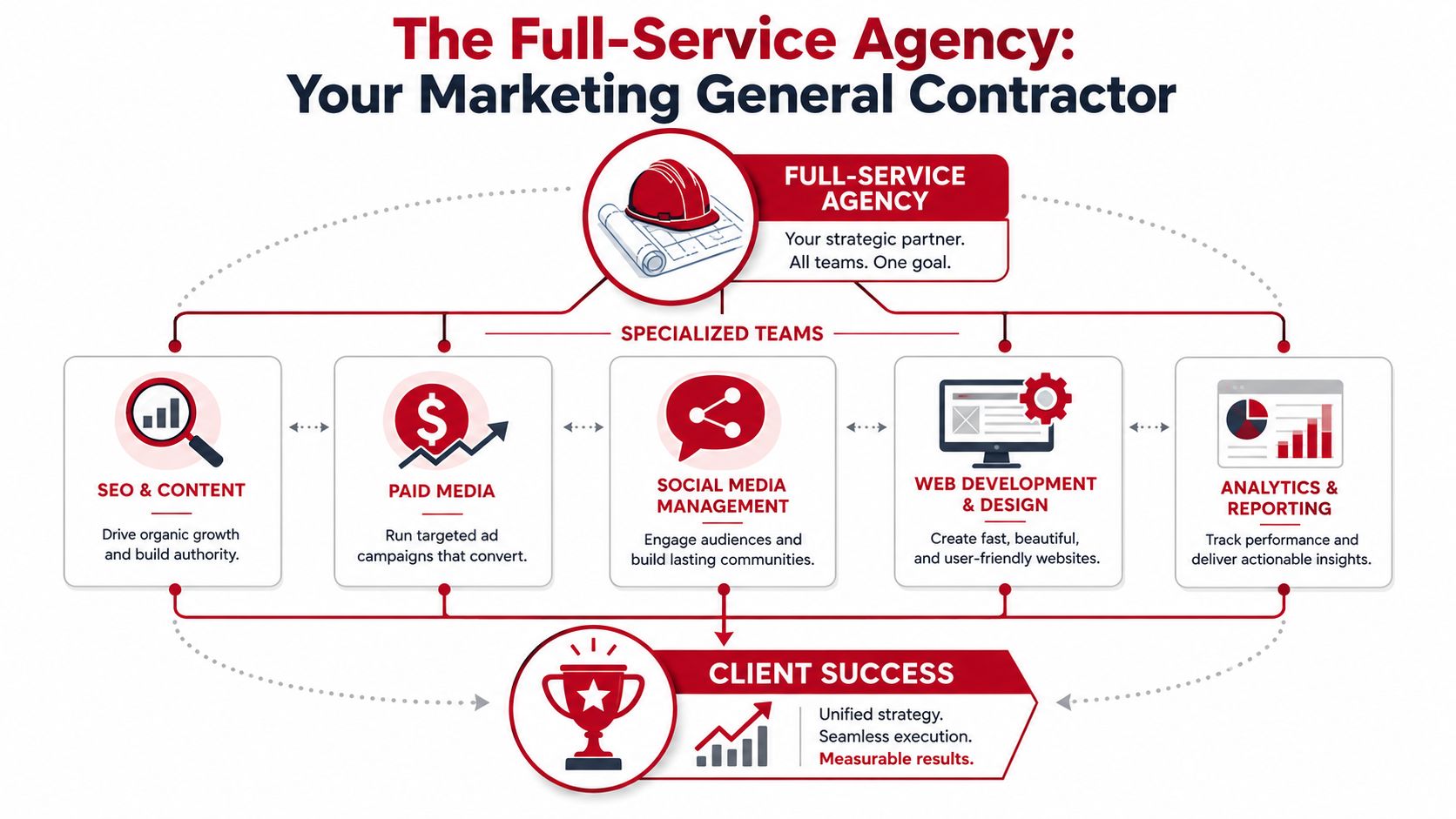
A true full-service agency isn't just a menu of services. It behaves more like a general contractor for growth. A general contractor doesn't win by being the best electrician, plumber, and carpenter individually. The value comes from coordinating all of them into one build that works.
Agency full service should work the same way. Strategy informs creative. Creative informs production. Production feeds distribution. Distribution generates performance data. Then the next round gets smarter because the whole system is connected.
Integration is the product
A lot of firms call themselves full service because they can technically provide many deliverables. That alone doesn't mean much. The structural test is whether the agency is built to integrate functions, route work through accountable ownership, and measure results in business terms.
Cella's in-house agency guidance makes that point directly. It says a true full-service model is designed to integrate multiple functions because fragmentation creates inconsistent outputs, and that the model works best when client use is consolidated through account managers and outcomes are measured in business terms such as revenue, market share, and brand awareness, as described in Cella's guidance on building a successful full-service in-house agency.
The core pillars of a real full-service model
Some agencies organize this well. Others only package disconnected services together. A buyer can usually tell the difference by looking for these pillars:
| Pillar | What it looks like in practice |
|---|---|
| Strategic ownership | One team defines positioning, priorities, and channel roles before execution starts |
| Central account management | A lead contact coordinates deliverables, approvals, and communication |
| Shared production workflow | Designers, editors, writers, and media buyers work from the same brief |
| Business-based reporting | Reporting connects activity to pipeline, revenue, market presence, or another business goal |
A weak model usually breaks at handoffs. A strong model reduces handoffs altogether.
The easiest way to spot fake full service is to ask who owns the outcome when web, content, video, and paid media disagree. If the answer is “it depends,” the client will probably end up owning it.
What clients should expect
A full-service partner should make the business easier to run. That means fewer parallel conversations, fewer contradictory recommendations, and fewer assets produced without a clear job.
It also means the agency should say no when a request doesn't fit the strategy. Coordination isn't passive administration. It's active judgment.
Core Services of a Modern Agency
Most buyers start by asking what services a full-service agency offers. That's fair, but it's not the most useful question. The better question is how those services connect into a repeatable engine.
A modern agency full service model usually includes three clusters. The first is brand and strategy. That covers positioning, messaging, campaign planning, audience definition, and offer development. The second is digital presence. That includes websites, landing pages, SEO support, UX decisions, and the systems that turn attention into action. The third is the one many companies still underuse, content ecosystems.
Brand and strategy
A lot of businesses often cut corners. They jump straight into tactics because tactics feel productive. But when a company hasn't clarified its audience, point of view, offer hierarchy, and conversion path, every downstream asset becomes harder to produce.
A strong agency starts by answering practical questions:
- Who is the audience really: Not everyone who could buy, but the segment the company can serve and persuade clearly.
- What problem gets repeated most often: Sales calls, customer interviews, and support questions usually reveal this quickly.
- What content should carry the load: Some brands need webinars. Others need category pages, founder-led video, or email nurture.
Without those decisions, execution turns into content volume without direction.
Digital presence
A website is often treated like a separate project. It shouldn't be. In a healthy operating system, the site supports the content, the offers, and the buyer journey instead of acting like a static brochure.
That means web design, landing pages, on-page messaging, video embeds, lead capture, and analytics all have to support the same plan. A homepage can't promise one thing while paid ads and social content promise another. A podcast can't build authority if episode pages are thin, hard to use, or disconnected from the next step.
Content ecosystems
Full service becomes tangible. One recording session can either become one upload or a month of useful assets. The difference is system design.
A modern example is full-service video podcast production paired with repurposing. Instead of treating the podcast as a stand-alone show, the agency treats it as a source file for the rest of the marketing machine.
One long-form episode can feed:
- YouTube publishing: Full episode editing, titles, descriptions, chapters, and visual polish
- Short-form distribution: Clips for Reels, Shorts, and TikTok built around specific hooks
- Audio assets: Podcast-ready audio versions and audiograms for social
- Written content: Quotes, newsletters, article drafts, and sales-enablement snippets
- Internal use: Talking points for founders, account managers, or development teams
That's the operating-system view. The content is recorded once, then adapted by format, intent, and channel. A business gets more value from the same expert conversation because every team works from the same source material.
One option in this category is a content repurposing agency model that handles editing, packaging, and multi-platform adaptation after recording. That approach is especially useful for founders, nonprofits, consultants, and in-house teams that have strong expertise but limited production bandwidth.
Good full service doesn't ask, “What else can we make?” It asks, “How many jobs can this asset do before the team creates something new?”
The agencies that do this well don't just create more content. They reduce waste, shorten approval cycles, and make thought leadership easier to sustain.
Full Service vs Specialist Agencies
This decision isn't about which model is better in every situation. It's about which model fits the current problem.
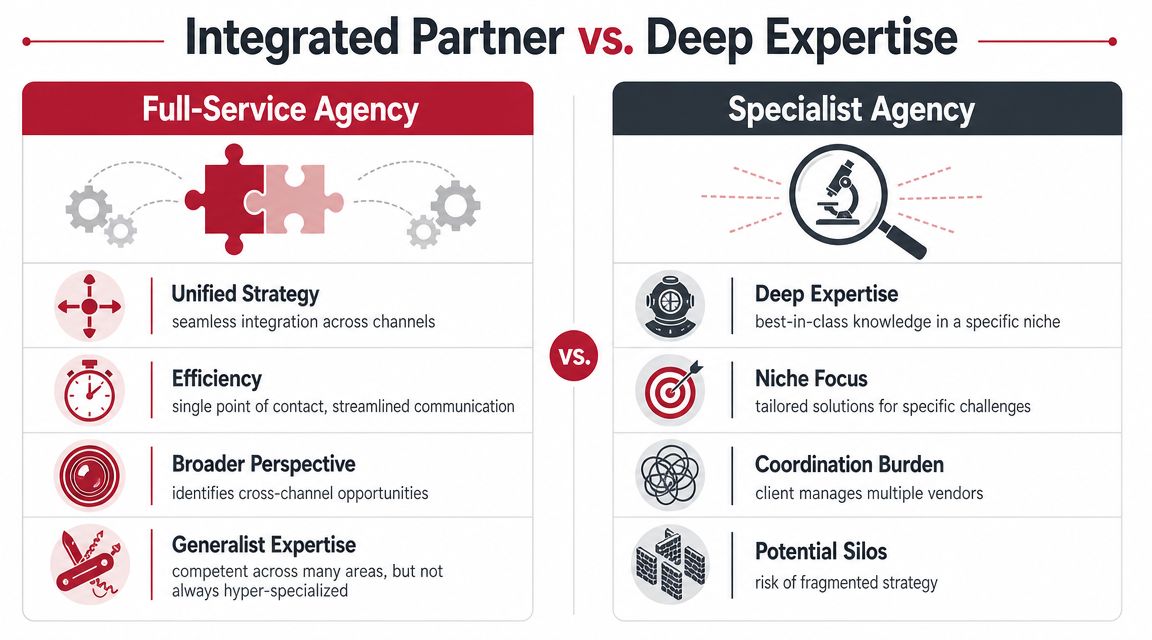
A specialist agency goes deep in one area. That can be the right call when the business has a narrow, high-stakes need. Technical SEO cleanups, complex media buying, influencer campaigns, conversion-rate optimization, or platform-specific creative often benefit from focused expertise.
A full-service agency trades some of that narrow depth for integration. That matters when the challenge isn't one channel. It's the whole system.
Where full service wins
When companies need to align web, content, video, reporting, and campaign planning, one integrated partner usually reduces friction. Fewer people need to be updated. Fewer briefs get rewritten. Fewer assets arrive out of sync.
That doesn't guarantee better creative. It does make coherent execution more likely.
Where specialists win
A specialist can outperform a broad agency when the work requires advanced channel knowledge and the company already has internal leadership to coordinate efforts. That's often the case with mature teams.
For example, a company exploring creator partnerships may want a dedicated resource list such as these best influencer marketing agencies if influencer strategy is the primary growth lever and the internal team can manage the cross-channel integration themselves.
The tradeoff is management load. Specialists often require the client to play conductor.
A quick visual can help frame the choice.
The real question is breadth versus depth
The most important caution is that “full service” can be misleading. Research on agency differentiation points out that even agencies marketed as full service still have meaningful specializations. Clients need to verify whether the firm can deliver strategy and execution across channels, not only package offerings together, as discussed in this YouTube discussion on agency differentiation and the breadth-depth tradeoff.
That leads to a practical buying framework:
- Choose a specialist when the business has one urgent, technical, high-impact problem.
- Choose full service when the business needs a connected system with one accountable owner.
- Choose a hybrid when internal leadership is strong enough to manage a few specialists but needs outside support to fill capability gaps.
A fragmented marketing operation doesn't usually fail because every vendor is weak. It fails because nobody is responsible for the seams.
That's why agency full service is often the better fit for growing businesses. The pain they feel isn't usually a single channel problem. It's the cost of fragmented execution.
Your Checklist for Evaluating Agencies
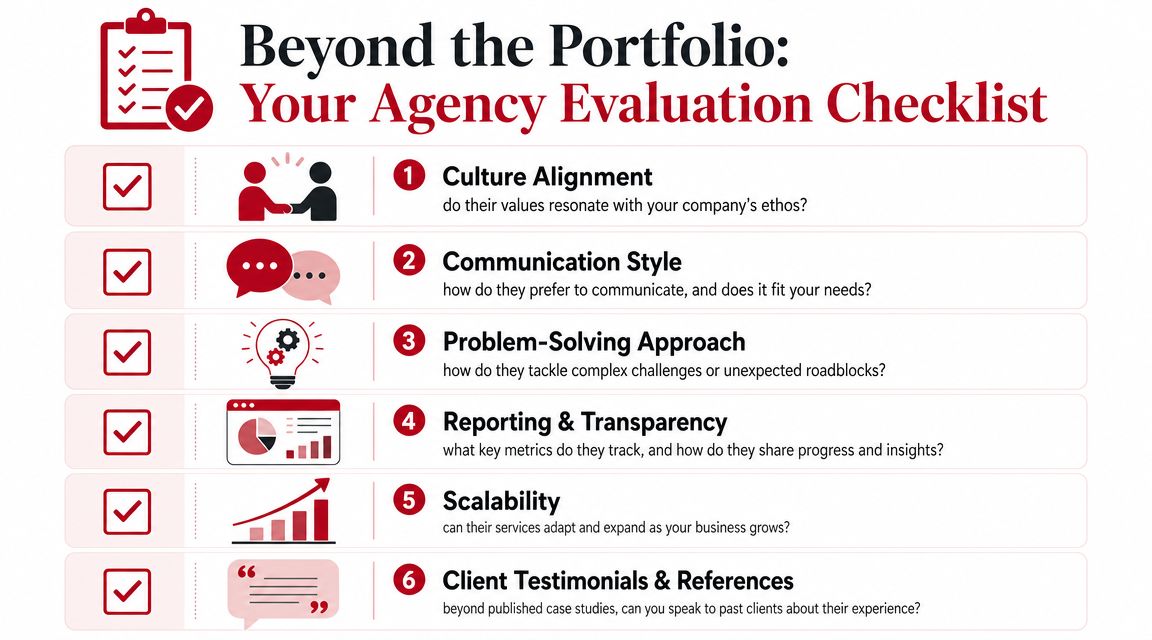
Portfolios are useful, but they don't tell the whole story. Attractive work can hide weak process, unstable staffing, vague reporting, and poor account management. The buying decision gets better when the evaluation moves beyond creative samples.
Questions that reveal how they actually operate
A serious evaluation should test how the agency thinks, not just what it makes.
Use questions like these:
- How do they define success: The answer should connect to business outcomes, not just activity reports.
- Who owns the relationship: Ask whether one account lead coordinates strategy, approvals, and delivery.
- How do they handle disagreement: Good agencies can explain what happens when channel recommendations conflict.
- What do current clients say about process: Published testimonials are less useful than direct reference conversations.
- How do they report progress: The client should know what gets tracked, how often it's reviewed, and what decisions reports are supposed to drive.
One practical way to screen agencies is to review how they talk about content operations and production systems. Teams that regularly publish detailed thinking on topics like workflow, repurposing, and campaign execution often give buyers a better sense of how they work. A useful example is this archive on content creation marketing agency topics.
The financial signal most clients never ask about
There's also a less obvious metric worth understanding: AGI per FTE, or agency gross income per full-time equivalent. Agency Management Institute identifies $150,000 of AGI per FTE as the target, with $130,000 as a comfortable lower bound and anything below that as a concern, according to Agency Management Institute's guide to key agency metrics.
Clients don't need to audit an agency's books. But they should understand what this benchmark suggests. If an agency consistently produces too little gross income relative to headcount, staffing pressure usually follows. That can lead to overextended teams, inconsistent service, and turnover.
A practical screening list
Before signing, check for signs of operating maturity:
| What to check | Why it matters |
|---|---|
| Clear account ownership | Prevents drift, confusion, and duplicated communication |
| Consistent time and scope discipline | Reduces surprise work and messy billing |
| Profitability by client or project awareness | Signals that the agency understands delivery economics |
| Defined minimum engagement fit | Helps avoid becoming a low-priority small account |
| Reference conversations | Reveals what working with the team feels like after the sale |
A good agency should welcome these questions. A weak one usually redirects the conversation back to awards, style, or vague promises.
Understanding Engagement Models and Pricing
Most agency pricing confusion comes from mismatched expectations, not bad intent. A client wants flexibility. The agency wants enough structure to staff the work properly. The right model depends on how defined the work is and how much collaboration the client expects.
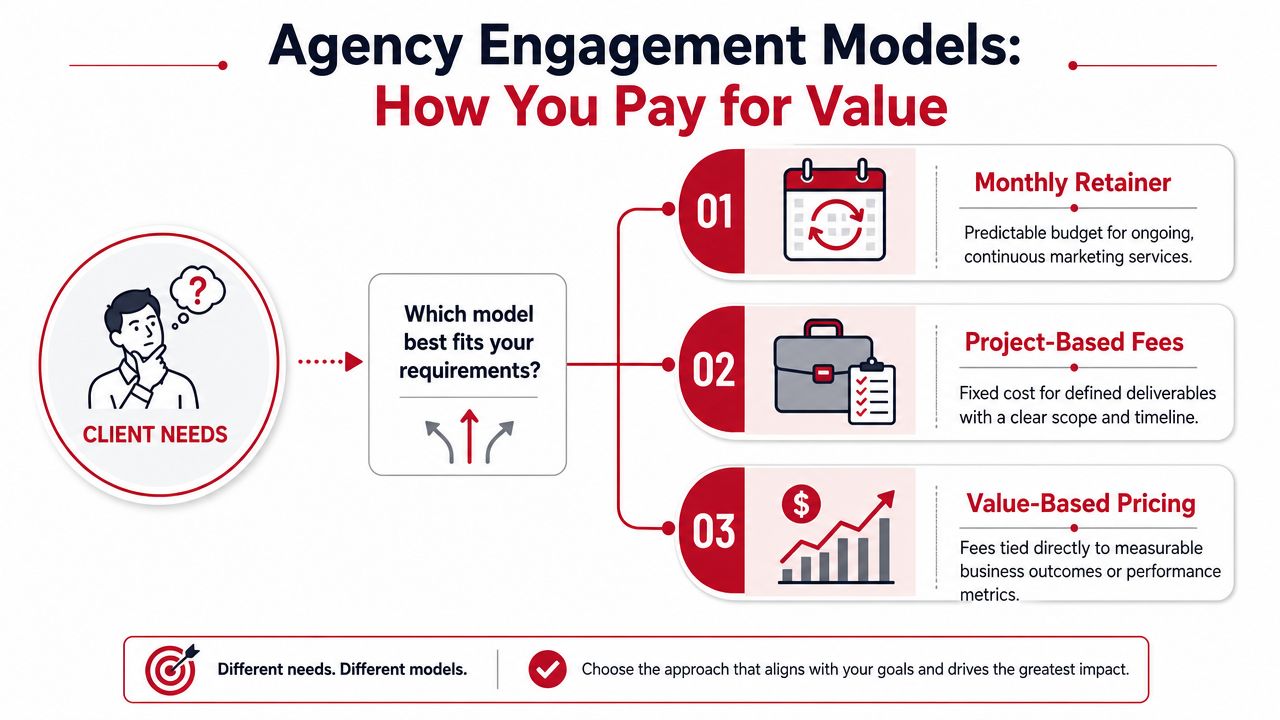
The three common engagement models
Monthly retainers work best when the company needs ongoing support. That could include strategy, content, channel management, reporting, and recurring creative production. The advantage is continuity. The team gets deeper context over time, and the client gets steadier execution.
Project-based fees fit work with clear deliverables and a defined timeline. Website launches, brand refreshes, video podcast setup, or campaign packages often belong here. This model breaks down when scope is loose.
Value-based pricing is less about time or outputs and more about the business result being pursued. This model requires strong trust, clear measurement, and narrow definition around what outcome the agency can influence.
For teams comparing structures and terminology, this overview of Pricing for marketing agencies can help frame the tradeoffs between common pricing approaches.
What drives cost and where budgets slip
Clients often assume pricing rises because agencies are padding estimates. More often, budgets drift because the brief was thin, decision-makers changed direction midstream, or approvals took too long and forced rework.
In project-based work, estimation accuracy should improve when the specifications are clear. Industry guidance says agencies with clear specifications should be able to estimate within ±15%, according to Rains Birchard Marketing's guidance on estimate expectations.
That's a useful standard for both sides. If a client wants tighter pricing, the brief has to include tighter decisions.
Better pricing starts with a better brief. Vague goals produce padded estimates or expensive revisions.
A realistic engagement flow
A solid agency relationship usually follows a sequence like this:
Discovery and diagnosis
The agency reviews goals, audience, current assets, team constraints, and decision-making structure.Strategy alignment
Messaging, priorities, deliverables, and channel roles get defined before production starts.Execution sprints
Assets are produced in batches, reviewed on a schedule, and released according to a shared calendar.Reporting and adjustment
The team reviews what performed, what stalled, and what should change in the next cycle.
This is another reason agency full service can be worth the investment. When one partner runs that workflow across channels, clients spend less time translating between vendors and more time making decisions that move the business forward.
Conclusion Is a Full Service Agency Right for You
A full-service agency makes sense when the business no longer needs random acts of marketing. It needs a system. The appeal isn't just convenience. It's coordinated execution.
That matters most when the company has strong ideas but weak bandwidth, multiple channels but no unifying strategy, or valuable content that keeps getting underused. In those cases, agency full service can turn scattered effort into an operating rhythm. Strategy informs production. Production supports distribution. Reporting improves the next cycle instead of sitting in a slide deck.
It's not always the right answer. Some businesses need a specialist to solve one hard problem. Others already have internal leadership capable of managing several niche vendors. But many growing brands don't need more disconnected hands. They need one partner that can align moving parts, protect message quality, and reduce management overhead.
The decision usually comes down to this. Is the business buying task completion or operational clarity?
If the goal is to build a repeatable marketing engine, especially one powered by long-form thought leadership, video podcasting, and systematic content repurposing, the strongest option is usually the one that treats marketing as an integrated system rather than a stack of unrelated services.
Are you looking for a set of hands to complete tasks, or a strategic partner to help steer the ship?
Get Up Productions helps brands, founders, nonprofits, and thought leaders build that kind of connected content system through turnkey podcast production, video editing, and multi-platform repurposing. Businesses that want a partner to turn one recorded conversation into a broader marketing engine can explore the workflow and service options at Get Up Productions.