
Projected 2026 spending puts branded podcast content at 5% of a $5 billion global podcast advertising market according to Digital Applied. That reframes the category. This isn't a side experiment anymore. It's a serious content asset, and premium episodes command premium investment because brands use them to build authority, trust, and a pipeline that can compound over time.
Most advice on podcast branded content stops at “tell good stories.” That's incomplete. Good branded audio has to do two jobs at once. It has to hold attention long enough to earn trust, and it has to connect that trust back to the brand without turning the episode into a dressed-up ad. When one side wins and the other loses, the show underperforms. It may entertain without converting, or promote without retaining listeners.
The smarter approach is to engineer the narrative the way a strong product team designs onboarding. Each episode needs a hook, a value promise, a clear emotional arc, and a branded takeaway that feels earned. That's how podcast branded content becomes a growth channel instead of an expensive hobby.
Table of Contents
- What Is Podcast Branded Content
- The Business Case for Branded Podcasts
- Choosing Your Branded Content Format
- The Production and Distribution Playbook
- Measuring Success and True ROI
- Branded Content Examples for Your Niche
- Partnering for Professional Podcast Production
What Is Podcast Branded Content
Podcast branded content is a show a company produces to build audience relationship, memory, and trust through useful listening, not rented ad inventory. The goal is bigger than awareness. The show has to hold attention long enough for the brand's point of view to stick.
That is the gap a lot of branded audio misses. Teams focus on making something informative, then wonder why nobody remembers who made it. Good branded content is engineered to do both jobs at once. It keeps the listener engaged and ties that engagement back to a clear brand association without turning the episode into a sales pitch.
A simple test helps. Remove the host-read sponsor line or brand mention. If the episode still has standalone value because the story, insight, or conversation works on its own, you are looking at branded content. If the whole piece loses its reason to exist, you are looking at an ad dressed up as a podcast.
What separates it from ordinary promotion
Traditional podcast ads buy a brief moment of borrowed attention. Branded content works more like owned media. The brand sets the premise, shapes the editorial angle, and decides which ideas it wants to be known for over time.
That ownership changes the economics and the creative standard. A branded show has to earn repeat listening, which means it needs format discipline, a clear audience promise, and a point of view that sounds like a real publication, not a brochure read into a microphone.
Strong podcast branded content usually does three things:
- Holds a distinct perspective instead of recycling safe industry commentary.
- Builds listener habit through recurring segments, questions, or narrative structure.
- Links the brand to a useful idea so recall grows alongside audience retention.
Practical rule: A branded podcast should sound like a media product shaped for a business objective.
That is why smart teams often connect the show to a larger content system. The podcast carries depth. Social clips, creator partnerships, and community distribution carry reach. In some cases, brands also use a platform for brand sales amplification to extend campaign visibility through creators and customer-facing content.
Value sits in ownership. A company can buy impressions anytime. Podcast branded content gives it an audience asset that can teach, entertain, and convert on the same feed.
The Business Case for Branded Podcasts
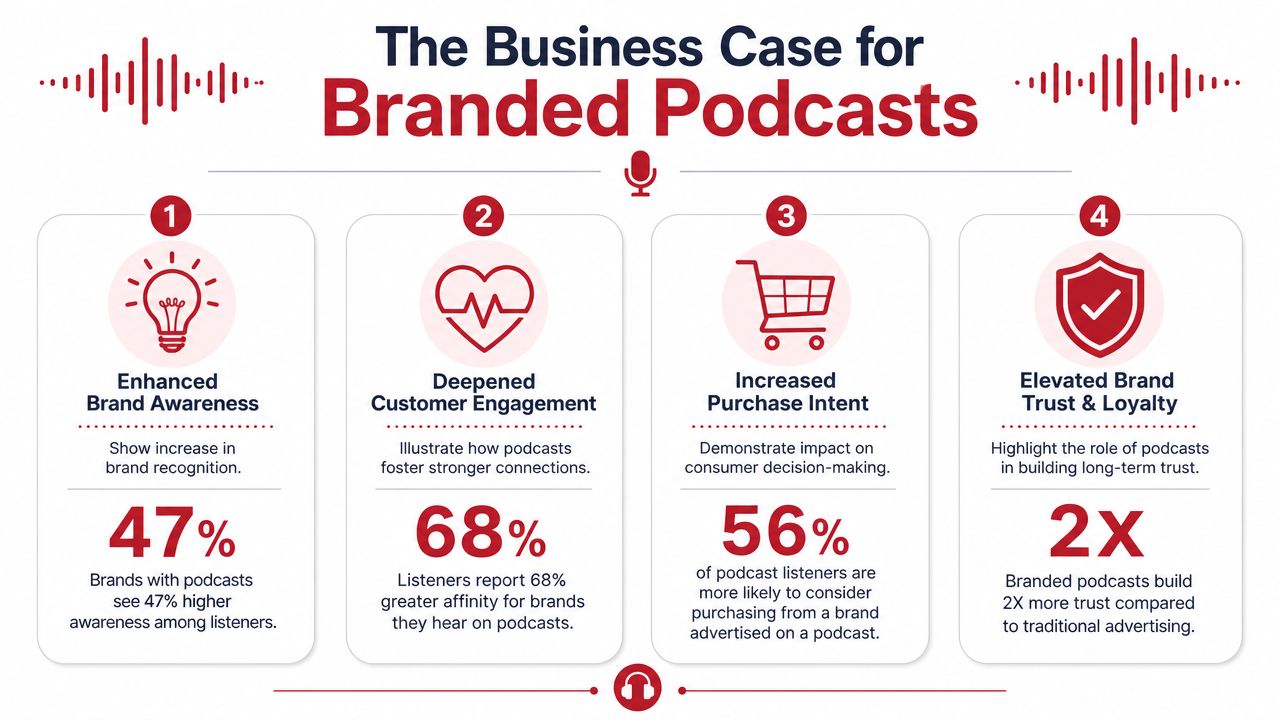
The argument for branded podcasts isn't “audio is trendy.” The argument is that brands need a format that can carry nuance. Buyers don't trust serious companies because of a banner ad or a short slogan. They trust companies that teach well, sound consistent, and show up often enough to become familiar.
A recent industry report found that 90% of brands were satisfied with their podcast results, 76% named thought leadership as the primary goal, and 64% planned to increase podcast budgets according to Quill Podcasting. That combination matters because it shows podcasts are being judged against strategic goals, not vanity alone.
A quick visual makes the case easier to absorb.
Why brands keep investing
The strongest business case usually starts with thought leadership, but it doesn't end there. A well-run show gives a team a place to articulate how it thinks, how it solves problems, and what kind of customer or community it wants to attract.
That changes the role of content. Instead of producing isolated posts, the podcast becomes a source file for the brand's worldview.
- Thought leadership: A recurring show gives executives, founders, and subject matter experts room to explain how they think.
- Brand positioning: Tone, guest selection, editing style, and recurring themes all shape perception.
- Audience growth: A podcast creates repeat exposure, which is hard to achieve through one-off campaigns alone.
A strong branded show doesn't just market a company. It teaches the audience how to understand that company.
The medium also works because people hear judgment, empathy, and confidence in a voice. Written content can explain expertise. Audio can make that expertise feel believable.
Later in the funnel, video can support the same point. This example shows how branded podcast strategy often overlaps with broader media execution:
What strong shows do for the rest of marketing
A branded podcast is rarely just a podcast. It becomes a content engine for clips, newsletters, sales follow-up, community touchpoints, and guest-driven partnerships.
Teams often get the most traction when they use the show to answer the same questions prospects, donors, or followers already ask:
- For B2B firms: episodes can unpack buyer problems that sales calls surface every week.
- For founders: the show can become the cleanest expression of the founder's thinking.
- For nonprofits: the format can carry stories with more care than short social posts allow.
What doesn't work is treating the podcast like a prestige object. If the team can't answer “what business outcome should this influence,” the show usually turns into a calendar burden.
Choosing Your Branded Content Format
Many teams pick the wrong format before they've clarified the job the content needs to do. That's why launches stall. The brand wants growth, trust, leads, and reach all at once, so it chooses a full show when a smaller recurring segment would be more useful.
The biggest strategic mistake is thinking there are only two options. Full podcasts for awareness. Ads for conversion. That binary misses the middle. SiriusXM Media's analysis highlights the middle-funnel role of branded segments, which can deliver native, educational value that moves listeners from aware to interested without a direct pitch in its comparison of branded podcasts and sponsored segments.
Three formats that solve different problems
A fully owned branded podcast gives the brand control over feed, tone, guest mix, publishing cadence, and audience relationship. It's best when the company has a durable point of view and enough operational discipline to keep publishing.
A sponsored series fits when the brand has expertise but doesn't want to build distribution from scratch. The brand aligns with an existing show or network, contributes to the editorial concept, and borrows trust from an established audience.
A branded segment is the most overlooked format. It works like a recurring feature inside a broader show or media property. Think of a short educational section that listeners expect and value. It can do real middle-funnel work because it teaches without demanding a hard conversion too early.
The right format isn't the most ambitious one. It's the one the brand can sustain while still sounding useful.
For teams also debating whether their format should be audio-only or camera-first, this comparison of video podcast vs audio podcast helps frame the production trade-offs.
Branded Content Format Comparison
| Format | Primary Goal | Resource Investment | Best For |
|---|---|---|---|
| Fully owned branded podcast | Authority and audience ownership | High | B2B firms, founders, nonprofits with a clear long-term message |
| Sponsored series | Fast access to aligned listeners | Medium | Brands that want association and reach without building a feed |
| Branded segment | Consideration and trust | Lower to medium | Consultants, educators, spiritual leaders, and brands testing the channel |
How to choose without overbuilding
A simple decision filter works better than brainstorming endless concepts.
Ask four questions:
Does the brand have a repeatable point of view?
If not, a segment is safer than a full series.Is the audience already gathering somewhere else?
If yes, a sponsored series may outperform a new feed.Does the team need trust before asking for action?
If yes, the middle-funnel segment is often the strongest move.Can the brand support editorial consistency?
If cadence will break every few weeks, scale down.
What fails most often is format inflation. Teams assume a big strategic goal requires a big production footprint. Usually the opposite is true. A compact, consistent format beats an impressive concept that never develops audience habit.
The Production and Distribution Playbook
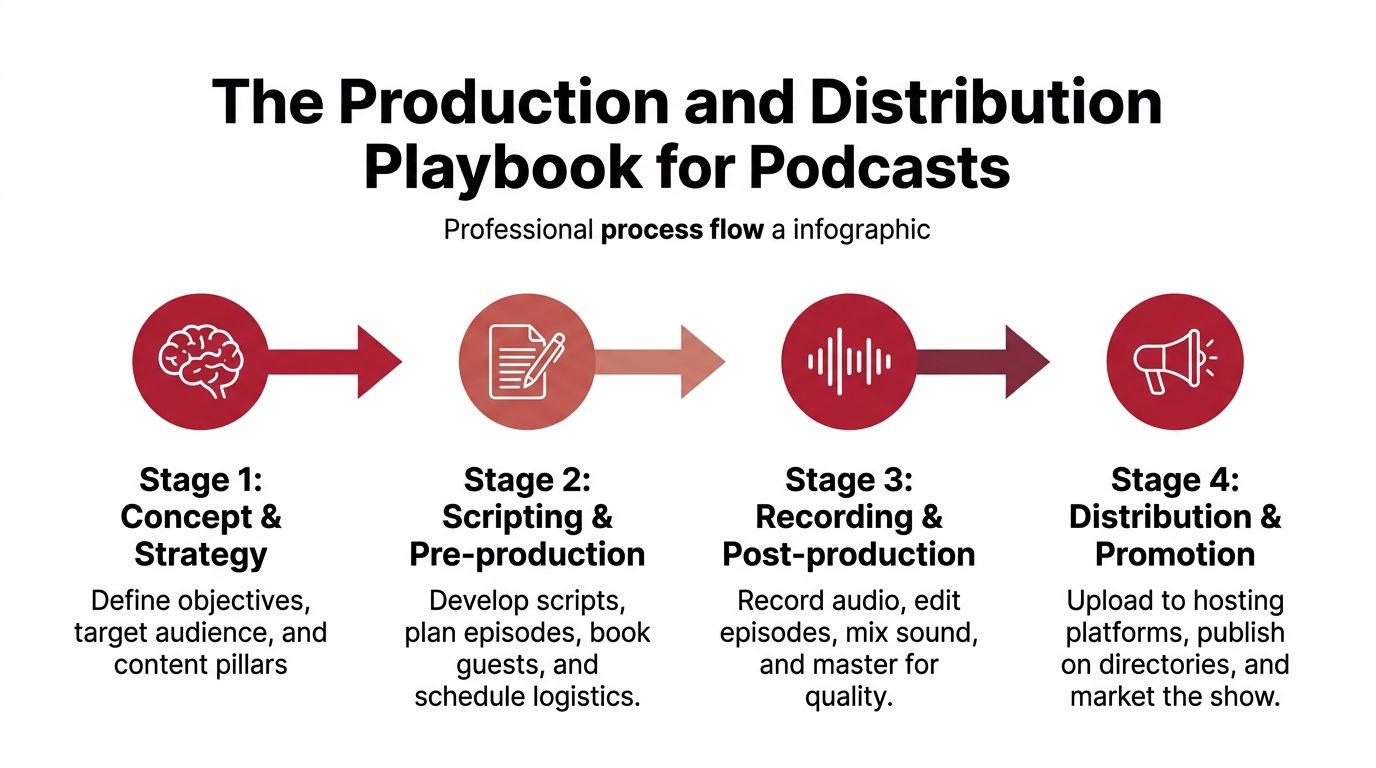
Good shows don't start with microphones. They start with editorial decisions. Production is part craft, part operations. When teams skip the planning layer, every later stage gets expensive.
The workflow below is a useful high-level model.
Build the show before recording it
Most branded podcasts need five pieces defined before anyone books a guest:
- Audience promise: What clear value does the listener get every episode?
- Content pillars: Which recurring themes keep the show focused?
- Narrative shape: Will episodes teach, interview, investigate, coach, or tell stories?
- Brand boundaries: How visible should the brand be inside the episode itself?
- Call to action: What next step fits the listener's level of trust?
Overestimating spontaneity is a common team error. Loose recording creates tight editing problems. A light prep document solves a lot. It doesn't have to be a script. It can be an outline in Google Docs, a guest brief in Notion, and a run-of-show that marks the hook, key beats, and closing CTA.
Then production gets practical. Record clean audio. Control room noise. Decide whether Riverside, Zoom, or an in-studio setup fits the guest mix. Standardize intros and outros. Build templates in Descript, Adobe Audition, or another editing workflow the team can repeat.
For a more detailed launch checklist, this guide on how to launch a podcast is a useful operational reference.
Use a content waterfall, not a one-and-done episode
A premium episode shouldn't live and die as a single upload. The smartest distribution model treats the full episode as source material.
That means one conversation can turn into:
- Short video clips for YouTube Shorts, Instagram Reels, and TikTok
- Audiograms for audiences that still respond well to audio-first snippets
- Quote graphics pulled from clear, opinionated statements
- Email content that summarizes one insight and points back to the episode
- Sales enablement assets such as a curated clip playlist for prospects
Record once. Publish many times. Otherwise the team pays premium production costs for a single content unit.
The waterfall only works when the original recording is structured for repurposing. Hosts need clean transitions, strong standalone quotes, and topic blocks that can survive outside the full episode. Rambling interviews produce weak clips.
Distribution also has to match behavior. A serious buyer may listen on Apple Podcasts or Spotify, then see a clip on LinkedIn later, then finally act through email. That path is rarely linear, which is why branded podcast production has to think like a media system rather than a publishing task.
Measuring Success and True ROI
Podcast ad recall is strong, but branded shows still get cut when teams cannot connect audience attention to pipeline, trust, or revenue. That is the measurement gap. A good branded podcast is not just a media product. It is a conversion system built to hold attention long enough for the brand to be remembered and acted on.
Start with clean measurement. IAB Tech Lab certified metrics give marketing and leadership teams a reporting standard they can trust, filtering out inflated activity and weak data as explained by Fame. Raw downloads are a weak proxy for performance because they cannot show whether the right people listened, stayed, or took the next step.
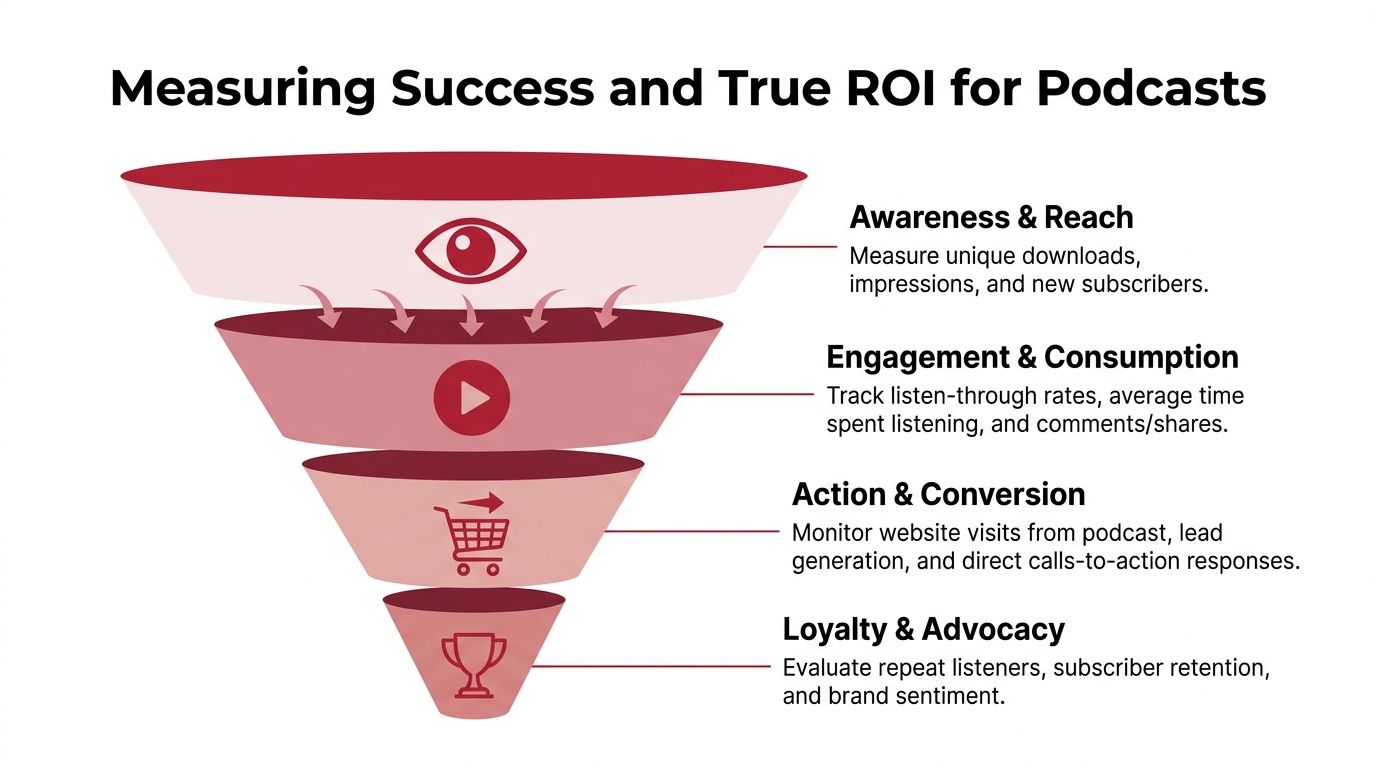
This visual captures the funnel more accurately than top-line download talk.
The metrics that matter
For branded content, unique listeners matter more than total downloads. Unique listener data gives a cleaner view of actual reach, while repeat downloads can make the audience look larger than it is. That distinction matters if the goal is qualified attention, not vanity reporting.
Early benchmarks help set expectations. Strong performance often includes converting 1% to 3% of listeners into email subscribers and reaching average completion rates of 40% to 50%+ according to Troy Lendman's benchmark guide. Content Allies also links early B2B podcast traction to 40% to 50%+ completion rates paired with consistent publishing in its B2B podcast statistics roundup.
Those numbers matter because retention sits at the center of branded podcast ROI. If listeners leave early, the narrative never has time to build memory, trust, or intent. If they stay, the brand has a better chance to educate, differentiate, and convert. That is the bridge between audience retention and brand recall that weak podcast strategies often miss.
A practical dashboard should track:
- Unique listeners: actual reach
- Completion rate: whether the story structure holds attention
- Subscriber growth: whether listeners want a continuing relationship
- Email signups or site visits: whether attention moves into owned channels
How to connect listening to business outcomes
The cleanest way to report direct response is still simple: ROI = (Total Revenue − Ad Spend) / Ad Spend. That formula works best for shows with a clear conversion path, such as demo requests, newsletter signups, event registrations, or attributed sales conversations.
Retention sharpens that picture. The same source notes that episodes retaining listeners for 70%+ of their duration correlate with a 2.5x higher likelihood of downstream action than episodes with early drop-off. That is a practical production lesson, not just an analytics note. A branded podcast needs narrative engineering. The opening has to earn attention, the middle has to keep momentum, and the close has to direct action without sounding like an ad read bolted on at the end.
Brand impact needs a second measurement lane. Controlled exposure studies can isolate brand lift by comparing a group that heard the content with a similar group that did not as described by JAR Audio. This approach is useful when the show's job is to improve perception, trust, or consideration before a buyer is ready to convert.
A team that wants cleaner reporting can also borrow from a broader framework for content marketing success that ties content performance to owned audience growth and downstream business action.
The main rule is straightforward. Match the KPI to the job.
If the show is built for leads, watch completion, subscriber conversion, and handoffs into owned channels. If it is built for reputation, track repeat listening, brand lift, and audience quality. The best measurement plans do not ask one metric to do every job. They connect format, narrative retention, and business outcome so the show can be judged like an asset, not a hobby.
Branded Content Examples for Your Niche
Abstract strategy gets clearer when it's translated into formats a real organization could run. The point isn't to copy a template word for word. The point is to see how the same principles adapt to different missions.
B2B service firm
A consulting firm that sells complex services often needs to prove judgment, not just visibility. A practical show format is a short weekly analysis built around one client problem per episode. The host breaks down what companies usually get wrong, interviews an operator or buyer, then ends with a concise “decision memo” segment.
That works because the listener hears the firm think in public. The show becomes a demonstration of method, not a string of self-congratulation.
If a B2B podcast can't help a prospect make a better decision, it's probably too self-focused.
Spiritual leader or community voice
A spiritual leader doesn't need a business podcast structure. The show may work better as a rhythm-based format. One reflection, one guided practice, one story from the community, and one invitation to continue the conversation off-platform.
The branded element is subtle but still deliberate. The tone, music bed, recurring language, and theological or philosophical framing all build recognition. The audience returns for grounding. Over time, the show can support event attendance, community participation, or deeper engagement without sounding transactional.
Nonprofit or mission-driven organization
A nonprofit often has a trust problem before it has a reach problem. Donors and supporters want proof that the mission is real, thoughtful, and well stewarded. A branded series can center on one impact story per episode, paired with field voices, staff context, and a simple explanation of why the issue matters.
This format works best when the storytelling is specific. One beneficiary story. One volunteer perspective. One clear challenge. One action the audience can take next.
Founders, authors, and creators can adapt the same pattern. Start with the value the audience wants. Build a repeatable narrative shape. Then make the brand the host of that value, not the interruption inside it.
Partnering for Professional Podcast Production
Branded podcasts look simple from the outside because listeners only hear the finished version. Behind the scenes, the work is layered. Editorial planning, guest prep, recording logistics, audio cleanup, video framing, clip selection, metadata, publishing, and repurposing all compete for time.
That's why many promising shows stall after a few episodes. The challenge usually isn't vision. It's execution capacity.
Why specialist support changes the outcome
A professional production partner helps in three places that matter most.
First, strategy gets sharper. The team can pressure-test format, listener promise, episode structure, and brand presence before money gets sunk into the wrong concept.
Second, the production quality becomes consistent. That doesn't just improve sound. It protects trust. A choppy remote recording, uneven pacing, or weak post-production makes the brand feel less credible than it intended.
Third, the content gets fully utilized. Instead of publishing one long episode and moving on, a capable partner helps turn it into a reusable media package. That's often the difference between a show that feels expensive and one that behaves like an asset.
For brands expanding beyond podcasts into spoken-word products, it can also help to understand adjacent production models such as create your audiobook, where narration quality, editing, and listener experience shape authority in similar ways.
Teams evaluating outside support should also know what responsibilities belong to the role. This overview of what a podcast producer does is a useful way to separate strategic production from simple file handling.
The best partner isn't just an editor. It's a system builder that helps the brand publish with discipline, sound like itself, and turn audience attention into a business result.
Get Up Productions helps brands, founders, nonprofits, and thought leaders turn podcast ideas into polished, growth-focused shows. For teams that want cinematic production, strategic repurposing, and a smoother path from recording to real audience impact, Get Up Productions is the place to start.