
A lot of Augusta residents hit the same wall. Trash service seems simple until a cart gets skipped, recycling directions conflict from one page to another, or a move triggers questions about who handles what. Then it turns into a scavenger hunt across city pages, hauler pages, and half-correct local advice.
That's where most frustration starts. Augusta waste management in GA works fine once the system is understood, but it punishes guesswork. Cart size affects billing. Recycling now follows a separate enrollment path. Special materials don't belong in the regular flow, and commercial service is a different world from residential pickup.
This guide brings the moving parts into one place so residents, property managers, business owners, and even local content creators can get to the right answer faster.
Table of Contents
- Your No-Nonsense Introduction to Augusta Waste Services
- Quick Reference Contact and Location Directory
- Residential Curbside Collection Guidelines
- The New Augusta Recycling Program Explained
- Handling Bulk Items Yard Waste and Special Materials
- Commercial Waste Solutions for Augusta Businesses
- How to Start Stop or Change Your Service
- For Local Creators Your Guide to Covering Augusta Services
- Augusta Waste Management FAQ
Your No-Nonsense Introduction to Augusta Waste Services
Most confusion around Augusta waste management GA comes from assuming one provider handles everything. That's not how the system feels on the ground. Residential trash follows one rhythm, recycling now has its own enrollment and billing path, and anything outside normal household trash usually requires a separate step.
That matters because the mistakes are predictable. Residents leave out the wrong container, set carts out too late, assume recycling is bundled into normal service, or try to solve a special-material problem through the wrong channel. None of that gets fixed faster by guessing.
Practical rule: Treat Augusta waste service as three separate lanes. Regular household trash, recycling, and non-curbside materials each have different rules.
The fastest way to stay out of trouble is to think operationally. Ask three questions before doing anything: What type of material is this, who handles it, and does this need curbside service or a separate request?
That approach saves time whether someone is moving into a new home, downsizing to a smaller cart, managing a rental, or running a local business that needs steady pickup without service headaches.
Quick Reference Contact and Location Directory
It usually starts the same way. A cart gets missed, a new tenant asks how to start service, or a business owner needs a dumpster quote before opening day. The delay comes from calling the wrong office first.
Use this directory to match the problem to the right contact.
Augusta Waste Management Contact Information
| Service/Entity | Primary Use | Phone Number | Website |
|---|---|---|---|
| Augusta 311 | General municipal service questions, city service routing, local service guidance | Check official website | Augusta 311 and city services |
| Augusta Curbside Garbage Collection | Residential trash rules, cart guidance, collection basics | Check official website | Augusta curbside garbage collection details |
| Coastal Waste & Recycling | Residential recycling enrollment, billing questions, recycling service details | Check official website | Coastal Waste Augusta recycling page |
| WM Augusta commercial service | Commercial trash and recycling service inquiries for businesses | Check official website | WM commercial trash service in Augusta |
| Local production contact for creator interviews and service explainers | Collaboration inquiries for locally focused service content | Check official website | Get Up Productions contact page |
How to use this list without wasting time
Start with the service line. That single step cuts a lot of wasted calls.
Residential cart issues usually belong with Augusta's curbside system. Recycling enrollment and billing questions usually belong with Coastal. Commercial pickup schedules, front-load containers, and service quotes should go straight to a business hauler. Augusta runs more smoothly once you stop treating all waste questions as one department.
One practical tip from dealing with this locally. If a resident says "trash," ask what they mean. In Augusta, that could mean weekly household garbage, the separate recycling program, yard debris, or a bulk item problem. The answer changes who can solve it.
For business owners, speed matters more than perfect research. If you are opening a restaurant, office, retail shop, or rental property, call the commercial provider that fits your container and pickup needs first, then confirm city requirements after. That order saves time because private haulers are built around routing, container placement, and service frequency. If you want context on why route density affects pickup windows and pricing, this primer on understanding route optimization is useful.
This directory also helps local creators. Podcasters, YouTubers, and neighborhood newsletter writers who cover Augusta services get better interviews and cleaner explainers when they contact the operator responsible for that specific part of the system. For local interview or production help tied to service coverage, use the Augusta creator collaboration contact form.
If the first contact cannot act on the request, ask: "Who owns this service line?" That question gets better handoffs than asking who has information.
Residential Curbside Collection Guidelines
Tuesday morning gets messy fast when the cart goes out late, the lid is propped open, or bags are stacked beside it. In Augusta, curbside pickup works best when the cart is ready before the truck reaches your block and everything meant for collection is inside the cart. The exact service details are listed in the directory above, including cart options and the standard early-morning set-out time.
What the weekly system is built to do
Residential curbside service is designed for repeatable routes, not one-off cleanup jobs. Standard carts speed up collection, reduce spill risk, and help crews move through neighborhoods without stopping to sort out side piles or blocked containers.
Cart size matters more than some households expect. A smaller cart can make sense if your home generates light trash and you want to avoid paying for capacity you never use. A larger cart usually fits better for bigger households, frequent takeout, diapers, or regular packaging waste. The trade-off is simple. Too small means overflow and missed material. Too large means paying for space you may not need.
The other rule that trips people up is placement. A full cart that is easy to grab gets picked up faster than a half-full cart tucked behind a car, tree limb, or basketball goal.
A curbside routine that saves headaches
Use the same routine every week.
- Set the cart out before the stated morning cutoff: In Augusta, crews start early. Putting it out the night before, if your block allows for it, is often the safest call.
- Keep all household garbage inside the cart: Side bags, loose debris, and overfilled lids are common reasons for trouble.
- Make sure the lid closes: If it cannot close normally, the cart is overloaded.
- Leave clearance around the cart: Give the truck a straight approach and keep it away from parked cars, mailboxes, and other obstacles.
- Match the cart to the house: If overflow happens every week, request a larger option instead of hoping the crew takes extra material.
There is a direct operations reason behind these rules. Waste routes run on timing, spacing, and repeatable stops. If you want a plain-English explanation of why cart placement and set-out times affect service windows, this overview of understanding route optimization is worth a few minutes.
Local creators covering Augusta services should pay attention here too. A quick curbside segment for YouTube, a podcast, or a neighborhood newsletter gets more useful when it shows the small mistakes that cause missed pickups. Film the difference between a clear, closed cart and an overloaded one. That helps residents more than reading policy language on camera.
Curbside collection is a weekly container service. Bulk items, yard waste, and recycling follow different rules, and mixing them at the curb is where many avoidable problems start.
The New Augusta Recycling Program Explained
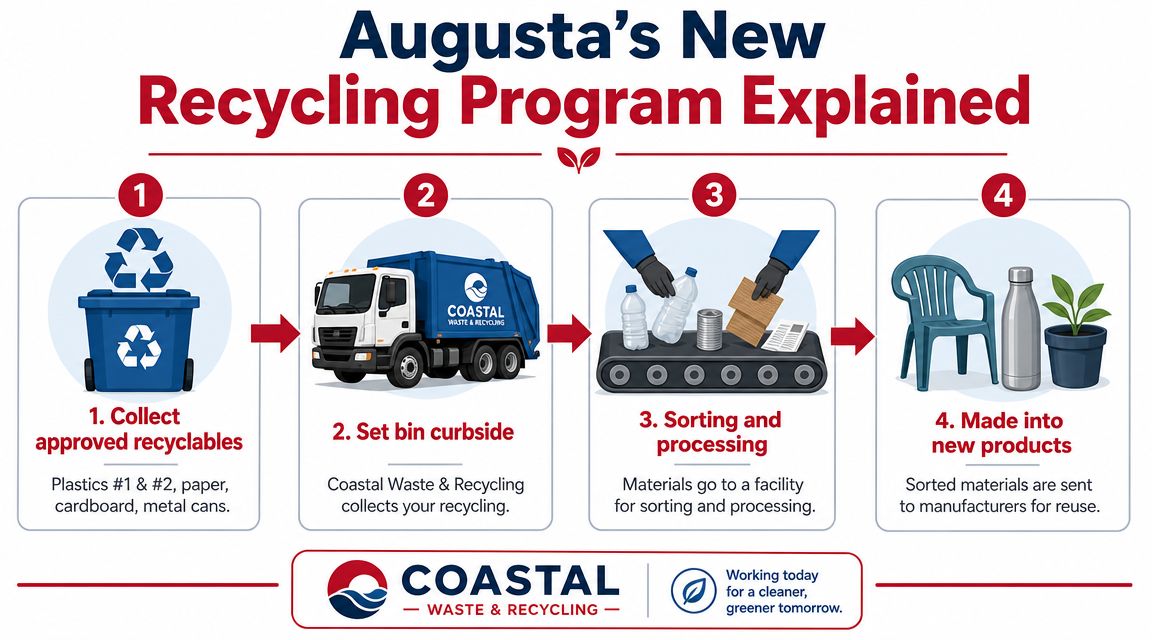
A lot of Augusta households are about to find out the hard way that recycling no longer runs on autopilot. You put out the cart, trash gets picked up, and you assume recycling works the same way. Under the 2025 setup, it does not. Recycling now has its own enrollment and billing track, separate from regular household trash service, as noted earlier in the directory section.
What changed in 2025
The practical change is simple. Residents should no longer assume recycling is bundled in by default with basic trash pickup. If you have moved, started service at a new address, or never confirmed your account under the new arrangement, check your recycling status directly with the provider listed earlier in this guide.
That one step saves a lot of wasted time. I have seen neighbors wait for a cart that was never scheduled because nobody enrolled the address.
Use this checklist:
- Confirm whether recycling is active at your address.
- Enroll if it is not already set up.
- Review the quarterly billing terms before service starts.
- Keep the provider's accepted-material list handy and follow it closely.
This split between trash service and recycling service also changes how you report problems. If your garbage pickup is fine but recycling is missed, treat those as separate service issues. That usually gets you to the right answer faster.
What actually gets Augusta carts rejected
Contamination causes more problems than lack of participation. The usual mistake is wish-cycling. Residents toss in items that seem recyclable, even when the local program does not want them.
The safer approach is narrower and cleaner. Stick to accepted paper, cardboard, cans, and approved plastic containers when they are empty and reasonably clean. Skip greasy pizza boxes, food-soiled paper, plastic bags, tangled cords, mixed-material packaging, and random household clutter. One bad load can create problems for the whole cart.
If your household wants recycling to work, assign it to one person. Someone needs to know whether the service is active, who pays the bill, and which materials are accepted. Shared responsibility sounds fine until nobody checks the account and the cart sits empty for a month.
There is a longer policy angle here that does not get enough attention. Augusta's 2025 recycling changes are not just an account-management update. They are part of a bigger pressure point around disposal capacity, contamination control, and long-term landfill use. Cleaner recycling streams lower handling costs and keep more material out of the landfill. That matters to residents, businesses, and local officials planning beyond this year.
Local creators should cover that angle instead of filming another generic “what goes in the bin” segment. A useful Augusta podcast episode or YouTube short would compare old assumptions against the 2025 rules, then ask what those changes say about landfill policy and city service design. If you want a practical add-on for that coverage, composting is one of the few ways residents can reduce trash volume at home without waiting on another city program. These compost plans for Cumming, GA are a solid starting point for showing audiences what that looks like in real life.
For Augusta households, this is the part of waste service that deserves a fresh check. Trash may still feel familiar. Recycling now requires active setup, cleaner sorting, and a little more attention than it did before.
Handling Bulk Items Yard Waste and Special Materials
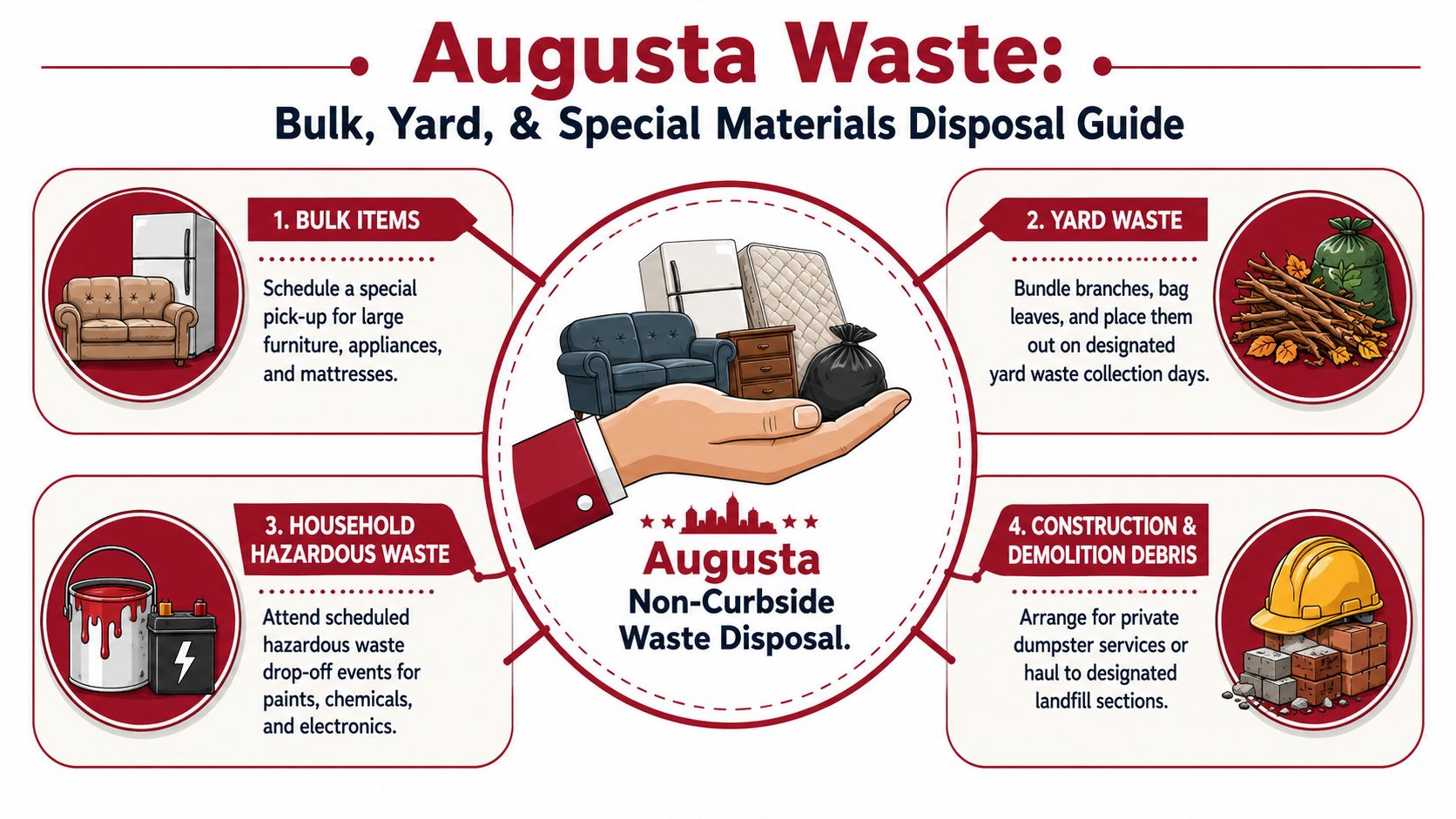
The regular cart isn't a solution for everything. When an item is too large, too messy, too hazardous, or tied to renovation debris, forcing it into the normal stream usually creates a bigger problem.
Treat each waste type as its own job
Here's the practical way to sort these categories before anything goes to the curb.
- Bulk items: Think furniture, mattresses, or appliances. These usually need a special pickup process or another approved disposal path rather than standard cart service.
- Yard waste: Leaves, limbs, and yard trimmings should be prepared according to local handling rules, not mixed into the regular household cart if they fall outside accepted trash guidance.
- Household hazardous materials: Paints, chemicals, batteries, and electronics should be treated as controlled items. They need a separate drop-off or event-based solution.
- Construction debris: Drywall, lumber, shingles, and demolition leftovers belong in a contractor-style disposal flow, not a residential curbside one.
The mistake to avoid is combining categories just because everything came from the same cleanup project. A garage cleanout can easily produce ordinary trash, electronics, paint, and bulky junk in one afternoon. Each one may require a different disposal path.
For yard waste reduction at home, some residents prefer to keep more organic material out of the disposal stream entirely. Anyone looking for practical backyard ideas can review these compost plans for Cumming, GA and adapt the concepts locally.
Why the landfill policy matters to residents and contractors
Augusta's waste system isn't only about carts on the curb. The larger infrastructure story matters too. Augusta's commission voted to revise the waste management plan to allow construction of a new construction-and-demolition landfill, according to Waste360's report on the landfill-related plan revision.
That's relevant because construction and demolition debris behave differently from household trash. Remodeling jobs, roof replacements, tear-outs, and commercial build-outs need dependable disposal capacity. When the local system plans for that capacity, it affects hauling options, project logistics, and where debris can realistically go.
Household waste is the visible part of the system. Debris capacity is the part people notice only when a project starts.
For homeowners, the takeaway is simple. If a cleanup job involves renovation material, don't assume the city cart is part of the answer. For contractors and landlords, disposal planning should happen before the first load comes off the truck.
Commercial Waste Solutions for Augusta Businesses
A Friday pickup missed behind a Broad Street restaurant creates the same problem every Augusta operator knows. The dumpster lid will not close, cardboard starts stacking by the enclosure, and staff lose time dealing with trash instead of customers. Commercial waste service works best when it is planned like staffing, deliveries, and inventory, not left to guesswork.
Augusta businesses have options, but the right setup depends on the mess your operation creates. A medical office produces a very different stream than a coffee shop, apartment complex, church, warehouse, or contractor yard. Copying a neighboring business usually leads to one of two expensive outcomes. You either run short on capacity and deal with overflow, or you pay for pickups and container size you do not need.
Three things matter first.
| Decision factor | What to check | Why it matters |
|---|---|---|
| Waste type | Bagged trash, flattened cardboard, mixed recyclables, bulky debris | Material determines the container style and service schedule |
| Volume pattern | Steady weekly output, weekend spikes, tenant cleanouts, holiday surges | Pickup frequency should match real peaks, not ideal averages |
| Site layout | Alley access, gated enclosure, loading dock, customer-facing frontage | Trucks need room to enter, lift, and exit without repeated service issues |
The practical mistake I see around Augusta is sizing service to a normal week. That fails fast in tourist season, during student move-outs, after a retail promotion, or during a property cleanout. Start with your worst week and build backward. If that number feels too high for year-round service, ask about adjusting pickup frequency instead of jumping straight to a larger container.
Use this process before signing anything:
- Track waste for one full week. Count how many bags, boxes, and bulky items your team throws out.
- Separate cardboard from trash. A lot of businesses are paying to landfill material that could be handled differently.
- Measure the enclosure or pad. Container choices get limited fast by fence width, gate swing, and truck approach.
- Ask about contamination rules. This matters more in 2025 as recycling expectations tighten and service problems get documented faster.
- Review the first month closely. Overflow, loose debris, or half-empty pickups are signs to reset the service level early.
Local businesses that create content or rely on public visibility should pay attention here too. Trash problems become photo problems. A messy enclosure behind a storefront, church, venue, or apartment property shows up in reviews, short-form video, and neighborhood Facebook threads long before management hears the complaint. Teams already investing in social media marketing for Augusta businesses should treat waste areas as part of the brand, not just a back-of-house detail.
One more Augusta-specific point deserves attention. Long-term landfill policy affects commercial operators even if you never think about disposal infrastructure day to day. Construction debris, tenant renovation waste, and build-out material do not belong in regular business trash service. With local landfill planning changing, businesses that manage remodels, turnovers, or contractor traffic should confirm where that material is supposed to go before the job starts. That saves reloading fees, rejected pickups, and arguments at the site gate.
How to Start Stop or Change Your Service
Moves, account changes, and cart swaps create more confusion than weekly pickup does. The easiest way to avoid billing headaches is to separate trash administration from recycling administration before making any request.
For new residents and move-ins
A move-in checklist works better than a one-call assumption.
- Verify trash service through the city path: Confirm that the address is set up correctly for residential curbside service.
- Check cart status at the property: Don't assume the right cart is already there or that the previous occupant left service in clean order.
- Choose the cart size that fits the household: Augusta offers 65-gallon and 95-gallon carts, and the size affects billing, as noted earlier from city guidance.
- Handle recycling separately: If the household wants recycling under the current arrangement, the account should be confirmed through the dedicated recycling provider rather than assumed to be bundled in.
If there's uncertainty during a move, the best practical question is, “Which part of this address setup is city trash, and which part is separate recycling?” That usually clears up the confusion faster than asking generally about waste service.
For move-outs service changes and account cleanup
People often remember to stop power and water. Waste service gets forgotten until a bill arrives or a cart is still assigned after move-out.
Use this sequence:
- Give notice before the move date. Last-minute service changes are where records get messy.
- Confirm what happens to the cart. Don't remove, swap, or abandon city-issued equipment without instructions.
- If downsizing or upsizing, ask specifically for a cart-size change, as the cart choice affects billing.
- Review recycling status separately. A trash change doesn't automatically mean the recycling side has been handled.
- Document the request. Save the confirmation email, account note, or reference number if one is provided.
A practical mistake to avoid is bundling every request into one vague message. “Need to change waste service” is weaker than “Need to stop city trash at this address on this date and confirm whether recycling also needs separate cancellation.”
Short, specific service requests get better results than long explanations.
For landlords and property managers, consistency matters more than speed. A standard move-out checklist for each unit prevents carts, billing, and occupancy records from getting crossed.
For Local Creators Your Guide to Covering Augusta Services
Local creators have an opening here because service content is usually weak, fragmented, or stale. Waste management sounds dull until a resident needs an answer. Then it becomes high-value local content.

Content angles that are actually useful
A creator covering Augusta waste topics should avoid generic “city services” content and go narrower.
- Do a recycling update episode: Focus on the operational change that residents must act on, not broad sustainability talk.
- Interview a city or service representative: Ask what residents get wrong most often.
- Cover a cleanup workflow: Show how to sort a garage, yard project, or move-out into correct disposal channels.
- Look at policy, not just pickup: Georgia's rules require local solid-waste plans to include waste stream analysis, reduction strategies, and public education under the Georgia Minimum Planning Standards. That gives creators a stronger angle than basic curbside instructions.
That policy layer is where a local show can stand out. A good episode doesn't just ask, “When does the truck come?” It asks why service decisions look the way they do.
How to make utility content more watchable
Useful service content still needs packaging. Strong local creators usually build around search intent first, then shape the format. This guide on SEO content for service businesses is a helpful reference for turning practical questions into content people can find.
For Augusta-based shows, topics like “how recycling enrollment works now,” “what not to put in a curbside cart,” or “what contractors should know about debris disposal” are more compelling than broad civic commentary. Local business podcasts can also build recurring segments around city operations, similar in spirit to Augusta Business Daily, where practical local issues become useful ongoing coverage.
Augusta Waste Management FAQ
What should residents do if trash pickup is missed
First, check whether the cart was placed correctly and on time. If the issue appears to be a service miss rather than a set-out problem, contact the city service path used for residential trash questions and report the address clearly.
What should residents do if recycling pickup is missed
Handle recycling through the recycling provider, not through a general trash complaint. The updated setup separates those responsibilities, so the fastest resolution usually comes from contacting the recycling service directly.
Can residents request a different cart size
Yes, residents should ask about changing service to the cart size that better fits actual household waste output. Augusta's residential system uses 65-gallon and 95-gallon carts, and that choice affects billing, as covered earlier.
Can residents get additional containers
The city notes that additional containers are available for an extra charge in its earlier-cited curbside guidance. Anyone considering that option should first decide whether the better fix is a cart-size change, cleaner bagging habits, or less overflow.
How should residents check holiday schedule changes
The most reliable method is to verify through current official service pages rather than relying on neighborhood posts or old calendar screenshots. Holiday adjustments are the kind of detail that becomes outdated quickly.
What's the easiest way to avoid service problems
Keep the system simple. Put regular trash in the proper cart, treat recycling as its own enrolled service, and don't use curbside carts for bulk, hazardous, or renovation debris.
If useful local information matters to a brand, organization, or host, Get Up Productions helps turn practical community topics into polished podcast and video content that people will watch, share, and trust.