
A first visit to Champions Retreat usually starts with a double take. The turn off the road feels understated, then the scale of the place starts to register and the usual Augusta-area golf shorthand no longer covers it.
Table of Contents
- An Unrivaled Golf Destination in the Heart of Augusta
- The Three Legends A Uniquely Forged Legacy
- A Trio of Masterpieces The Bluff Creek and Island Courses
- The Reimagined Club Experience Amenities Lodging and Events
- How to Experience Champions Retreat Access and Membership
- Practical Guide for Your Visit Directions and Tips
- Frequently Asked Questions About Visiting Champions Retreat
- Can non-members play Champions Retreat?
- Is Champions Retreat worth visiting if someone isn't a golf architecture obsessive?
- Is it mainly a golf club or a broader private-club destination now?
- What's the smartest way to plan a first visit?
- Is Masters week the best time to go?
- Can non-golfers enjoy the visit?
- What mistake should first-time visitors avoid?
An Unrivaled Golf Destination in the Heart of Augusta
Champions Retreat Augusta GA sits in that rare category of golf property that means one thing to architecture fans, another to event planners, and something else entirely to Masters-week visitors. It's close enough to Augusta's orbit that every golfer feels the pull, but it has its own identity and its own pace.
What separates it from most “near Augusta” searches is that the appeal isn't just geography. The draw is the combination of elite design pedigree, private-club atmosphere, and a setting that feels built for long golf days rather than quick public rounds.
For golfers who like to study the area before they travel, a good complement to planning this visit is this Augusta National hole-by-hole analysis, because it helps frame why the broader Augusta market carries so much weight for serious players.
Champions Retreat works best when treated as a destination day, not a spare round squeezed between other plans.
That's the practical difference. Visitors who come here expecting a standard upscale club often underplan the day. The ones who get the most from it leave room for practice, meals, and time to settle into the property.
Why this place feels different
The club's atmosphere comes from a blend of seclusion and relevance. It isn't in the middle of Augusta traffic, but it remains tied to one of golf's most recognized destinations.
That creates a useful trade-off:
| What visitors expect | What actually matters |
|---|---|
| A prestige round near Augusta | A full-property experience with logistics that need planning |
| A single standout nine | Three different design personalities on one visit |
| Public-club simplicity | Private-club rules, hosting norms, and access limits |
Those interested in Champions Retreat Augusta GA generally seek information on two fronts. They aim to discover if the destination warrants a visit, or they look for guidance on how to get on property. Both answers are yes, but only if the trip is planned with private-club realities in mind.
The Three Legends A Uniquely Forged Legacy
The first time I explained Champions Retreat to a golfer who had never been, I skipped the usual founding-story polish and gave him the practical version. You are not booking a round built around one architect's preferences. You are stepping into a club built on contrast, where three all-time greats each left a separate imprint on the same property. That difference is the reason the place still stands out.
Champions Retreat was conceived from the start as a three-part design collaboration, with separate nines by Jack Nicklaus, Arnold Palmer, and Gary Player, as the club explains on its our story page. Plenty of clubs attach famous names to a course. Far fewer ask golfers to compare those design instincts in one day.
That shows up in the visitor experience more than many first-timers expect.
The founding idea still matters because it affects how the round feels from hole to hole. Nicklaus, Palmer, and Player brought different preferences for shaping strategy, framing targets, and asking for commitment off the tee. At Champions Retreat, those differences are not hidden under one uniform club aesthetic. They remain part of the day, which is why the property feels purposeful rather than assembled.
That matters for planning. Golfers who enjoy architecture and course strategy usually get more from Champions Retreat than golfers who only want a single signature hole or a quick prestige stop. The club rewards attention. If you notice how one nine asks for patience and another asks for assertiveness, the day gets better.
Practical rule: Champions Retreat is best appreciated as three distinct design conversations, not one luxury round with extra holes.
That is also why the club avoids the museum-piece problem that affects some legacy properties. The famous names are central to the identity, but the place does not feel trapped by them. It feels active, current, and built for actual use, which fits the 2026 visitor experience better than the older mythology-heavy writeups you still see online.
For anyone choosing between this and another high-end Augusta-area round, the trade-off is straightforward. A golfer looking for a pure, uninterrupted statement from one architect may prefer a different club. A golfer who wants to spend a day comparing three championship minds on one property will find Champions Retreat hard to match.
A Trio of Masterpieces The Bluff Creek and Island Courses
The smartest way to think about Champions Retreat is not as one course with extra holes. It's three distinct nines that ask different questions. Golfers who adjust to that usually score better and enjoy the day more.
The club's architecture is uniquely differentiated because it's the only course in the world with three nines designed by Jack Nicklaus, Arnold Palmer, and Gary Player, combining multiple championship design philosophies in one property. In practical terms, that creates varied hole profiles and strategy demands, including risk-reward shaping, forced carries, and precise approach angles, as summarized in the Champions Retreat Golf Club overview.

How the property changes the golf
The property itself does a lot of the work. Champions Retreat's routing is organized into Island, Bluff, and Creek across 365 acres of former timberland, and that scale allows championship-length corridors while preserving buffers, wetlands, and distinct playing environments, as described in the club's story page.
That means a golfer doesn't get the boxed-in feel common at many modern clubs. Holes can breathe. Angles matter more. Misses don't always look severe from the tee, but they often leave awkward recoveries.
A practical approach is to play the day in thirds. Reset expectations at the start of each nine instead of assuming the same shot pattern will hold up across all 27 holes.
Bluff
Bluff tends to feel the most visually dramatic. High views and stronger topographic character shape decision-making before the swing even starts.
Golfers who rely on comfort from a flat lie should pay attention here. Approach shots can ask for better distance control than the yardage alone suggests, especially when elevation changes alter trajectory and landing behavior.
Best mindset for Bluff:
- Trust the number, then verify the landing area: A higher vantage point can make a green look closer or more receptive than it is.
- Favor disciplined targets over hero shots: This is not the nine to chase recovery magic from poor positions.
- Use the terrain as information: The ground gives clues about how the hole wants to be played.
Creek
Creek usually puts strategy front and center. Water influence and shaping demands mean this nine can punish indecision more than outright aggression.
Half-committed swings become expensive. A player doesn't need to play timidly, but the line has to be chosen early and accepted. Golfers who keep trying to steer the ball around trouble often create worse angles than a committed, conservative target would have produced.
A good round on Creek usually looks boring from the fairway and smart on the scorecard.
That's the trade-off. Spectacular attempts can work, but disciplined golf travels better here.
A simple decision filter helps:
| Situation | Better play |
|---|---|
| Narrow visual corridor | Choose the widest safe start line and commit |
| Water influencing the approach | Play to the fattest part of the green complex |
| Between clubs | Lean toward the shot that removes the bigger miss |
Island
Island tends to leave the strongest memory. Water features and more serene visuals can make the nine feel gentle at first glance, but that calm look is exactly why players get loose with club selection and target discipline.
This is often the nine where confidence can help, but overconfidence hurts. The right play isn't always defensive. It's controlled. If a hole invites a bold line, the player should take it only with a clear reason and a stock shot shape that matches the demand.
How to build the best 27-hole day
A full day at Champions Retreat works best with pacing, not urgency. Golfers trying to “see everything” too quickly often miss the property's best feature, which is contrast.
Three habits improve the experience:
- Warm up with intention: The course variety makes a rushed first tee harder to recover from.
- Adjust club selection by nine: The same stock choices won't necessarily translate.
- Save energy for the last stretch: This isn't a place where mental fatigue hides well.
The payoff is that a 27-hole visit can feel like three related rounds rather than one long blur.
The Reimagined Club Experience Amenities Lodging and Events
The old shorthand for Champions Retreat was simple. Great golf, private setting, Augusta adjacency. That's no longer enough to describe what visitors encounter today.
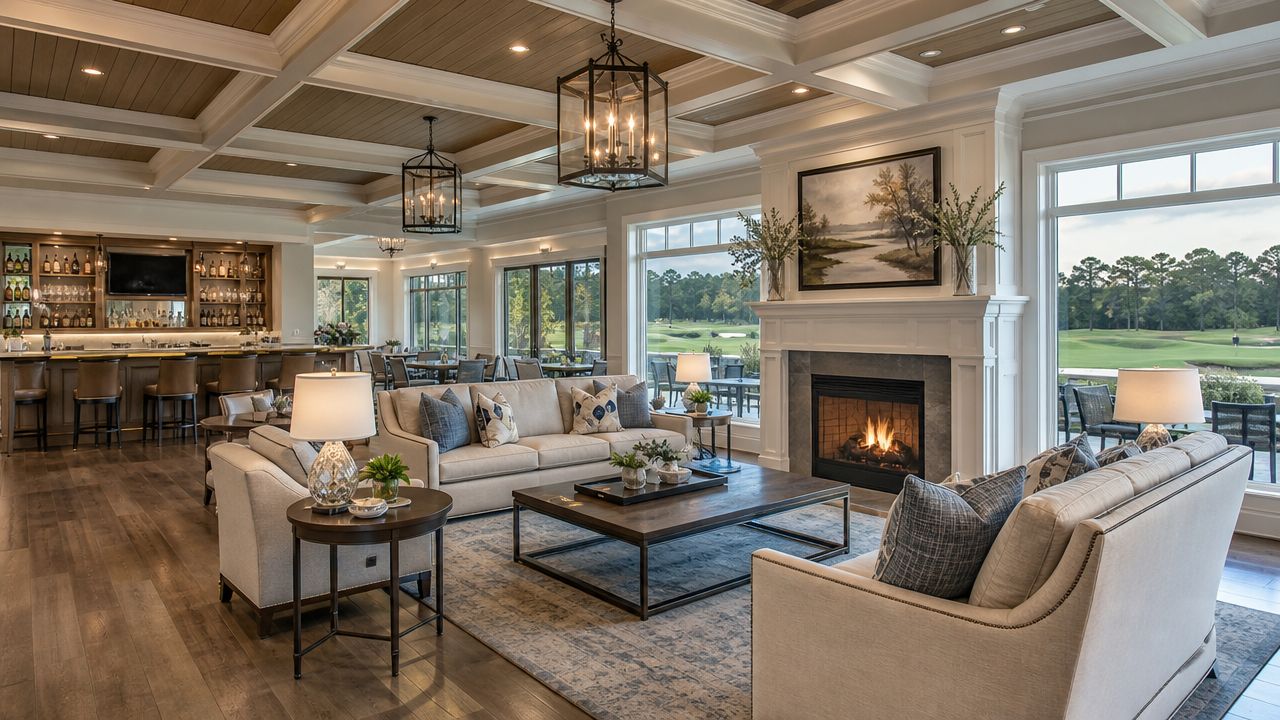
In April 2026, Arcis Golf announced that the club completed phase one of a multi-million-dollar transformation, including new dining venues, culinary upgrades, refreshed amenities, and course and practice-area improvements, repositioning it as a fuller private-club hospitality destination, according to the renovation announcement from Arcis Golf.
What changed in 2026
The practical takeaway isn't just that the club improved finishes or refreshed spaces. The bigger shift is that Champions Retreat now asks to be evaluated as a hospitality environment, not only as a golf venue.
That alters how different visitors should consider it:
- Golf groups: Don't plan the trip like a drive-in round with a quick lunch. The upgraded food and club spaces reward a longer stay.
- Corporate planners: The venue has stronger all-day usability because golf is no longer the only anchor.
- Wedding and social-event clients: The club presents more like a private destination than a single-purpose sports property.
A useful local comparison point for how brands shape polished visitor-facing experiences is the broader Augusta creative and marketing landscape, where presentation and environment often matter as much as the core service.
Who gets the most value from staying on site
On-site lodging changes the trip more than most first-timers expect. The gain isn't only convenience. It's rhythm.
Guests who stay on property can separate arrival, golf, dining, and downtime without re-entering Augusta traffic or rebuilding the day around transportation. That makes a meaningful difference for groups with mixed priorities, especially when some people want golf and others care more about meals, social time, or event programming.
The strongest fit for lodging is usually one of these groups:
| Visitor type | Why staying on site helps |
|---|---|
| Corporate retreat attendees | Keeps meetings, hospitality, and recreation in one place |
| Wedding parties | Simplifies movement across events and reduces day-of stress |
| Masters-week visitors | Preserves time and energy during a crowded week |
| Buddy trips | Turns one round into a fuller shared experience |
Why events work here better than at a golf only club
A lot of private clubs can host events. Fewer can absorb them well without making non-golfers feel like secondary guests.
That's where the renovation matters most. Refreshed amenities and stronger dining give event planners more room to build a balanced schedule. Golf can remain the centerpiece, but it doesn't have to carry the whole experience.
This video gives a clearer feel for the property's hospitality side and overall atmosphere:
The best use of Champions Retreat is usually a blended one. Golf anchors the visit, but the club now supports everything around the round much better than older coverage suggests.
That's the key update for 2026. Anyone planning from outdated assumptions may still think of Champions Retreat as a prestigious course with some supporting amenities. The smarter read is the reverse. It's now a more complete private-club destination built around golf, lodging, dining, and hosted experiences.
How to Experience Champions Retreat Access and Membership
Most searchers ask the same practical question: can a non-member get in? The answer is yes, but not in the normal public-golf sense.
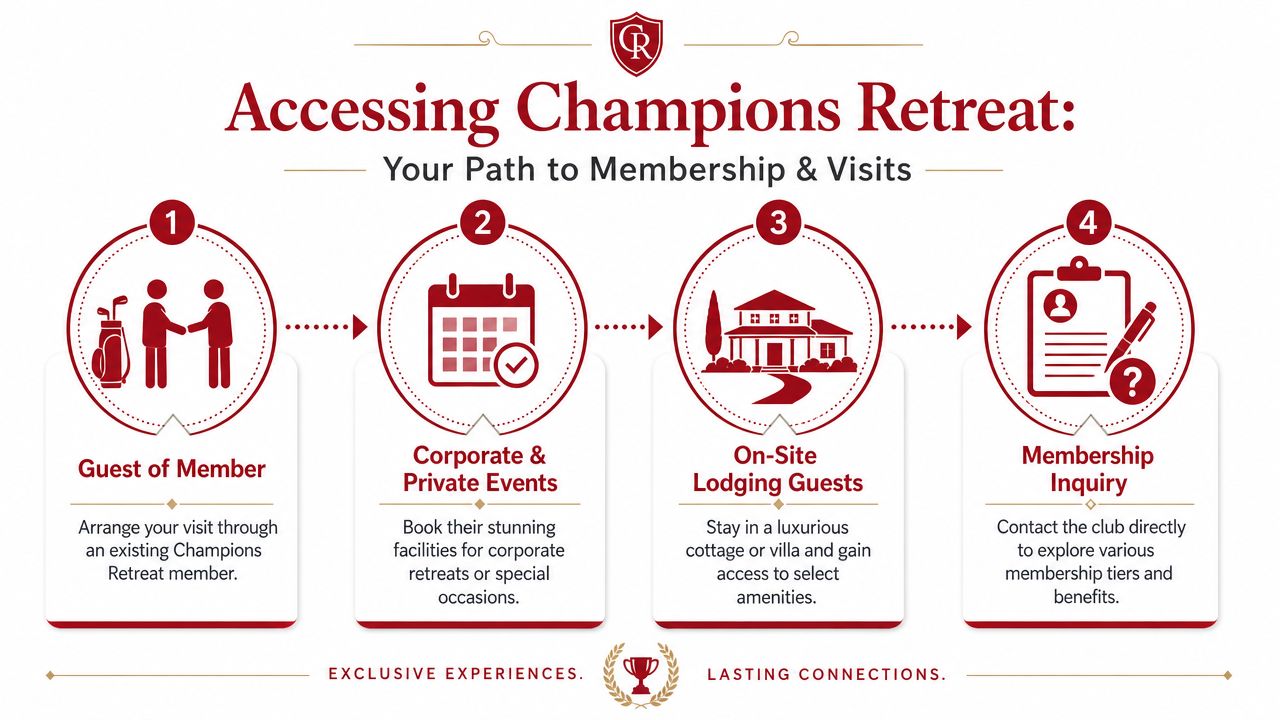
The key logistical reality is that Champions Retreat is private. Direct public tee times are not the standard, but access is possible through membership, being a guest of a member, or booking on-site lodging or a corporate/private event, according to the Champions Retreat experience page.
The short answer on public access
If someone is searching for a standard online tee sheet, that search is pointed in the wrong direction. Champions Retreat doesn't operate like a daily-fee course.
A better question is which access path fits the purpose of the visit. That's where planning gets easier.
For local visitors evaluating private clubs and polished destination properties, details often matter just as much as aesthetics, which is true in fields far beyond golf, including Augusta web design strategy for premium local brands.
Best access path by visitor type
The four realistic routes are straightforward, but they suit different travelers.
Member hosting
This is the cleanest path for pure golf access. A hosted guest visit usually works best for players whose main goal is the course itself, not a broader overnight stay or event program.
On-site lodging
This is often the strongest choice for out-of-town visitors. It turns access into part of a larger hospitality package and removes some of the friction that comes with private-club coordination.
Corporate or private events
This path makes sense for companies, wedding parties, and curated group experiences. It's less about squeezing in a round and more about using the property as a controlled environment for hosting.
Membership inquiry
For people who expect repeat use, this is the only path worth serious attention. Anyone who already knows they want regular access shouldn't waste time trying to recreate a member experience through one-off workarounds.
Mistakes that make planning harder
Visitors usually run into problems when they treat “private but accessible” as if it means “public with extra steps.” It doesn't.
The most common errors are:
- Waiting too long: Private-club coordination usually takes longer than public-course booking.
- Assuming every access route includes golf: Event or lodging access may involve different privileges, so details need confirmation.
- Underestimating high-demand periods: Masters-week planning requires more lead time and more flexibility.
- Not asking operational questions: Arrival windows, guest naming, dress expectations, and hosted access rules should be clarified early.
Private access works best when the visitor plans backward from the purpose of the trip, not forward from the hope of finding a tee time.
That single shift saves time. If the goal is a golf day, a member connection matters most. If the goal is a premium Augusta-area stay with golf attached, lodging or event access may be the more practical route.
Practical Guide for Your Visit Directions and Tips
The first time I drove out to Champions Retreat, the mistake would have been obvious in hindsight. I almost treated it like a quick Augusta side trip. It isn't. Even though the club sits in Evans, outside the central Augusta corridor, the visit feels better when you plan it as the main event of the day rather than a round you squeeze between other stops.
That matters even more during peak golf weeks. A route that looks simple on a map can slow down fast once tournament traffic, security patterns, and local event congestion start stacking up.

Arrive early enough to use the property properly
The smartest visitors give themselves extra time before the first commitment on site. At a club like this, that buffer does more than protect against traffic. It gives the day room to settle.
Private-club arrival has its own rhythm. Check-in can involve guest verification, bag handling, valet flow, or directions across a larger property than first-time guests expect. If your access includes practice time, dining, lodging, or hosted hospitality, a tight arrival window puts pressure on the best parts of the experience.
A good rule is simple. If your schedule feels tight on paper, it will feel rushed in real life.
That same local planning mindset helps with other trip details around Augusta, especially during high-demand weeks when basic services get stretched. Anyone coordinating a bigger group can learn something from Augusta-area operational logistics planning, where timing and confirmation matter more than last-minute optimism.
Pack for a private club day, not just a tee time
Champions Retreat rewards quiet preparation. Show up ready for a full day on property.
| Item | Why it matters |
|---|---|
| Golf attire that fits private-club expectations | Saves you from dress-code friction at arrival or in dining areas |
| Comfortable golf and walking shoes | The property is large, and a long day gets longer in the wrong pair |
| A light layer or rain option | Georgia conditions can shift between morning and afternoon |
| Hat, sunscreen, and basic weather protection | Sun and humidity can wear you down before the back nine |
Phone use, photos, and general club etiquette deserve the same conservative approach. If a policy has not been spelled out in advance, ask. Staff will usually point you in the right direction quickly, and that is far better than assuming the club operates like a resort open to public traffic.
Choose your date based on the kind of day you want
A lot of first-time visitors fixate on Masters week because the atmosphere is real and the demand proves it. The trade-off is obvious once you have done a few Augusta trips. Higher energy usually comes with tighter logistics, less flexibility, and more pressure on every reservation tied to the visit.
For a calmer golf-first day, pick a date that gives you space to arrive early, warm up properly, eat without rushing, and enjoy the grounds. For a trip built around Augusta buzz, accept that the club experience may depend on patience as much as planning.
Groups should also match the date to the makeup of the party. If non-golfers are coming, a less compressed visit often produces the better overall day because the hospitality side of Champions Retreat has more room to show itself. That is one of the biggest differences in the post-renovation experience. The property works better now as an all-day destination, not only as a place to play 18 holes.
Small details that prevent avoidable problems
A few checks save a lot of friction:
- Confirm the exact arrival point before departure
- Verify the guest name listed for access
- Ask about dining availability and dress expectations
- Clarify whether practice facilities are included
- Build in time for departure, not just arrival
Champions Retreat is prestigious, but the visit works best when handled practically. Respect the club's pace, give yourself margin, and treat the day like a hosted private-club experience. That is usually the difference between merely getting on property and actually enjoying why people want to be there.
Frequently Asked Questions About Visiting Champions Retreat
Can non-members play Champions Retreat?
Yes, but not through standard public access. The practical options include being hosted by a member, staying on site, or accessing the property through a corporate or private event, as covered earlier in the guide.
Is Champions Retreat worth visiting if someone isn't a golf architecture obsessive?
Yes. The design pedigree is a major draw, but the club now has more hospitality value than older coverage suggests. That makes it more appealing for couples, hosted groups, and event attendees who want more than a pure golf stop.
Is it mainly a golf club or a broader private-club destination now?
It's both, though the 2026 repositioning pushed it more clearly toward a broader private-club experience. For many visitors, that changes the planning math in a good way because the day doesn't depend entirely on the round.
What's the smartest way to plan a first visit?
Start with the access path, not the golf itinerary. Once membership hosting, lodging, or event access is confirmed, build the rest of the day around arrival time, practice, dining, and any non-golf needs.
Is Masters week the best time to go?
It's the most coveted time, not automatically the best. Visitors who want atmosphere may prefer it. Visitors who want a calmer, more spacious day may prefer another window.
Can non-golfers enjoy the visit?
Often, yes. That depends on the format of the visit, but the club's dining, refreshed amenities, and event-oriented positioning make it stronger for mixed-interest groups than a golf-only property.
What mistake should first-time visitors avoid?
Treating Champions Retreat Augusta GA like a normal tee-time stop. The place works best when the visit is planned as a private-club experience from the start.
If your business needs the same kind of polish and intentional experience that top-tier destinations aim for, Get Up Productions helps brands, leaders, and organizations turn their expertise into authority-building podcasts without carrying the production burden themselves. Their team handles recording, editing, show packaging, and multi-platform repurposing so clients can focus on the message instead of the workflow.